
MELU-206 · Lesson 12 of 12 · 20 min
Practice exam review and test-day strategy
▶ Video coming soon A video version of this lesson is on the way.
Three weeks before her exam, Lucia sat at the kitchen table with a timer, a clean code book and a 90-question practice set. She finished with 11 minutes left and scored 61. Two points short of passing. The next morning she sorted her misses by outline area and found the pattern: nine of her 29 misses came from grounding and bonding and calculations, and five more were questions she had answered correctly in her head and then marked wrong in a hurry. "That's not a knowledge problem," Walt said when she showed him. "That's a process problem. Fix the process." Two weeks later she scored 71 on a new set, and on exam day she passed.
This final lesson pulls the course together. It reviews the exam's structure and scoring, shows how to use practice exams to find and fix weaknesses, gives a plan for the final weeks, explains a time and lookup strategy for test day and reviews the Colorado law topics that candidates should know without looking anything up. It does not reproduce exam questions or code text.
What the exam measures
The Colorado master electrician exam, as PSI's June 2026 bulletin describes it, has 90 scored items in 240 minutes, plus up to 10 unscored pretest items with 30 more minutes. The passing score is 70 in 100, which is 63 of the 90 scored items, and scoring is compensatory, meaning a strong area can make up for a weak one. The NEC and a formula page are provided at the center, along with an on-screen calculator. Candidates may not bring their own books or notes.
The content outline weights the exam heavily toward the parts of the code that masters use most: grounding and bonding has the most items, followed by services, feeders and branch circuits, then special occupancies, special equipment, electrical calculations and motors. Smaller areas include overcurrent protection, raceways and boxes, conductors and cables, electrical devices, transformers, general electrical knowledge and special conditions. A study plan that follows those weights puts effort where the points are.
Using practice exams well
A practice exam is a diagnostic tool, not just a score. After each full or partial set, the candidate reviews every miss and every guess, and puts each one in one of four categories: did not know the rule, could not find the rule, found the rule but misread it, or knew the answer but made a mechanical error such as choosing the wrong option or miscalculating. Each category has a different fix. A knowledge gap needs study; a lookup problem needs index and tab practice; misreading needs slower reading of key words; and mechanical errors need a checking habit.
Lucia's first practice set showed that her biggest single category was lookup problems: she knew the rules but spent too long finding them. Her fix was a daily drill of ten lookup questions using only the index, timed, with the goal of reaching the right section in under a minute. Within two weeks, her average lookup time dropped by about a third, which freed the minutes she needed to check her calculations.
| Miss category | What it looks like | Fix |
|---|---|---|
| Did not know the rule | No idea where to start | Study the article; do targeted questions |
| Could not find the rule | Knew it existed but ran out of time searching | Index drills; learn article layout |
| Misread the rule or question | Missed an exception or a key word | Slow down on qualifiers and exceptions |
| Mechanical error | Right reasoning, wrong option or arithmetic slip | Recheck answers and calculations before moving on |
# Projecting a score and finding the weakest areas from a practice set (study aid)
outline = {"Grounding and bonding": 14, "Services, feeders, branch circuits": 11,
           "Special occupancies": 9, "Special equipment": 9, "Calculations": 9, "Motors": 8,
           "General knowledge": 6, "Overcurrent": 5, "Raceways and boxes": 5,
           "Conductors and cables": 4, "Devices": 4, "Transformers": 4, "Special conditions": 2}
correct = {"Grounding and bonding": 9, "Services, feeders, branch circuits": 8,
           "Special occupancies": 7, "Special equipment": 7, "Calculations": 5, "Motors": 6,
           "General knowledge": 5, "Overcurrent": 4, "Raceways and boxes": 4,
           "Conductors and cables": 3, "Devices": 3, "Transformers": 3, "Special conditions": 1}
total = sum(correct.values())
print("Projected score:", total, "of", sum(outline.values()), "| need 63")
misses = sorted(((outline[a] - correct[a], a) for a in outline), reverse=True)
for m, a in misses[:3]:
print(f"Most points lost: {a} ({m})")Projected score: 65 of 90 | need 63 Most points lost: Grounding and bonding (5) Most points lost: Calculations (4) Most points lost: Services, feeders, branch circuits (3)
The projection shows a score just short of passing, with the most points lost in grounding and bonding and calculations, the same pattern Lucia found. Fixing those two areas alone, by recovering even half the misses, would move the score above 63.
The final six weeks
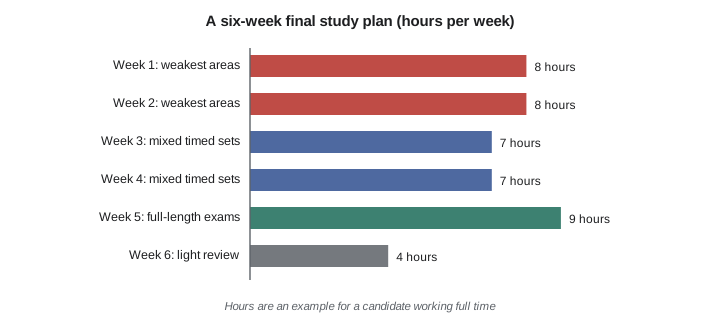
A plan for the final six weeks turns practice results into progress. In weeks one and two, spend most study time on the two or three weakest outline areas, using targeted questions and reading the relevant articles. In weeks three and four, switch to mixed, timed sets of 30 to 45 questions, which build speed and train the habit of switching between topics. In week five, take two full-length practice exams under real timing, with a clean book and the same calculator type, and review every miss. In week six, keep study light, review the formula page and the Colorado law summary, and handle logistics.
The plan should fit the candidate's life. A crew lead working full days may manage only an hour on weeknights and a longer session on weekends. That is enough if it is consistent. Lucia studied about an hour each weeknight and three hours each Saturday, and she kept Sundays free, which helped her avoid burnout in the final weeks.
Time strategy on test day
With 90 scored items in 240 minutes, a candidate has about 2 minutes and 40 seconds per item, but questions are not equal. Some are quick recall or simple lookups; others are multi-step calculations. A good strategy uses two passes. On the first pass, answer every question that can be answered with confidence in about two minutes, and mark the rest for review. On the second pass, return to the marked questions, starting with the ones that seemed closest to solved. Leave no question blank, because an unanswered item is always wrong and a guess may be right.
Time checkpoints help. At 60 minutes, a candidate on a good pace has completed about a quarter of the items, and at 120 minutes about half or more. If the pace is behind, the candidate marks long questions sooner and moves on. The unscored pretest items cannot be identified, so every question deserves a real attempt.
Lookup strategy
The code book provided at the center is clean, without tabs or highlighting, so candidates should practice with a clean copy too. The index is the fastest path for most questions: look up the key noun in the question, such as the equipment or the occupancy, then a modifier, such as grounding or overcurrent protection. Knowing the overall layout of the code, which chapters cover general rules, which cover special occupancies, equipment and conditions, and where the tables live, lets a candidate jump to the right part of the book even when the index term is unclear.
When a question includes an exception, a condition or a word like minimum, maximum, permitted or required, read the question and the provision twice. Many misses come from finding the right rule and then applying the general rule when an exception applies, or the reverse.
Calculation strategy
Calculation questions reward a fixed routine. Write down what the question asks for, list the given values with units, identify the formula or code method, compute, and check that the answer is reasonable. The formula page provided at the center covers common electrical formulas, but candidates should know which code method applies, such as the standard or optional method for dwelling loads, and when demand factors or adjustment factors apply. A rough mental estimate before calculating catches most decimal and unit errors.
Working through question styles
Exam questions come in a few recognizable styles, and practicing each style builds a routine. A direct lookup question asks for a single requirement, such as a minimum size, a clearance or whether a method is permitted; the routine is to find the governing article, confirm the section applies to the stated equipment and occupancy, and check exceptions. A table question requires reading a code table correctly, which means checking the table's headings, notes and footnotes before choosing a row. A calculation question requires a method and arithmetic, and often a table lookup too. A scenario question describes a job and asks what the code requires; the routine is to underline the facts that matter, such as the occupancy, the voltage, the location and whether it is new work, before looking anything up.
Lucia practiced each style separately before mixing them. She found that table questions caused most of her misreading errors, so she adopted a habit of placing a finger on the column heading and reading the notes before choosing a value. The habit added a few seconds per table question and removed almost all of her table errors.
Managing nerves
Some candidates know the material but lose points to anxiety. The best defense is familiarity: a candidate who has taken several full-length, timed practice exams under realistic conditions has already lived through the hard middle hours of the real one. On the day, a slow breath at each checkpoint, a planned snack before arriving and a willingness to mark and move on from a frustrating question keep one bad item from affecting the next ten. Remembering that the score is compensatory helps too, because no single question decides the result.
Colorado law to know cold
Some questions in a master's career are about Colorado law rather than the NEC, and a master should know them without looking anything up. The board adopts the NEC by rule as a statewide minimum, and local programs may be more stringent but not weaker. Public schools and state buildings are inspected by the state. Permits go to a master who is a registered contractor, a master employed by one, or a homeowner on the owner's own residence. A state inspector inspects within three working days after a request. A licensed electrician may directly supervise no more than three apprentices at a job site. A master qualifies one contractor, and the board is notified within 15 days if the qualifying master leaves. Licenses renew every three years, expiring September 30, with 24 hours of continuing education. And a mechanics' lien requires a notice of intent served at least 10 days before filing, with the statement filed within four months after the last work.
Exam-day logistics
Logistics should be settled before the last week. Confirm the appointment time and the test center address, and drive the route once if it is unfamiliar. Check the identification requirements in the bulletin and make sure the name on the ID matches the name on the registration. Plan to arrive early. Bring nothing that the center does not allow, because personal items must be stored. Sleep and food matter more than a final cram session; a tired candidate misreads questions.
At the center, take the tutorial even if PSI's interface is familiar, because it shows how to mark questions and use the calculator on this exam. During the exam, take a breath at each checkpoint, and if a question causes frustration, mark it and move on. When finished, use the remaining time for marked questions and then for a quick review of calculations.
After the exam
A candidate who passes still needs the board to issue the license, which follows the board's process after the score is received. A candidate who does not pass receives a score report that shows performance by content area, which is the most useful study guide for a retake. PSI's bulletin explains the retake process and fee; there is no same-day retest. The best retake plans repeat the cycle in this lesson: sort the weak areas, target them, then rebuild speed with timed sets.
Worked problem
Fixing a practice score of 61
A candidate scores 61 of 90 on a timed practice set with 11 minutes left. Nine misses came from grounding and bonding and calculations, eight were lookup problems and five were mechanical errors. How should the next two weeks be spent?
Show solution
- The candidate needs 63, so two more correct answers would pass, but a safe margin requires more.
- Mechanical errors are the cheapest fix: use the spare 11 minutes to recheck answers and calculations, which could recover several points.
- Lookup problems need daily timed index drills.
- Grounding and bonding and calculations need targeted study, with questions and article reading.
- After two weeks, take a new full-length set to measure progress.
Answer: Use the spare minutes to check work, drill lookups daily and target grounding and calculations, then retest with a new full set.
Common mistakes
MistakeTaking practice exams without reviewing misses.
InsteadSort every miss into a category and fix the cause.
MistakePracticing with a tabbed, highlighted code book.
InsteadThe center provides a clean book; practice with a clean copy.
MistakeSpending ten minutes on one hard question early in the exam.
InsteadMark it and return on the second pass.
MistakeLeaving questions blank.
InsteadUnanswered items are always wrong; answer every question.
MistakeCramming the night before.
InsteadKeep the last week light and settle logistics early.
Summary and key terms
- The exam has 90 scored items in 240 minutes, with a passing score of 63 and compensatory scoring.
- Use practice exams as diagnostics and sort misses into knowledge, lookup, misreading and mechanical errors.
- Build a six-week plan: weak areas, mixed timed sets, full-length exams, then light review.
- Use two passes and time checkpoints on test day, and answer every question.
- Practice lookups in a clean book and use a fixed routine for calculations.
- Know the key Colorado law points without looking them up.
- Compensatory scoring
- Scoring in which the total, not each area, decides the result.
- Pretest item
- An unscored question included to evaluate it for future exams.
- Two-pass strategy
- Answering sure questions first and returning to marked ones.
- Lookup drill
- Timed practice finding code provisions through the index.
- Mechanical error
- A wrong answer caused by a slip rather than a lack of knowledge.
Practice problems
Work each problem on paper first, then reveal the answer to check.
How many scored items must a candidate answer correctly to pass?
Show answer
63 of 90.
About how much time is available per scored item?
Show answer
About 2 minutes and 40 seconds.
What should a candidate do with a question that will take too long?
Show answer
Mark it and return on the second pass.
What should a candidate bring to practice lookups?
Show answer
A clean code book without tabs or highlighting.
Lesson quiz · 5 questions
Score 60% or more to complete this lesson.
Create a free account to save your progress, take quizzes and earn a certificate.