
MELU-206 · Lesson 4 of 12 · 20 min
The exam format and the references allowed
▶ Video coming soon A video version of this lesson is on the way.
Two weeks before her exam date, Lucia drove to Walt's house with the PSI candidate information bulletin printed and highlighted. Walt had taken his own master exam in 1992 on paper, with his own tabbed code book and a stack of reference books in a milk crate. "Different world," he said, reading the bulletin. "They give you the book now, and you can't mark it at all?" Lucia nodded. "Clean book, a formula sheet, an on-screen calculator. Ninety questions that count, four hours. Everything I know about finding things fast has to work in a book I've never touched."
This lesson describes the Colorado master electrician exam as PSI presents it in the candidate information bulletin updated June 18, 2026: the number of items, the time, the passing standard, the content outline and the references. It then turns to what those facts mean for preparation. Bulletins are revised, especially around code changes, so confirm every number in the current bulletin before your exam.
The structure of the exam
According to the bulletin, the master electrician exam has 90 scored items with a time limit of 240 minutes. It also includes up to 10 non-scored items, with an additional 30 minutes for those. Non-scored items are questions PSI is trying out for future exams; they look like the others and are mixed in, so the candidate cannot tell which ones count. A tutorial on how to use the testing system, of up to 15 minutes, comes before the exam and does not count against the exam time.
The passing standard is a scaled score of 70, which the bulletin equates to 63 correct answers out of the 90 scored items. The bulletin describes the scoring as compensatory: strong performance in some content areas can offset weaker performance in others, as long as the total reaches the passing point. There is no separate minimum for each area. That matters for strategy, because it means a candidate does not have to be perfect at everything, but cannot afford to give up on a large area either.
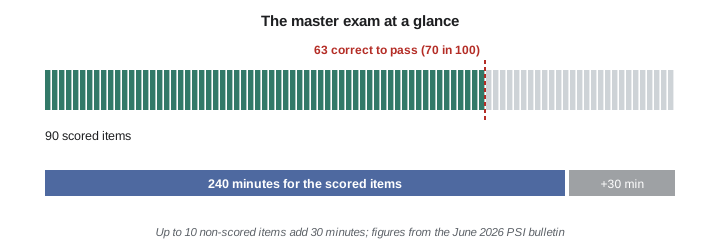
| Feature | Master electrician exam (June 2026 bulletin) |
|---|---|
| Scored items | 90 |
| Time for scored items | 240 minutes |
| Non-scored items | Up to 10, with 30 additional minutes |
| Tutorial | Up to 15 minutes, not counted |
| Passing standard | Scaled 70, equal to 63 of 90 scored items |
| Scoring model | Compensatory; no minimum per area |
| References | NEC and formula page provided at the test center; no personal materials |
| Calculator | On-screen calculator provided |
The content outline
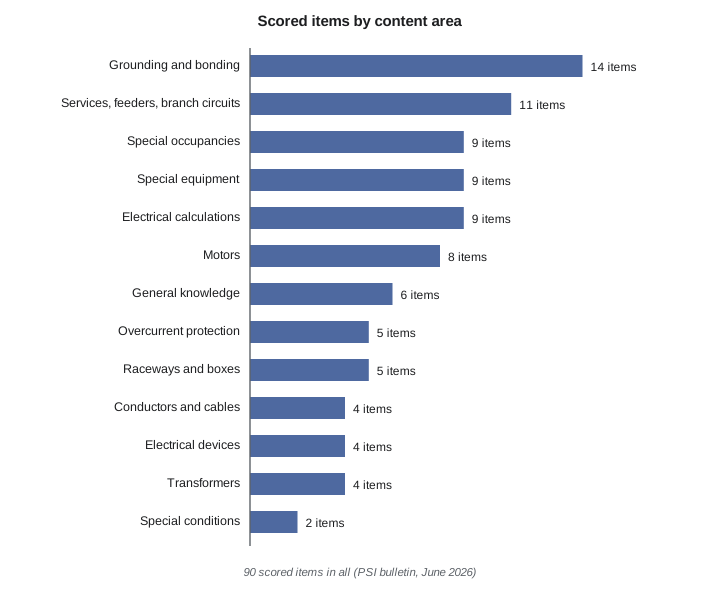
The bulletin lists thirteen content areas and the number of scored items from each. Grounding and bonding carries the most weight, with 14 items. Services, feeders and branch circuits follow with 11. Special occupancies, special equipment and electrical calculations each carry 9. Motors carry 8. General electrical knowledge carries 6. Overcurrent protection and raceways and boxes carry 5 each. Conductors and cables, electrical devices and transformers carry 4 each. Special conditions carry 2. The total is 90.
Look closely at what the outline leaves out. Unlike some states, the Colorado master exam outline in the bulletin is built around the National Electrical Code and electrical theory and calculations. It does not list a separate business and law section or a Colorado statutes section. That does not make Colorado law unimportant: a master electrician needs it every day to run jobs, supervise apprentices, pull permits and protect lien rights, and later lessons in this course cover it. But exam preparation time should follow the outline, and the outline points squarely at the code topics covered in the master electrician core courses.
| Content area | Scored items | Core course that covers it |
|---|---|---|
| Grounding and bonding | 14 | Grounding and bonding (Article 250) |
| Services, feeders and branch circuits | 11 | Load calculations; conductors and overcurrent protection |
| Special occupancies | 9 | Special occupancies, equipment and conditions |
| Special equipment | 9 | Special occupancies; motors, transformers and equipment |
| Electrical calculations | 9 | Load calculations |
| Motors | 8 | Motors, transformers and equipment |
| General electrical knowledge | 6 | Navigating the NEC |
| Overcurrent protection | 5 | Conductors, raceways and overcurrent protection |
| Raceways and boxes | 5 | Conductors, raceways and overcurrent protection |
| Conductors and cables | 4 | Conductors, raceways and overcurrent protection |
| Electrical devices | 4 | Navigating the NEC; special occupancies |
| Transformers | 4 | Motors, transformers and equipment |
| Special conditions | 2 | Special occupancies, equipment and conditions |
The references: a clean book provided at the center
The biggest difference from older exams, and from some other states, is the reference policy. The bulletin says the test center provides the NEC code book and a formula page. Candidates may not write in, highlight, underline or index the provided book, and no other materials are allowed: no personal code book, no tabs, no handbooks, no notes. The bulletin also advises candidates to review basic electrical theory and formulas, which are not provided beyond the formula page.
For code editions, the June 2026 bulletin states that the 2023 NEC is provided, that beginning August 1, 2026 the 2026 NEC book is provided, and that the 2023 book remains available on request until December 1, 2026. A candidate testing in late 2026 should confirm which edition will be on the desk and should study from that edition.
The clean-book rule changes how candidates should practice. A candidate who has relied on colorful tabs and handwritten notes in her own book will feel lost without them. The solution is to practice with an unmarked copy of the same edition, using only the table of contents, the article and part structure and the index. The core course on navigating the NEC emphasized exactly those skills: knowing where an article lives in the chapter structure, how the parts of an article are organized, and how to use the index efficiently. On this exam those skills are the whole game.
The calculator
The bulletin says an online calculator is available during the exam. Candidates do not bring their own. The on-screen calculator handles basic arithmetic and the functions needed for electrical calculations, but entering numbers with a mouse is slower than tapping a familiar calculator, and it is easy to make a keying error. Practicing calculations with a basic on-screen calculator before exam day, and writing down intermediate results on the scratch material the center provides, if it provides any, reduces mistakes.
# Time budget for the scored items (study aid)
scored_items = 90
minutes = 240
per_item = minutes / scored_items
print(f"Average time per scored item: {per_item:.2f} minutes")

# A two-pass plan: answer quick items first, return to long calculations.
quick, lookups, calcs = 40, 32, 18
quick_min, lookup_min, calc_min = 1.0, 2.75, 4.5
used = quick * quick_min + lookups * lookup_min + calcs * calc_min
print(f"Planned time: {used:.0f} of {minutes} minutes")
print(f"Reserve for review: {minutes - used:.0f} minutes")

# How many items can be missed and still pass?
needed = 63
print("Items you can miss and still pass:", scored_items - needed)Average time per scored item: 2.67 minutes Planned time: 209 of 240 minutes Reserve for review: 31 minutes Items you can miss and still pass: 27
The arithmetic shows two useful facts. The average is just under two and three-quarter minutes per scored item, which is generous for quick recall questions and tight for long calculations. And a candidate can miss 27 of the 90 scored items and still pass. That margin is the reason to move on from a question that is eating time: one stubborn calculation is not worth three easy questions left unanswered at the end.
What the questions look like
The bulletin describes multiple-choice items. Most master-level items fall into three types. Recall items test something a master should know without looking it up, such as the purpose of a grounding electrode conductor or the meaning of a defined term. Lookup items require finding a specific rule or table value in the code, such as a minimum burial depth, a required clearance or a conductor ampacity adjustment. Calculation items require several steps, such as a dwelling service calculation, a motor branch-circuit protection size or a voltage drop check. The content areas with the most items, grounding and bonding and services, feeders and branch circuits, mix all three types.
Worked problem
Reading a question carefully
A practice item asks for the minimum size of a copper grounding electrode conductor for a service with a stated conductor size, connected to a ground rod as the only electrode. Lucia first looks up the general table for grounding electrode conductors and gets one answer. Then she rereads the question. What did she almost miss?
Show solution
- The question says the electrode is a ground rod.
- The grounding electrode conductor core course covered a special limit for the portion of the conductor that connects only to a rod.
- That limit can make the required size smaller than the general table value.
- She checks the rule for connections to rod, pipe or plate electrodes in the provided book.
- She selects the answer that reflects that limit rather than the general table value.
Answer: The detail that the conductor connects only to a rod changes the answer; lookup items often hinge on one qualifying phrase.
Practicing the right way
Good practice imitates the real conditions. Lucia set up her kitchen table on Saturday mornings with an unmarked copy of the code edition she would test on, a printed formula page similar to the one PSI describes, an on-screen calculator on her laptop and a timer set to 240 minutes. She took full-length practice sets from the core courses and from commercial practice exams, then reviewed every miss and every lucky guess, writing down where in the code the answer lived. After four of those Saturdays, her average lookup time had dropped from about four minutes to under two and a half.
She also kept a list of the articles she looked up most often and practiced opening the book to each one from the index without hesitating. Grounding and bonding, branch circuits, feeders, services, overcurrent protection, conductors and the motor article came up again and again, matching the outline's weights.
Weighting study time by the outline
A simple way to plan study time is to divide it in proportion to the scored items. Grounding and bonding is about 16 in 100 of the exam, services, feeders and branch circuits about 12 in 100, and the four areas of special occupancies, special equipment, calculations and motors together about 39 in 100. Lucia had about 60 hours of study time between her approval and her exam. She spent roughly ten hours on grounding and bonding, seven on services, feeders and branch circuits, five or six each on special occupancies, special equipment, calculations and motors, and the rest spread across the smaller areas and full-length practice sets. She also kept a short daily drill of ten lookup questions drawn from all areas, so that no part of the book became unfamiliar.
Weighting by the outline does not mean ignoring small areas. Special conditions carries only two items, but a candidate who knows where the relevant articles live can answer both in a few minutes. The goal is to avoid spending ten hours polishing a two-item area while a fourteen-item area stays shaky.
Tracking progress before the exam
Lucia kept a simple log during her last six weeks of study. For each practice set she wrote the date, the number of items, the number correct, the time used and the outline area of every miss. Each Sunday she totaled the misses by area and chose the two weakest areas for the coming week. By the third week, grounding and bonding had moved from her weakest area to one of her strongest, and her time per item had dropped below the budget she set from the exam's 240 minutes. The log also told her when to stop adding new material and switch to timed sets, which she did ten days before the exam.
Exam-day logistics
On exam day, candidates arrive early with the required identification, store personal items as the center directs and complete check-in. The tutorial explains how to move between questions, mark items for review and use the on-screen calculator; candidates should take it even if they have tested with PSI before, because interfaces change. During the exam, the system shows the time remaining. Most candidates find it helpful to note the time at the end of each block of 30 questions and compare it with their plan. Breaks, if the center allows them, usually do not stop the clock, so a candidate who needs a break should plan for the lost minutes. When the last item is answered and the review is done, the candidate ends the exam and receives the result as the bulletin describes.
Retakes and score reports
A candidate who does not pass receives a diagnostic report by content area. Because scoring is compensatory, the report shows where the points were lost rather than which area was failed. The best retake plans target the two or three heaviest areas where the candidate scored lowest. The bulletin says a retest cannot be scheduled on the same day as a failed attempt, and the retest fee applies.
Common mistakes
MistakeBringing a personal tabbed code book.
InsteadThe test center provides the NEC; no personal books, tabs or notes are allowed.
MistakeExpecting a minimum score in every content area.
InsteadScoring is compensatory; only the total against the passing point of 63 of 90 counts.
MistakeSpending most study time on Colorado statutes for the exam.
InsteadThe bulletin's outline is built on NEC and calculation topics; study time should follow the outline.
MistakePracticing only with a heavily marked book.
InsteadPractice with an unmarked copy of the same edition and the index, as on exam day.
MistakeStudying the wrong code edition.
InsteadConfirm which edition the center will provide on your test date and study from it.
Summary and key terms
- The master exam has 90 scored items in 240 minutes, plus up to 10 non-scored items with 30 more minutes, and a tutorial that is not timed.
- Passing is a scaled 70, equal to 63 of 90 scored items, under a compensatory model.
- Grounding and bonding (14) and services, feeders and branch circuits (11) carry the most weight.
- The center provides the NEC and a formula page; candidates may not mark the book or bring materials.
- The 2026 NEC is provided from August 1, 2026, with the 2023 book available on request until December 1, 2026.
- An on-screen calculator is provided; practice under the same conditions.
- Scored item
- A question that counts toward the result.
- Non-scored item
- A trial question mixed into the exam that does not count.
- Compensatory scoring
- A model in which strong areas can offset weak ones; only the total matters.
- Formula page
- The sheet of formulas provided by the test center.
- Diagnostic report
- The breakdown by content area given after a failed attempt.
Practice problems
Work each problem on paper first, then reveal the answer to check.
How many scored items must a candidate answer correctly to pass?
Show answer
63 of 90.
Which content area carries the most scored items?
Show answer
Grounding and bonding, with 14.
May a candidate highlight the provided code book?
Show answer
No; writing, highlighting, underlining and indexing are not allowed.
What is the average time per scored item?
Show answer
About 2.67 minutes (240 divided by 90).
Lesson quiz · 5 questions
Score 60% or more to complete this lesson.
Create a free account to save your progress, take quizzes and earn a certificate.