
MELU-206 · Lesson 2 of 12 · 21 min
Eligibility for the Master Electrician License
▶ Video coming soon A video version of this lesson is on the way.
Lucia spread her pay stubs, her old apprenticeship records and a calendar on the break room table. Walt's office manager, Dana Kim, sat across from her with the board's experience verification form. "The board doesn't let you vouch for yourself," Dana said. "Every hour has to be verified by someone who saw the work, on the board's form, with exact dates and a breakdown by type of work." Lucia had worked for two contractors since her apprenticeship began: a large commercial firm in Denver for three years and Timberline after that. Both would have to sign. Before she could book an exam, the board would have to agree that her experience added up.
This lesson explains who can apply for the Colorado master electrician license: the experience routes in the statute, how board rules translate them into hours, how experience is documented, how education can count, and what does not count. The numbers here come from C.R.S. 12-115-110 and board rule 1.7; confirm them in the current versions before applying.
Three routes in the statute
The statute gives three ways to qualify for the master license. The first is for a graduate electrical engineer from an accredited college or university who has at least one year of practical electrical experience in construction. The second is for a graduate of an electrical trade school or community college program who has at least four years of practical electrical experience. The third, which most candidates use, is for an electrician with at least one year of practical experience planning, laying out, supervising and installing electrical wiring and equipment, beyond the experience the statute requires for a journeyman.
That third route builds on the journeyman requirement: at least four years of apprenticeship or practical experience, with at least two of those years in commercial, industrial or substantially similar work, plus the required safety and code training. A candidate on the third route therefore needs the journeyman's foundation plus a further year focused on planning and supervision.
The rule in hours
Board rule 1.7 turns those years into hours. A residential wireman needs 4,000 hours over at least two years. A journeyman needs 8,000 hours over at least four years. A master needs 10,000 hours over at least five years. A widely used summary of the board's requirements describes the master's extra experience as at least 2,000 hours over at least one year spent planning, laying out and supervising electrical installations, on top of the journeyman experience. Both the hours and the minimum calendar time apply: a candidate cannot pack 10,000 hours into three years of overtime and qualify early.
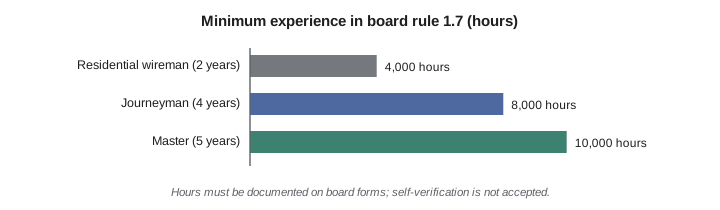
| License | Minimum hours | Minimum time | Notes |
|---|---|---|---|
| Residential wireman | 4,000 | 2 years | Dwellings of one to four families |
| Journeyman | 8,000 | 4 years | At least 2 years commercial or industrial; 288 hours of training |
| Master | 10,000 | 5 years | Includes at least a year of planning, layout and supervision |
Documenting experience
Board rules are strict about documentation. Experience must be shown on the board's forms, with exact employment dates and hours broken down by type of work: commercial, residential, industrial, or maintenance and service. Applicants cannot verify their own experience. A former employer, a licensed electrician who supervised the work or another qualified person signs for each period. When a company has closed or a supervisor has died, the applicant has to find another way to prove the hours, such as tax records, union hall records or statements from coworkers, and the board decides whether the proof is enough.
For the master application, the planning, layout and supervision experience deserves particular care. The board wants to see that the candidate did more than install: that she planned circuits and services, laid out installations from drawings, directed crews and took responsibility for the work. Lucia asked Walt to describe her crew-leader work on the Fort Collins tenant finishes and the school district remodel in specific terms on the verification form, with the dates she ran each job.
Maintenance and service experience
Not every electrician works in construction. Board rules give limited credit for maintenance work: up to two years for supervised maintenance experience verified by a licensed electrician, and up to one year for unsupervised maintenance experience verified by the employer. A plant electrician who has spent ten years maintaining equipment will not be able to count all of it toward a license, but part of it counts. The limits push candidates toward the kind of installation and planning experience the license is meant to recognize.
Experience from outside Colorado or the United States
Experience from another state counts if it is documented on the board's forms. Experience from outside the country is treated more carefully. Board rules require at least one year of in-country experience and familiarity with the National Electrical Code, and they cap the foreign years that count: up to three years toward the journeyman requirement and up to four toward the master requirement. Documents in another language need certified English translations, at the applicant's expense. One of Timberline's electricians, Mateo Silva, trained and worked in Mexico before moving to Colorado; his foreign years helped, but not all of them could count.
Education credit
Education can substitute for part of the experience. The statute gives one year of experience credit to a graduate electrical engineer or a graduate of a qualifying community college or trade school program. Board rules define a qualifying trade school program by size: at least 165 credit hours, with each credit hour representing at least 19 classroom hours. Apprenticeship training does not count as trade school. Other or non-accredited training may earn up to one year of credit at the rate of one month of credit for every two months of schooling.
The 288 hours of training
The journeyman requirement includes 288 hours of training during the apprenticeship, covering safety and the related National Electrical Code instruction. Board rules require each hour to be at least 50 minutes and require 10 to 40 of those hours to be OSHA-based safety training; the board does not pre-approve courses. In 2025 the legislature extended the window for completing the 288 hours from four years to eight years before licensure, and applicants with older training can be licensed at the board's discretion if they complete at least four more hours on the current or immediately preceding NEC. Master candidates already hold a journeyman license, so this mostly matters to the electricians a master supervises and helps qualify.
# Does a candidate meet the master hour and time minimums? (study aid, simplified)
def master_ready(hours, years, planning_hours, planning_years):
    problems = []
    if hours < 10000:
        problems.append(f"needs {10000 - hours} more total hours")
    if years < 5:
        problems.append(f"needs {5 - years:.1f} more years of calendar time")
    if planning_hours < 2000 or planning_years < 1:
        problems.append("needs a full year and 2,000 hours of planning and supervision")
    return problems or ["meets the minimums; the board still reviews the documents"]

candidates = {
    "Lucia": (11400, 10.5, 2600, 1.5),
    "Mateo": (10200, 4.5, 2100, 1.0),
    "Eli":   (9300, 6.0, 900, 0.5),
}
for name, args in candidates.items():
    print(name + ":")
    for p in master_ready(*args):
print(" -", p)Lucia: - meets the minimums; the board still reviews the documents Mateo: - needs 0.5 more years of calendar time Eli: - needs 700 more total hours - needs a full year and 2,000 hours of planning and supervision
The code mirrors the rule's structure: total hours, minimum time and the extra year of planning and supervision are separate tests. Meeting all three makes a candidate eligible to apply; it does not guarantee approval, because the board still reviews whether the documents prove what they claim.
Worked problem
Counting a candidate's hours
Mateo has 10,200 verified hours over four and a half years, including 2,100 hours as a crew leader over the last year. Four of his years were in Mexico; the rest were in Colorado. Is he ready to apply for the master license?
Show solution
- Total hours: 10,200 meets the 10,000-hour minimum.
- Calendar time: four and a half years is short of the five-year minimum.
- Foreign experience: board rules cap foreign credit at four years toward the master requirement and require at least one year in the country.
- Mateo has only about half a year in Colorado, so he also needs more in-country experience.
- Planning experience: 2,100 hours over a year meets the supervision piece if properly documented.
Answer: Not yet; he needs at least another half year of calendar time and more in-country experience before the board would approve him.
Building a supervision record
The year of planning, layout and supervision is the part of the master requirement that candidates most often struggle to document, because crew-leader work rarely comes with a separate title or pay code. A journeyman may run a crew for months without anyone writing it down. The board does not require a particular job title; it wants evidence that the candidate actually did the work. Lucia's verification described three projects in detail: a 22-unit townhome project in Johnstown, where she laid out the services and feeders from the engineer's one-line diagram and ran a crew of four; the Fort Collins tenant finishes, where she produced the panel schedules and coordinated with the general contractor's superintendent; and the school district remodel, where she planned the phasing so the building could stay occupied. For each, Walt listed the dates, the hours and the size of the crew she directed.
A candidate who expects to apply for the master license in a few years can make this much easier by keeping a simple log now: job name, address, dates, hours, crew size and what she planned or laid out. Copies of panel schedules, layout sketches and daily reports she wrote are useful backup if the board asks for more. Records kept at the time are far more convincing than memories reconstructed years later, and they protect the candidate if a former employer is reluctant or hard to reach.
From residential wireman to master
A residential wireman who wants to become a master electrician faces an extra hurdle. The wireman license requires two years of experience on dwellings, but the journeyman requirement, which the third master route builds on, needs at least two years of commercial, industrial or substantially similar work. A wireman who has wired only houses therefore needs commercial or industrial experience before the board will treat the experience as meeting the journeyman foundation, and then the additional planning and supervision year on top of that. Many wiremen move to a contractor with commercial work for a few years for exactly this reason.
Lucia's timeline
Laid out on Dana's calendar, Lucia's record looked like this. She registered as an apprentice in March 2015 and logged about 2,000 hours a year. Her first three years were with the Denver commercial firm, mostly on office buildings and a hospital addition, which covered the commercial requirement easily. She joined Timberline in 2018, passed the journeyman exam in 2020 and began running crews in 2023. By the end of 2025 she had more than 11,000 verified hours over ten years, including well over 2,000 hours of crew-leader work spread across more than a year. She met every minimum with room to spare. The work that remained was paperwork: getting the Denver firm's current supervisor to sign for the early years, and making sure Walt's description of her supervision was specific.
What does not count
Several kinds of work regularly cause disappointment. Hours worked without proper supervision as an unregistered helper may not count. Work outside the electrical trade, even if it involved electricity, does not count. Self-employment that the applicant cannot document through someone other than herself is hard to prove. Experience on low-voltage systems may be treated differently from line-voltage work. And hours over the time limits, such as more than the maximum credit for maintenance, simply do not add up past the cap. When in doubt, candidates call the division before applying rather than after a denial.
Questions candidates often ask
Does union or open-shop experience count differently? No. The board looks at the documented work, not who employed the candidate, as long as someone qualified verifies it. Does experience as a journeyman in another state count toward the planning and supervision year? It can, if it is documented on the board's forms and describes real planning and supervision. Do hours as an apprentice count toward the master's 10,000? Yes; the master total includes the apprenticeship and journeyman years, which is why the rule frames the master requirement as a total over at least five years. Can a candidate apply before reaching the minimums, hoping the board will approve early? The board will not approve an application that falls short of the rule, and an incomplete application simply waits and then lapses after a year.
What about experience as an estimator or project manager who did not install anything? Planning and layout count only alongside installation and supervision; pure office work is unlikely to satisfy the board on its own. And what if the candidate's hours are scattered across many small employers? That is allowed, but each one has to verify its own period, so candidates with long, scattered histories should start collecting signatures early.
If the board says no
A denial is not always the end. Board rules allow a written request for reconsideration within 45 days of the board's decision, but the request must include new information, such as a missing verification form or better proof of supervision. An applicant who simply disagrees without new evidence will not get far. An incomplete application is kept for one year from submission; after that the applicant has to reapply and pay the fee again.
Common mistakes
MistakeSigning your own experience verification.
InsteadBoard rules prohibit self-verification; a former employer or supervising electrician must sign.
MistakeAssuming overtime can shorten the time requirement.
InsteadThe master requirement has both an hour minimum and a minimum of five calendar years.
MistakeCounting all maintenance years.
InsteadMaintenance credit is capped: up to two years supervised and one year unsupervised.
MistakeTreating apprenticeship classes as trade school credit.
InsteadBoard rules say apprenticeship training does not count as trade school.
MistakeAsking for reconsideration with no new information.
InsteadA reconsideration request must be filed within 45 days and must include new information.
Summary and key terms
- The statute offers three master routes: engineering graduate plus one year, trade school or community college graduate plus four years, or journeyman experience plus a year of planning and supervision.
- Board rule 1.7 sets a master minimum of 10,000 hours over at least five years.
- Experience must be verified by others on the board's forms, broken down by type of work.
- Maintenance, foreign and education credit all have caps.
- The 288-hour training window was extended to eight years in 2025.
- Reconsideration requires new information within 45 days; incomplete applications lapse after one year.
- Experience verification
- The board's form, signed by someone other than the applicant, documenting dates and hours by type of work.
- Planning and supervision experience
- Experience planning, laying out and supervising installations beyond journeyman work.
- Endorsement
- Licensing based on an active license and comparable exam from another jurisdiction.
- Reconsideration
- A written request, with new information, asking the board to revisit a decision within 45 days.
Practice problems
Work each problem on paper first, then reveal the answer to check.
What is the board's minimum total experience for a master electrician?
Show answer
10,000 hours over at least five years.
How much maintenance experience can count if it was supervised by a licensed electrician?
Show answer
Up to two years.
How many years of foreign experience can count toward the master requirement?
Show answer
Up to four, with at least one year of in-country experience.
How long do you have to request reconsideration of a denial?
Show answer
45 days, and the request must include new information.
Lesson quiz · 5 questions
Score 60% or more to complete this lesson.
Create a free account to save your progress, take quizzes and earn a certificate.