
MELU-206 · Lesson 5 of 12 · 21 min
The NEC as adopted in Colorado and state amendments
▶ Video coming soon A video version of this lesson is on the way.
In June, a month after Lucia passed her exam, the Timberline crew gathered at the shop for a Friday lunch-and-learn. Walt had a stack of new code books on the table. "The board is moving to the 2026 code," he said. "Some cities will go with it, some will lag, and the school district job will follow the state no matter what. Lucia, you're the master now. Tell us what code applies where." She laughed, then opened her notes. The answer, it turned out, was mostly about who adopts the code and when, and much less about memorizing every change.
This lesson explains how the National Electrical Code becomes the minimum standard in Colorado, the relationship between the state minimum and local codes, how editions change, how variances work, and how a few recent state laws and board policies affect electrical work. It does not reproduce any code text; candidates should read the provisions in their own copy of the adopted edition and the board's rules.
Adoption by the State Electrical Board
In Colorado, the State Electrical Board adopts the edition of the National Electrical Code that serves as the statewide minimum standard. It does so by rule, through the board's rule on incorporation by reference in 3 CCR 710-1. The adopted NEC applies to electrical installations statewide, and the state's own inspectors enforce it in areas where the board is the inspection authority, in public schools and in state buildings.
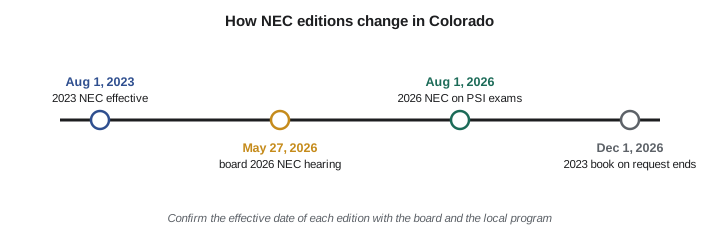
The board adopted the 2023 NEC effective August 1, 2023. In 2026, the board held a rulemaking hearing on May 27 to revise the incorporation-by-reference rule to adopt the 2026 NEC. PSI's June 2026 bulletin reflects that change on the exam side, providing the 2026 code book from August 1, 2026. Because rule effective dates can differ from exam dates and from local adoption dates, a master electrician confirms the effective date of the current edition on the board's website rather than assuming it.
How a rulemaking works
Adopting a new edition is a rulemaking under the state's administrative procedure law. The board publishes notice of a proposed rule, posts the draft, accepts written comments and holds a public hearing at which anyone may speak. After the hearing the board votes, and the adopted rule takes effect on a date the board sets, which is usually some weeks or months later so that contractors, inspectors and local governments can prepare. Electricians who want a voice in the process can subscribe to the board's email notices, read drafts when they are posted and submit comments before the hearing. Trade associations often coordinate comments, but an individual master electrician may comment too.
Because the board's website is the official place for notices, Lucia signed Timberline up for the board's email bulletins after her exam. The bulletins announce rulemaking hearings, new policies, changes to permit procedures and legislative summaries, and they are the fastest way to learn that an effective date has been set.
Preparing a shop for a new edition
A code change is a business project as much as a technical one. A master electrician who supervises a contractor's work plans the transition before the effective date rather than after the first failed inspection. Lucia's plan for Timberline had five parts. She bought current code books for each crew truck and the office. She scheduled continuing education on the changes so that every licensed electrician on the payroll heard the same summary. She reviewed the company's standard details, such as its typical service, garage circuit and kitchen layouts, against the new edition. She updated the estimating templates for any change that added material or labor. And she flagged every open job whose permit date straddled the change so the crew knew which edition applied.
The review of standard details matters most. A company that installs the same layout hundreds of times a year multiplies any error in that layout, and a correction made once in the office saves dozens of corrections in the field. Lucia asked each crew lead to bring one question about the new edition to the next lunch-and-learn, and she kept a running list of answers in the office binder.
A minimum, not a ceiling
The statute makes the board's adopted code a minimum. Municipalities must adhere to the minimum standards of the adopted code, according to the board's 2023 announcement citing section 12-115-107 of the statute. Local governments that run their own inspection programs may adopt and enforce standards that are more stringent than the board's minimum. A municipality that adopts more stringent standards must send a copy of its amended code to the board.
That rule produces a patchwork that a master electrician has to manage. Some cities adopt the new NEC promptly with few local amendments. Others adopt it on their own schedule, often alongside the International Building Code and related codes, and add local amendments that reflect their own priorities, such as requirements for electric vehicle readiness, conduit in certain buildings, or local rules on service equipment location. No city may enforce an older or weaker standard than the board's minimum, so when a local adoption lags, the state minimum still sets the floor.
| Where the job is | Who inspects | Which code applies |
|---|---|---|
| Area where the board inspects | State electrical inspector | The board's adopted NEC |
| City or county with a qualifying program | Local inspector | The local code, at least as stringent as the board's minimum |
| Public school construction or remodel | State electrical inspector | The board's adopted NEC |
| State building | State electrical inspector | The board's adopted NEC |
| Qualifying state college or university with its own program | That institution's inspectors | Its code, meeting the state minimum |
Reading local amendments
When Timberline bids a job in a new jurisdiction, Lucia now checks three things before pricing. First, which edition of the NEC the jurisdiction enforces and since when. Second, whether the jurisdiction has local electrical amendments, and if so what they change. Third, whether the jurisdiction's amendments include administrative rules, such as permit types, inspection stages or plan review thresholds, that affect the schedule. Most jurisdictions publish their adopted codes and amendments online. If the amendments are not clear, she calls the building department's chief electrical inspector before committing to a price.
Local amendments do not change the exam. The PSI exam tests the NEC edition the center provides, not any city's version. A candidate should answer exam questions from the NEC as written, even if a local amendment in her own city says something different.
State modifications and board rules
When the board adopts an edition, its rule can include modifications or clarifications for Colorado. Candidates and contractors should read the board's incorporation-by-reference rule and any related rules alongside the code book to see whether the board has modified any section. Board policies, which are separate from rules, explain how the board applies the code in particular situations. One example is the board's policy on variances for electric vehicle power infrastructure in multifamily buildings, which the board took public comment on in March 2026. A master electrician who works on multifamily electric vehicle projects reads the current version of that policy before designing.
Variances
Sometimes an installation cannot meet a code requirement for a practical reason, or an equivalent method would provide the same safety. In areas inspected by the state, code variances require board approval through the board's variance request form. In areas with local inspection programs, the local building official usually handles alternate methods under the locally adopted code. A variance is never something an electrician grants himself; it is a documented approval, obtained before the work is covered, that the inspector can see.
Which edition applies to a job in progress
When an edition changes, projects already under way raise a practical question: which edition governs? Jurisdictions handle this in their adoption ordinances or rules, typically by tying the applicable edition to the date a permit was applied for or issued. A job permitted before the new edition took effect generally stays under the earlier edition, and a new permit applied for after the effective date falls under the new one. Because the details vary, Lucia confirms the rule with the inspection authority for any project that straddles a code change, and she writes the edition into the job file so the crew knows which book to follow.
# Which edition applies? (study aid; real rules come from the adopting authority)
from datetime import date

EDITIONS = [  # (edition, effective date) for an example jurisdiction
    ("2020 NEC", date(2020, 8, 1)),
    ("2023 NEC", date(2023, 8, 1)),
    ("2026 NEC", date(2026, 8, 1)),   # illustrative date; confirm the actual effective date
]

def edition_for(permit_applied):
    current = None
    for name, start in EDITIONS:
        if permit_applied >= start:
            current = name
    return current

jobs = {
    "Johnstown townhomes": date(2025, 3, 14),
    "Fort Collins tenant finish": date(2026, 7, 28),
    "Loveland custom home": date(2026, 9, 2),
}
for job, applied in jobs.items():
print(f"{job}: permit applied {applied.isoformat()} -> {edition_for(applied)}")Johnstown townhomes: permit applied 2025-03-14 -> 2023 NEC Fort Collins tenant finish: permit applied 2026-07-28 -> 2023 NEC Loveland custom home: permit applied 2026-09-02 -> 2026 NEC
The output shows how a few days can change the governing edition. The dates in the list are illustrative examples, including an assumed effective date for the 2026 edition; a real project uses the effective dates and transition rule that the adopting authority publishes.
Studying the changes for the exam
A candidate who tests near an edition change should know which book PSI will hand her. The June 2026 bulletin says the 2026 NEC is provided from August 1, 2026, and that candidates may request the 2023 book until December 1, 2026. A candidate who studied with the earlier edition can therefore ask for it during that window, but should make the request when scheduling rather than at the test center. After the window closes, every candidate tests from the newer edition.
Studying the changes does not mean memorizing a list of revised sections. Exam questions ask what the code requires, and the candidate looks it up. What helps most is knowing where articles have moved, which articles are new and which familiar rules have changed in ways that alter a calculation. A candidate who practices with the same edition she will test from avoids the trap of finding a rule in the wrong place under time pressure.
Recent state laws that touch electrical work
State legislation outside the electrical practice act also affects what electricians install. In 2026 the legislature passed HB26-1007, which sets rules for portable solar devices and meter collar adapters, devices that fit between a meter and its socket to connect equipment such as solar or batteries. According to the board's summary, the law requires meter collar adapters to be installed by an electrical contractor registered with the board, requires utilities to keep a public list of approved adapters and to review customer-owned adapters within 90 days, and requires the adapters to meet a listing standard and code clearance and safety requirements.
State energy code laws matter too. Colorado has required local governments that update their building codes to adopt energy provisions, including requirements that new buildings be ready for electric appliances, solar and electric vehicle charging. Those provisions live in energy and building codes rather than the NEC, but they show up in electrical designs as extra circuits, panel space and conduit. Because the details depend on each jurisdiction's adoption, a master electrician checks the local energy code amendments along with the electrical code.
Solar and storage permitting
Solar photovoltaic systems are permitted under the same split between state and local inspection as other electrical work. In areas where the board issues permits, the division accepts either the documents listed in its alternative energy submittal guidelines or a plan review completed through an automated permitting platform such as SolarApp+ or Symbium. Local jurisdictions set their own submittal requirements. In every case the installation must meet the adopted NEC, and the installer pulls the permit in its own name.
Worked problem
Choosing the code for three jobs
Timberline has three jobs in the summer of 2026: a school district gym remodel in Loveland, a tenant finish in a city that has not yet adopted the 2026 NEC, and a house in an unincorporated area where the state inspects. Which code applies to each?
Show solution
- The school remodel is a public school project, so a state electrical inspector inspects it under the board's adopted edition.
- The city's local code applies to the tenant finish, but it cannot be less stringent than the board's minimum.
- If the city still enforces the earlier edition while the board's new edition is in effect, the contractor confirms with the city how it is meeting the state minimum.
- The unincorporated house is inspected by the state under the board's adopted edition.
- For each job, the edition in force on the permit application date generally governs; Lucia confirms the transition rule.
Answer: The school and the unincorporated house follow the board's adopted edition under state inspection; the tenant finish follows the city's code, which must meet the state minimum.
Common mistakes
MistakeAssuming every city adopts the new NEC on the same day as the board.
InsteadLocal programs adopt on their own schedules but may never enforce less than the board's minimum.
MistakeAnswering exam questions from a local amendment.
InsteadThe PSI exam tests the NEC edition provided at the center, not local amendments.
MistakeGranting yourself a variance because the alternative is just as safe.
InsteadIn state-inspected areas, variances require board approval through the variance request form.
MistakeAssuming the new edition applies to every job on its effective date.
InsteadTransition rules usually tie the edition to the permit application or issue date; confirm with the authority.
MistakeLetting an unregistered installer put in a meter collar adapter.
InsteadHB26-1007 requires installation by an electrical contractor registered with the board.
Summary and key terms
- The State Electrical Board adopts the NEC by rule as the statewide minimum; the 2023 NEC took effect August 1, 2023, and the board held 2026 NEC rulemaking in May 2026.
- Local programs may be more stringent, must meet the minimum and must send amended codes to the board.
- Public schools and state buildings are inspected by the state under the board's edition.
- Variances in state-inspected areas need board approval; board policies explain how the board applies the code.
- Transition rules usually tie the edition to the permit date; confirm with the authority.
- HB26-1007 requires registered contractors to install meter collar adapters.
- Incorporation by reference
- Adopting a published code, such as the NEC, by naming it in a rule.
- Statewide minimum
- The board's adopted code, which local codes may exceed but not weaken.
- Local amendment
- A change a local jurisdiction makes to the code it enforces.
- Variance
- A documented approval to use a method other than the one the code prescribes.
- Meter collar adapter
- A device installed between a meter and its socket to connect equipment such as solar or batteries.
Practice problems
Work each problem on paper first, then reveal the answer to check.
When did the 2023 NEC take effect as Colorado's minimum standard?
Show answer
August 1, 2023.
May a city enforce a less stringent electrical code than the board's adopted edition?
Show answer
No; local codes may only be more stringent.
Who approves a code variance in an area the state inspects?
Show answer
The State Electrical Board, through its variance request form.
Who may install a meter collar adapter under HB26-1007?
Show answer
An electrical contractor registered with the board.
Lesson quiz · 5 questions
Score 60% or more to complete this lesson.
Create a free account to save your progress, take quizzes and earn a certificate.