
MELU-206 · Lesson 1 of 12 · 21 min
How electrical licensing works in Colorado
▶ Video coming soon A video version of this lesson is on the way.
Walt Brennan started Timberline Electric in Loveland in 1994 with a borrowed bucket truck, one apprentice and the master electrician license he had earned two years earlier. Thirty-two years later the company employs sixteen electricians and apprentices and runs five service vans. Its work is a steady mix of custom homes in the foothills west of town, tenant finishes in Fort Collins, a school district remodel, ranch shops out on the plains east of Interstate 25, and a fast-growing list of electric vehicle chargers and panel upgrades. On a cold Monday in January, Walt asked his lead journeyman, Lucia Ortega, to stay after the morning safety talk. "I'm sixty-two," he said. "Our contractor registration rides on my master license. When I step back, this company needs another master electrician who works here full time and supervises all of our electrical work. I want that to be you." He handed her a printout of the board's application page and the testing company's candidate bulletin.
Lucia had registered as an apprentice in 2015, passed the journeyman exam in 2020 and had run crews for Timberline on commercial and residential jobs ever since. She had already worked through the master electrician core courses on the National Electrical Code, load calculations, grounding and bonding, motors and transformers, special occupancies, and business and law. This course applies that preparation to Colorado: who licenses electricians and contractors, how the master exam works, which code edition applies, how permits and inspections are handled, and the Colorado law on apprentices, contracts, mechanics' liens, workplace safety, workers' compensation and renewal that a master electrician needs to know.
The board and the division
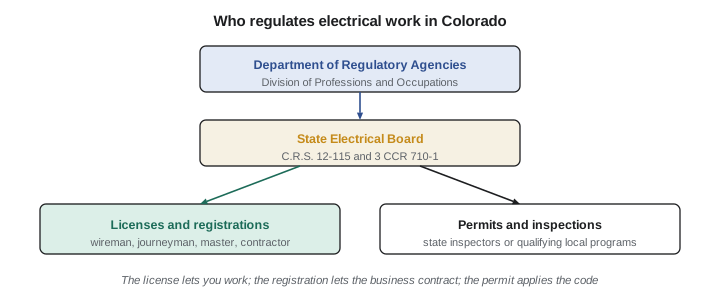
Colorado licenses electricians and registers electrical contractors through the State Electrical Board. The board sits inside the Division of Professions and Occupations, which is part of the Colorado Department of Regulatory Agencies, usually shortened to DORA. The division's staff process applications, renewals and complaints, and its electrical inspectors carry out inspections in the parts of the state where the board is the inspection authority. The board itself is a group of appointed members, most of them from the electrical trade, that adopts rules, decides which edition of the National Electrical Code applies statewide, approves or denies applications that need judgment, grants variances and hears disciplinary cases.
The licensing law is Article 115 of Title 12 of the Colorado Revised Statutes, often written as C.R.S. 12-115. Older electricians sometimes refer to it by its former location in Article 23; the statute was renumbered in a 2019 reorganization of Title 12, but the structure is familiar. The statute sets the license types and experience requirements, the rules for contractor registration, apprentice supervision, permits and inspections, fees and discipline. The board's rules in 3 CCR 710-1 fill in the details: how experience is documented, how continuing education works, which code edition is incorporated, and how variances are requested.
The license types
Colorado's electrical licenses form a ladder. A person starts as a registered apprentice working under the direct supervision of a licensed electrician. After enough documented experience and training, the apprentice can become a residential wireman, licensed for one- to four-family dwellings, or a journeyman electrician, licensed for all types of work. A journeyman with more experience, including time planning, laying out and supervising installations, can become a master electrician. On the business side, a person or firm that contracts for electrical work registers with the board as an electrical contractor, and that registration depends on a master electrician.
| Credential | What it allows | Exam |
|---|---|---|
| Apprentice (registered by the employer) | Electrical work under the direct supervision of a licensed electrician | None |
| Residential wireman | Wiring of one-, two-, three- and four-family dwellings | Yes, through PSI |
| Journeyman electrician | Electrical work of all types, typically for a registered contractor | Yes, through PSI |
| Master electrician | Planning, laying out and supervising installations; qualifying an electrical contractor; applying for permits | Yes, through PSI |
| Electrical contractor (registration) | Engaging in the business of electrical contracting through a qualifying master electrician | None, but registration is required |
There is no exam to register as an electrical contractor. The statute instead ties the registration to a master electrician: either an owner or part owner holds the master license and supervises all the electrical work, or the business employs at least one licensed master electrician who supervises all the electrical work. A master electrician can be the qualifying master for only one contractor and must be actively engaged full time with that company. Those two rules shape how Colorado electrical companies are organized, and Lessons 7 and 8 return to them in detail.
Reciprocity and the master license
Colorado takes part in a reciprocity network for some licenses. Board rules allow a license from a member state of the National Electrical Reciprocal Alliance, or from a jurisdiction with a board reciprocity agreement, to be recognized if the applicant passed an exam and was not grandfathered in. The rule is explicit on one point that matters to Lucia's generation of candidates: a Colorado master license cannot be granted by reciprocity. A master electrician moving to Colorado from another state can still apply by endorsement if the other state's license and exam are comparable, but the shortcut that works for some journeymen does not exist for the master level.
Experience earned in another state, or even another country, can count toward the hours if it is documented on the board's forms. Board rules limit foreign experience credit and require in-country experience and familiarity with the NEC. Lesson 2 covers how experience is counted.
A single statewide minimum code
Colorado has a statewide minimum standard for electrical work: the edition of the National Electrical Code that the State Electrical Board adopts by rule. The board adopted the 2023 NEC effective August 1, 2023, and in 2026 it held rulemaking to adopt the 2026 NEC. Cities, towns, counties and qualifying state colleges and universities may run their own electrical inspection programs, and they may adopt standards that are more stringent than the board's minimum. They may not go below it. A local government that adopts stricter standards has to send a copy of its amended code to the board.
This arrangement matters every day. Timberline's Loveland jobs are permitted and inspected by the city's building division. Its Fort Collins jobs go through that city. Its ranch shop jobs in an unincorporated part of the plains may be permitted through the county or through the state, depending on whether the county has a qualifying inspection program. Its school district remodel is always inspected by a state electrical inspector, because the statute requires state inspection of public school construction, remodeling and repair even where a local government inspects everything else. Lesson 6 covers how to find the right inspection authority for an address.
Local contractor licensing
The state license and registration are the core requirements, but some home-rule cities and counties add their own contractor licensing or registration on top of the state's. Denver, for example, runs its own contractor licensing program and checks apprentice ratios on its job sites. A contractor that takes a job in a city with local licensing checks those rules before bidding. The local license is an extra step, not a substitute for the state license and registration, and its requirements vary from place to place.
Unlicensed work and compliance checks
Performing electrical work without the required license, or engaging in the business of electrical contracting without registering, violates Article 115 and can lead to fines, discipline and orders to stop. The statute also funds compliance checks: division staff can visit job sites statewide, whether the permit came from the board or a local department, to confirm that the people doing electrical work are licensed or are registered apprentices under direct supervision, and that licensed electricians are not supervising more apprentices than the law allows. Walt told Lucia about a basement finish in Berthoud where an unlicensed handyman ran circuits without a permit. The homeowner paid twice: once for the handyman and again for Timberline to open the walls and redo the work under a permit.
# Which Colorado credential covers each role? (simplified study aid)
roles = [
    ("Pull wire under a journeyman's direct supervision", "apprentice"),
    ("Wire a new duplex for a registered contractor", "residential wireman"),
    ("Install a 400 A commercial service for a contractor", "journeyman"),
    ("Supervise all electrical work for a company and apply for permits", "master"),
    ("Sign a contract with a client to do electrical work", "electrical contractor"),
]
needs_exam = {"apprentice": False, "residential wireman": True, "journeyman": True,
              "master": True, "electrical contractor": False}
for role, cred in roles:
    tag = "exam required" if needs_exam[cred] else "no exam, registration only"
    print(role)
print(" credential:", cred, "-", tag)Pull wire under a journeyman's direct supervision credential: apprentice - no exam, registration only Wire a new duplex for a registered contractor credential: residential wireman - exam required Install a 400 A commercial service for a contractor credential: journeyman - exam required Supervise all electrical work for a company and apply for permits credential: master - exam required Sign a contract with a client to do electrical work credential: electrical contractor - no exam, registration only
The output shows a point that surprises many people from other states: the business registration has no exam in Colorado, because the knowledge test sits with the master electrician the business relies on. The registration is about who is responsible; the master license is about what that person knows.
Worked problem
Mapping a company to the registration rules
A company in Grand Junction has two owners, neither of them electricians, and wants to start commercial electrical contracting. It plans to name a master electrician who already serves as the qualifying master for his own small electrical company and would work for the new company two days a week. What problems does this plan have?
Show solution
- The owners do not need licenses themselves, but the company must register with the board as an electrical contractor.
- Without an owner who holds a master license, the company must employ at least one licensed master electrician who supervises all the electrical work.
- A master electrician may be the qualifying master for only one contractor.
- The qualifying master must be actively engaged full time with that company.
- The proposed master is already qualifying another company and would work only part time.
Answer: The plan fails on both the one-contractor rule and the full-time rule; the company needs a different master electrician who works for it full time.
One career, several agencies
Lucia's own path shows how the pieces connect. When Timberline hired her in 2015, the company registered her with the board as an apprentice within its first month of employing her, and it reported her hours every January. Her classroom training through an apprenticeship program counted toward the 288 hours of training the statute requires for a journeyman. After four years of documented experience, at least two of them on commercial and industrial work, she applied to the board, was approved to test, passed the PSI exam and received her journeyman license. Since then she has renewed every three years with continuing education. Now she is preparing for the master application, which needs another stretch of documented experience planning, laying out and supervising installations. When she passes, Timberline will update its contractor registration to show her as the qualifying master. At every step a different office touched her file: the employer, the apprenticeship program, the division's licensing staff, PSI and, on each job, an inspection authority. A master electrician is expected to understand that whole chain, because the master is the person the others rely on.
Where the rules live
Colorado electrical contractors work under several layers of law, and the exam and daily practice both expect a master electrician to know which layer answers which question. Article 115 and the board's rules set licensing, registration, apprentice supervision, permits, inspections, renewal and discipline. The adopted NEC, incorporated by the board's rules, sets installation requirements, with any local amendments where a local government inspects. Title 38, Article 22 governs mechanics' liens and the construction trust fund. Federal OSHA standards cover workplace safety for private employers. The Workers' Compensation Act of Colorado covers injured workers. The PSI candidate bulletin explains exam logistics. When a question comes up, start by asking which layer it belongs to.
Those layers also tell you who to call. A question about whether your hours count goes to the division's licensing staff. A question about whether a receptacle needs ground-fault protection goes to the inspector for that jurisdiction. A question about whether you can still file a lien goes to a construction lawyer. Knowing the right office saves days of phone tag and keeps you from relying on a friend's guess.
Common mistakes
MistakeAssuming a business needs an exam to register as an electrical contractor.
InsteadContractor registration has no exam; it depends on a licensed master electrician who owns part of the company or works for it full time.
MistakeBelieving a Colorado master license can be obtained by reciprocity.
InsteadBoard rules state that a Colorado master license cannot be granted by reciprocity; endorsement requires a comparable license and exam.
MistakeThinking a city can adopt an older code edition than the state.
InsteadLocal governments must meet the board's minimum standard; they may only be more stringent and must send amended codes to the board.
MistakeAssuming a local inspection program covers every building in town.
InsteadPublic school construction, remodeling and repair are inspected by state electrical inspectors even where a local government inspects other work.
MistakeTreating a local contractor license as a substitute for state registration.
InsteadLocal licensing, where it exists, is in addition to state licensing and registration.
Summary and key terms
- The State Electrical Board, within DORA's Division of Professions and Occupations, licenses electricians and registers electrical contractors under C.R.S. 12-115 and board rules in 3 CCR 710-1.
- The credential ladder runs from registered apprentice to residential wireman or journeyman to master electrician; contractor registration has no exam but requires a qualifying master.
- A master can qualify only one contractor and must work full time for it.
- A Colorado master license cannot be granted by reciprocity.
- The board adopts a statewide minimum NEC edition; local programs may be stricter, never weaker, and public schools are always state inspected.
- Compliance checks statewide verify licenses and apprentice supervision limits.
- State Electrical Board
- The Colorado board that licenses electricians, registers contractors, adopts the code edition and hears discipline.
- DORA
- The Colorado Department of Regulatory Agencies, home of the Division of Professions and Occupations.
- Qualifying master
- The licensed master electrician on whom an electrical contractor's registration depends.
- Residential wireman
- A Colorado license limited to wiring one- to four-family dwellings.
- Compliance check
- A job site visit by division staff to verify licenses and apprentice supervision.
Practice problems
Work each problem on paper first, then reveal the answer to check.
Which agency registers electrical contractors in Colorado?
Show answer
The State Electrical Board, through DORA's Division of Professions and Occupations.
Can a city adopt a less demanding version of the NEC than the board's edition?
Show answer
No. Local programs must meet the board's minimum and may only be more stringent.
Who inspects a public school remodel in a city that runs its own inspection program?
Show answer
A state electrical inspector; the statute requires state inspection of public school work.
Can a master electrician qualify two contractors at once?
Show answer
No. A master can be the qualifying master for only one contractor and must work full time for it.
Lesson quiz · 5 questions
Score 60% or more to complete this lesson.
Create a free account to save your progress, take quizzes and earn a certificate.