
MELU-206 · Lesson 11 of 12 · 20 min
Renewal and continuing education
▶ Video coming soon A video version of this lesson is on the way.
In August 2026, Dana sent Timberline's licensed electricians an email with a simple subject line: "Licenses expire September 30." Below it was a table of every electrician's name, license type and continuing education hours on file. Most rows were green. Two journeymen were short, and Lucia's row had a note: "First renewal after exam. Check." Lucia looked it up that afternoon and found that, because she had passed her master exam in April, the statute did not require continuing education for her first master renewal. She renewed online the next morning and then signed up for a code update class anyway.
This lesson explains how Colorado electrical licenses are renewed, what continuing education the board requires, how hours are documented and audited, what happens when a license lapses, and how contractor registrations renew alongside licenses. It relies on C.R.S. 12-115, the board's renewal and continuing education pages and widely used summaries of the board's rules. Because renewal details can change by rule, licensees confirm the current requirements on the board's website before each cycle.
The three-year cycle
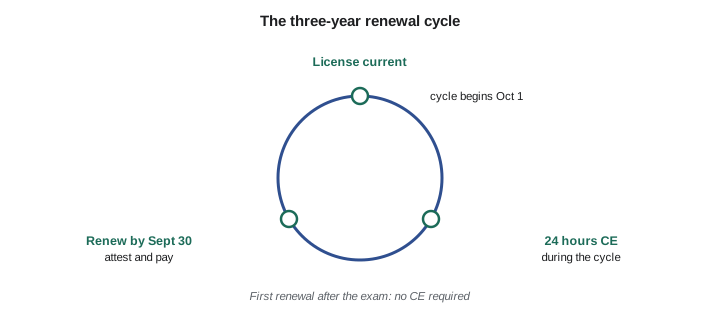
Colorado electrical licenses renew on a three-year cycle, with expiration on September 30 at the end of the cycle. Every license type renews on the same schedule, so a master electrician who passed the exam early in a cycle holds a license that expires at the end of that same cycle, not three years after the exam. In 2026, the board's website noted that licenses expire September 30, 2026, and could be renewed through November 30, 2026. Electricians should not rely on any grace period without checking the board's current notice, because rules on late renewal can change.
The renewal itself is online through the state's licensing system. The licensee confirms personal information, attests to completing the required continuing education, pays the fee and submits. The license record on the board's verification site updates when the renewal is processed. Contractors and inspectors check that site, so a licensee whose renewal has not processed may find a general contractor asking questions.
Continuing education requirements
The statute and the board's rules require licensed electricians to complete 24 hours of continuing education during each three-year renewal period. A licensee who renews for the first time after passing the exam is not required to complete continuing education for that first renewal. Widely used summaries of the board's rules describe further limits on content: at least some of the hours must cover changes in the currently adopted NEC, and hours in general safety topics are capped. A licensee should read the board's current continuing education rule for the exact numbers before choosing courses.
Continuing education must come from approved or qualifying providers, and the board's page explains that providers must attest that their courses meet the requirements. Courses can be classroom, live online or self-paced, as the rules allow. A good course does more than satisfy the hours: it walks through the changes in the new edition, explains why they were made and shows how they affect common installations.
| Item | Rule | Note |
|---|---|---|
| Renewal period | Three years, ending September 30 | Same cycle for all license types |
| Continuing education | 24 hours per renewal period | C.R.S. 12-115 and board rules |
| First renewal after the exam | No continuing education required | Statute exempts the first renewal |
| Content limits | Part of the hours on current NEC changes; safety hours capped | Confirm the exact numbers in the board's rule |
| Providers | Must attest that courses meet the requirements | Board's continuing education page |
| Records | Keep certificates for each cycle | Needed if the board audits |
# Tracking continuing education by person (study aid)
REQUIRED = 24

people = {
    "Lucia (first master renewal)": {"hours": 0, "first_renewal": True},
    "Mateo": {"hours": 24, "first_renewal": False},
    "Ana": {"hours": 16, "first_renewal": False},
    "Ben": {"hours": 20, "first_renewal": False},
}
for name, p in people.items():
    need = 0 if p["first_renewal"] else REQUIRED
    short = max(0, need - p["hours"])
    status = "ready" if short == 0 else f"needs {short} more hours"
print(f"{name}: {p['hours']} of {need} -> {status}")Lucia (first master renewal): 0 of 0 -> ready Mateo: 24 of 24 -> ready Ana: 16 of 24 -> needs 8 more hours Ben: 20 of 24 -> needs 4 more hours
The output tells Dana which electricians need classes before the deadline. In a real tracker she would also check the content limits, such as hours on code changes and the cap on safety hours, because a person with 24 hours in the wrong topics is still short.
Documentation and audits
At renewal, licensees attest that they completed the required continuing education. The board may audit a sample of licensees and ask them to produce certificates. A licensee who cannot produce them may face discipline for a false attestation, even if the hours were actually completed. The safest practice is to keep every certificate, with the course title, provider, date and hours, in a folder for each cycle, and to keep the folder for at least the following cycle.
Timberline keeps a copy of every electrician's certificates in the office as well. When an electrician leaves the company, the originals go with him, but the office copy remains in case questions arise about work done while he was employed.
Responding to an audit
An audit usually starts with a letter or email from the board asking the licensee to submit proof of the hours attested at renewal by a stated date. The licensee gathers certificates for the cycle, checks that they add up to the required total and meet the content limits, and submits them as the notice directs. If a certificate is missing, the licensee contacts the provider for a duplicate right away, because providers keep attendance records. A licensee who discovers a real shortfall should contact the board promptly rather than ignore the notice; ignoring an audit turns a fixable problem into a disciplinary one.
Spreading hours across the cycle
The easiest way to meet the requirement is to spread hours across the three years instead of taking all 24 in the final summer. Eight hours a year is one full-day class or a few evening sessions. Spreading the hours also matches how editions change: a code update course is most useful soon after a new edition takes effect, while a course on a specialty topic can come whenever the company starts that kind of work. Electricians who wait until the last month often find classes full or end up taking whatever is available rather than what helps them.
Timberline's practice is to schedule one in-house class each year with an approved provider, timed to the company's slow season, and to let each electrician choose additional courses that match the work he does. The office pays for approved courses and gives paid time for the in-house class. Lucia sees the cost as an investment: a crew that understands the current code fails fewer inspections.
Classroom, online and self-paced courses
Electricians can choose among formats where the rules allow. Classroom courses let students ask questions and hear how other contractors handle the same problems. Live online courses save travel, which matters for crews on the plains and in the mountains. Self-paced online courses are flexible but require discipline, and their completion records must show the hours the board will accept. Whatever the format, the electrician checks before enrolling that the provider's course will count toward the Colorado requirement and in which content category.
Late renewal, lapse and reinstatement
A license that is not renewed by the deadline expires. An electrician with an expired license may not perform electrical work that requires the license, and a contractor whose qualifying master's license expires has lost its qualifying master. The statute and the board's rules provide ways to reinstate an expired license, which usually involve an application, a fee, proof of continuing education and, after a long lapse, possibly more. Because the requirements depend on how long the license has been expired, a licensee whose license lapses should contact the board promptly and read the current reinstatement rules.
Working on an expired license is a serious problem. Permits listing an expired master may be questioned, and the board can discipline both the electrician and the contractor. Dana's calendar flags every license deadline months in advance for that reason.
Contractor registration renewal
Electrical contractor registrations renew on the board's schedule too. Renewal confirms the qualifying master and the contractor's evidence of workers' compensation and unemployment insurance compliance. A contractor whose registration lapses may not offer or perform electrical contracting until it is renewed or reinstated. Timberline renews its registration and Lucia's master license at the same time, so the qualifying master and the company stay in step.
Renewal and the exam edition
Renewal and the exam follow different calendars. The exam moves to a new edition on the date PSI announces, while the code that governs installations changes on the effective dates the board and local programs set. A master who renews in 2026 may hold a license earned on a 2023 NEC exam while the company's jobs move to the 2026 edition. The license remains valid; what changes is the knowledge needed to supervise the work. That gap is exactly what code update continuing education is meant to close, and it is why a master who is exempt from hours at her first renewal may still choose to take a code update course.
Changes in name, address or employer
Licensees keep their contact information current with the board, because notices about renewal, audits and rule changes go to the address and email on file. A recent law on the Division of Professions and Occupations allows more notices by email, which makes a current email address even more important. When a master changes employers, the qualifying master rules apply: the board must be notified within 15 days after a qualifying master leaves a contractor, and the new employer's registration must be updated if she will qualify it.
Choosing courses that help
Continuing education is most valuable when it matches the work. A master electrician whose company does mostly residential work benefits from courses on dwelling changes, ground-fault and arc-fault protection, and energy code requirements. A commercial master may want courses on services, feeders, emergency systems and electric vehicle charging. Courses on Colorado rules and the board's policies help everyone, because those rules change between editions too.
Lucia plans her own continuing education around the company's work. In the cycle after her first renewal, she plans eight hours on the 2026 NEC changes in a classroom course, a course on solar and storage systems because Timberline has started installing them, and a course on the board's rules and recent laws. She shares notes from each course at a lunch-and-learn, which turns her hours into training for the whole crew.
Keeping up between cycles
Continuing education is the minimum, not the whole job. A master electrician also reads the board's bulletins, follows rulemaking, watches for new state laws that touch electrical work, reads local amendments in the jurisdictions where the company works and talks with inspectors about questions they are seeing. Code knowledge fades quickly when it is not used, so short, regular study is more effective than cramming before a renewal deadline.
Renewal for the whole company
For a contractor, renewal is a company project. Every licensed electrician, the qualifying master and the contractor registration renew in the same window. The office tracks each person's hours, reminds them of deadlines, schedules group classes when several people need the same topics and checks that each renewal has processed. After renewal, the office prints the updated license records for the job-site folders so that crews can show current licenses during compliance checks.
In the 2026 cycle, Dana scheduled a two-day code update class at the shop in July for the journeymen who were short. The two who had been behind finished their hours with weeks to spare. She also sent a reminder to the apprentices, whose registration and annual reporting run on their own schedule, so that their records stayed current too.
Worked problem
Two journeymen short of hours
It is August 15, 2026. Ana has 16 of 24 hours and Ben has 20. Both licenses expire September 30. Lucia's first master renewal is due at the same time. What should Dana do?
Show solution
- Confirm that Lucia's first renewal after the exam does not require continuing education.
- Identify the shortfall for Ana (8 hours) and Ben (4 hours), and check that their existing hours meet the content limits, such as hours on code changes.
- Enroll Ana and Ben in approved courses that finish well before September 30.
- Collect certificates and file copies in each person's cycle folder.
- Remind everyone to renew online before September 30 and confirm that each renewal has processed.
Answer: Confirm Lucia's exemption, get Ana and Ben into approved courses that cover the right topics, file the certificates and confirm every renewal by September 30.
Common mistakes
MistakeCounting three years from the exam date.
InsteadAll licenses expire on the same cycle, on September 30 at the end of the period.
MistakeTaking 24 hours of general safety courses.
InsteadSafety hours are capped and part of the hours must cover current NEC changes.
MistakeThrowing away certificates after renewing.
InsteadKeep certificates in case of an audit.
MistakeWorking after a license expires while the renewal is pending.
InsteadWork requiring a license stops until the license is current.
MistakeAssuming the first renewal after the exam needs 24 hours.
InsteadThe statute exempts the first renewal after the exam.
Summary and key terms
- Colorado electrical licenses renew every three years, expiring September 30 at the end of the cycle.
- Licensees complete 24 hours of continuing education per cycle; the first renewal after the exam is exempt.
- Part of the hours must cover current NEC changes, and safety hours are capped; confirm the exact numbers in the rule.
- Licensees attest at renewal and keep certificates for audits.
- An expired license cannot be used; reinstatement requirements depend on the length of the lapse.
- Contractor registrations renew on the board's schedule with evidence of insurance compliance.
- Renewal period
- The three-year period ending September 30 during which continuing education is earned.
- Continuing education
- Approved courses that licensees complete to renew.
- Attestation
- The licensee's statement at renewal that requirements were met.
- Audit
- A board review asking licensees to prove their continuing education.
- Reinstatement
- The process for restoring an expired license.
Practice problems
Work each problem on paper first, then reveal the answer to check.
How many hours of continuing education are required per renewal period?
Show answer
24 hours.
On what date do Colorado electrical licenses expire at the end of a cycle?
Show answer
September 30.
Does a master who passed the exam in the current cycle need continuing education for the first renewal?
Show answer
No; the first renewal after the exam is exempt.
Why should a licensee keep certificates after renewing?
Show answer
The board may audit and ask for proof.
Lesson quiz · 5 questions
Score 60% or more to complete this lesson.
Create a free account to save your progress, take quizzes and earn a certificate.