
MELU-206 · Lesson 10 of 12 · 21 min
Workplace safety law and OSHA for electrical contractors
▶ Video coming soon A video version of this lesson is on the way.
Eli, Timberline's second-year apprentice, was pulling wire on the ranch shop job when he reached into a panel that a crew member believed was off. It was not; the feeder from the house panel was still live. Eli was lucky. He felt a jolt through a glove and stepped back. That afternoon Lucia shut down the job, gathered the crew and walked through what had gone wrong. By the end of the week the company had a revised lockout procedure, new voltage testers in every truck and a log entry describing what happened. "A near miss," she said, "is a free lesson. We are not getting a second one."
This lesson explains the workplace safety law that applies to Colorado electrical contractors: federal OSHA's coverage of private employers in the state, the construction and general industry standards that matter most to electricians, the role of NFPA 70E, recordkeeping and reporting duties, multi-employer worksites, and how safety connects to workers' compensation and to the training hours that Colorado requires for journeyman applicants. It does not reproduce any standard's text; contractors should read the current federal regulations and their own safety programs.
Who enforces workplace safety in Colorado
Colorado does not operate its own OSHA-approved state plan for private employers, so federal OSHA enforces workplace safety and health for private employers in the state, including electrical contractors. Federal OSHA's area offices in Colorado conduct inspections, respond to complaints and investigate serious injuries and fatalities. Public employers, such as cities and school districts, are handled differently because federal OSHA does not cover state and local government employees, so a contractor working for a public owner still follows OSHA for its own employees while the owner's employees follow whatever rules apply to them.
OSHA's rules are federal regulations in Title 29 of the Code of Federal Regulations. Construction work falls under Part 1926, and general industry work, including much maintenance work in existing facilities, falls under Part 1910. Electrical contractors often work under both: Part 1926 on new construction and remodels, and Part 1910 on service and maintenance work in operating buildings. When no specific standard addresses a hazard, OSHA can cite the General Duty Clause of the federal act, which requires employers to keep their workplaces free of recognized hazards likely to cause death or serious harm.
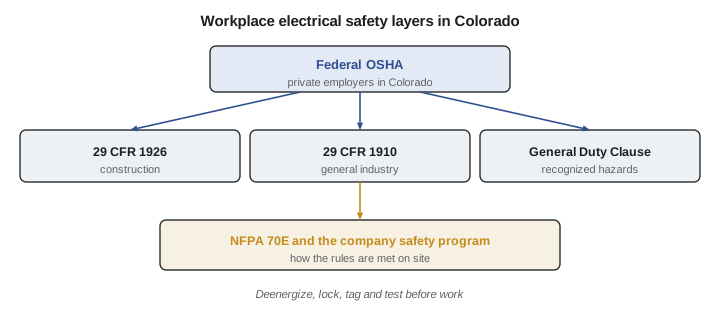
| Layer | What it is | How electricians meet it |
|---|---|---|
| OSH Act General Duty Clause | Federal duty to protect against recognized serious hazards | Hazard assessment and a working safety program |
| 29 CFR 1926 (construction) | Federal construction standards, including electrical, fall protection and ladders | Safe work practices on new work and remodels |
| 29 CFR 1910 (general industry) | Federal standards for operating workplaces, including electrical work practices and lockout/tagout | Service and maintenance procedures |
| NFPA 70E | A consensus standard for electrical safety in the workplace | Arc flash and shock risk assessment, PPE and energized work permits |
| Company safety program | The employer's written rules and training | Procedures, training records and enforcement |
The electrical hazards that matter most
Electricians face three main hazard groups. Shock and electrocution happen when a worker becomes part of a circuit. Arc flash and arc blast release intense heat, light and pressure when current flows through air between conductors. And the ordinary construction hazards, especially falls from ladders and lifts, injure electricians more often than electricity does. A complete safety program addresses all three.
OSHA's construction standards include requirements for ground-fault protection of temporary power on job sites, either through ground-fault circuit interrupters or an assured equipment grounding conductor program, and for deenergizing circuits and protecting workers from accidental reenergizing. The general industry standards include electrical safe work practices and the control of hazardous energy, commonly called lockout/tagout. Ladders, scaffolds, aerial lifts and fall protection have their own standards in both parts.
Deenergize first
The core principle in both OSHA and NFPA 70E is that equipment should be placed in an electrically safe work condition before work begins, unless deenergizing would create a greater hazard or is infeasible. Placing equipment in an electrically safe condition means identifying all sources, opening the disconnecting means, applying locks and tags, testing for absence of voltage with a properly rated tester that has been checked on a known source, and grounding where stored or induced energy may be present.
Eli's near miss happened because two steps were skipped. Nobody identified that the shop panel was fed from the house panel, and nobody tested for absence of voltage before Eli reached in. Timberline's revised procedure requires the person doing the work to test, not just the person who opened the breaker, and to verify the tester on a known live source before and after. It also requires the crew lead to sketch the sources on the work order when a building has more than one supply.
# A lockout checklist that refuses to skip steps (study aid)
STEPS = ["Identify all sources", "Notify affected workers", "Open disconnecting means",
         "Apply lock and tag", "Verify tester on known source", "Test for absence of voltage",
         "Verify tester again", "Ground if stored or induced energy is possible"]

def review(done):
    for i, step in enumerate(STEPS, 1):
        mark = "done" if step in done else "MISSING"
        print(f"{i}. {step}: {mark}")
    missing = [s for s in STEPS if s not in done]
    print("Safe to work:", "yes" if not missing else "no")

review({"Open disconnecting means", "Apply lock and tag"})1. Identify all sources: MISSING 2. Notify affected workers: MISSING 3. Open disconnecting means: done 4. Apply lock and tag: done 5. Verify tester on known source: MISSING 6. Test for absence of voltage: MISSING 7. Verify tester again: MISSING 8. Ground if stored or induced energy is possible: MISSING Safe to work: no
The output shows the ranch shop job on the day of the near miss: two steps done and six missing. A procedure written as a checklist makes a skipped step visible before someone reaches into a panel.
NFPA 70E and arc flash
NFPA 70E is a consensus standard, not a federal regulation, but OSHA treats it as an important guide to recognized hazards and feasible protection, and many owners require it in their contracts. It describes how to assess shock and arc flash risk, establish approach boundaries, select personal protective equipment, and decide when energized work is justified. When energized work is justified, it calls for an energized electrical work permit that documents the reason, the hazards and the protection.
Timberline's commercial crews carry arc-rated clothing and face protection, and Lucia requires an energized work permit signed by her or a crew lead for any justified energized work above the threshold in the company's program. Most of Timberline's residential work never needs energized work at all, because deenergizing a house circuit is simple; the permit exists for the rare commercial job where a process cannot be shut down.
Falls, ladders and the ordinary hazards
Falls are a leading cause of death in construction, and electricians spend much of their day on ladders and lifts. OSHA's construction standards set requirements for portable ladders, scaffolds, aerial lifts and fall protection, and they require training for workers who use them. Electricians should use nonconductive ladders near energized parts, inspect ladders before use, keep three points of contact and set extension ladders at the right angle. Aerial lift operators need training on the specific equipment. Other everyday hazards include cuts, eye injuries, silica dust from drilling concrete and noise, each of which a safety program addresses with protective equipment and work practices.
Colorado's climate adds its own hazards. Summer heat on roofs and in attics can cause heat illness, and winter work on the plains and in the foothills brings cold stress and icy access. Timberline schedules attic work early in summer days, provides water and shade, and keeps traction aids and warm layers in trucks in winter. These are small measures, but they prevent injuries that would otherwise be predictable.
Building a safety culture
Rules work only when crews follow them on ordinary days. Lucia's approach is to make safety part of every job-start meeting, to let any worker stop work if something looks wrong without fear of blame, and to praise the person who reports a near miss. Crew leads hold a short weekly safety talk on a topic tied to current work. When a procedure changes, the reason is explained, as it was after Eli's near miss, so the crew understands why the extra steps matter.
Training and the 288 hours
OSHA requires employers to train workers in the hazards of their work and the safe practices that apply. For electricians, that includes recognizing qualified and unqualified work, lockout/tagout, ladder and fall protection, and the use of protective equipment. Training should be documented with dates, topics and the names of trainees and trainers.
Colorado ties safety training to licensing too. The board's rules for the 288 hours of training required for a journeyman application include between 10 and 40 hours of safety training based on OSHA. Many apprentices meet that requirement through an OSHA construction outreach course along with their other classroom training. A master electrician who supervises apprentices makes sure their training records support their future applications.
Recordkeeping and reporting
Many employers must keep records of work-related injuries and illnesses on OSHA's forms, including the log of injuries and illnesses and the annual summary that is posted each year. Employers with ten or fewer employees at all times during the previous year are generally exempt from routine recordkeeping, but not from reporting. Every employer must report a work-related fatality to OSHA within 8 hours, and an inpatient hospitalization, amputation or loss of an eye within 24 hours. Some larger employers must also submit injury data electronically.
Near misses do not have to be recorded on OSHA's log, but recording them internally is good practice. Timberline logs every near miss with a short description, the cause and the corrective action, and Lucia reviews the log monthly. Eli's near miss was the first entry that led to a company-wide procedure change.
Multi-employer worksites
Construction sites have many employers. OSHA's multi-employer citation policy explains that more than one employer can be cited for the same hazard: the employer that created it, the employer whose workers were exposed, the employer responsible for correcting it and the controlling employer, usually the general contractor, that has general authority over the site. An electrical contractor that leaves an open panel or an unprotected temporary cord can be cited even if another trade's worker is the one exposed. And a general contractor that knows of an electrical hazard on its site has its own duty to see it corrected.
On the Johnstown townhomes, Timberline's temporary power was protected by ground-fault circuit interrupters, and the crew checked them each morning. When a framing crew plugged an unprotected extension cord into a builder-supplied generator, Lucia raised it with the builder's superintendent the same day. The builder controlled the site; Timberline had no authority over the framers, but it did have a duty to report the hazard and protect its own workers.
Workers' compensation when someone is hurt
Workplace safety law and workers' compensation work together. Colorado employers with at least one employee must carry workers' compensation, which pays medical care and wage benefits for work-related injuries regardless of fault. According to Pinnacol Assurance's guidance, an injured worker should give the employer written notice of an injury within four days, and the employer should report the injury to its insurer within ten days. Employers must post the required workers' compensation notices where employees can see them, including information about designated medical providers.
A good safety program lowers workers' compensation costs over time, because insurers price coverage partly on claims history. Colorado also offers a premium cost containment program that can reduce premiums for employers with qualifying safety programs. Lucia's first goal is simple: no one gets hurt. Her second is to make sure that when someone is hurt, the report goes in on time and the worker gets care quickly.
Inspections and citations
OSHA inspections can follow a complaint, a referral, a reported injury or a targeted program. An inspector presents credentials, holds an opening conference, walks the site and holds a closing conference. Citations, if issued, describe the violation, the classification, the proposed penalty and the date by which the hazard must be abated. An employer may contest a citation within the time OSHA sets, usually 15 working days after receiving it, or may request an informal conference to discuss it. Abatement must still be documented.
A contractor prepares for an inspection the same way it prepares for any day on the job: by having its safety program, training records and procedures in order, and by making sure crews follow them. Lucia keeps a copy of the written safety program, training records and the hazard communication information in each truck so that a crew lead can produce them on site.
Worked problem
Investigating the ranch shop near miss
Eli felt a shock through a glove while reaching into a panel at the ranch shop. The panel was fed from the house, and its breaker had not been opened. Nobody tested for voltage. What should Lucia do?
Show solution
- Stop work and make the panel safe by identifying all sources and opening and locking the correct disconnecting means.
- Make sure Eli is checked by a medical provider and report the injury to the insurer if he needs treatment.
- Record the event in the company's near-miss log with its causes: an unidentified source and no test for absence of voltage.
- Revise the procedure so the worker tests before touching and the crew lead sketches all sources on multi-supply buildings.
- Train every crew on the revised procedure and document the training.
Answer: Make the equipment safe, care for Eli, document the near miss, fix the procedure and train every crew.
Common mistakes
MistakeAssuming Colorado has its own OSHA plan for private contractors.
InsteadFederal OSHA enforces workplace safety for private employers in Colorado.
MistakeTreating NFPA 70E as optional because it is not a regulation.
InsteadOSHA treats it as a guide to recognized hazards, and many contracts require it.
MistakeTesting for voltage with an unverified tester.
InsteadVerify the tester on a known source before and after testing.
MistakeWaiting until the next business day to report a fatality.
InsteadA fatality must be reported to OSHA within 8 hours.
MistakeIgnoring another trade's hazard on a shared site.
InsteadUnder the multi-employer policy, report hazards and protect your own workers.
Summary and key terms
- Federal OSHA enforces workplace safety for private employers in Colorado.
- Construction work falls under 29 CFR 1926 and much maintenance work under 29 CFR 1910; the General Duty Clause covers recognized hazards without a specific standard.
- Place equipment in an electrically safe work condition before work, including testing for absence of voltage.
- NFPA 70E guides arc flash and shock risk assessment, PPE and energized work permits.
- Report fatalities within 8 hours and hospitalizations, amputations or eye losses within 24 hours.
- Workers' compensation covers work injuries; workers give notice within four days and employers report to the insurer within ten days.
- Electrically safe work condition
- Equipment that has been disconnected, locked, tested for absence of voltage and grounded where needed.
- Lockout/tagout
- Procedures for controlling hazardous energy while equipment is serviced.
- Arc flash
- A release of heat and light from an electric arc through air.
- Controlling employer
- The employer with general authority over a worksite, usually the general contractor.
- General Duty Clause
- The federal requirement to keep a workplace free of recognized serious hazards.
Practice problems
Work each problem on paper first, then reveal the answer to check.
Who enforces workplace safety for private electrical contractors in Colorado?
Show answer
Federal OSHA.
Within how many hours must a work-related fatality be reported to OSHA?
Show answer
8 hours.
What is the first principle of electrical safety under OSHA and NFPA 70E?
Show answer
Place equipment in an electrically safe work condition before working on it.
How many hours of OSHA-based safety training are included in the 288 training hours?
Show answer
Between 10 and 40 hours.
Lesson quiz · 5 questions
Score 60% or more to complete this lesson.
Create a free account to save your progress, take quizzes and earn a certificate.