
MELU-206 · Lesson 6 of 12 · 21 min
Permits, inspections and the inspection authority
▶ Video coming soon A video version of this lesson is on the way.
The call came on a Tuesday. A homeowner in Berthoud had bought a house with a finished basement and wanted to add a bedroom egress window and a few circuits. When Lucia walked the basement, she found a subpanel with no permit history and splices buried behind drywall. "Before we touch anything," she told the owner, "we find out who has inspection authority here, and we pull a permit that covers what we are doing and what we have to fix." The owner had assumed permits were a city formality. For a master electrician, they are the legal gate to every job.
This lesson covers who issues electrical permits in Colorado, who may apply for them, when a permit is needed, how state inspections are requested and scheduled, how long permits last, what happens when work is disapproved and how the utility connection depends on final approval. It relies on the statute's permit section, C.R.S. 12-115-120, and the Electrical Board's permit and inspection pages.
Two kinds of inspection authority
Colorado splits electrical inspection between the state and local governments. A city, town, county or qualifying state college or university may run its own electrical inspection program if it adopts an electrical code and inspection program that meet the board's minimum standards. Where a local program exists, the contractor gets the permit from that local building department and the local inspector inspects the work. Where no qualifying local program exists, the State Electrical Board issues permits and its inspectors inspect.
Two categories always go to the state regardless of local programs: public school construction and remodeling, and state buildings. The board's permit page explains that it issues permits for state-inspected areas, public schools and state buildings. That is why Timberline's school district remodel, inside a city with its own inspection program, was permitted and inspected by the state.
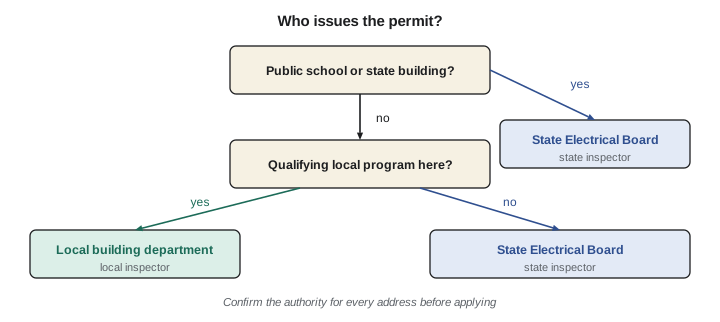
| Job | Permit from | Inspector |
|---|---|---|
| House in a city with a qualifying program | City building department | City electrical inspector |
| Ranch shop in an unincorporated area the state covers | State Electrical Board | State electrical inspector |
| Public school remodel anywhere in the state | State Electrical Board | State electrical inspector |
| State office building | State Electrical Board | State electrical inspector |
| Homeowner work on own home | Board or local authority, depending on the address | Matching inspector |
Who may apply for a permit
The statute limits who may obtain an electrical permit. A permit may be issued to a master electrician who is a registered electrical contractor, to a master electrician employed by a registered contractor, or to a homeowner for work on the homeowner's own residence. A master electrician who is not a registered contractor and does not work for one cannot pull permits for others. The board's guidance adds that contractors pull permits in their own company name, so the permit ties the job to the registered business and its responsible master.
Before Walt retired, Timberline's permits listed him as the responsible master. After Lucia became the qualifying master for the company, Dana updated the company's online account so that new permits listed her. Permits already open under Walt stayed valid, but Lucia took responsibility for supervising the remaining work under them.
When a permit is needed
The statute requires a permit before electrical wiring is installed, altered or extended, with limited exceptions such as minor repair work and certain work by utilities and some industrial operations under their own programs. Local programs may have their own lists of exempt work under their adopted codes. A master electrician treats the requirement conservatively: if new wiring is installed, a circuit is extended or equipment is added, the job needs a permit unless a written exemption clearly applies.
Starting work before the permit is issued is a violation that can lead to fines and discipline, and it creates practical problems. An inspector who arrives after the walls are closed may require them to be opened. A homeowner who later sells the house may have to disclose or correct unpermitted work. On the Berthoud job, Lucia applied for one permit that covered the new circuits and the corrections to the existing subpanel, and she photographed the original condition before starting.
Homeowner permits
A homeowner may obtain a permit for electrical work on the home the homeowner owns and lives in. According to the board's guidance, the homeowner must personally perform the work, the property must not be intended for sale, rent or public use, and the work must be inspected before it is covered and again at final. Homeowners may obtain permits from the board for state-inspected addresses or from the local authority where a local program applies. A homeowner permit is not a way for an unlicensed worker to do work for hire; anyone the homeowner pays to do electrical work must be properly licensed and working for a registered contractor.
Requesting and scheduling state inspections
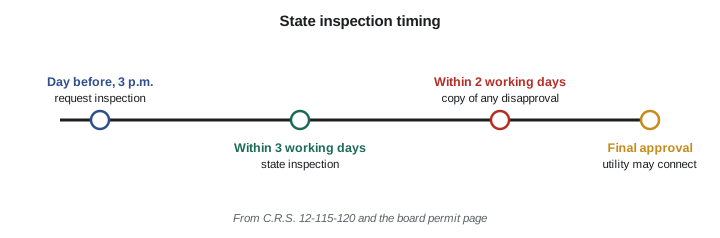
For state-inspected permits, the board's permit page explains the practical steps. A contractor requests an inspection by 3 p.m. the day before; inspections are usually scheduled within three days; and the site must be accessible during the inspection window, generally 8 a.m. to 5 p.m. The statute requires the state inspector to inspect within three working days after the request, and if the work is disapproved, to provide a copy of the disapproval within two working days.
A typical residential or light commercial job has at least two inspections: a rough-in inspection before walls and ceilings are covered and a final inspection when the work is complete. Larger jobs often have additional stages, such as underground or slab inspections before concrete is placed, service inspections before the utility connects, and partial inspections of individual floors or areas. The master electrician plans these stages into the construction schedule so that other trades do not cover work that has not been inspected.
# Counting working days for a state inspection (study aid)
from datetime import date, timedelta

def add_working_days(start, n):
    d = start
    while n > 0:
        d += timedelta(days=1)
        if d.weekday() < 5:   # Monday to Friday; holidays ignored in this sketch
            n -= 1
    return d

requested = date(2026, 6, 12)   # a Friday
latest = add_working_days(requested, 3)
NAMES = ["Monday", "Tuesday", "Wednesday", "Thursday", "Friday", "Saturday", "Sunday"]
print("Request made:", requested.isoformat(), NAMES[requested.weekday()])
print("Inspect by: ", latest.isoformat(), NAMES[latest.weekday()])Request made: 2026-06-12 Friday Inspect by: 2026-06-17 Wednesday
The calculation shows why a Friday request leads to an inspection deadline the following Wednesday. Holidays and weather can change real schedules, so the aid ignores them only for illustration.
Permit life, extensions and transfers
Under the statute, a permit is valid for 12 months. For substantial projects, the board may allow up to three years, and a permit holder may obtain a six-month extension if the board is notified before the permit expires. A permit that expires is not revived; the contractor must obtain a new permit to continue. The board's guidance adds a few practical rules for state permits: online permits are valid for one year, refunds may be requested within six months if no inspections have been performed, one six-month extension may be requested by calling before expiry, and a permit may be transferred to another address only if the fee is the same and no inspection has occurred. Permits cannot be transferred between contractors.
The no-transfer rule matters when a contractor leaves a job. If a homeowner fires one contractor and hires another, the new contractor obtains its own permit for the remaining work, and the inspector may need to see work installed under the earlier permit before accepting it. A master electrician taking over another company's job documents what was already installed before starting.
Disapprovals and corrections
When an inspector disapproves work, the inspector identifies the deficiencies and the contractor corrects them and requests reinspection. The statute requires the state inspector to provide a copy of any disapproval within two working days after the inspection. A contractor who disagrees with a disapproval can raise the issue with the inspector's supervisor and, if necessary, appeal to the board. The statute provides for a hearing on an appeal within seven days.
Most disapprovals are routine and are resolved by correcting the work. A master electrician reads each correction notice carefully, assigns the correction, confirms it was done and keeps the notice in the job file. Patterns in disapprovals are a training signal: if three crews miss the same item in a month, Lucia adds it to the next lunch-and-learn.
Utility connection and final approval
A utility may not connect electrical service to a new installation until the inspection authority has given final approval, except in an emergency for up to seven days, as the statute provides. In practice, the inspector notifies the utility of the approval or releases the job in the utility's system. Contractors coordinate service dates with the utility and the inspector so that the release arrives before the scheduled connection. A builder who wants the power on early for construction can obtain a temporary service permit and inspection rather than asking the utility to connect without approval.
Variances, plan review and special situations
Some jobs need more than a standard permit. In state-inspected areas, code variances require board approval. Larger commercial projects in local jurisdictions often require plan review before a permit issues. Solar and battery systems have their own submittal requirements. Public school projects may involve the school district's own construction managers and the state inspector. The master electrician identifies these requirements early, ideally during bidding, because they can add weeks to the schedule.
Getting ready for an inspection
An inspection goes faster when the inspector can see everything without hunting for it. Before calling in a rough-in, Lucia's crew leads walk the job with a short checklist. The permit card is posted where the inspector expects it. Every box is accessible and its conductors are made up or neatly folded so that grounding connections can be seen. Cables are supported and protected where they pass through framing. Panel locations, circuit routes and any equipment that is not yet installed are marked on the plans left on site. Ladders and lighting are available in attics and crawl spaces. Someone who knows the job is on site or reachable by phone.
At final, the checklist changes. Covers and trims are installed, panel directories are filled in, equipment labels required by the code are in place, and devices have been tested. Ground-fault and arc-fault protection has been checked where required. Any special systems, such as generators, solar or electric vehicle chargers, have their documentation on site. A job that is ready on the first visit saves the inspector a return trip and saves the contractor a day.
Working with inspectors
Inspectors and contractors share a goal: a safe installation that complies with the adopted code. A master electrician builds a professional relationship with the inspectors in the areas where the company works. That means calling with questions before work is installed rather than after, accepting correction notices without argument when they are right, and explaining a position calmly, with code references, when the contractor believes a correction is mistaken. Inspectors remember contractors whose jobs are ready, whose crews are licensed and supervised and whose corrections are done promptly.
When a disagreement cannot be resolved on site, the master electrician asks the inspector to put the finding in writing and then follows the appeal path. For state inspections that starts with the inspector's supervisor and then the board; for local inspections it starts with the chief electrical inspector or building official and then the local appeals board. Keeping the discussion professional matters, because the same inspector will see the company's next job.
Job records
A permit file is a business record. Timberline's file for each job holds the permit, the plans, every inspection result and correction notice, photos of work before it was covered, load calculations and equipment data sheets. When a homeowner calls years later about a breaker, or a buyer's inspector asks whether a subpanel was permitted, the file answers the question. Records also protect the master electrician whose license is on the permit, because they show what was installed, who supervised it and when it was approved.
Compliance checks
Board inspectors also perform compliance checks under C.R.S. 12-115-119, visiting job sites to confirm that workers are licensed, that apprentices are registered and properly supervised and that permits are in place. A compliance check can happen on any site, and a contractor whose crews cannot show licenses or registration can face citations. Lucia keeps a folder in each truck with copies of licenses, apprentice registration cards and the permit, so that a crew lead can answer a compliance check without calling the office.
Worked problem
The Berthoud basement
A homeowner hires Timberline to add circuits in a basement with an unpermitted subpanel. The address is inside a town with its own qualifying inspection program. What should Lucia do before starting?
Show solution
- Confirm the inspection authority for the address; here, the town's building department.
- Apply for a permit in Timberline's name, listing Lucia as the responsible master, covering the new circuits and corrections to the existing panel.
- Document the existing condition with photos before any work.
- Wait for the permit to be issued, then start work.
- Schedule a rough-in inspection before the walls are closed and a final inspection at completion.
Answer: Lucia pulls a town permit in the company's name before work, corrects the existing panel under that permit and schedules rough-in and final inspections.
Common mistakes
MistakePulling a state permit for a job in a city with its own program.
InsteadWhere a qualifying local program exists, the local building department issues the permit.
MistakeHaving the school remodel inspected by the city.
InsteadPublic school work is always permitted and inspected by the state.
MistakeLetting a homeowner permit cover work by a hired unlicensed worker.
InsteadHomeowner permits require the owner to personally do the work.
MistakeTransferring a permit to the next contractor on the job.
InsteadPermits cannot be transferred between contractors; the new contractor pulls its own.
MistakeLetting a permit lapse and continuing under it.
InsteadAn expired permit must be replaced with a new one; request any extension before expiry.
Summary and key terms
- Local programs meeting the board's minimum inspect in their areas; the state inspects elsewhere and always inspects public schools and state buildings.
- Permits go to a master who is a registered contractor, a master employed by one, or a homeowner on the owner's own residence.
- A permit is required before work starts.
- State inspectors inspect within three working days after a request and provide any disapproval copy within two working days.
- Permits last 12 months, with board-allowed longer terms for substantial work and a six-month extension if requested before expiry.
- Utilities connect only after final approval, except in limited emergencies.
- Inspection authority
- The agency, state or local, that issues permits and inspects work at an address.
- Rough-in inspection
- An inspection of wiring before it is covered by walls or ceilings.
- Final inspection
- The inspection of completed work before approval.
- Disapproval
- An inspector's written finding that work does not comply.
- Compliance check
- A board inspector's site visit to confirm licensing, apprentice supervision and permits.
Practice problems
Work each problem on paper first, then reveal the answer to check.
Who inspects a public school remodel in a city with its own inspection program?
Show answer
The state electrical inspector.
Within how many working days must a state inspector inspect after a request?
Show answer
Three working days.
Can a permit be transferred from one contractor to another?
Show answer
No; the new contractor obtains its own permit.
How long is a standard permit valid under the statute?
Show answer
12 months.
Lesson quiz · 5 questions
Score 60% or more to complete this lesson.
Create a free account to save your progress, take quizzes and earn a certificate.