
MELU-102 · Lesson 9 of 12 · 26 min
Feeder and service sizing
▶ Video coming soon A video version of this lesson is on the way.
A load calculation produces a number of volt-amperes, which becomes a number of amperes. An inspector, though, does not inspect amperes on paper. Gloria Haynes inspects a breaker, a set of conductors, their terminations and the equipment they connect to. The last step of every Article 220 question is turning a calculated load into those physical choices. This lesson follows Delgado Fabrication's service upgrade from its calculated load to the service rating, then works the same chain for the Lakeview Outfitters tenant feeder, and covers the code rules that connect the two: 215.2 and 230.42 for feeder and service conductors, 240.4 and 240.6 for overcurrent protection, 110.14(C) for terminal temperatures, and the adjustment and correction factors that can push a conductor size up.
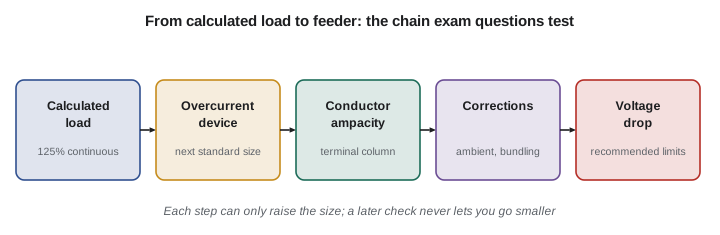
The minimum rating of a feeder or service
Sections 215.2(A) and 230.42(A) set the minimum size of feeder and service conductors, and 215.3 and 230.90 cover their overcurrent protection. The arithmetic is the same as for branch circuits: the conductors and the overcurrent device must be rated for the noncontinuous load plus 125% of the continuous load, unless the assembly is listed for operation at 100% of its rating. Motor loads add 25% of the largest motor's full-load current under 430.24. If you applied the 125% factor while building the load calculation, as Lessons 7 and 8 did, do not apply it a second time.
Delgado Fabrication's calculated load
Delgado Fabrication is a 9,000 square foot machine shop served at 480Y/277 volts, three phase. Its existing 200-ampere service trips on hot afternoons when the air compressor, both CNC lathes and the heat-treating oven run together. Owner Luis Delgado plans to add a third CNC machine next year. Dana gathered the loads.
| Load | Connection | Rating or current |
|---|---|---|
| High-bay LED lighting (continuous) | 277 V | 14,000 VA |
| Heat-treating oven (continuous) | 480 V three phase | 30 kW |
| Air compressor motor | 480 V three phase | 34 A full-load current |
| Three CNC machines | 480 V three phase | 21 A each |
| Dust collector motor | 480 V three phase | 14 A |
| Office transformer, 45 kVA (calculated secondary load) | 480 V primary | 30,000 VA |
The motor currents in a real calculation come from the full-load current tables in Article 430, not from nameplates, which MELU-105 covers. Here they are given.
Worked problem
The shop's calculated load in amperes
Find the service load at 480 V three phase.
Show solution
- Lighting: 14,000 × 1.25 = 17,500 VA; 17,500 ÷ 831.4 = 21.05 A.
- Oven: 30,000 × 1.25 = 37,500 VA; 37,500 ÷ 831.4 = 45.10 A.
- Motors: 34 + 3 × 21 + 14 = 111 A, plus 25% of the largest, 0.25 × 34 = 8.5 A, for 119.5 A.
- Office transformer: 30,000 ÷ 831.4 = 36.08 A.
- Total: 21.05 + 45.10 + 119.5 + 36.08 = 221.7 A.
Answer: About 222 A.
The transformer line deserves a comment. A transformer is not a load in itself; it passes on the load of what it serves, plus a little loss. Using the calculated load of the panel on its secondary is the usual approach. Some designers instead use the transformer's full rating, which here would be 45,000 ÷ 831.4 = 54.1 A, to leave room for the office to grow. The exam will tell you which to use.
Luis also wants room for a fourth CNC machine and a second oven within five years. Ray adds them as a planned future load of 120 A, bringing the design load to about 342 A. The next standard overcurrent device rating above that is 350 A, which would satisfy the code. Service equipment is far more commonly built at 400 A, though, and the larger size leaves margin for growth Luis has not planned yet, so Ray chooses a 400 A service. On an exam that asks for the minimum standard rating, the answer would be 350 A.
Choosing the overcurrent device
Section 240.6(A) lists the standard ampere ratings of fuses and inverse-time circuit breakers. Above 100 A the steps grow: 110, 125, 150, 175, 200, 225, 250, 300, 350, 400, 450, 500 and so on. Section 240.4 requires conductors to be protected at their ampacity, but 240.4(B) lets you use the next higher standard device rating when the conductor's ampacity does not match a standard rating, provided the device is rated 800 A or less and the conductors are not part of a multiwire branch circuit serving receptacles for cord-and-plug equipment. Above 800 A, 240.4(C) requires the conductor ampacity to be at least the device rating.
Worked problem
Rounding up under 240.4(B)
A feeder's calculated load is 342 A, and the conductors Dana selects have an ampacity of 380 A at the terminal temperature rating. May she protect them with a 400 A breaker?
Show solution
- The load (342 A) is within the conductors' ampacity (380 A).
- 380 A is not a standard rating; the next higher standard rating is 400 A.
- 400 A is not over 800 A and the feeder is not a receptacle multiwire branch circuit, so 240.4(B) permits a 400 A breaker.
Answer: Yes, a 400 A breaker is permitted.
The reverse question is just as common: given a 400 A breaker, what minimum conductor ampacity is acceptable? Under 240.4(B), any conductor whose ampacity is above 350 A, the next standard size below 400, and at least the calculated load, can be protected at 400 A. Many candidates miss this and pick a conductor with a full 400 A ampacity, which is acceptable but not the minimum.
Terminal temperatures
Section 110.14(C) limits the conductor temperature rating you may use for ampacity to the lowest temperature rating of any connected termination, conductor or device. For circuits rated 100 A or less, or marked for conductors 14 through 1 AWG, terminations are assumed to be rated 60°C unless the equipment is listed and marked otherwise. For circuits over 100 A, or conductors larger than 1 AWG, terminations are assumed to be 75°C. A conductor with 90°C insulation may be used, but its ampacity for the circuit must be read from the 60°C or 75°C column, as the terminations require. The 90°C value is useful only as the starting point for derating, as the next section shows.
For Delgado Fabrication's 400 A service, the terminations are 75°C, so Dana reads the conductor ampacity from the 75°C column of Table 310.16 for the material and size she chooses, or uses parallel sets of smaller conductors, which 310.10(G) permits for sizes 1/0 AWG and larger.
Correction and adjustment factors
Two conditions reduce a conductor's ampacity below its table value. If the ambient temperature is above the table's basis of 30°C, a correction factor from 310.15(B) applies. If more than three current-carrying conductors share a raceway or cable for more than 24 inches, an adjustment factor from 310.15(C) applies. When both apply, multiply. You may start from the 90°C column for this derating when the conductor is rated 90°C, but the final result may not exceed the ampacity in the column that the terminations require.
Worked problem
A derated feeder
A tenant feeder uses conductors whose 90°C table ampacity is 130 A and whose 75°C ampacity is 115 A. They run through a hot ceiling space where this example's correction factor is 0.82, with no more than three current-carrying conductors. What ampacity may Dana use?
Show solution
- Derated from the 90°C column: 130 × 0.82 = 106.6 A.
- Terminal limit: the 75°C ampacity, 115 A.
- Use the smaller: 106.6 A.
Answer: 106.6 A.
The order matters. Correct from the column of the conductor's insulation rating, then compare with the column the terminations allow, and use the smaller. Exam questions that give both a 90°C conductor and a derating factor are almost always testing this comparison.
The Lakeview Outfitters feeder
Back at Harlow Commons, the store's calculated load was 95.8 A, already including the 125% factor for its continuous lighting, show window and sign. The landlord's existing tenant feeder has a 100 A breaker.
Worked problem
Is the existing tenant feeder adequate?
The feeder conductors have a 60°C ampacity of 95 A and a 75°C ampacity of 115 A, and the breaker and panel terminals are listed and marked for 75°C. Is the 100 A feeder adequate for the 95.8 A calculated load?
Show solution
- The circuit is 100 A or less, so terminations are 60°C unless listed and marked otherwise. Here they are marked 75°C, so the 75°C ampacity of 115 A may be used.
- 115 A is at least the 95.8 A calculated load and at least the 100 A breaker rating.
- Had the terminations been unmarked, the 60°C ampacity of 95 A would be less than the 95.8 A load, and the feeder would not be adequate.
Answer: Yes, but only because the terminations are marked for 75°C.
That example shows why a field electrician cannot answer the landlord's question from the load calculation alone. The same conductors pass or fail depending on a marking on the breaker.
import math
STANDARD = [100, 110, 125, 150, 175, 200, 225, 250, 300, 350, 400, 450, 500, 600, 700, 800]

def amps_3ph(va, v=480):
    return va / (v * math.sqrt(3))

lighting = amps_3ph(14000 * 1.25)
oven = amps_3ph(30000 * 1.25)
motors = 34 + 3 * 21 + 14 + 0.25 * 34
office = amps_3ph(30000)
calc = lighting + oven + motors + office
design = calc + 120
print("Calculated:", round(calc, 1), "A; with future load:", round(design, 1), "A")
print("Minimum standard rating:", next(s for s in STANDARD if s >= design), "A")
print("Derated tenant feeder:", round(min(130 * 0.82, 115), 1), "A")Calculated: 221.7 A; with future load: 341.7 A Minimum standard rating: 350 A Derated tenant feeder: 106.6 A
Services, feeders and the 83% rule
One more rule applies only to dwellings. Section 310.12 lets the service or main feeder conductors of a single dwelling unit, at 120/240 volts single phase or 208Y/120 volts, be sized at 83% of the service or feeder rating. The rule reflects the low diversity-adjusted demand of a house. It does not apply to commercial services, to multifamily building services, or to feeders that do not carry the entire load of the dwelling. Delgado Fabrication's service gets no such reduction.
Putting the chain to work on an exam
Exam questions about feeders rarely ask you to do every step at once. One question might give the calculated load and ask for the minimum standard overcurrent device. The next might give the device and the conductor material and ask for the minimum conductor, which needs the terminal column and possibly 240.4(B). A third might add an ambient temperature or a crowded raceway and ask for the ampacity after derating. Reading the question's final sentence first tells you where in the chain to stop, and starting from the beginning of the chain every time keeps you from skipping a step that the question quietly depends on.
Two habits help. First, carry the continuous and noncontinuous parts of the load separately until the very end, so that you can apply the 125% factor exactly once. Second, when a question involves both a 90°C conductor and a derating factor, write all three numbers, the 90°C table value, the derated value and the terminal-column value, and circle the smallest. Ray says he has watched more candidates lose points to that comparison than to any formula in Article 220.
Common mistakes
MistakeApplying the 125% continuous load factor twice, once in the load calculation and again for the feeder.
InsteadApply it once: either while building the load or when sizing the feeder, not both.
MistakeChoosing a conductor with an ampacity equal to the breaker when 240.4(B) allows a smaller one.
InsteadA conductor above the next lower standard rating, and at least the load, may be protected at the next higher standard size up to 800 A.
MistakeReading ampacity from the 90°C column for a circuit with 75°C terminations.
InsteadUse the terminal temperature column for the final ampacity; the 90°C column is only a starting point for derating.
MistakeApplying 240.4(B) to a 1,000 A feeder.
InsteadAbove 800 A, the conductor ampacity must be at least the device rating.
MistakeUsing the 83% rule for a commercial or multifamily service.
InsteadIt applies only to a single dwelling unit's service or main feeder.
Summary and key terms
- Feeder and service conductors and devices must carry the noncontinuous load plus 125% of the continuous load, plus 25% of the largest motor.
- Standard device ratings are listed in 240.6(A); 240.4(B) allows the next higher standard rating up to 800 A when the conductor ampacity is not a standard size.
- Terminations limit the usable ampacity: 60°C for 100 A or less and small conductors unless marked otherwise, 75°C above 100 A.
- Correction for ambient temperature and adjustment for more than three current-carrying conductors are multiplied, starting from the insulation's column.
- The final ampacity is the smaller of the derated value and the terminal-column value.
- Only a single dwelling's service or main feeder may use the 83% rule of 310.12.
- Ampacity
- The current a conductor can carry continuously under its conditions of use without exceeding its temperature rating.
- Overcurrent device
- A fuse or circuit breaker that opens a circuit on overload or fault.
- Terminal temperature rating
- The maximum conductor temperature a termination is listed for, which limits the usable ampacity column.
- Correction factor
- A multiplier that reduces ampacity for ambient temperatures above the table basis.
- Adjustment factor
- A multiplier that reduces ampacity when more than three current-carrying conductors are grouped.
- Parallel conductors
- Two or more conductors connected together at each end to act as one, permitted at 1/0 AWG and larger.
Practice problems
Work each problem on paper first, then reveal the answer to check.
A feeder has 120 A of continuous load and 50 A of noncontinuous load. What minimum rating is required?
Show answer
50 + 150 = 200 A.
A calculated load is 265 A. What is the next standard device rating?
Show answer
300 A.
Conductors have an ampacity of 335 A. What is the largest device 240.4(B) permits?
Show answer
350 A, the next higher standard rating.
A conductor's 90°C ampacity is 150 A and its 75°C ampacity is 130 A. With a factor of 0.8, what ampacity applies?
Show answer
150 × 0.8 = 120 A, less than 130 A, so 120 A.
Find the current of a 250 kVA load at 480Y/277 V three phase.
Show answer
250,000 ÷ 831.4 = 300.7 A.
Lesson quiz · 5 questions
Score 60% or more to complete this lesson.
Create a free account to save your progress, take quizzes and earn a certificate.