
MELU-102 · Lesson 7 of 12 · 29 min
Commercial occupancy calculations
▶ Video coming soon A video version of this lesson is on the way.
Harlow Commons has six units. The Copper Kettle takes the end unit, and the unit next door is becoming Lakeview Outfitters, a 3,000 square foot outdoor-gear store with a 20-foot show window, a lighted sign over the door and one rooftop heating and cooling unit. The landlord's panel serves each tenant at 208Y/120 volts, three phase. Priya needs a load calculation for the permit and for the landlord, who wants to know whether the existing 100-ampere tenant feeder is enough. Commercial calculations look different from dwelling calculations, but they are built from the same pieces: unit loads, outlet loads, continuous load factors and a few demand factors that apply only in specific situations.
This lesson works through a nondwelling feeder calculation: general lighting from Table 220.12, the 125% factor for continuous lighting, receptacle loads and the demand factor in 220.44, show windows, signs and multioutlet assemblies, the special receptacle rule for offices and banks, and motor loads.
General lighting for nondwelling occupancies
Table 220.12 lists a unit load in volt-amperes per square foot for many occupancy types: offices, retail stores, restaurants, schools, warehouses, hospitals, hotels and so on. The general lighting load is the floor area times that unit load. The 2023 edition also allows, under conditions in 220.12(B), the use of an energy code's lighting power density in place of the table value where the building is designed and monitored to that code; exam questions that intend this will say so.
General lighting in a store or office is a continuous load, because it runs for three hours or more. For a feeder or service, 215.2(A) and 230.42(A) require the conductors and overcurrent devices to carry the noncontinuous load plus 125% of the continuous load, the same arithmetic you met for branch circuits in Lesson 3. In this course's examples, the general lighting of a commercial occupancy is therefore multiplied by 1.25.
Worked problem
Lighting for Lakeview Outfitters
Using 1.9 VA per square foot as this example's unit load for a retail store (check Table 220.12), find the store's general lighting load for the feeder.
Show solution
- Lighting: 3,000 × 1.9 = 5,700 VA.
- Continuous: 5,700 × 1.25 = 7,125 VA.
Answer: 7,125 VA.
Unlike dwelling lighting, nondwelling general lighting usually gets no demand factor. Table 220.42 lists demand factors for a few occupancies with large lighting loads that never all run at once, such as hospitals, hotels and warehouses, but stores, offices and restaurants take their lighting at 100% before the continuous factor.
Receptacle loads and the 220.44 demand factor
Receptacles in a nondwelling occupancy are counted at 180 VA per yoke under 220.14(I), as in Lesson 3. When you total them for a feeder, 220.44 lets you apply a demand factor: the first 10 kVA of receptacle load at 100% and the remainder at 50%. The factor applies only to general-use receptacles counted under 220.14(H) and (I), not to receptacles for specific appliances.
Worked problem
Receptacles at Lakeview Outfitters
The store has 60 general-use duplex receptacles. Find the receptacle demand load.
Show solution
- Connected: 60 × 180 = 10,800 VA.
- Demand: 10,000 + 0.50 × 800 = 10,400 VA.
Answer: 10,400 VA.
Receptacle loads are not continuous by default, so they do not get the 125% factor unless the question says they serve continuous equipment.
Show windows, signs and multioutlet assemblies
Several kinds of outlet have their own load values. For a feeder, a show window is calculated at 200 VA per linear foot of window, measured horizontally along its base, under 220.14(G) and 220.43(A). Show window lighting typically runs into the evening and is treated as continuous in this course's examples. Each commercial building and occupancy accessible to pedestrians must have at least one sign outlet under 600.5, and 220.14(F) counts it at no less than 1,200 VA; sign lighting is also a continuous load. Multioutlet assemblies, the plug strips mounted along benches and counters, are counted under 220.14(H) at 180 VA for each 5 feet, or for each foot where appliances are likely to be used at the same time, as on a workbench with soldering irons.
Worked problem
Show window and sign
Lakeview Outfitters has 20 ft of show window and one sign outlet. Find their feeder loads.
Show solution
- Show window: 20 × 200 = 4,000 VA; continuous, so 4,000 × 1.25 = 5,000 VA.
- Sign: 1,200 VA minimum; continuous, so 1,200 × 1.25 = 1,500 VA.
Answer: 5,000 VA and 1,500 VA.
Worked problem
A multioutlet assembly in a repair shop
Lakeview Outfitters' back room has a 30 ft workbench with a multioutlet assembly where staff repair gear and run soldering irons and heat guns at the same time. Find its load. Then find it again for a 30 ft assembly along a display wall where appliances are not used together.
Show solution
- Workbench, appliances used at the same time: 180 VA for each foot: 30 × 180 = 5,400 VA.
- Display wall: 180 VA for each 5 ft: 30 ÷ 5 = 6 sections; 6 × 180 = 1,080 VA.
- Both count as receptacle load for the 220.44 demand factor.
Answer: 5,400 VA for the workbench and 1,080 VA for the display wall.
The difference between the two answers is a factor of five, and it rests entirely on how the space will be used. Exam questions make the use explicit; in the field, Dana asks the tenant before she designs the circuits.
Offices and banks
Section 220.14(K) has a rule for banks and office buildings. Their receptacle load is the larger of two values: the receptacles counted at 180 VA each (or the actual load), or 1 VA per square foot of floor area. The rule exists because offices are often fitted out after the electrical design is done, and a minimum based on area guarantees capacity for the computers and printers that arrive later.
Worked problem
Receptacles in a small office
An insurance office on the second floor of a Harlow building is 4,000 sq ft and has 30 duplex receptacles. Find its receptacle load before the 220.44 demand factor.
Show solution
- By count: 30 × 180 = 5,400 VA.
- By area: 4,000 × 1 = 4,000 VA.
- Use the larger: 5,400 VA. It is under 10 kVA, so 220.44 does not reduce it.
Answer: 5,400 VA.
Motors and HVAC equipment
Motor loads on a feeder follow 430.24: the sum of the full-load currents of all the motors plus 25% of the largest motor's full-load current, plus the other loads. For packaged heating and cooling equipment, the nameplate minimum circuit ampacity already includes the 25% for its own largest motor. In this lesson's example the rooftop unit's nameplate load is given in volt-amperes with the compressor identified as its largest motor, and the 25% is added for the feeder. MELU-105 covers motor feeders in detail.
Worked problem
The rooftop unit
The store's rooftop unit draws 9,000 VA in total at 208 V three phase, of which the compressor, its largest motor, is 6,000 VA. Find its feeder load.
Show solution
- Add 25% of the largest motor: 9,000 + 0.25 × 6,000 = 9,000 + 1,500 = 10,500 VA.
Answer: 10,500 VA.
Heating and cooling are noncoincident in commercial buildings too, under 220.60. If the store had separate electric heat that could not run with the cooling, only the larger would be counted.
Putting the store together
| Item | Rule | Feeder load (VA) |
|---|---|---|
| General lighting, 3,000 sq ft | Table 220.12 × 1.25 | 7,125 |
| Receptacles, 60 | 220.14(I), 220.44 | 10,400 |
| Show window, 20 ft | 220.14(G) × 1.25 | 5,000 |
| Sign outlet | 220.14(F), 600.5 × 1.25 | 1,500 |
| Rooftop unit | 430.24, 25% of largest motor | 10,500 |
| Total | 34,525 |
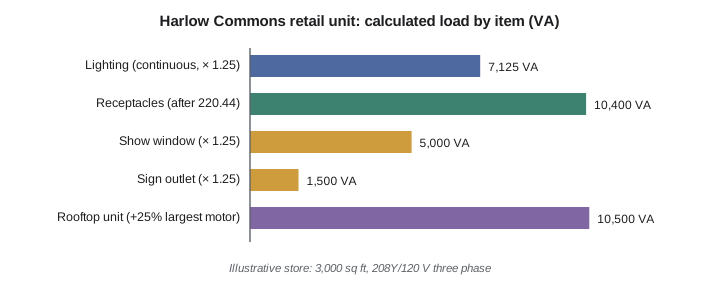
At 95.8 amperes, the calculated load fits under the existing 100-ampere tenant feeder, but only just. Before telling the landlord the feeder is adequate, Dana checks that the feeder conductors' ampacity, the breaker and the terminal temperature ratings all support 100 amperes, which is the subject of Lesson 9. She also notes that the store has no spare capacity for a second rooftop unit or a heated sign upgrade, which the tenant mentioned might come later.
import math

def commercial_feeder(sqft, unit_va, receptacles, show_ft, signs, hvac_va, largest_motor_va):
    lighting = sqft * unit_va * 1.25
    rec = receptacles * 180
    rec_d = min(rec, 10000) + 0.5 * max(rec - 10000, 0)
    window = show_ft * 200 * 1.25
    sign = signs * 1200 * 1.25
    hvac = hvac_va + 0.25 * largest_motor_va
    return lighting + rec_d + window + sign + hvac

va = commercial_feeder(3000, 1.9, 60, 20, 1, 9000, 6000)
print("Store feeder:", va, "VA =", round(va / (208 * math.sqrt(3)), 1), "A at 208 V three phase")Store feeder: 34525.0 VA = 95.8 A at 208 V three phase
Other nondwelling occupancies
The same pattern extends to almost any commercial building. A warehouse has a low lighting unit load and may qualify for a demand factor on lighting in Table 220.42. A hotel's guest rooms have their own lighting value and lighting demand factors, and their receptacles are included in the lighting load the way a dwelling's are. A hospital's lighting gets a demand factor too, but its feeders and essential electrical system have additional rules in Article 517. Schools and restaurants have optional methods of their own, covered in the next lesson. When an exam describes an occupancy you have not practiced, find its line in Table 220.12, look for it in Table 220.42, and check whether 220.14 has a special rule for its outlets.
Reading the occupancy correctly
The single most important choice in a commercial calculation is the occupancy type, because it sets the unit load. A space described as a clothing store uses the retail value; a space described as a doctor's office uses the office value, and also brings in the 220.14(K) receptacle rule; a self-storage building uses the storage or warehouse value. Exam writers sometimes describe a mixed space, such as a store with an office in the back, and expect you to calculate each area with its own unit load. When the question gives only a total floor area and one occupancy type, use that type for the whole area.
A second choice is whether a load is continuous. The definition turns on whether the maximum current is expected to continue for three hours or more, which depends on how the space is used, not just on the type of equipment. Office lighting during business hours is continuous; a storage room light switched on for a few minutes is not, but it is part of the general lighting load anyway, and general lighting in a commercial occupancy is treated as continuous as a whole. Receptacles become continuous only when they serve equipment that runs for hours, such as a bank of point-of-sale terminals that never turn off. Unless the question tells you that, leave receptacles at 100%.
Last, remember that the feeder calculation in this lesson gives a minimum load. The tenant feeder must also be checked against the conductors' terminal temperature ratings, voltage drop on a long run and any spare capacity the owner wants, and those checks often push the feeder to a larger size than the calculation alone would require.
The tenant feeder question also has a business side that the exam does not ask about. A landlord who leases space to restaurants, gyms or clinics needs far more capacity than one who leases to clothing stores, and a feeder sized exactly to one tenant's calculation may be too small for the next. Ray's habit with landlords is to show them both numbers: the calculated minimum for the tenant in hand, and the capacity the space would need for the most demanding tenant it is likely to attract.
Common mistakes
MistakeApplying the 220.44 receptacle demand factor to lighting or to appliance receptacles.
InsteadIt applies only to general-use receptacle loads counted under 220.14(H) and (I).
MistakeForgetting the 125% factor on commercial general lighting for the feeder.
InsteadGeneral lighting in a store or office is continuous: noncontinuous load plus 125% of continuous load.
MistakeCounting a show window at 180 VA per outlet.
InsteadShow windows are 200 VA per linear foot of window for the feeder.
MistakeLeaving out the required sign outlet.
InsteadCount at least 1,200 VA for each required sign outlet (220.14(F), 600.5).
MistakeUsing only the receptacle count in an office building.
InsteadUse the larger of the count at 180 VA or 1 VA per square foot (220.14(K)).
Summary and key terms
- Nondwelling general lighting is floor area times the Table 220.12 unit load, taken at 125% for the feeder because it is continuous.
- General-use receptacles count at 180 VA per yoke; for a feeder, 220.44 takes the first 10 kVA at 100% and the remainder at 50%.
- Show windows count at 200 VA per linear foot; each required sign outlet counts at no less than 1,200 VA.
- Offices and banks take the larger of the receptacle count at 180 VA or 1 VA per square foot.
- Motor feeders add 25% of the largest motor's full-load current under 430.24.
- Three-phase commercial loads are divided by the line-to-line voltage times 1.732.
- Unit load
- A load in volt-amperes per square foot assigned to an occupancy type in Table 220.12.
- Show window
- A window used to display goods, usually lit, calculated per linear foot.
- Multioutlet assembly
- A surface or flush raceway with receptacles along its length.
- Sign outlet
- An outlet required at an accessible entrance of a commercial occupancy to supply a sign.
- Lighting power density
- An energy code's allowance for lighting in watts per square foot.
- Tenant feeder
- A feeder from a landlord's distribution equipment to one tenant's panel.
Practice problems
Work each problem on paper first, then reveal the answer to check.
A 5,000 sq ft office uses 1.3 VA per sq ft for lighting. Find the feeder lighting load.
Show answer
6,500 × 1.25 = 8,125 VA.
A store has 90 receptacles. Find the receptacle demand load.
Show answer
16,200 VA; 10,000 + 0.50 × 6,200 = 13,100 VA.
A store has a 32 ft show window. Find its feeder load if continuous.
Show answer
32 × 200 × 1.25 = 8,000 VA.
An 8,000 sq ft bank has 40 receptacles. What receptacle load applies before 220.44?
Show answer
Larger of 7,200 VA or 8,000 VA: 8,000 VA.
A commercial feeder load is 54,000 VA at 208Y/120 V. Find the current.
Show answer
54,000 ÷ 360.3 = 149.9 A.
Lesson quiz · 5 questions
Score 60% or more to complete this lesson.
Create a free account to save your progress, take quizzes and earn a certificate.