
MELU-102 · Lesson 3 of 12 · 29 min
Branch circuit calculations
▶ Video coming soon A video version of this lesson is on the way.
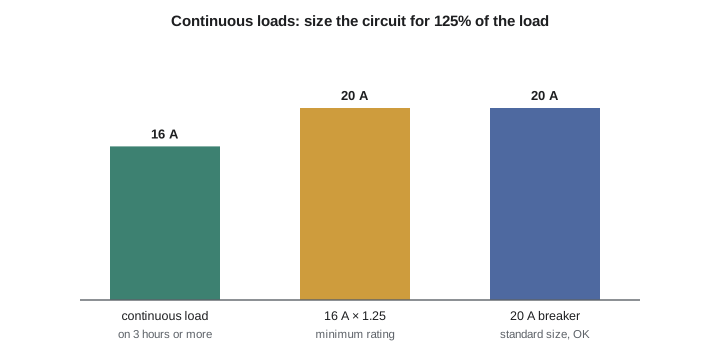
Tyler, Brightwater's second-year apprentice, asked Dana a question on the Copper Kettle job that every master candidate should be able to answer instantly. The dining room's cove lighting is 16 amperes of LED drivers on a 20-ampere breaker. Why does the inspector's checklist flag it as fine, while the walk-in cooler's evaporator heaters, also about 16 amperes, needed a bigger breaker? Dana's answer covered the idea at the heart of this lesson. Both loads draw the same current, but they are not the same kind of load, and the code sizes branch circuits by what the load is and how long it runs, not just by how many amperes it draws.
Before you can calculate a feeder or a service, you need to calculate branch circuits. Article 210 sets the rules for branch circuit ratings and permissible loads, and the first parts of Article 220 tell you how much load to assign to each kind of outlet. This lesson works through continuous loads, the loads Article 220 assigns to receptacles and other outlets, the number of branch circuits a dwelling needs, and the special branch circuit rules for water heaters, space heating and electric vehicle chargers.
Continuous and noncontinuous loads
Article 100 defines a continuous load as one where the maximum current is expected to continue for three hours or more. Store lighting, office lighting, parking lot lighting, electric heat and electric vehicle charging are classic examples. A receptacle that powers a toaster for five minutes is not. The distinction matters because conductors, terminals and overcurrent devices are tested and rated assuming they will not carry their full rating for hours at a time.
Sections 210.19(A) and 210.20(A) give the same basic arithmetic for branch circuit conductors and overcurrent devices. The minimum rating is the noncontinuous load plus 125% of the continuous load. Put another way, a continuous load may use only 80% of a standard breaker's rating. There are exceptions for assemblies and devices listed for operation at 100% of their rating, which are uncommon on branch circuits and almost never the subject of exam questions unless the question says so.
Worked problem
Tyler's two loads
The cove lighting draws 16 A continuously. Size the minimum branch circuit rating. Then do the same for a circuit with 12 A of continuous lighting plus 3 A of noncontinuous receptacle load.
Show solution
- Cove lighting: 16 × 1.25 = 20 A, so a 20 A circuit is adequate.
- Mixed circuit: 3 + (12 × 1.25) = 3 + 15 = 18 A, so a 20 A circuit is adequate.
- If the walk-in evaporator heaters drew 17 A continuously, 17 × 1.25 = 21.25 A would require the next standard size, 25 A, with conductors rated for at least 21.25 A.
Answer: 20 A in both cases.
The standard ampere ratings for fuses and inverse-time breakers are listed in 240.6(A). For branch circuits, the common sizes are 15, 20, 25, 30, 35, 40, 45, 50 and 60 amperes, and the list continues in larger steps above that. When a calculation gives a value between sizes, check whether the rule you are applying lets you round up to the next standard size; Lesson 9 covers 240.4(B), which governs that choice for conductors.
Loads Article 220 assigns to outlets
When an outlet's actual load is not known, Section 220.14 tells you what load to assume. Outlets for specific appliances are calculated at the ampere rating of the appliance or load served. Receptacle outlets in nondwelling occupancies are calculated at 180 VA for each single or multiple receptacle on one yoke, the strap that mounts the device. A duplex receptacle is one yoke and counts as 180 VA, not 360. A device with four or more receptacles on it counts at 90 VA per receptacle. Other outlets not covered elsewhere also count at 180 VA each. Show windows, signs, multioutlet assemblies and heavy-duty lampholders have their own entries in 220.14 that come up in Lesson 7.
In dwellings, the general-use receptacles in living areas are not counted outlet by outlet. They are already included in the general lighting load computed from floor area, which Lesson 4 covers. That is why a house with 60 receptacles does not get 10,800 VA added for them.
Worked problem
How many receptacles on a 20 A circuit?
An office in Harlow Commons needs general-purpose duplex receptacles. How many may Dana put on one 120 V, 20 A circuit when each is counted under 220.14?
Show solution
- Circuit capacity: 20 × 120 = 2,400 VA.
- Each duplex yoke: 180 VA.
- 2,400 ÷ 180 = 13.3, so no more than 13 receptacles.
Answer: 13 receptacle yokes.
Many designers put fewer than the maximum on each circuit, and some local codes set lower limits, but the exam answer is the arithmetic. Note that the receptacle load is not a continuous load by default. If a question tells you that the receptacles serve equipment that will run for three hours or more, apply the 125% factor as well.
Lighting at its actual current
Section 220.18 has a rule that catches people who learned the trade with incandescent lamps. For inductive and LED lighting, the load on a branch circuit is based on the total ampere rating of the luminaires, not on the total wattage of the lamps. A driver or ballast draws more current than the lamp wattage alone suggests, because of its own losses and power factor. On an exam, if a fixture's input current is given, use it.
Worked problem
Counting LED fixtures on a 277 V circuit
The warehouse at Delgado Fabrication uses high-bay LED fixtures that each draw 0.62 A at 277 V. They run 12 hours a day. How many can go on one 20 A, 277 V circuit?
Show solution
- The lighting is continuous, so the load may not exceed 20 ÷ 1.25 = 16 A.
- 16 ÷ 0.62 = 25.8, so no more than 25 fixtures.
- Using lamp watts (say 150 W each, 0.54 A at 277 V) would have suggested 29 fixtures and overloaded the circuit.
Answer: 25 fixtures.
Permissible loads on a branch circuit
Section 210.23 limits what you may connect to a branch circuit of a given rating. On a 15 A or 20 A circuit, a single cord-and-plug connected piece of utilization equipment may not exceed 80% of the circuit rating. Equipment fastened in place, other than luminaires, may not exceed 50% of the circuit rating where the circuit also supplies lighting or cord-and-plug equipment that is not fastened in place. The idea is to leave room for the other loads on the circuit. Larger circuits, 25 A and up, have their own limits on what they may serve, and individual branch circuits may serve any load within their rating.
Worked problem
A fastened-in-place load on a shared circuit
A bathroom exhaust fan with a heater, fastened in place, shares a 20 A circuit with the lights. What is the largest fan-heater the circuit may serve?
Show solution
- 50% of 20 A = 10 A.
- At 120 V, 10 A is 1,200 VA.
Answer: 10 A, or 1,200 VA.
How many circuits a dwelling needs
Section 210.11(A) requires enough branch circuits to supply the calculated load, and 210.11(B) requires the load to be evenly proportioned among them as far as practical. For a dwelling's general lighting and general-use receptacles, the load is the floor area times the unit load from Table 220.12, which for dwelling units is a value in volt-amperes per square foot. The number of circuits is that load divided by the capacity of one circuit.
In addition, 210.11(C) requires specific circuits in every dwelling: at least two 20 A small-appliance branch circuits for the kitchen, pantry, dining and similar areas, at least one 20 A laundry circuit, and at least one 20 A circuit for the bathroom receptacles. Recent editions add a garage circuit requirement as well. These are in addition to the general lighting circuits.
Worked problem
General lighting circuits for a 2,600 sq ft house
Using 3 VA per square foot as the dwelling unit load in this example (check the value in Table 220.12 of your edition), how many 15 A or 20 A, 120 V general lighting circuits does a 2,600 sq ft house need?
Show solution
- Load: 2,600 × 3 = 7,800 VA.
- Current: 7,800 ÷ 120 = 65 A.
- 15 A circuits: 65 ÷ 15 = 4.33, so 5 circuits.
- 20 A circuits: 65 ÷ 20 = 3.25, so 4 circuits.
Answer: Five 15 A circuits or four 20 A circuits, plus the required small-appliance, laundry and bathroom circuits.
The floor area is measured using the outside dimensions of the dwelling, and under 220.5(C) in the 2023 edition it does not include open porches or unfinished spaces that are not adaptable for future use. Garages are also excluded from the dwelling floor area for this calculation. Exam questions sometimes give the dimensions of a house plus a garage and a porch, and the test is whether you leave those out.
Branch circuits with their own sizing rules
Several kinds of equipment have rules in their own articles that tell you to treat them as continuous loads. Section 422.13 treats a fixed storage water heater of 120 gallons or less as a continuous load, so its branch circuit must be rated at least 125% of the nameplate. Section 424.4(B) does the same for fixed electric space heating. Article 625 treats electric vehicle charging as continuous and requires the branch circuit to be sized at 125% of the equipment's maximum load. Exam writers like these because the 125% factor is easy to forget when the question does not use the word continuous.
Worked problem
Water heater and EV charger circuits
Size the minimum branch circuit for a 4,500 W, 240 V storage water heater and for an EV charger set to 48 A continuous.
Show solution
- Water heater current: 4,500 ÷ 240 = 18.75 A. Times 1.25 = 23.4 A, so the next standard breaker is 25 A, with conductors rated at least 23.4 A.
- EV charger: 48 × 1.25 = 60 A, so a 60 A circuit.
Answer: 25 A for the water heater and 60 A for the charger.
| Load | Treat as continuous? | Where the rule is |
|---|---|---|
| Store, office or warehouse lighting | Usually yes (3 hours or more) | Article 100 definition |
| Storage water heater, 120 gal or less | Yes, always | 422.13 |
| Fixed electric space heating | Yes, always | 424.4(B) |
| EV charging equipment | Yes, always | Article 625 |
| General receptacles | Only if the question says so | Article 100 definition |
import math
STANDARD = [15, 20, 25, 30, 35, 40, 45, 50, 60, 70, 80, 90, 100]

def min_rating(noncontinuous, continuous):
    return noncontinuous + 1.25 * continuous

def next_standard(amps):
    return next(s for s in STANDARD if s >= amps)

for name, nc, c in [("Cove lighting", 0, 16), ("Mixed circuit", 3, 12),
                    ("Water heater", 0, 4500 / 240), ("EV charger", 0, 48)]:
    need = min_rating(nc, c)
    print(f"{name}: needs {need:.2f} A, use {next_standard(need)} A")
print("Receptacles on 20 A:", math.floor(20 * 120 / 180))Cove lighting: needs 20.00 A, use 20 A Mixed circuit: needs 18.00 A, use 20 A Water heater: needs 23.44 A, use 25 A EV charger: needs 60.00 A, use 60 A Receptacles on 20 A: 13
Dana's answer to Tyler, then, was this. The cove lights are continuous, 16 A times 1.25 is exactly 20 A, and a 20 A breaker is permitted. The walk-in evaporator heaters were rated slightly higher, 17 A, and electric heating elements in that equipment are treated as continuous, so the 125% factor pushed them past 20 A to a 25 A circuit. The amperes looked the same on paper, but the arithmetic did not.
Common mistakes
MistakeSizing a continuous load at 100% of its current.
InsteadUse the noncontinuous load plus 125% of the continuous load (210.19(A), 210.20(A)).
MistakeCounting a duplex receptacle as two outlets at 180 VA each.
InsteadA single or multiple receptacle on one yoke counts as 180 VA (220.14(I)).
MistakeAdding dwelling general-use receptacles to the load outlet by outlet.
InsteadThey are included in the general lighting load based on floor area.
MistakeUsing lamp wattage for LED or fluorescent fixtures.
InsteadUse the luminaires' ampere rating (220.18).
MistakeIncluding the garage and open porch in the dwelling floor area.
InsteadUse outside dimensions but exclude open porches, garages and unfinished spaces not adaptable for future use.
Summary and key terms
- Continuous loads run three hours or more; branch circuits must be rated for the noncontinuous load plus 125% of the continuous load.
- Nondwelling receptacles count at 180 VA per yoke; a device with four or more receptacles counts at 90 VA per receptacle.
- LED and fluorescent lighting is calculated at the luminaires' ampere rating, not lamp wattage.
- On 15 and 20 A circuits, cord-and-plug equipment may use 80% of the rating, and fastened-in-place equipment sharing the circuit only 50%.
- A dwelling's general lighting circuits are sized from floor area; small-appliance, laundry and bathroom circuits are required in addition.
- Storage water heaters, fixed space heating and EV chargers are treated as continuous by their own articles.
- Continuous load
- A load whose maximum current is expected to continue for three hours or more.
- Yoke (strap)
- The metal frame that mounts a receptacle; one yoke counts as one receptacle outlet for 220.14.
- Branch circuit
- The circuit conductors between the final overcurrent device and the outlets.
- Standard ampere rating
- A fuse or breaker size listed in 240.6(A).
- Small-appliance branch circuit
- A required 20 A circuit serving receptacles in a dwelling's kitchen, dining and similar rooms.
- Fastened in place
- Equipment attached so that it is not readily moved, such as a built-in fan or heater.
Practice problems
Work each problem on paper first, then reveal the answer to check.
A circuit serves 10 A of continuous lighting and 4 A of noncontinuous load. What minimum rating is required?
Show answer
4 + 12.5 = 16.5 A, so a 20 A circuit.
How many duplex receptacles may go on a 15 A, 120 V circuit in an office?
Show answer
1,800 ÷ 180 = 10 receptacles.
A 3,000 sq ft dwelling uses 3 VA per sq ft. How many 20 A general lighting circuits are needed?
Show answer
9,000 ÷ 120 = 75 A; 75 ÷ 20 = 3.75, so 4 circuits.
A 5,500 W, 240 V water heater needs what minimum circuit rating?
Show answer
22.9 A × 1.25 = 28.6 A, so a 30 A circuit.
Fixtures draw 0.75 A each at 277 V and run continuously. How many fit on a 20 A circuit?
Show answer
16 ÷ 0.75 = 21.3, so 21 fixtures.
Lesson quiz · 5 questions
Score 60% or more to complete this lesson.
Create a free account to save your progress, take quizzes and earn a certificate.