
MELU-102 · Lesson 2 of 12 · 28 min
Single-phase and three-phase calculations
▶ Video coming soon A video version of this lesson is on the way.
The Copper Kettle is a 72-seat restaurant going into the end unit of Harlow Commons, a strip mall on the east side of Harlow. Brightwater Electric won the fit-out, and Priya handed Dana the equipment schedule on a Monday morning: a six-burner range, two fryers, a convection oven, a dish machine with a booster heater, a walk-in cooler, a rooftop unit and two dozen LED fixtures. The panel is fed at 208Y/120 volts, three phase, four wire. Dana's first pass at the schedule divided every load by 240 volts out of habit. Ray caught it in thirty seconds. A 208-volt system is not a 240-volt system, and a three-phase load is not a single-phase load, and getting those two facts wrong is the fastest way to miss a master exam question that is otherwise easy.
This lesson covers the two families of systems you will meet in Article 220 questions and the current formulas that go with each. It also covers single-phase loads connected to three-phase panels, how a balanced three-phase panel distributes load, and how to find the current a transformer or a feeder can deliver.
Single-phase systems
A dwelling in Harlow is served at 120/240 volts, single phase, three wire. The utility transformer has a secondary winding with a center tap. Each end of the winding is a hot conductor, called line A and line B, and the center tap is the grounded neutral. Between either line and the neutral you have 120 volts; between the two lines you have 240 volts. The current formula for a single-phase load is the one from Lesson 1.
The only judgment call is which voltage to use. A 240-volt load, such as a water heater, range or dryer, is divided by 240. A 120-volt load, such as a receptacle circuit, is divided by 120 if you want its own current. For a whole-house load calculation you total all the volt-amperes and divide by 240, which assumes the 120-volt loads are spread evenly across the two lines. That assumption is built into the Article 220 method and is why a service size comes from total VA divided by 240.
Worked problem
Single-phase currents in the Maple Street fourplex
Each fourplex unit has a 9.6 kW electric range at 240 V and a 1,200 VA dishwasher at 120 V. Find the current each draws.
Show solution
- Range: 9,600 ÷ 240 = 40 A on each line.
- Dishwasher: 1,200 ÷ 120 = 10 A on one line and the neutral.
Answer: 40 A for the range and 10 A for the dishwasher.
Three-phase systems
Commercial and industrial buildings are usually served three phase. Three hot conductors carry alternating voltages that peak one third of a cycle apart, 120 degrees on a phasor diagram. Three-phase power delivers more power through a given amount of copper than single phase and makes motors run smoothly, which is why almost every building larger than a house uses it.
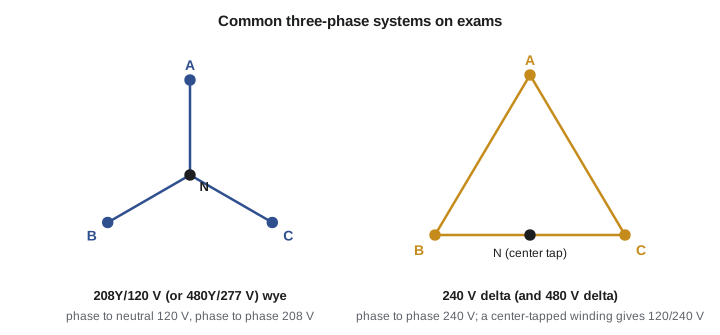
Two arrangements dominate exams. In a wye system the three transformer windings meet at a common point that becomes the neutral. The 208Y/120 volt system gives 120 volts from any phase to neutral and 208 volts between any two phases. The 480Y/277 volt system gives 277 volts from phase to neutral and 480 volts between phases; it is common in larger commercial and industrial buildings because 277-volt lighting and 480-volt motors save copper. In a delta system the windings are connected end to end in a triangle, and there is no center point. A 240-volt delta gives 240 volts between phases, and if one winding is center tapped you also get 120/240 volts for lighting and receptacles, with the third phase, called the high leg, at about 208 volts to neutral.
Where the square root of 3 comes from
In a wye system, the voltage between two phases is not the sum of the two phase-to-neutral voltages, because the two voltages are 120 degrees apart. The phasor diagram shows that the line between the tips of two 120-volt phasors is 1.732 times as long as either phasor. That ratio is the square root of 3, and it appears everywhere in three-phase work.
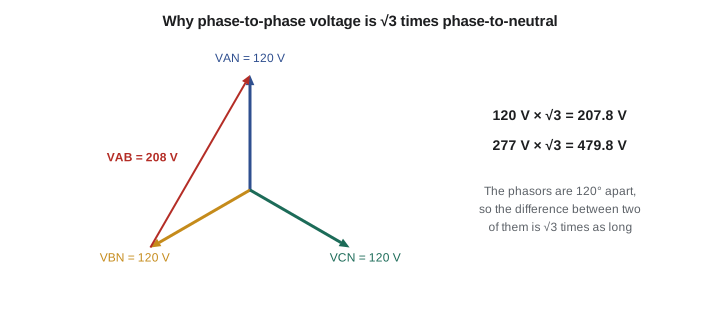
The same factor shows up in the power formula. A balanced three-phase load draws its total power through three conductors, and the current in each conductor is the total power divided by the line-to-line voltage times 1.732.
Many candidates memorize two shortcut divisors: 208 × 1.732 = 360 and 480 × 1.732 = 831. Divide a three-phase load in volt-amperes by 360 to get amperes at 208 volts, or by 831 at 480 volts. Use the full value of 1.732 rather than rounding it to 1.7; the difference can be enough to land you between two answer choices on a large service.
Worked problem
A three-phase heater
Delgado Fabrication has a 30 kW three-phase heat-treating oven on its 480 V system. Find the line current.
Show solution
- I = 30,000 ÷ (480 × 1.732) = 30,000 ÷ 831.4 = 36.1 A.
- Each of the three phase conductors carries about 36.1 A.
Answer: About 36.1 A per phase.
Worked problem
A transformer's full-load current
A 45 kVA transformer steps 480 V three phase down to 208Y/120 V for the shop's office and receptacles. Find the full-load current on the secondary and on the primary.
Show solution
- Secondary: 45,000 ÷ (208 × 1.732) = 45,000 ÷ 360.3 = 124.9 A.
- Primary: 45,000 ÷ (480 × 1.732) = 45,000 ÷ 831.4 = 54.1 A.
- The power is the same on both sides; the current changes in inverse proportion to the voltage.
Answer: About 124.9 A on the 208 V side and 54.1 A on the 480 V side.
Single-phase loads on a three-phase panel
Most loads in the Copper Kettle are not three phase at all. The fryers, range and booster heater are 208-volt single-phase loads connected between two phases, and the lights and receptacles are 120-volt loads connected from one phase to neutral. A single-phase 208-volt load draws its current by the single-phase formula, using 208 volts.
Worked problem
A single-phase range on a 208Y/120 V panel
The Copper Kettle's range is rated 15 kW at 208 V, single phase. Find its current.
Show solution
- I = 15,000 ÷ 208 = 72.1 A.
- Had you divided by 240 you would have found 62.5 A and chosen a circuit that is too small.
Answer: About 72.1 A.
When you total a panel that serves a mix of three-phase and single-phase loads, you add all the volt-amperes and divide by the three-phase divisor. That assumes the single-phase loads are balanced across the three phases, which is how the panel should be laid out and how exam questions intend you to proceed unless they say otherwise. If a question gives you the load on each phase, the feeder must be sized for the most heavily loaded phase.
Worked problem
Balancing three equal single-phase loads
Three 10 kW, 208 V single-phase heaters are connected A-B, B-C and C-A. Find the current in each heater and in each line.
Show solution
- Each heater: 10,000 ÷ 208 = 48.1 A.
- Balanced total: 30,000 VA ÷ (208 × 1.732) = 30,000 ÷ 360.3 = 83.3 A per line.
- The line current is 1.732 times one heater's current (48.1 × 1.732 = 83.3 A), because each line feeds two heaters whose currents are out of phase.
Answer: 48.1 A per heater and 83.3 A per line.
That last relationship surprises people: with three identical loads arranged in a delta, the line current is not twice one load's current, because the two currents meeting at each line are not in step. The balanced three-phase formula handles it automatically, which is one more reason to total the VA and use the three-phase divisor.
| System | Phase to neutral | Phase to phase | Three-phase divisor |
|---|---|---|---|
| 120/240 V single phase | 120 V | 240 V | not applicable (divide by 240) |
| 208Y/120 V three phase | 120 V | 208 V | 208 × 1.732 = 360.3 |
| 480Y/277 V three phase | 277 V | 480 V | 480 × 1.732 = 831.4 |
| 240 V delta (center-tapped) | 120 V on two phases | 240 V | 240 × 1.732 = 415.7 |
Checking a panel's capacity
Questions also run the formulas backward. A 200 A, 208Y/120 V three-phase panel can deliver 200 × 208 × 1.732 = 72,051 VA, about 72 kVA. A 200 A, 120/240 V single-phase panel can deliver 200 × 240 = 48,000 VA. The same ampere rating gives half again as much capacity at three phase, which is why commercial buildings almost always use it. When Ray bids a fit-out, his first check is whether the calculated load fits the existing service in VA.
import math

def amps_1ph(va, volts):
    return va / volts

def amps_3ph(va, volts_ll):
    return va / (volts_ll * math.sqrt(3))

print("Range on 208 V single phase:", round(amps_1ph(15000, 208), 1), "A")
print("Oven, 30 kW at 480 V three phase:", round(amps_3ph(30000, 480), 1), "A")
print("45 kVA transformer secondary:", round(amps_3ph(45000, 208), 1), "A")
print("200 A at 208Y/120 V carries", round(200 * 208 * math.sqrt(3)), "VA")Range on 208 V single phase: 72.1 A Oven, 30 kW at 480 V three phase: 36.1 A 45 kVA transformer secondary: 124.9 A 200 A at 208Y/120 V carries 72053 VA
Working the Copper Kettle schedule
Back at the shop, Dana redid the equipment schedule with a column for each load's connection: three phase, 208 volts single phase, or 120 volts to neutral. The rooftop unit and the walk-in condensing unit are three phase. The range, fryers, oven and booster heater are 208-volt single-phase loads. The lights, receptacles and hood controls are 120-volt loads. She computed each load's own current with the formula that matches its connection, so she could size the branch circuits, and she totaled the VA for the panel, which she would later reduce with the commercial kitchen demand factor in Lesson 8. Ray looked over the new schedule and pointed at one line. The dish machine's booster heater was listed as a 208-volt load, but its nameplate offered 208 or 240 volts with different kilowatt ratings at each. A dual-voltage heater produces less power at the lower voltage, exactly the squared relationship from Lesson 1, so the schedule had to use the 208-volt rating.
The habit Dana took away is to write the connection type next to every load before calculating anything. The exam version of that habit is to read the system voltage in the question stem twice, underline whether it is single phase or three phase, and pick the formula only then.
Unbalanced panels and the busiest phase
Real panels are rarely perfectly balanced. If the Copper Kettle's 120-volt loads add up to 9,000 VA on phase A, 7,500 VA on phase B and 6,000 VA on phase C, the three phase conductors do not carry the same current. Phase A carries 9,000 ÷ 120 = 75 A of that lighting and receptacle load, phase C only 50 A. When a question gives you the load phase by phase, the feeder conductors must handle the most heavily loaded phase, because each conductor is sized individually even though they are installed together. Exam writers use this to separate candidates who reach for the balanced three-phase formula automatically from those who read the question.
The practical lesson for the field is to lay out a panel schedule so that each phase carries about the same load. Ray's rule is to keep the busiest phase within about 10% of the lightest. Doing so lets the balanced formula describe the feeder accurately, keeps the neutral current low, and avoids overheating one phase while the others loaf. For an exam, unless the question gives phase-by-phase loads, assume the designer balanced the panel and use the total volt-amperes with the three-phase divisor.
The high leg on a 240-volt delta
One older system deserves its own warning because it shows up on exams more than in new construction. A 240-volt delta with one winding center tapped gives 120 volts from two of the phases to the neutral, but the third phase, the high leg, measures about 208 volts to the neutral. Connecting a 120-volt load to the high leg would put 208 volts on it. The NEC requires the high leg to be identified, typically with orange marking, and it must occupy a specific position in panelboards and switchboards. Load calculations on such a system treat three-phase loads at 240 volts with the 1.732 factor and single-phase 120-volt loads only on the two phases that are 120 volts to neutral, which makes balancing harder than on a wye system.
Common mistakes
MistakeDividing a three-phase load by the voltage alone, or by 3.
InsteadDivide by the line-to-line voltage times 1.732.
MistakeUsing 240 V for single-phase loads on a 208Y/120 V system.
InsteadSingle-phase loads connected between two phases of a 208Y/120 V system operate at 208 V.
MistakeAdding the currents of single-phase loads to get the three-phase line current.
InsteadTotal the VA and divide by the three-phase divisor; currents meeting at a line are out of phase.
MistakeRounding 1.732 to 1.7 on large loads.
InsteadUse 1.732 (or the square root key) so the answer matches the intended choice.
MistakeTreating 277 V as the three-phase voltage of a 480Y/277 V system.
Instead277 V is phase to neutral; the three-phase formula uses 480 V.
Summary and key terms
- Single-phase current is VA divided by the voltage the load is connected at: 120, 208 or 240 V.
- Three-phase current is VA divided by the line-to-line voltage times 1.732 (360.3 at 208 V, 831.4 at 480 V).
- In a wye system, phase-to-phase voltage is 1.732 times phase-to-neutral voltage: 120 to 208 V, 277 to 480 V.
- Single-phase loads on a three-phase panel are totaled in VA and divided by the three-phase divisor, assuming balance.
- Three equal loads connected in delta draw a line current 1.732 times the current of one load.
- A panel's capacity in VA is its ampere rating times the voltage, times 1.732 for three phase.
- Wye system
- A three-phase system whose windings meet at a common point that serves as the neutral.
- Delta system
- A three-phase system whose windings are connected end to end, with no common center point.
- Line-to-line voltage
- The voltage between two phase conductors.
- Line-to-neutral voltage
- The voltage between a phase conductor and the neutral.
- High leg
- On a center-tapped 240 V delta, the phase that measures about 208 V to the neutral.
- Balanced load
- A three-phase load that draws equal current on all three phases.
Practice problems
Work each problem on paper first, then reveal the answer to check.
Find the current of a 75 kVA three-phase load at 208 V.
Show answer
75,000 ÷ 360.3 = 208.2 A.
Find the current of a 75 kVA three-phase load at 480 V.
Show answer
75,000 ÷ 831.4 = 90.2 A.
A 5 kW single-phase heater is connected between two phases of a 208Y/120 V panel. Find its current.
Show answer
5,000 ÷ 208 = 24.0 A.
How many volt-amperes can a 400 A, 480Y/277 V three-phase service deliver?
Show answer
400 × 480 × 1.732 = 332,554 VA, about 333 kVA.
A 112.5 kVA transformer has a 208Y/120 V secondary. What is its full-load secondary current?
Show answer
112,500 ÷ 360.3 = 312.2 A.
Lesson quiz · 5 questions
Score 60% or more to complete this lesson.
Create a free account to save your progress, take quizzes and earn a certificate.