
MELU-102 · Lesson 12 of 12 · 27 min
Mixed load calculation practice set
▶ Video coming soon A video version of this lesson is on the way.
Eleven weeks into her twelve-week plan, Dana sat down for a timed practice set on a Saturday morning at the Brightwater office, with Marcus at the next desk and Ray holding the stopwatch. The rules were the exam's rules: open book, the bound 2023 code with permanent tabs only, a non-programmable calculator, scratch paper, and no talking. This lesson is that practice set, worked the way a strong candidate works it, followed by the habits that turn a long calculation into a reliable one under time pressure. Try each problem yourself before reading the solution. Everything here uses this course's illustrative values; check every factor against your own copy of the edition your state has adopted.
A time budget for the exam
Master exams vary by state, but a common format is about 100 questions in four to five hours, with a passing score near 70 to 75 out of 100. Your state's candidate bulletin gives the real numbers. Load calculations are a small share of the questions and a large share of the time, so they need a plan.
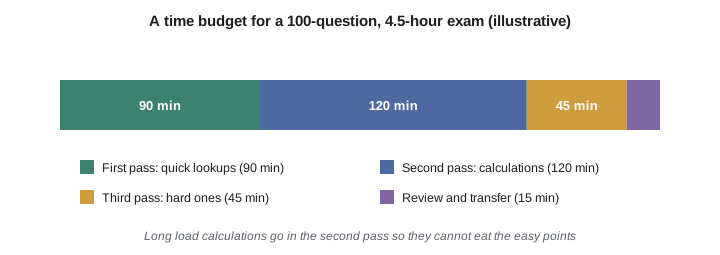
Dana's plan is three passes. On the first pass she answers every question she can settle with a quick lookup or a fact she knows, and marks the rest. On the second pass she works the calculations, the longest ones last. On the third pass she returns to the questions she could not answer at all. The last fifteen minutes are for checking that every answer is recorded. A load calculation that takes twelve minutes is worth the same single point as a definition that takes forty seconds, so the order matters.
Problem 1: a house by the standard method
A 2,000 sq ft house has three small-appliance circuits and one laundry circuit. Its fixed appliances are a 1,200 VA dishwasher, a 900 VA disposal, a 5,000 VA water heater and a 1,000 VA trash compactor. It has a 5,000 W dryer, a 14 kW range, gas heat and a 5,500 VA central air conditioner. Find the load in amperes by the standard method.
Worked problem
Solution
Work the steps in order.
Show solution
- Lighting: 2,000 × 3 = 6,000 VA. Small appliance: 3 × 1,500 = 4,500 VA. Laundry: 1,500 VA. Subtotal 12,000 VA.
- Demand: 3,000 + 0.35 × 9,000 = 6,150 VA.
- Fixed appliances: four, so 75%: 0.75 × 8,100 = 6,075 VA.
- Dryer: 5,000 VA. Range: 14 kW is 2 kW over 12, so 8,000 × 1.10 = 8,800 VA.
- Air conditioning: 5,500 VA (gas heat adds no electric heating load).
- Total: 6,150 + 6,075 + 5,000 + 8,800 + 5,500 = 31,525 VA; 31,525 ÷ 240 = 131.4 A.
Answer: About 131.4 A.
Two traps in this problem catch candidates. The third small-appliance circuit adds 1,500 VA that the minimum case would not. The range is over 12 kW, so the table value is increased. A candidate who missed both would have found 30,200 VA and 125.8 A, an answer an exam writer would happily include.
Problem 2: the same house by the optional method
Worked problem
Solution
Find the load by 220.82.
Show solution
- General loads: 6,000 + 4,500 + 1,500 + 8,100 + 5,000 + 14,000 = 39,100 VA.
- Demand: 10,000 + 0.40 × 29,100 = 21,640 VA.
- Air conditioning at 100%: 5,500 VA. Total: 27,140 VA.
- Current: 27,140 ÷ 240 = 113.1 A.
Answer: About 113.1 A.
The optional method takes every appliance at nameplate, including the range at 14 kW, yet still comes out lower than the standard method because of the 40% factor on everything above 10 kVA.
Problem 3: the neutral of Problem 1
Worked problem
Solution
Find the calculated neutral load. The dishwasher, disposal and compactor are 120 V; the water heater and air conditioner are 240 V.
Show solution
- Lighting group: 6,150 VA.
- Fixed appliances, 120 V items only, at the 75% factor: 0.75 × (1,200 + 900 + 1,000) = 2,325 VA.
- Dryer at 70%: 3,500 VA. Range at 70%: 0.7 × 8,800 = 6,160 VA.
- Water heater and air conditioner: 0 VA.
- Total: 6,150 + 2,325 + 3,500 + 6,160 = 18,135 VA; 18,135 ÷ 240 = 75.6 A.
Answer: About 75.6 A.
Problem 4: a mixed-use building
A two-story building on Main Street has a 1,500 sq ft insurance office on the ground floor and two apartments above. The office has 20 duplex receptacles; use 1.3 VA per square foot as this example's office lighting unit load. The two apartments, calculated together by the standard method, have a demand load of 26,400 VA. The building is served at 120/240 V single phase. Find the service load.
Worked problem
Solution
Calculate the office by the nondwelling rules and add the apartments.
Show solution
- Office lighting: 1,500 × 1.3 = 1,950 VA; continuous: 1,950 × 1.25 = 2,437.5 VA.
- Office receptacles: the larger of 20 × 180 = 3,600 VA or 1 × 1,500 = 1,500 VA, so 3,600 VA (under 10 kVA, no 220.44 reduction).
- Apartments: 26,400 VA.
- Total: 2,437.5 + 3,600 + 26,400 = 32,437.5 VA; 32,437.5 ÷ 240 = 135.2 A.
Answer: About 135.2 A.
Mixed-use buildings test whether you switch rule sets cleanly. The office's lighting gets the continuous factor and the 220.14(K) receptacle rule; the apartments get the dwelling demand factors. Neither part borrows the other's rules.
Problem 5: a three-phase office building
A 20,000 sq ft office building is served at 480Y/277 V. Use 1.3 VA per square foot for lighting. It has 150 general-use receptacles, and its packaged HVAC equipment totals 60,000 VA with a largest motor of 20,000 VA. Find the service load in amperes.
Worked problem
Solution
Work each item, then use the three-phase divisor.
Show solution
- Lighting: 20,000 × 1.3 = 26,000 VA; × 1.25 = 32,500 VA.
- Receptacles: larger of 150 × 180 = 27,000 VA or 20,000 VA, so 27,000 VA; 220.44 gives 10,000 + 0.5 × 17,000 = 18,500 VA.
- HVAC: 60,000 + 0.25 × 20,000 = 65,000 VA.
- Total: 32,500 + 18,500 + 65,000 = 116,000 VA; 116,000 ÷ 831.4 = 139.5 A.
Answer: About 139.5 A.
Problem 6: an existing service
A strip mall's 225 A, 208Y/120 V service had a one-year peak demand of 50 kVA. A new tenant adds 20 kVA of calculated load. Is the service adequate under 220.87?
Worked problem
Solution
Apply the measured demand method.
Show solution
- Existing: 1.25 × 50,000 = 62,500 VA. New: 20,000 VA. Total: 82,500 VA.
- Current: 82,500 ÷ 360.3 = 229.0 A.
- 229.0 A is more than 225 A, so the service is not adequate.
Answer: No: about 229 A on a 225 A service.
Problem 6 is a good example of why rounding matters. Rounding 1.732 down to 1.7 gives a divisor of 353.6 and a current of 233 A, which still fails, but a slightly different problem could flip from pass to fail on that rounding alone.
| Problem | Method | Answer |
|---|---|---|
| 1 | Standard method, dwelling | 131.4 A |
| 2 | Optional method, dwelling (220.82) | 113.1 A |
| 3 | Neutral (220.61) | 75.6 A |
| 4 | Mixed use: office + apartments | 135.2 A |
| 5 | Commercial, 480Y/277 V | 139.5 A |
| 6 | Existing service (220.87) | 229.0 A, not adequate |
Habits that make long calculations reliable
Ray has watched candidates for thirty years, and he says the ones who pass are not faster at arithmetic. They are more systematic. Before starting, they read the last sentence of the question to see what it wants: amperes, volt-amperes, a service rating, a conductor or the neutral. They write the steps of the method down the left side of the scratch paper before entering a single number. They mark each load as 120 volts, 240 volts, three phase, continuous or noncontinuous. They keep full precision until the end. And when their answer is not among the choices, they check the steps, not the arithmetic, because a missing or doubled step is far more common than a keying error.
Tabs help too. Dana's code book has permanent tabs on Article 100, Article 210, Article 215, Article 220 and its tables, Article 230, Article 240, Article 310 and its ampacity tables, Article 430, and Chapter 9. Most states allow tabs that are permanently attached and contain no writing beyond article numbers and titles; check your bulletin before you tab.
import math

def std_house(sqft, sa, laundry, fixed, dryer, range_kw, hvac, ev=0):
    light = sqft * 3 + 1500 * (sa + laundry)
    light_d = min(light, 3000) + 0.35 * max(light - 3000, 0)
    fixed_d = sum(fixed) * (0.75 if len(fixed) >= 4 else 1)
    rng = 8000 if range_kw <= 12 else 8000 * (1 + 0.05 * round(range_kw - 12))
    return light_d + fixed_d + max(dryer, 5000) + rng + hvac + (max(ev, 7200) if ev else 0)

def opt_house(sqft, sa, laundry, appliances, hvac):
    g = sqft * 3 + 1500 * (sa + laundry) + sum(appliances)
    return min(g, 10000) + 0.4 * max(g - 10000, 0) + hvac

p1 = std_house(2000, 3, 1, [1200, 900, 5000, 1000], 5000, 14, 5500)
p2 = opt_house(2000, 3, 1, [1200, 900, 5000, 1000, 5000, 14000], 5500)
p5 = 26000 * 1.25 + (10000 + 0.5 * (27000 - 10000)) + 60000 + 0.25 * 20000
p6 = 1.25 * 50000 + 20000
print("P1:", round(p1 / 240, 1), "A   P2:", round(p2 / 240, 1), "A")
print("P5:", round(p5 / (480 * math.sqrt(3)), 1), "A P6:", round(p6 / (208 * math.sqrt(3)), 1), "A")P1: 131.4 A P2: 113.1 A P5: 139.5 A P6: 229.0 A
Where this course leads
Load calculations sit at the center of the master exam because every other topic depends on them. The service rating from a load calculation feeds the conductor sizing of MELU-103, the motor feeders of MELU-105 and the special equipment of MELU-106, and the business and law content of MELU-107 assumes you can defend a calculation to an inspector or a customer. If you finish this practice set and can explain every step, including why each factor applies, you are ready to move on. If a step still feels uncertain, go back to its lesson and redo the worked example from a blank page, without looking at the solution.
Dana finished the set in fifty-one minutes and missed one problem, a neutral question where she had counted the water heater. She has not made that mistake since. Marcus finished faster and missed two. Ray reminded them both that speed is useful only after accuracy is automatic.
One more drill pays off in the last week: redo three problems you got wrong earlier in the course, from a blank page, against the clock. The aim is not to memorize the answers but to prove that the method now runs without hesitation. If a problem still trips you, write down the step where you hesitated and go back to that lesson's worked example once more.
Common mistakes
MistakeStarting a long calculation on the first pass of the exam.
InsteadAnswer quick lookups first and do long calculations on the second pass.
MistakeChoosing the answer that matches your first result without checking the steps.
InsteadCommon errors produce answers that exam writers include as choices; check the method, step by step.
MistakeMixing dwelling and nondwelling rules in a mixed-use building.
InsteadCalculate each part with its own rules, then add.
MistakeRounding 1.732 to 1.7 or rounding intermediate results.
InsteadKeep full precision until the final answer.
MistakeWriting notes on tabs or in the code book against the bulletin's rules.
InsteadCheck your state's candidate bulletin for what reference materials and tabs are allowed.
Summary and key terms
- Plan the exam in passes: quick lookups first, calculations second, hard questions third, then review.
- Read the last sentence of a question first to see whether it wants amperes, VA, a device, a conductor or the neutral.
- Write the method's steps before entering numbers, and mark each load by voltage and as continuous or not.
- The same house usually calculates lower by the optional method than by the standard method.
- Mixed-use buildings are calculated in parts with each part's own rules.
- Keep full precision and use 1.732 for three-phase work.
- Candidate bulletin
- The testing vendor's document describing an exam's format, references and rules.
- Permanent tab
- A tab attached to a code book page that cannot be removed or rewritten.
- Open-book exam
- An exam in which a specified edition of the code may be used.
- Mixed-use building
- A building with both dwelling and nondwelling occupancies.
- First pass
- The initial run through an exam, answering only questions that can be settled quickly.
- Scaled score
- A score converted to a standard scale; some states report results this way.
Practice problems
Work each problem on paper first, then reveal the answer to check.
A 1,500 sq ft house has two small-appliance circuits, one laundry circuit, three fixed appliances totaling 6,000 VA, a 5,000 W dryer, an 11 kW range and an 8,000 W heater with no A/C. Find the standard method load.
Show answer
4,500 + 4,500 = 9,000; 3,000 + 2,100 = 5,100; 6,000; 5,000; 8,000; 8,000 → 32,100 VA = 133.75 A.
Find the optional method load of the previous house with the heat in two separately controlled rooms (65%).
Show answer
General: 9,000 + 6,000 + 5,000 + 11,000 = 31,000 → 10,000 + 8,400 = 18,400; heat 5,200 → 23,600 VA = 98.3 A.
A store's loads total 48,000 VA at 208Y/120 V. Find the current.
Show answer
48,000 ÷ 360.3 = 133.2 A.
A 400 A, 208Y/120 V service had a 100 kVA peak. Can it take 30 kVA more?
Show answer
125,000 + 30,000 = 155,000 VA; ÷ 360.3 = 430.2 A, so no.
A neutral load calculates to 280 A. Apply the reduction above 200 A.
Show answer
200 + 0.7 × 80 = 256 A.
Lesson quiz · 5 questions
Score 60% or more to complete this lesson.
Create a free account to save your progress, take quizzes and earn a certificate.