
MELU-102 · Lesson 4 of 12 · 20 min
The standard method for dwelling units
▶ Video coming soon A video version of this lesson is on the way.
Ray's longtime customer Helen Brandt is renovating her 2,200 square foot house on Orchard Lane. She is replacing the gas furnace with electric baseboard heat, adding a 32-ampere electric vehicle charger in the garage and keeping her electric range, dryer and water heater. The house has a 150-ampere service. Ray handed Dana the appliance list and asked her for a load calculation by the standard method, the way the inspector, Gloria Haynes, would want to see it on the permit application. It is also, almost word for word, the most common long calculation on master electrician exams.
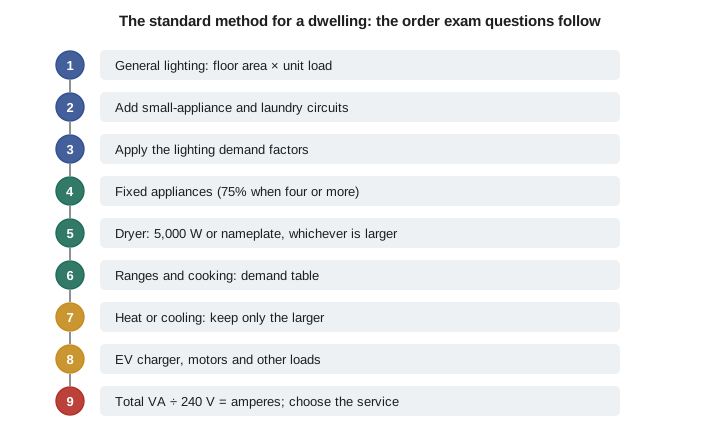
The standard method is set out in Part III of Article 220 (in 2026 adoptions, the corresponding part of Article 120). It works through the loads of a dwelling in a fixed order, applying a demand factor to each group. Demand factors reflect the fact that not everything in a house runs at once. The method looks long, but each step is simple, and the order never changes. Learn the order and you can work any dwelling calculation an exam throws at you.
Step 1: General lighting from floor area
The general lighting load of a dwelling is the floor area times the unit load for dwelling units in Table 220.12, expressed in volt-amperes per square foot. Under 220.5(C) the floor area uses the outside dimensions and leaves out open porches, garages and unfinished spaces that are not adaptable for future use. This one figure covers all the general lighting and the general-use receptacles in the house. This lesson's examples use 3 VA per square foot; confirm the value in your edition's table before an exam.
Helen's house: 2,200 sq ft × 3 VA = 6,600 VA.
Step 2: Small-appliance and laundry circuits
Section 220.52(A) adds 1,500 VA for each two-wire small-appliance branch circuit required by 210.11(C)(1), and there must be at least two. Section 220.52(B) adds 1,500 VA for each laundry circuit required by 210.11(C)(2), at least one. These loads are added to the general lighting load because the demand factors in the next step apply to all three together. If a question says the house has three small-appliance circuits, use 4,500 VA, not the minimum of 3,000 VA.
Helen's house: 2 × 1,500 + 1,500 = 4,500 VA, for a subtotal of 6,600 + 4,500 = 11,100 VA.
Step 3: Lighting demand factors
Table 220.42 applies demand factors to this subtotal. For dwelling units, the first block of the load is taken at 100% and the remainder at reduced values, with a lower value again for very large loads. In this lesson's examples, the first 3,000 VA is taken at 100% and the next portion at 35%, which is how the table treats the range that almost every house falls into; check the block sizes and factors in your edition.
Step 4: Appliances fastened in place
Section 220.53 lets you take 75% of the nameplate total of four or more appliances fastened in place, other than the electric ranges, clothes dryers, space heating and air conditioning that are counted separately, and other than the EV charger, which has its own rule. Dishwashers, disposals, water heaters, built-in microwaves, trash compactors and attic fans are typical. With three or fewer such appliances, take them at 100%.
Helen's appliances: dishwasher 1,200 VA, disposal 900 VA, water heater 4,500 VA and a built-in microwave 1,500 VA. Four appliances total 8,100 VA, and 75% of that is 6,075 VA.
Step 5: Clothes dryer
Section 220.54 takes each household electric dryer at 5,000 VA or its nameplate rating, whichever is larger. Table 220.54 gives demand factors when several dryers are on one feeder, as in an apartment building. A single dryer in a house is taken at full value.
Helen's dryer is rated 5,500 W, larger than 5,000, so use 5,500 VA.
Step 6: Ranges and other cooking appliances
Section 220.55 and its table give the demand load for household ranges, wall-mounted ovens, counter-mounted cooking units and similar appliances over 1.75 kW. For a single range of not over 12 kW, the table's main column gives a demand of 8 kW. For a range over 12 kW, a note to the table increases that value by 5% for each kilowatt or major fraction over 12. Other columns and notes handle smaller appliances and combinations of separate ovens and cooktops. This is a table that rewards practice with your own copy; the examples here use only the single-range value.
Helen's range is rated 12 kW, so its demand load is 8,000 VA. Had it been 14 kW, the demand would be 8,000 × 1.10 = 8,800 VA, because it is 2 kW over 12.
Step 7: Heating or cooling, not both
Section 220.60 says that where two loads are unlikely to be used at the same time, only the larger needs to be counted. Heating and air conditioning are the classic pair. Fixed electric space heating is calculated at 100% of its total connected load under 220.51, and air conditioning at its nameplate. Compare them and keep the larger. For a heat pump with supplemental electric heat, count the compressor and the supplemental heat that can run together as the heating load.
Helen will have 10,000 W of baseboard heat and her existing central air conditioner draws 28 A at 240 V, or 6,720 VA. Heating is larger: use 10,000 VA.
Step 8: EV chargers, motors and other loads
The 2023 edition added 220.57, which takes electric vehicle supply equipment at 7,200 W or its nameplate rating, whichever is larger. Other loads that are not covered by the earlier steps, such as a well pump, a hot tub or a workshop welder, are added at their nameplate values. Section 220.50 also brings in the motor rules of Article 430, which add 25% of the largest motor's full-load current; many exam questions specify whether to include that step, so follow the question.
Helen's charger is set to 32 A at 240 V, or 7,680 VA. That is larger than 7,200, so use 7,680 VA.
Step 9: Total and divide
Add the demand loads and divide by 240 volts for a 120/240 volt single-phase service.
| Step | Item | Demand load (VA) |
|---|---|---|
| 1-3 | Lighting, small appliance, laundry after demand factors | 5,835 |
| 4 | Four fixed appliances at 75% | 6,075 |
| 5 | Dryer | 5,500 |
| 6 | Range, 12 kW | 8,000 |
| 7 | Electric heat (larger than A/C) | 10,000 |
| 8 | EV charger | 7,680 |
| 9 | Total | 43,090 |
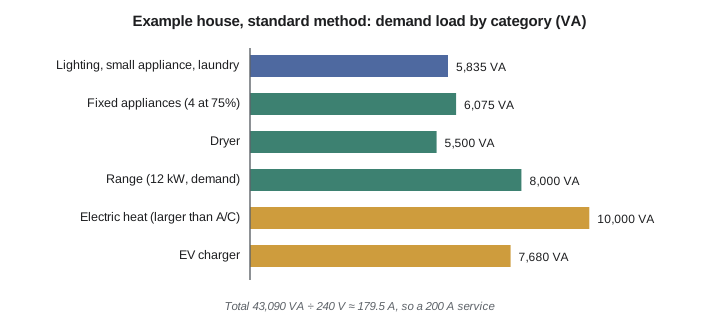
The calculated load is 179.5 A, which is more than the existing 150 A service. Ray's recommendation is a 200 A service. For a 120/240 volt dwelling service or main feeder, 310.12 lets the service conductors be sized at 83% of the service rating, so the conductors need an ampacity of at least 0.83 × 200 = 166 A, read from the table in that section for the conductor material and size Dana chooses. Exam questions often ask for the service rating first and the conductor second, so finish the calculation before you open Table 310.12.
Worked problem
A fourplex unit by the standard method
Each unit in the Maple Street fourplex is 1,050 sq ft and has two small-appliance circuits, one laundry circuit, a 1,200 VA dishwasher, an 800 VA disposal, a 4,500 VA water heater, a 4,800 W dryer, a 9.6 kW range, and a heat pump with a 4,200 VA compressor and 5,000 W of supplemental heat that can run together. Find the unit's calculated load.
Show solution
- Lighting: 1,050 × 3 = 3,150 VA; plus 3,000 + 1,500 = 7,650 VA.
- Demand: 3,000 + 0.35 × 4,650 = 4,627.5 VA.
- Appliances: three only, so 100%: 1,200 + 800 + 4,500 = 6,500 VA.
- Dryer: nameplate 4,800 is less than 5,000, so 5,000 VA.
- Range: 9.6 kW is not over 12 kW, so 8,000 VA.
- Heating: 4,200 + 5,000 = 9,200 VA, larger than the 4,200 VA cooling load.
- Total: 4,627.5 + 6,500 + 5,000 + 8,000 + 9,200 = 33,327.5 VA; 33,327.5 ÷ 240 = 138.9 A.
Answer: About 138.9 A, so a 150 A feeder for the unit.
That unit result comes back in Lesson 6, where the four units are combined into one service for the whole building.
def standard_dwelling(sqft, sa_circuits, laundry, fixed, dryer, range_kw, heat, cool, ev, other=0):
    light = sqft * 3 + 1500 * sa_circuits + 1500 * laundry
    light_demand = min(light, 3000) + 0.35 * max(light - 3000, 0)  # example factors; check Table 220.42
    fixed_demand = sum(fixed) * (0.75 if len(fixed) >= 4 else 1.0)
    dryer_demand = max(dryer, 5000)
    rng = 8000 if range_kw <= 12 else 8000 * (1 + 0.05 * round(range_kw - 12))
    hvac = max(heat, cool)
    ev_demand = max(ev, 7200) if ev else 0
    total = light_demand + fixed_demand + dryer_demand + rng + hvac + ev_demand + other
    return total, total / 240

va, amps = standard_dwelling(2200, 2, 1, [1200, 900, 4500, 1500], 5500, 12, 10000, 6720, 7680)
print("Brandt house:", va, "VA =", round(amps, 1), "A")
va, amps = standard_dwelling(1050, 2, 1, [1200, 800, 4500], 4800, 9.6, 9200, 4200, 0)
print("Fourplex unit:", va, "VA =", round(amps, 1), "A")Brandt house: 43090.0 VA = 179.5 A Fourplex unit: 33327.5 VA = 138.9 A
Where exam questions set traps
Most wrong answers on standard method questions come from a small set of traps. The floor area includes the garage or porch. The small-appliance circuits are left out of the demand factor step and added later at 100%. The appliance count includes the range or dryer, which pushes the count to four and wrongly triggers the 75% factor. Both heating and cooling are added. The dryer is taken at its nameplate even though it is less than 5,000 VA. The range is taken at its nameplate instead of the table value. The answer is divided by 120 or by the three-phase divisor. Each trap produces an answer that the exam writer has helpfully included among the choices, which is why checking the steps beats checking the arithmetic.
Some exams also ask for the load on the neutral, which uses different rules covered in Lesson 10, or ask you to compare the standard method with the optional method, which is the next lesson. Read the last sentence of the question before you start, so that you know whether the answer is in VA, in amperes or in a service size.
Why the method looks the way it does
It helps to understand why the code takes the general lighting load at only 35% above the first block, or the range at 8 kW when its nameplate says 12. The demand factors come from long experience measuring real houses. Lights and receptacle loads in a home are many small loads, almost never all on together. A range with four burners and an oven rarely runs every element at full heat for long. A clothes dryer and a water heater, by contrast, really do draw their full rating whenever they run, so they are counted at full value. Space heating and electric vehicle charging run for hours and are counted in full. Knowing which loads are diversified and which are not makes the method easier to remember and helps you spot a step that does not look right.
The result of a standard method calculation is a minimum, not a design target. Ray usually adds room for the loads a customer is likely to add over the next decade, such as a second vehicle charger, a heat pump water heater or a hot tub. An exam will never ask for that judgment, but a permit reviewer like Gloria will want to see that the service you install is at least the calculated minimum, and your customer will thank you later if it is somewhat more.
One final check closes every dwelling calculation. Compare the result with the existing service and with the utility's standard service sizes before you write the answer down. Helen's house calculated at 179.5 A on a 150 A service, so the service must grow. If her calculation had come out at 140 A, the existing 150 A service would have been adequate on paper, and the next question would be whether the meter base, the panel and the service conductors were all in good condition. Exam questions phrase this as whether an existing service is adequate for added loads, and they answer it with the same comparison.
Common mistakes
MistakeIncluding the garage, open porch or unfinished basement in the floor area.
InsteadUse outside dimensions but leave those spaces out, as 220.5(C) describes.
MistakeAdding small-appliance and laundry loads after the lighting demand factors.
InsteadAdd them to the general lighting load first, then apply Table 220.42 to the total.
MistakeCounting the range, dryer or heat as fixed appliances toward the 75% rule.
InsteadThose loads have their own steps; only other fastened-in-place appliances count toward four.
MistakeAdding both the heating and the air conditioning.
InsteadThey are noncoincident under 220.60; keep only the larger.
MistakeTaking a 4,800 W dryer at 4,800 VA.
InsteadThe dryer is 5,000 VA or the nameplate, whichever is larger.
Summary and key terms
- The standard method runs in a fixed order: lighting, small appliance and laundry, demand factors, fixed appliances, dryer, range, heat or cooling, other loads, then divide by 240 V.
- General lighting is floor area times the dwelling unit load from Table 220.12; garages, open porches and unfinished spaces are excluded.
- Small-appliance and laundry circuits are 1,500 VA each and are added before the Table 220.42 demand factors.
- Four or more fixed appliances may be taken at 75% under 220.53; dryers are at least 5,000 VA under 220.54; a single range up to 12 kW is 8 kW under Table 220.55.
- Heating and cooling are noncoincident: keep the larger; EV chargers are at least 7,200 W under 220.57.
- Dwelling service conductors may be sized at 83% of the service rating under 310.12.
- Demand factor
- The ratio of the maximum demand of a system to its total connected load.
- Standard method
- The Part III method of Article 220 for calculating dwelling feeder and service loads.
- Noncoincident loads
- Loads unlikely to operate at the same time, such as heating and cooling.
- Fastened in place
- Installed so that it is not readily moved, such as a dishwasher or water heater.
- Connected load
- The sum of the ratings of all loads connected to a system.
- Supplemental heat
- Electric resistance heat that runs with a heat pump in cold weather.
Practice problems
Work each problem on paper first, then reveal the answer to check.
A 1,800 sq ft house has two small-appliance circuits and one laundry circuit. Find the lighting demand load.
Show answer
5,400 + 4,500 = 9,900 VA; 3,000 + 0.35 × 6,900 = 5,415 VA.
A house has a dishwasher (1,000 VA), disposal (750 VA) and water heater (4,500 VA). Find their demand load.
Show answer
Only three appliances, so 100%: 6,250 VA.
Find the demand load of a single 15 kW range using the 5% per kW rule.
Show answer
3 kW over 12: 8,000 × 1.15 = 9,200 VA.
A house has 12 kW of electric heat and a 5 kVA air conditioner. What heating or cooling load is used?
Show answer
The larger, 12,000 VA.
A calculation totals 38,400 VA. What is the load in amperes at 120/240 V?
Show answer
38,400 ÷ 240 = 160 A.
Lesson quiz · 5 questions
Score 60% or more to complete this lesson.
Create a free account to save your progress, take quizzes and earn a certificate.