
MELU-102 · Lesson 10 of 12 · 24 min
Neutral load calculations
▶ Video coming soon A video version of this lesson is on the way.
Ray asked Dana to size the neutral for Helen Brandt's new 200-ampere service, and she reached for the same size as the ungrounded conductors. The inspector would have accepted that. But the code allows something else, and master exams ask about it often: the neutral of a feeder or service may be smaller than the ungrounded conductors when the load on it is smaller. Section 220.61 tells you how to calculate the neutral load, which reductions are allowed and which are forbidden. This lesson works through the neutral of Helen's house, a large apartment service and the Copper Kettle's three-phase panel.
What the neutral carries
On a 120/240 volt single-phase feeder, 120-volt loads connect from one line to the neutral, and 240-volt loads connect from line to line. A 240-volt water heater, baseboard heater, air conditioner or EV charger puts no current on the neutral at all. For the 120-volt loads, the neutral carries only the difference between the two lines. If line A carries 40 amperes of 120-volt load and line B carries 25 amperes, the neutral carries 15 amperes. This is why a well-balanced panel has a lightly loaded neutral.
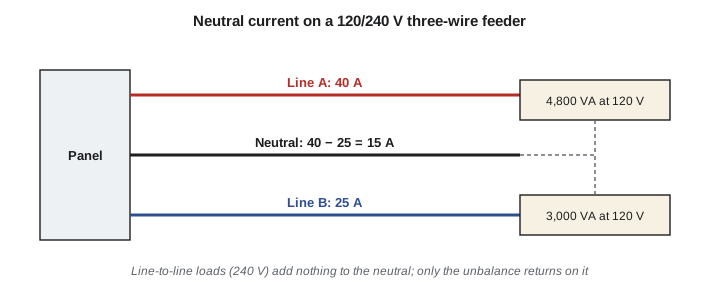
Section 220.61(A) defines the feeder or service neutral load as the maximum unbalance of the load. In a calculation, that means the largest net calculated load between the neutral and any one ungrounded conductor. Because a load calculation assumes the 120-volt loads are spread over both lines but could at worst all land on one, the method counts every 120-volt load at its calculated value and every 240-volt load at zero, then divides by 240.
The reduction for ranges and dryers
Household ranges, wall ovens, cooktops and clothes dryers have both 240-volt heating elements and 120-volt parts, such as the clock, controls, lights and timer motor. Only the 120-volt parts use the neutral, and they are small. Section 220.61(B)(1) therefore lets you count these appliances on the neutral at 70% of the load on the ungrounded conductors, as calculated by Table 220.55 for cooking appliances and Table 220.54 for dryers.
Worked problem
The neutral of Helen Brandt's house
Use the standard method values from Lesson 4. Which loads go on the neutral, and at what value? The fixed appliances are a 120 V dishwasher (1,200 VA), a 120 V disposal (900 VA), a 120 V built-in microwave (1,500 VA) and a 240 V water heater (4,500 VA).
Show solution
- Lighting, small appliance and laundry demand: 5,835 VA, all 120 V loads, so 5,835 VA.
- Fixed appliances: the 75% factor applies to the group; only the 120 V items count: 0.75 × (1,200 + 900 + 1,500) = 2,700 VA. The water heater is 240 V only.
- Dryer: 70% of 5,500 VA = 3,850 VA.
- Range: 70% of 8,000 VA = 5,600 VA.
- Electric heat and the EV charger are 240 V only: 0 VA.
- Neutral total: 5,835 + 2,700 + 3,850 + 5,600 = 17,985 VA; 17,985 ÷ 240 = 74.9 A.
Answer: About 74.9 A on the neutral, compared with 179.5 A on the ungrounded conductors.
The neutral could legally be sized for about 75 amperes. In practice it must also satisfy other rules. For a service, the grounded conductor must be at least the size required by 250.24(C) based on the size of the ungrounded service conductors, so it can carry fault current back to the source. Many electricians use a full-size neutral on a dwelling service anyway. On an exam, read whether the question asks for the calculated neutral load or the minimum neutral conductor size.
The reduction above 200 amperes
Section 220.61(B)(2) allows a second reduction on larger feeders and services. The portion of the unbalanced load in excess of 200 amperes may be taken at 70%. It applies to single-phase three-wire systems and to three-phase four-wire systems, among others. The idea is that at large loads, unbalance becomes less likely.
Worked problem
The neutral of a large apartment service
A 24-unit apartment building's calculated neutral load, after the range and dryer reduction, is 260 A. Apply the reduction above 200 A.
Show solution
- First 200 A at 100%: 200 A.
- Excess over 200 A: 60 A at 70% = 42 A.
- Neutral load: 200 + 42 = 242 A.
Answer: 242 A.
Apply the two reductions in order. First reduce the range and dryer loads to 70% when building the neutral load. Then, if the result exceeds 200 amperes, reduce the portion above 200. Exam questions that give a building's total and ask for the neutral often test whether you skip one of the two.
Reductions that are not allowed
Section 220.61(C) forbids reductions in two situations, and both appear on exams. First, you may not reduce the neutral of a three-wire circuit made up of two ungrounded conductors and the neutral of a four-wire, three-phase wye system. On a 208Y/120 volt system, two phases and a neutral do not behave like a 120/240 volt single-phase circuit. The two phase currents are 120 degrees apart rather than opposite, so with balanced loads the neutral carries about the same current as each phase conductor. Second, you may not reduce the neutral for the portion of the load made up of nonlinear loads supplied from a four-wire, three-phase wye system. Nonlinear loads such as LED drivers, computer power supplies and variable-frequency drives draw current in pulses that create harmonic currents, and some of those harmonics add up on the neutral instead of canceling.
| Situation | Neutral treatment | Rule |
|---|---|---|
| 120/240 V loads (lighting, receptacles) | Count at calculated value | 220.61(A) |
| 240 V-only loads (water heater, heat, A/C, EV) | No neutral load | 220.61(A) |
| Household ranges, ovens, cooktops, dryers | 70% of their calculated load | 220.61(B)(1) |
| Unbalanced load over 200 A | Excess over 200 A at 70% | 220.61(B)(2) |
| Two phases and neutral of a 208Y/120 V system | No reduction | 220.61(C)(1) |
| Nonlinear loads on a 4-wire wye system | No reduction | 220.61(C)(2) |
The Copper Kettle's three-phase neutral
On a three-phase, four-wire panel, the neutral carries the unbalance of the 120-volt loads. Three-phase loads and 208-volt single-phase loads connected between phases put nothing on it. If the 120-volt loads were perfectly balanced across the three phases and perfectly linear, the neutral current would be zero. Neither assumption holds in a real restaurant.
Worked problem
The restaurant's neutral load
The Copper Kettle's 120 V loads are 4,200 VA of LED lighting, 5,400 VA of receptacles and the 1,200 VA sign, for 10,800 VA. Everything else is 208 V single phase or three phase. Find the calculated neutral load.
Show solution
- Only the 120 V loads count: 10,800 VA.
- As a three-phase calculated load: 10,800 ÷ (208 × 1.732) = 10,800 ÷ 360.3 = 30.0 A.
- The LED drivers and the point-of-sale equipment on the receptacles are nonlinear loads on a four-wire wye system, so no reduction is permitted.
- Because the neutral carries harmonic currents from these loads, 310.15(E) may also require it to be counted as a current-carrying conductor when applying adjustment factors.
Answer: About 30 A, with no reduction allowed.
Compare that with the ungrounded conductors, which carry the 224-ampere load of Lesson 8 that includes the kitchen equipment and rooftop unit. The calculated neutral is small, but because the restaurant's 120-volt loads are largely nonlinear, many designers install a full-size neutral on such a panel. The code permits a smaller one based on the calculation; the exam tests whether you know where the calculation forbids reductions.
Neutral current from two phases of a wye
The forbidden reduction in 220.61(C)(1) surprises people, so it is worth one more look. Suppose a 208Y/120 volt panel feeds a small subpanel with only two phases and a neutral, and the subpanel serves 120-volt lighting that draws 30 amperes on each phase. On a 120/240 volt single-phase system, two equal loads on opposite lines leave the neutral with nothing. On two phases of a wye, the currents are 120 degrees apart, and adding them as phasors gives a neutral current of 30 amperes, the same as each phase. That is why the neutral of such a circuit must be full size and why no reduction may be taken.
import math

def neutral_current_two_phases(i_a, i_b):
    # Phase currents 120 degrees apart (two phases of a wye system).
    ax, ay = i_a, 0.0
    bx, by = i_b * math.cos(math.radians(-120)), i_b * math.sin(math.radians(-120))
    return math.hypot(ax + bx, ay + by)

def dwelling_neutral(light_demand, fixed_120, n_fixed, dryer, range_demand):
    fixed = sum(fixed_120) * (0.75 if n_fixed >= 4 else 1.0)
    return light_demand + fixed + 0.7 * dryer + 0.7 * range_demand

n = dwelling_neutral(5835, [1200, 900, 1500], 4, 5500, 8000)
print("Brandt neutral:", n, "VA =", round(n / 240, 1), "A")
print("Two phases of a wye, 30 A each:", round(neutral_current_two_phases(30, 30), 1), "A on the neutral")
print("Single phase 120/240 V, 30 A each: 0 A on the neutral")Brandt neutral: 17985.0 VA = 74.9 A Two phases of a wye, 30 A each: 30.0 A on the neutral Single phase 120/240 V, 30 A each: 0 A on the neutral
Neutral questions on the exam
Neutral questions come in a few predictable forms. The most common gives a dwelling's appliance list and asks for the neutral load in amperes, which tests whether you zero out the 240-volt loads and take the range and dryer at 70%. A second form gives a large building's neutral load and asks you to apply the reduction above 200 amperes. A third describes a three-phase panel with computers or LED lighting and asks whether a reduction is permitted, which tests 220.61(C). A fourth shows two phases and a neutral from a wye system and asks for the neutral current with balanced loads; the answer is the same as each phase current, not zero.
Dana's error on her first attempt at Helen's neutral was a small one with a big effect. She counted the 4,500-volt-ampere water heater on the neutral because it appeared in the fixed appliance group, which inflated the neutral by more than 14 amperes. The habit that fixed it was to mark every appliance with its voltage when she first copies the list, before any calculation begins.
It also helps to remember what the neutral calculation is for. The result tells you the smallest neutral the load requires. It does not override the minimum grounded conductor size for a service in 250.24(C), the rules for neutrals in parallel, or the requirement in 200.4 that each multiwire circuit have its own neutral. A question that asks for the minimum neutral conductor for a service needs both the calculated neutral load and the 250.24(C) minimum, and the answer is the larger of the two.
Three-phase neutrals deserve one more practical note. Even when every 120-volt load is perfectly balanced across the phases, a panel full of LED drivers and computers can put a substantial third-harmonic current on the neutral, because those harmonic currents from the three phases are in step with each other and add instead of canceling. That is the physics behind the prohibition in 220.61(C)(2) and behind the rule in 310.15(E) that can make the neutral a current-carrying conductor for adjustment purposes. Designers of offices and data rooms sometimes install neutrals larger than the phase conductors for this reason.
Common mistakes
MistakeCounting a 240 V water heater, heater, air conditioner or EV charger on the neutral.
InsteadLoads connected only line to line put no current on the neutral.
MistakeTaking ranges and dryers at full value on the neutral.
InsteadSection 220.61(B)(1) allows 70% of their calculated load on the ungrounded conductors.
MistakeReducing the neutral of a circuit made of two phases and the neutral of a 208Y/120 V system.
InsteadSection 220.61(C)(1) forbids it; the neutral carries about the same current as the phases.
MistakeReducing the neutral for nonlinear loads on a four-wire wye system.
InsteadSection 220.61(C)(2) forbids it, because harmonic currents add on the neutral.
MistakeApplying the 70% reduction to the whole neutral load of a large service.
InsteadOnly the portion above 200 A is reduced to 70%.
Summary and key terms
- The neutral load is the maximum unbalance: count 120 V loads at their calculated value and 240 V-only loads at zero.
- Household ranges, ovens, cooktops and dryers may be counted on the neutral at 70% of their calculated load.
- The portion of a neutral load above 200 A may be taken at 70%.
- No reduction is allowed for two phases and the neutral of a four-wire wye system, or for nonlinear loads on such a system.
- On two phases of a wye with balanced loads, the neutral carries about the same current as each phase.
- A service neutral must also meet the minimum size in 250.24(C) for fault current.
- Neutral
- The grounded conductor that carries the unbalanced current of 120 V or 277 V loads.
- Unbalanced load
- The difference between the loads on the ungrounded conductors that returns on the neutral.
- Nonlinear load
- A load whose current is not proportional to voltage, such as LED drivers and computer power supplies.
- Harmonic current
- Current at a multiple of the supply frequency, produced by nonlinear loads.
- Grounded conductor
- A system conductor intentionally connected to ground, usually the neutral.
- Multiwire branch circuit
- A branch circuit of two or more ungrounded conductors sharing a neutral.
Practice problems
Work each problem on paper first, then reveal the answer to check.
Line A carries 52 A and line B carries 38 A of 120 V load. What does the neutral carry?
Show answer
52 − 38 = 14 A.
A dwelling's 120 V loads after demand total 9,000 VA; its range demand is 8,000 VA and its dryer 5,000 VA. Find the neutral load in amperes.
Show answer
9,000 + 5,600 + 3,500 = 18,100 VA; ÷ 240 = 75.4 A.
A service's calculated neutral load is 330 A. Apply the reduction above 200 A.
Show answer
200 + 0.7 × 130 = 291 A.
A subpanel fed by two phases and the neutral of a 208Y/120 V system carries 40 A of balanced 120 V load per phase. What is the neutral current?
Show answer
About 40 A; no reduction is permitted.
A 240 V, 10 kW electric heater is on a dwelling feeder. What does it add to the neutral load?
Show answer
Nothing; it is a line-to-line load.
Lesson quiz · 5 questions
Score 60% or more to complete this lesson.
Create a free account to save your progress, take quizzes and earn a certificate.