
MELU-102 · Lesson 1 of 12 · 29 min
Exam math refresher: Ohm's law and power
▶ Video coming soon A video version of this lesson is on the way.
Dana Whitfield finished MELU-101 able to find almost any rule in the National Electrical Code in under two minutes. Her first full practice exam showed the next problem. Of the 100 questions, 31 needed a calculation, and she lost 14 of those 31. Most of the misses were not exotic. She divided by 240 when the load was on a three-phase panel, forgot that a continuous load needs extra headroom, or rounded too early and landed between two answer choices. Ray Ochoa, who has sat beside more master candidates than he can count, told her the same thing he tells everyone: the load calculation chapter is where master exams are won, and it rests on a handful of formulas you must be able to run half asleep.
This course is about Article 220 of the 2023 NEC, the article that tells you how to turn a building full of lights, receptacles, appliances, motors and chargers into a number of volt-amperes and then into amperes. In the 2026 edition the same material moves to a new Article 120, but most states will test on the 2023 edition for a while yet, and the methods carry over. Before the code methods, though, you need the arithmetic underneath them. This lesson rebuilds that arithmetic: Ohm's law, the power formulas, watts versus volt-amperes, efficiency and power factor, the nominal voltages the code tells you to use, the rounding rule, and a first look at voltage drop.
One rule applies to every number in this course. The NEC is a copyrighted standard, so these lessons cite article, section and table numbers and explain them in plain words, but they never reproduce the code's text or tables. The worked examples use our own illustrative values. Keep your own copy of the edition your state adopted open beside you, check every factor against it, and check your state's amendments and your testing vendor's candidate bulletin.
The four quantities
Every electrical calculation on a master exam juggles four quantities. Voltage (V, in volts) is the electrical pressure that pushes current. Current (I, in amperes) is the rate of flow. Resistance (R, in ohms) opposes the flow. Power (P, in watts) is the rate at which energy is delivered. Ohm's law ties the first three together: voltage equals current times resistance. The power formula ties power to voltage and current: power equals voltage times current. Combine the two and you can find any of the four quantities from any other two.
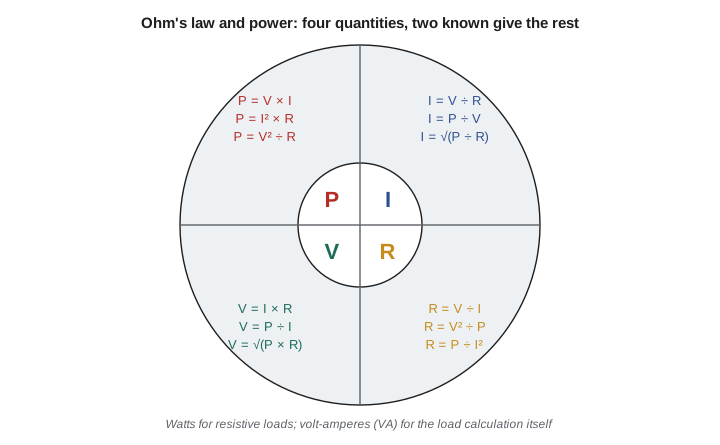
You do not need to memorize all twelve forms on the wheel. Memorize the two root formulas and rearrange. If you know power and voltage, current is power divided by voltage. If you know current and resistance, power is current squared times resistance. The squared forms matter because they explain two things exam writers love: a heater run at reduced voltage makes much less heat than you might guess, and doubling the current in a conductor quadruples the heat produced in it.
Worked problem
A space heater on a branch circuit
A portable heater is rated 1,500 W at 120 V. Find its current and its resistance. Then find the power it produces if the voltage at the receptacle is only 108 V.
Show solution
- Current at rated voltage: I = P ÷ V = 1,500 ÷ 120 = 12.5 A.
- Resistance: R = V ÷ I = 120 ÷ 12.5 = 9.6 Ω. (Or R = V² ÷ P = 14,400 ÷ 1,500 = 9.6 Ω.)
- At 108 V the resistance stays about the same, so P = V² ÷ R = 108² ÷ 9.6 = 11,664 ÷ 9.6 = 1,215 W.
- A 10% drop in voltage cut the heat output by 19%, because power varies with the square of voltage.
Answer: 12.5 A, 9.6 Ω, and about 1,215 W at 108 V.
Look at what the last step assumed: the heater is a simple resistance. That is true of heating elements and incandescent lamps. It is not true of motors, which draw more current when the voltage sags, or of electronic power supplies, which hold their output power roughly constant and draw more current as the voltage falls. Exam questions about reduced voltage almost always involve resistive loads, and the squared relationship is the point being tested.
Watts, volt-amperes and power factor
A load calculation under Article 220 is done in volt-amperes (VA), not watts. For a purely resistive load such as a water heater, the two numbers are the same. For a motor, a fluorescent or LED driver, or a transformer, they are not. Volt-amperes, also called apparent power, is simply voltage times current. Watts, the true power, is the part of that product that actually does work. The ratio between them is the power factor.
Conductors and overcurrent devices respond to current, and current is set by volt-amperes. A 10 kVA load at a power factor of 0.85 delivers only 8.5 kW of useful power, but it draws the full current of 10 kVA. That is why the code works in VA and why the unit loads in Article 220 are expressed in volt-amperes per square foot. When an exam gives you a load in watts and a power factor, convert to VA before you find the current.
Worked problem
A motor-driven load given in watts
Delgado Fabrication has a single-phase 240 V air compressor whose nameplate lists an input of 4,080 W at a power factor of 0.85. What current does it draw?
Show solution
- Apparent power: VA = W ÷ PF = 4,080 ÷ 0.85 = 4,800 VA.
- Current: I = VA ÷ V = 4,800 ÷ 240 = 20 A.
- If you had divided watts by volts you would get 17 A and undersize the circuit.
Answer: 20 A.
Two more words come up with motors. Efficiency is the ratio of output power to input power. A motor nameplate in horsepower describes output: one horsepower is 746 W of shaft power. Input power is output divided by efficiency. For motors, though, the NEC does not want you to work from horsepower and efficiency at all when sizing conductors. Article 430 sends you to the full-load current tables instead, which MELU-105 covers. On a load calculation question, use the table current when the question says to follow the code, and use the physics only when the question asks for the physics.
Worked problem
Input power from output and efficiency
A 7.5 kW pump motor (shaft output) runs at 88% efficiency. What is its electrical input in watts?
Show solution
- Input = output ÷ efficiency = 7,500 ÷ 0.88 = 8,523 W.
- The 1,023 W difference becomes heat in the motor.
Answer: About 8,523 W.
Nominal voltages and the rounding rule
Section 220.5(A) tells you which voltages to use in Article 220 calculations. Unless some other voltage is specified, you compute branch circuit, feeder and service loads at nominal system voltages such as 120, 120/240, 208Y/120, 240, 347, 480Y/277, 480, 600Y/347 and 600 volts. This matters more than it looks. A dryer that a customer swears runs at 230 volts is still calculated at 240 volts. A rooftop unit in a strip mall served at 208Y/120 is calculated at 208 volts, not 240. Using the wrong nominal voltage is one of the most common ways candidates end up with an answer that is not among the choices.
Section 220.5(B) then tells you how to round. Where a calculation produces a fraction of an ampere, a fraction of less than 0.5 may be dropped. Dana's practice exam lost her a question here: she rounded 179.54 A up to 180 A in an early step, carried it forward through three more steps, and ended between two choices. The habit to build is simple. Keep full precision through the calculation, apply the rounding rule once at the end, and round only where the code permits.
| Situation | Use this voltage | Why |
|---|---|---|
| Dwelling service, single phase | 240 V (120 V for line-to-neutral loads) | 120/240 V is the nominal system |
| Restaurant panel in a strip mall | 208 V or 120 V | 208Y/120 V system, not 240 V |
| Machine shop service | 480 V or 277 V | 480Y/277 V system |
| Equipment nameplate says 230 V | the nominal system voltage | Section 220.5(A) |
A first look at voltage drop
Voltage drop is not a load calculation in the Article 220 sense, but master exams often place a voltage drop question right next to a feeder question, and the arithmetic is the same Ohm's law. The NEC treats voltage drop mostly in informational notes, which recommend keeping drop on a branch circuit to about 3% and the combined feeder and branch circuit drop to about 5% for reasonable efficiency. Those notes are advisory, not mandatory, except where a specific rule elsewhere makes them so. Many exams still ask you to compute the drop.
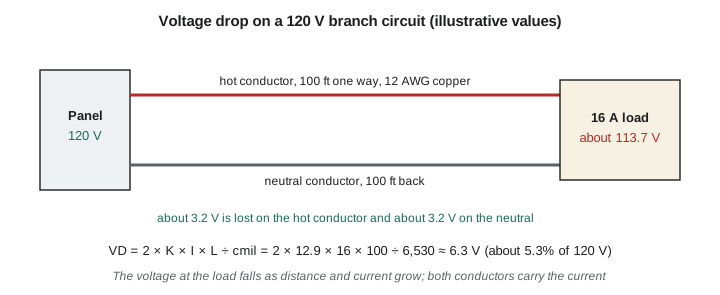
The common shortcut for a single-phase circuit multiplies 2, the conductor resistivity constant K, the current and the one-way length, then divides by the conductor's area in circular mils. K is about 12.9 ohm-circular mils per foot for copper and about 21.2 for aluminum at typical operating temperatures. The circular mil area of each conductor size is listed in Chapter 9, Table 8, which you should look up rather than memorize. For three-phase circuits the factor 2 becomes the square root of 3, about 1.732.
Worked problem
Voltage drop on a long receptacle circuit
Tyler is running a 120 V circuit to a detached workshop 100 ft away. The load is 16 A and the conductors are 12 AWG copper, which Chapter 9 Table 8 lists at about 6,530 circular mils. Find the voltage drop and the voltage at the load.
Show solution
- VD = 2 × 12.9 × 16 × 100 ÷ 6,530 = 41,280 ÷ 6,530 = 6.32 V.
- As a share of 120 V: 6.32 ÷ 120 = 5.3%, above the 3% branch circuit recommendation.
- Voltage at the load: 120 − 6.32 = 113.7 V.
- Moving to 10 AWG (about 10,380 cmil) gives 41,280 ÷ 10,380 = 3.98 V, about 3.3%.
Answer: About 6.3 V of drop, leaving about 113.7 V at the load.
To find the conductor size that keeps the drop under a target, run the formula backward: required circular mils equal 2 × K × I × L divided by the allowed drop in volts. For a 3% target on 120 V the allowed drop is 3.6 V, so the shop circuit would need 41,280 ÷ 3.6 = 11,467 circular mils, which is a little more than 10 AWG provides. In the field Dana would probably accept 10 AWG at 3.3%; on an exam, follow the question's stated target exactly.
A calculator you can edit
Exams do not allow programmable calculators, but practicing with a small script is a good way to check your hand work while you study. The listing below runs the three examples from this lesson. Change the numbers and run it again, then do the same problem by hand and see whether you agree.
def current(va, volts):
    return va / volts

def resistance(volts, amps):
    return volts / amps

def power_at(volts, ohms):
    return volts ** 2 / ohms

def vdrop_1ph(k, amps, length_ft, cmil):
    return 2 * k * amps * length_ft / cmil

i = current(1500, 120)
r = resistance(120, i)
print("Heater:", i, "A,", r, "ohms,", round(power_at(108, r)), "W at 108 V")
print("Compressor:", current(4080 / 0.85, 240), "A")
vd = vdrop_1ph(12.9, 16, 100, 6530)
print("Shop circuit drop:", round(vd, 2), "V =", round(vd / 120 * 100, 1), "% of 120 V")Heater: 12.5 A, 9.6 ohms, 1215 W at 108 V Compressor: 20.0 A Shop circuit drop: 6.32 V = 5.3 % of 120 V
How exam questions dress these up
Few master exams ask a bare Ohm's law question. Instead the formula hides inside a code question. A question might give a heater's wattage and ask for the minimum branch circuit rating, which means finding the current and then applying the continuous load rule from Lesson 3. Another might describe a motor in watts and power factor and ask whether a conductor is large enough. A third might give a load in kVA on a three-phase system and expect you to divide by the voltage times 1.732, which is the subject of the next lesson. In every case the first step is to identify which of the four quantities you know, which one you need, and which nominal voltage applies.
Marcus, Dana's study partner, keeps a one-line checklist on the inside cover of his code book: what is the load in VA, what is the system voltage, is it single phase or three phase, is it continuous, and what does the question want, amperes, VA or a device size. It looks almost too simple to be useful. Run it on every calculation question and it catches most of the traps in this course.
One more habit is worth building now, before the calculations get longer. Estimate the answer before you calculate it. A 1,500 W load at 120 V should be somewhere above 10 A and well below 20 A. A 12 kW range on a 240 V circuit should be roughly 50 A. A whole house of ordinary size usually lands between 100 and 200 A on the standard method. If your careful calculation produces 1,800 A for a house, you have multiplied when you meant to divide or dropped a decimal point, and the estimate tells you so before you choose a wrong answer that happens to be on the list. Exam writers deliberately include the answers produced by the most common slips, so an answer appearing among the choices proves nothing.
Units deserve the same attention. Article 220 mixes volt-amperes, kilovolt-amperes, watts, kilowatts, square feet, linear feet and amperes, sometimes in a single question. Convert everything to volt-amperes and amperes before you combine anything. A range nameplate in kilowatts becomes volt-amperes by multiplying by 1,000; a demand value read in kilowatts from a column of a table needs the same conversion; a feeder current in amperes multiplied by the voltage gives volt-amperes again. Keeping one set of units on scratch paper is how good candidates avoid adding 12 kW to 6,600 VA and getting 6,612.
Finally, notice which formulas the code itself expects you to use and which it does not. Article 220 assumes that the load in volt-amperes divided by the nominal voltage is the current. It does not ask you to account for power factor at the service, for harmonics, or for the exact voltage at the meter. The physics in this lesson is there so that you understand why the code's simple division works and when a question is testing something else. When a question says to calculate the load in accordance with the code, apply the code's method exactly, even where your field experience says the real number would be different.
Common mistakes
MistakeDividing watts by volts for a motor or other load with a power factor below 1.
InsteadConvert to volt-amperes first (W ÷ PF), then divide by the voltage.
MistakeUsing 230 V or the measured voltage because the nameplate shows it.
InsteadUse the nominal system voltage that 220.5(A) lists, unless the question says otherwise.
MistakeRounding in the middle of a calculation and carrying the rounded number forward.
InsteadKeep full precision and round once at the end, as 220.5(B) permits.
MistakeAssuming a heater's output falls in proportion to voltage.
InsteadPower in a resistance varies with the square of voltage: 10% less voltage gives about 19% less power.
MistakeUsing one-way length without the factor of 2 in a single-phase voltage drop.
InsteadCurrent flows out and back, so the single-phase formula doubles the one-way length.
Summary and key terms
- Ohm's law (V = I × R) and the power formula (P = V × I) let you find any of voltage, current, resistance and power from two of them.
- Article 220 calculations are done in volt-amperes; divide watts by the power factor to get volt-amperes when they differ.
- Use the nominal voltages listed in 220.5(A), and round fractions of an ampere only at the end, as 220.5(B) allows.
- Power in a resistance varies with the square of voltage, so small voltage changes make large changes in heat.
- Single-phase voltage drop is 2 × K × I × L ÷ circular mils; three-phase uses 1.732 in place of 2; the 3% and 5% figures are recommendations in informational notes.
- In 2026 NEC adoptions, the load calculation material moves from Article 220 to Article 120.
- Volt-ampere (VA)
- Apparent power: voltage times current, the unit Article 220 uses.
- Power factor
- The ratio of true power in watts to apparent power in volt-amperes.
- Nominal voltage
- The standard system voltage used for calculations, such as 120, 208, 240 or 480 V.
- Efficiency
- The ratio of a machine's output power to its input power.
- Circular mil
- A unit of conductor cross-sectional area used in the voltage drop formula.
- K constant
- The resistivity of the conductor material in ohm-circular mils per foot, about 12.9 for copper.
Practice problems
Work each problem on paper first, then reveal the answer to check.
A 4,500 W water heater operates at 240 V. Find its current and resistance.
Show answer
I = 4,500 ÷ 240 = 18.75 A; R = 240 ÷ 18.75 = 12.8 Ω.
The same water heater is connected at 208 V by mistake. What power does it produce?
Show answer
P = 208² ÷ 12.8 = 43,264 ÷ 12.8 = 3,380 W, about 75% of its rating.
A fluorescent fixture draws 0.9 A at 277 V with a power factor of 0.9. Find its VA and watts.
Show answer
VA = 277 × 0.9 = 249.3 VA; W = 249.3 × 0.9 = 224 W.
Find the voltage drop for a 240 V, 30 A single-phase load 150 ft from the panel on 10 AWG copper (10,380 cmil).
Show answer
VD = 2 × 12.9 × 30 × 150 ÷ 10,380 = 11.2 V, about 4.7% of 240 V.
What circular mil area keeps the drop in the previous problem to 3%?
Show answer
Allowed drop = 7.2 V; cmil = 2 × 12.9 × 30 × 150 ÷ 7.2 = 16,125 cmil, so 8 AWG (about 16,510 cmil).
Lesson quiz · 5 questions
Score 60% or more to complete this lesson.
Create a free account to save your progress, take quizzes and earn a certificate.