
MELU-102 · Lesson 6 of 12 · 27 min
Multifamily dwelling calculations
▶ Video coming soon A video version of this lesson is on the way.
The Maple Street fourplex is the biggest residential job Brightwater has this year: four two-bedroom units of 1,050 square feet each, all electric, with a heat pump in every unit, plus a small amount of common-area load for the stair lights, exterior lights and a heater in the meter room. The developer wants one 120/240 volt service with a meter stack, and he wants to know how big it has to be. Dana already has the load for one unit from Lessons 4 and 5. This lesson combines the units into a building, first by the standard method and then by the multifamily optional method in 220.84, and shows why the two results can differ by 150 amperes or more.
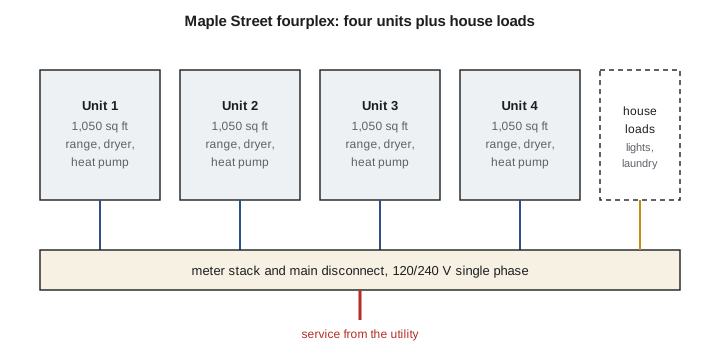
The standard method for a building
The standard method for an apartment building works exactly like the standard method for a house, with one change in spirit: you add up the loads of all the units first, then apply each demand factor to the building total. Because the demand factors in Table 220.42, Table 220.54 and Table 220.55 grow more generous as loads are added together, the building's demand load is much less than four times one unit's load.
Work through the steps with the fourplex's numbers. Each unit has two small-appliance circuits, one laundry circuit, a 1,200 VA dishwasher, an 800 VA disposal, a 4,500 VA water heater, a 4,800 W dryer, a 9.6 kW range, and a heat pump whose 4,200 VA compressor and 5,000 W of supplemental heat can run together. The house loads total 2,400 VA.
Worked problem
Steps 1 to 3: lighting, small appliance and laundry
Find the building's lighting group demand.
Show solution
- General lighting: 4 × 1,050 × 3 = 12,600 VA.
- Small appliance: 4 × 2 × 1,500 = 12,000 VA. Laundry: 4 × 1,500 = 6,000 VA.
- Subtotal: 30,600 VA.
- Demand, with the first 3,000 VA at 100% and the next block at 35%: 3,000 + 0.35 × 27,600 = 3,000 + 9,660 = 12,660 VA.
Answer: 12,660 VA.
Look at what the demand factor did. Four units each had a lighting group subtotal of 7,650 VA. Calculated one at a time, each would get its first 3,000 VA at full value, for 4 × 4,627.5 = 18,510 VA. Calculated together, only the first 3,000 VA of the whole building is at full value, and the total demand drops to 12,660 VA.
Worked problem
Step 4: fixed appliances
Find the demand load of the dishwashers, disposals and water heaters.
Show solution
- Twelve appliances in all, so the 75% factor of 220.53 applies.
- Nameplate total: 4 × (1,200 + 800 + 4,500) = 26,000 VA.
- Demand: 0.75 × 26,000 = 19,500 VA.
Answer: 19,500 VA.
In a single fourplex unit the three appliances did not qualify for the 75% factor. In the building they do, because 220.53 counts the appliances on the feeder or service you are calculating.
Worked problem
Steps 5 and 6: dryers and ranges
Find the demand load of the four dryers and the four 9.6 kW ranges.
Show solution
- Each dryer is taken at 5,000 VA, the larger of 5,000 and its 4,800 W nameplate: 4 × 5,000 = 20,000 VA.
- Table 220.54 takes small numbers of dryers at full value; with four, the demand stays 20,000 VA in this example (check the table for larger numbers).
- Ranges: Table 220.55 gives a combined demand for four ranges of not over 12 kW each. This course's example uses 17 kW, the table's main-column value for four ranges; check it in your edition.
- Range demand: 17,000 VA, compared with 4 × 8,000 = 32,000 VA if each were taken alone.
Answer: 20,000 VA for dryers and 17,000 VA for ranges.
Worked problem
Steps 7 to 9: heating, house loads and total
Finish the standard method calculation for the building.
Show solution
- Heating: 4 × (4,200 + 5,000) = 36,800 VA, larger than the cooling load of 4 × 4,200 = 16,800 VA.
- House loads: 2,400 VA.
- Total: 12,660 + 19,500 + 20,000 + 17,000 + 36,800 + 2,400 = 108,360 VA.
- Current: 108,360 ÷ 240 = 451.5 A.
Answer: About 451.5 A by the standard method.
Heating is the biggest single item, and it gets no demand factor in the standard method. Every unit's heat pump and strip heat are counted at full value. That is the reason the multifamily optional method, which reduces the heating load along with everything else, makes such a difference for all-electric buildings.
The optional method for multifamily buildings
Section 220.84 offers an optional calculation for a building with three or more dwelling units. It applies only when every unit is supplied by a single feeder, every unit has electric cooking equipment, and every unit has electric space heating, air conditioning or both. A note in the section lets you use it where the cooking equipment is gas if you substitute the load of a standard electric range, but the usual exam question describes an all-electric building and asks for the optional result.
The method is short. For each unit, add up the connected load the way the dwelling optional method does: lighting at the floor area value, 1,500 VA for each small-appliance and laundry circuit, every fastened-in-place appliance, range, dryer and water heater at nameplate, permanently connected motors, and the larger of the heating or air-conditioning load. Multiply by the number of units to get the building's connected load, then apply the single demand factor that Table 220.84 assigns to that number of units. House loads are calculated separately by the standard method and added at the end.
Worked problem
The fourplex by the multifamily optional method
Find the building's load using 220.84. This course's example uses 45% as the Table 220.84 factor for four units; confirm it in your edition.
Show solution
- Per unit: lighting 3,150 + small appliance and laundry 4,500 + dishwasher 1,200 + disposal 800 + water heater 4,500 + dryer 4,800 + range 9,600 = 28,550 VA.
- Add the larger of heating (4,200 + 5,000 = 9,200 VA) or cooling (4,200 VA): 28,550 + 9,200 = 37,750 VA per unit.
- Building connected load: 4 × 37,750 = 151,000 VA.
- Demand: 0.45 × 151,000 = 67,950 VA.
- Add house loads by the standard method: 67,950 + 2,400 = 70,350 VA.
- Current: 70,350 ÷ 240 = 293.1 A.
Answer: About 293.1 A by the optional method.
| Method | Building load | Service current |
|---|---|---|
| Standard method (Part III) | 108,360 VA | 451.5 A |
| Multifamily optional method (220.84) | 70,350 VA | 293.1 A |
The developer was pleased: a 400-ampere service with a meter stack satisfies the optional calculation, where the standard method would have pushed him to a larger service. The Table 220.84 factor shrinks as the number of units grows, so the optional method's advantage is even bigger for large buildings.
Feeders to the individual units
The building calculation sizes the service. Each unit also needs its own feeder from the meter stack to its panel, and that feeder is calculated as a single dwelling unit, by either the standard method of Lesson 4 or the single-dwelling optional method of Lesson 5. The fourplex unit came to 138.9 A by the standard method and 103.6 A by the optional method, so a 150-ampere feeder would satisfy the first and a 125-ampere feeder the second.
Section 310.12 lets a dwelling unit's service or main feeder conductors be sized at 83% of the rating of the service or feeder. That rule applies to each unit's main feeder, not to the building's service conductors, which carry the combined load of several units and the house loads. Exam questions test this by asking for the size of a unit feeder and the size of the building service in the same question.
Unequal ranges and other variations
Real buildings rarely have identical units. When units have different floor areas, add each unit's area. When the ranges are of different ratings, the notes to Table 220.55 tell you how to adjust: for ranges all over 12 kW but under a certain size, average them to an equivalent rating; for a mix, convert each smaller one to 12 kW before averaging. When some units have more small-appliance circuits than others, count the actual circuits. None of this changes the structure of the calculation; it only changes the numbers you feed into each step.
Mixed-use buildings, with shops on the ground floor and apartments above, are calculated in parts. The dwelling units are calculated by the dwelling methods and the commercial spaces by the nondwelling rules of Lesson 7, and the parts are added for the service. Lesson 12's practice set includes one.
def standard_building(units, sqft, sa, laundry, fixed_each, dryer_w, range_demand, heat_each, cool_each, house):
    light = units * (sqft * 3 + 1500 * (sa + laundry))
    light_d = min(light, 3000) + 0.35 * max(light - 3000, 0)        # example factors
    fixed = units * sum(fixed_each) * (0.75 if units * len(fixed_each) >= 4 else 1)
    dryers = units * max(dryer_w, 5000)                              # small counts at full value
    hvac = units * max(heat_each, cool_each)
    return light_d + fixed + dryers + range_demand + hvac + house

def optional_building(units, per_unit_connected, factor, house):
    return units * per_unit_connected * factor + house

std = standard_building(4, 1050, 2, 1, [1200, 800, 4500], 4800, 17000, 9200, 4200, 2400)
opt = optional_building(4, 28550 + 9200, 0.45, 2400)
print("Standard:", std, "VA =", round(std / 240, 1), "A")
print("Optional:", opt, "VA =", round(opt / 240, 1), "A")Standard: 108360.0 VA = 451.5 A Optional: 70350.0 VA = 293.1 A
Reading a multifamily exam question
Multifamily questions are long, and the length hides the question being asked. Before calculating, Dana underlines four things in the stem: how many units, whether they are identical, whether the question names a method, and what the answer must be, the building service, a unit feeder or the neutral. A question that gives twenty units and asks for the feeder to one apartment needs only one unit's calculation. A question that gives three units and says all electric probably wants the optional method, and if it does not say which method to use, the safe reading is the standard method unless the answer choices make the intent obvious.
Watch for the conditions of 220.84 as well. If the question says the apartments have gas ranges and gas heat with no air conditioning, the optional method does not apply as written, because the units lack electric space heating and air conditioning. If it says one unit is fed by two feeders, the method is not available. Exam writers include those details deliberately, and they are easy to skim past.
Finally, a word about the house loads, which candidates often mishandle. In the standard method they are simply added with the other loads. In the multifamily optional method they are calculated separately by the standard method and added after the Table 220.84 factor has been applied to the units. If the house loads include common laundry equipment or an elevator, those items follow their own rules: the laundry dryers by 220.54 and the elevator motor by Article 620. Leaving the house loads out entirely, or multiplying them by the optional factor, are both common wrong answers on exams.
Common mistakes
MistakeMultiplying one unit's standard method load by the number of units.
InsteadAdd the units' loads by category first, then apply the demand factors to the building totals.
MistakeApplying the Table 220.84 factor to the house loads.
InsteadCalculate house loads by the standard method and add them after the factor.
MistakeUsing 220.84 for a building whose units have gas heat and no air conditioning.
InsteadThe method requires electric heating, air conditioning or both in each unit.
MistakeLeaving heating out of each unit's connected load in 220.84.
InsteadInclude the larger of heating or cooling in each unit's connected load.
MistakeApplying the 83% rule of 310.12 to the whole building's service conductors.
InsteadIt applies to a dwelling unit's own service or main feeder.
Summary and key terms
- For a multifamily building by the standard method, total each category across all units, then apply the demand factors.
- Combining units makes the lighting, appliance, dryer and range demand factors more favorable, but heating stays at 100%.
- The optional method of 220.84 applies to three or more units, each on a single feeder with electric cooking and electric heat or air conditioning.
- In 220.84, each unit's connected load includes all appliances at nameplate plus the larger of heating or cooling; the building total gets one factor from Table 220.84.
- House loads are calculated by the standard method and added after the 220.84 factor.
- Each unit's feeder is calculated as a single dwelling; the 83% rule of 310.12 applies to those feeders, not to the building service.
- Multifamily dwelling
- A building containing three or more dwelling units.
- House loads
- Common-area loads in a multifamily building, such as hall lighting and laundry rooms.
- Meter stack
- An assembly of meter sockets and disconnects serving several units from one service.
- Connected load
- The total of the ratings of all equipment connected to a feeder or service.
- Feeder
- The conductors between the service equipment and the final branch circuit overcurrent devices.
- Table 220.84
- The table of demand factors for the multifamily optional method, by number of units.
Practice problems
Work each problem on paper first, then reveal the answer to check.
Six identical units each have a lighting group subtotal of 7,650 VA. Find the building's lighting group demand.
Show answer
45,900 VA; 3,000 + 0.35 × 42,900 = 18,015 VA.
A building's units have 20 fixed appliances totaling 60,000 VA. Find their demand load.
Show answer
0.75 × 60,000 = 45,000 VA.
Five all-electric units each have a connected load of 32,000 VA. Using a factor of 45%, find the demand before house loads.
Show answer
160,000 × 0.45 = 72,000 VA.
Add 3,600 VA of house loads to the previous building. Find the service current at 120/240 V.
Show answer
75,600 ÷ 240 = 315 A.
A unit's feeder is rated 150 A. What minimum conductor ampacity does 310.12 allow?
Show answer
0.83 × 150 = 124.5 A.
Lesson quiz · 5 questions
Score 60% or more to complete this lesson.
Create a free account to save your progress, take quizzes and earn a certificate.