
MELU-102 · Lesson 11 of 12 · 25 min
Existing installations and added loads
▶ Video coming soon A video version of this lesson is on the way.
Much of Brightwater's work is not new construction. It is adding something to a building that already has a service: a vehicle charger in an older house, a heat pump replacing a gas furnace, a new tenant in a strip mall. Each of those jobs asks the same question. Can the existing service carry the new load? Article 220 gives two ways to answer it without pretending the building is brand new. Section 220.87 lets you use the measured maximum demand of an existing service, and 220.83 offers an optional method for an existing dwelling. This lesson uses both, along with the energy management provisions that can let a new load fit where it otherwise would not.
Using measured demand: 220.87
Section 220.87 lets you determine the existing load of a feeder or service from real data instead of a calculation. If maximum demand data for a one-year period is available, you take the highest demand recorded in that year at 125% and add the new load calculated under Article 220. If a year of data is not available, you may use the maximum demand measured over a 30-day period by a recording meter that averages the load over 15-minute intervals, again at 125%, adjusted to reflect any seasonal loads such as heating or cooling that were not running during the recording. The method applies only where the feeder or service has overcurrent protection in accordance with the code, and the section has conditions for buildings with on-site generation or peak load shaving that you should check in your edition.
The 125% factor is a safety margin for the fact that one year's peak may not be the building's worst. Utilities usually keep demand data for commercial accounts, so the landlord or owner can request it. For a house, a utility may have interval data from a smart meter, or the electrician can install a recording meter for 30 days.
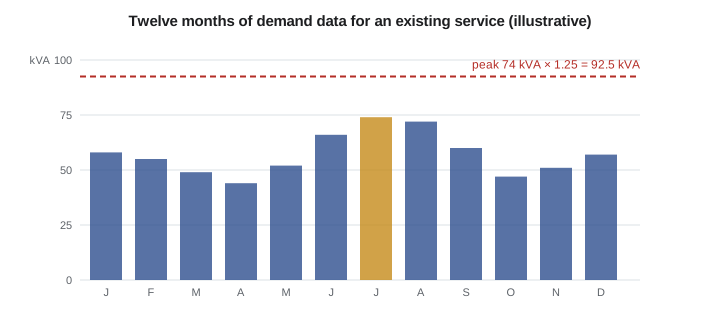
Worked problem
Adding two tenants to Harlow Commons
The Harlow Commons building service is 800 A at 208Y/120 V three phase. The utility's demand records show a peak of 74 kVA in July over the last twelve months, with the two end units vacant. The new tenants' calculated loads are 80,770 VA for the Copper Kettle and 34,525 VA for Lakeview Outfitters. Is the service adequate?
Show solution
- Existing load: 1.25 × 74,000 = 92,500 VA.
- New loads: 80,770 + 34,525 = 115,295 VA.
- Total: 92,500 + 115,295 = 207,795 VA.
- Current: 207,795 ÷ 360.3 = 576.8 A.
- Service capacity: 800 A, so the service is adequate.
Answer: About 577 A, within the 800 A service.
Without the demand data, Dana would have had to calculate the load of the four occupied units from scratch, with all the conservative assumptions that entails, and the total would almost certainly have been much higher. Measured demand reflects how the building really behaves. That is also its weakness: if a tenant's business changes, the old data no longer describes the building, which is why the 125% margin is required.
Worked problem
A 30-day recording instead of a year of data
A small office building has no utility demand history because it was recently converted from a warehouse. Dana installs a recording meter for 30 days in October. The highest 15-minute average is 41 kVA. The building has electric heat that did not run during the recording, rated 24 kVA. A 15 kVA load is being added. Find the load.
Show solution
- Recorded peak at 125%: 1.25 × 41,000 = 51,250 VA.
- Seasonal adjustment: the electric heat was off, so its load must be accounted for. Adding it at its rating: 51,250 + 24,000 = 75,250 VA.
- New load: 15,000 VA. Total: 90,250 VA.
Answer: About 90,250 VA.
How to adjust for seasonal loads is a judgment the section leaves to the designer and the inspector; the conservative approach in this example adds the full heating load to the recorded peak. On an exam, follow the adjustment the question describes.
The optional method for existing dwellings: 220.83
Section 220.83 gives a simplified calculation for adding loads to an existing dwelling unit. It has two versions. Section 220.83(A) applies where no additional air conditioning or electric space heating is being installed, and 220.83(B) applies where it is. In both, the load includes the general lighting at the floor area value, 1,500 VA for each small-appliance and laundry circuit, and the nameplate ratings of the fixed appliances, ranges, ovens, cooktops, dryers and water heaters. The first 8 kVA of that load is taken at 100% and the remainder at 40%. In version (B), the air conditioning or heating is added at 100% on top.
Compare that with the new-dwelling optional method of Lesson 5, which takes the first 10 kVA at 100%. The existing-dwelling method starts the 40% factor sooner, because it is meant for adding loads to a house whose real use is already known in a general way. Exam questions sometimes test whether you used 8 kVA or 10 kVA.
Worked problem
An EV charger and heat pump in an older house
The Morales house in the Westgate neighborhood is 1,600 sq ft with a 100 A, 120/240 V service. It has two small-appliance circuits and one laundry circuit, a 10 kW range, a 5 kW dryer, a 4.5 kW water heater and a 1.2 kW dishwasher. The owners want to add a 32 A (7,680 VA) EV charger and a 6,000 VA heat pump, with no electric resistance backup. Is the service adequate under 220.83(B)?
Show solution
- Lighting: 1,600 × 3 = 4,800 VA. Small appliance and laundry: 3 × 1,500 = 4,500 VA.
- Appliances at nameplate: 10,000 + 5,000 + 4,500 + 1,200 = 20,700 VA.
- EV charger: 7,680 VA. Other loads total: 4,800 + 4,500 + 20,700 + 7,680 = 37,680 VA.
- Demand: 8,000 + 0.40 × 29,680 = 8,000 + 11,872 = 19,872 VA.
- Heat pump at 100%: 6,000 VA. Total: 25,872 VA.
- Current: 25,872 ÷ 240 = 107.8 A, more than the 100 A service.
Answer: About 107.8 A, so the 100 A service is not adequate as planned.
Energy management: making a load fit
The Morales family does not want to pay for a service upgrade if they can avoid it. The 2023 edition gives them an option. Section 625.42 lets the load of electric vehicle supply equipment be set by an energy management system that limits its current, and 220.70 recognizes energy management systems in load calculations, under conditions in 750.30. In plain terms, if a listed system monitors the service and automatically reduces the charger's current so that the service is never overloaded, the charger may be calculated at the maximum current the system allows rather than at its full rating.
Worked problem
How far must the charger be limited?
Find the largest charger load that keeps the Morales calculation within 100 A (24,000 VA).
Show solution
- Other loads without the charger: 37,680 − 7,680 = 30,000 VA.
- Requirement: 8,000 + 0.40 × (22,000 + x) + 6,000 ≤ 24,000, where x is the charger load.
- 8,000 + 8,800 + 0.4x + 6,000 ≤ 24,000, so 0.4x ≤ 1,200 and x ≤ 3,000 VA.
- At 240 V, 3,000 VA is 12.5 A. A charger limited to 12 A (2,880 VA) gives a total of 23,952 VA, or 99.8 A.
Answer: The charger must be limited to about 12 A unless the energy management system is set to respond to the actual service load.
A charger limited to 12 amperes adds about 9 or 10 miles of range per hour, which is enough for many households that charge overnight. A smarter system that watches the whole service can let the charger run faster when the range and dryer are idle and slow it when they are on. That is how the code expects such a system to work, and it is why the section requires a listed system rather than a hand-set limit.
Other approaches to existing loads
Not every addition needs a full calculation. Adding a single small load to a service with obvious spare capacity is usually handled with judgment and a quick check. When the margin is thin, the measured-demand method of 220.87 or the existing-dwelling method of 220.83 gives a defensible number for the permit. For a house, a load calculation by the standard or new-dwelling optional method may also be used, treating the house as if it were new, which is often the most conservative answer.
One more rule matters when adding loads to an existing building: the new load's branch circuits and the feeders that serve them must meet today's code, even if the rest of the building does not. A charger added to a 1970s house still needs a branch circuit sized at 125% under Article 625, ground-fault protection where required, and a disconnecting means where required. The load calculation decides whether the service can carry it; the rest of the code decides how it is wired.
| Situation | Method | Key numbers |
|---|---|---|
| Existing commercial service, demand data available | 220.87 | 1.25 × one-year peak (or 30-day, 15-minute peak) + new load |
| Existing dwelling, no added heating or A/C | 220.83(A) | First 8 kVA at 100%, rest at 40% |
| Existing dwelling, adding heating or A/C | 220.83(B) | Same, plus heating or A/C at 100% |
| EV charger with energy management | 625.42, 220.70 | Calculate at the managed maximum current |
def existing_dwelling(other_loads, hvac=0):
    return min(other_loads, 8000) + 0.40 * max(other_loads - 8000, 0) + hvac

def measured_demand(peak_va, new_va):
    return 1.25 * peak_va + new_va

total = existing_dwelling(4800 + 4500 + 20700 + 7680, 6000)
print("Morales as planned:", total, "VA =", round(total / 240, 1), "A")
total = existing_dwelling(4800 + 4500 + 20700 + 2880, 6000)
print("With a 12 A managed charger:", total, "VA =", round(total / 240, 1), "A")
va = measured_demand(74000, 80770 + 34525)
print("Harlow Commons:", va, "VA =", round(va / (208 * 3 ** 0.5), 1), "A")Morales as planned: 25872.0 VA = 107.8 A With a 12 A managed charger: 23952.0 VA = 99.8 A Harlow Commons: 207795.0 VA = 576.8 A
How these questions are worded
Questions on existing installations often hide the method choice in the story. A question that mentions a utility bill, a demand meter or a twelve-month history is pointing at 220.87. A question about adding a hot tub or a charger to an existing house, with no mention of measured data, is pointing at 220.83. A question that says a heat pump replaces a gas furnace is adding heating and cooling, so it needs version (B) of 220.83. Each of these is a single sentence in a long stem, which is why Dana reads every stem twice before choosing.
The arithmetic differences between the methods are worth memorizing as a set. The new-dwelling optional method splits at 10 kVA; the existing-dwelling method splits at 8 kVA. The measured-demand method multiplies the peak by 1.25 and adds the new load at its calculated value. The energy management rules let a managed load be counted at the limit the system enforces. If you can state those four facts from memory, you can work nearly any existing-load question the exam offers.
Common mistakes
MistakeUsing the average demand from utility records.
InsteadUse the highest demand in the period, at 125%.
MistakeAdding new loads at 125% as well as the existing peak.
InsteadOnly the existing peak gets the 125% factor; new loads are added as calculated under Article 220.
MistakeUsing 10 kVA as the 100% block in the existing-dwelling method.
InsteadSection 220.83 takes the first 8 kVA at 100%.
MistakeUsing 220.83(A) when a heat pump is being added.
InsteadAdding heating or air conditioning calls for 220.83(B), with that equipment at 100%.
MistakeLimiting a charger with a simple dial setting and calculating it at that value.
InsteadUse a listed energy management system as 625.42 and 750.30 describe.
Summary and key terms
- Section 220.87 sets an existing load at 125% of the highest demand in one year, or of a 30-day, 15-minute recorded peak, plus the new load.
- Measured demand reflects how the building is really used, which usually gives a smaller existing load than a calculation.
- Section 220.83 takes an existing dwelling's loads at 100% for the first 8 kVA and 40% for the rest.
- Where heating or air conditioning is added, 220.83(B) adds it at 100%.
- A listed energy management system can let an EV charger be calculated at its managed maximum under 625.42 and 220.70.
- New circuits added to an old building must meet the current code even if the building does not.
- Maximum demand
- The highest average load over a demand interval, such as 15 minutes, in a given period.
- Demand interval
- The period over which a meter averages load to record demand, often 15 minutes.
- Recording meter
- A meter that logs demand over time, used for the 30-day method.
- Energy management system
- Equipment that monitors and controls loads to keep demand within a limit.
- Peak load shaving
- Reducing demand peaks with on-site generation, storage or load control.
- Existing dwelling unit
- A dwelling already in service, to which loads are being added.
Practice problems
Work each problem on paper first, then reveal the answer to check.
A building's one-year peak demand is 120 kVA. A 40 kVA load is added. Find the new load.
Show answer
1.25 × 120 + 40 = 190 kVA.
Is a 600 A, 208Y/120 V service adequate for the previous building?
Show answer
190,000 ÷ 360.3 = 527.3 A, so yes.
An existing dwelling's other loads total 30,000 VA and no heating or A/C is added. Find the load.
Show answer
8,000 + 0.4 × 22,000 = 16,800 VA; ÷ 240 = 70 A.
Add a 5,000 VA air conditioner to the previous house under 220.83(B).
Show answer
16,800 + 5,000 = 21,800 VA; ÷ 240 = 90.8 A.
What largest charger load keeps a 26,000 VA other-load house with a 4,000 VA heat pump within 100 A?
Show answer
8,000 + 0.4(18,000 + x) + 4,000 ≤ 24,000 gives x ≤ 12,000 VA.
Lesson quiz · 5 questions
Score 60% or more to complete this lesson.
Create a free account to save your progress, take quizzes and earn a certificate.