
MELU-102 · Lesson 5 of 12 · 23 min
The optional method for dwelling units
▶ Video coming soon A video version of this lesson is on the way.
When Dana showed Ray her standard method result for Helen Brandt's house, 179.5 amperes, he nodded and then asked a question that surprised her. Could the house stay on a 150-ampere service after all? Not by the standard method. But Article 220 offers a second way to calculate a single dwelling, the optional method in Part IV, and for houses with large electric loads it usually produces a smaller number. Whether it is the right number for Helen depends on more than arithmetic, but on an exam the question is simpler: can you run the method correctly, and do you know when it is permitted?
This lesson covers the optional calculation for a dwelling unit in 220.82, the conditions for using it, how it treats heating and cooling, and how its result compares with the standard method. Lesson 6 covers the optional method for multifamily buildings in 220.84, and Lesson 11 covers the optional method for existing dwellings in 220.83.
When you may use it
Section 220.82(A) allows the optional method for a single dwelling unit served by one set of 120/240 volt or 208Y/120 volt three-wire service or feeder conductors with an ampacity of 100 amperes or more. That covers almost every house. It is a choice, not a requirement: the code says the load may be calculated this way instead of by the standard method, and either result is acceptable to the inspector. On an exam, use the optional method only when the question tells you to, or when it asks for the smallest permitted service and the conditions are met.
The method does not apply to a whole apartment building, which has its own optional method, and it does not apply to a dwelling fed by a two-wire service. It also does not reduce any branch circuit; it is a feeder and service calculation only.
The two halves of the calculation
The optional method splits the house's load into two groups. The general loads in 220.82(B) are added at nameplate and then reduced with one simple demand factor. The heating and air-conditioning load in 220.82(C) is chosen from a short list of possibilities and added on top. The structure is much shorter than the standard method, which is part of its appeal.
General loads
The general loads include four groups. First, the general lighting and general-use receptacle load at the dwelling unit value per square foot, the same floor area figure as the standard method. Second, 1,500 VA for each two-wire small-appliance circuit and each laundry circuit. Third, the nameplate ratings of all appliances that are fastened in place, permanently connected or on a specific circuit, including ranges, wall ovens, cooktops, dryers, water heaters and, in this course's examples, the EV charger. Fourth, the nameplate rating of permanently connected motors not already included. A close reading of the list shows the main difference from the standard method: nothing is reduced item by item. The range goes in at its full nameplate, not 8 kW; the dryer goes in at its nameplate, even if that is less than 5,000 VA; and every fixed appliance goes in at 100%, however many there are.
The total of the general loads is then taken at 100% for the first 10 kVA and 40% for the remainder.
Worked problem
General loads for the Brandt house
Helen's house: 2,200 sq ft; two small-appliance circuits and one laundry circuit; dishwasher 1,200 VA, disposal 900 VA, water heater 4,500 VA, built-in microwave 1,500 VA, dryer 5,500 W, range 12 kW and an EV charger at 7,680 VA. Find the general load after the demand factor.
Show solution
- Lighting: 2,200 × 3 = 6,600 VA.
- Small appliance and laundry: 3 × 1,500 = 4,500 VA.
- Appliances at nameplate: 1,200 + 900 + 4,500 + 1,500 + 5,500 + 12,000 + 7,680 = 33,280 VA.
- General loads: 6,600 + 4,500 + 33,280 = 44,380 VA.
- Demand: 10,000 + 0.40 × 34,380 = 10,000 + 13,752 = 23,752 VA.
Answer: 23,752 VA.
Heating and cooling
Section 220.82(C) lists several ways to count heating and air-conditioning equipment, and you use the largest one that applies to the house. The list includes air-conditioning and cooling equipment at 100% of nameplate; a heat pump without supplemental heat at 100%; a heat pump compressor at 100% together with central supplemental heat at a reduced value, unless the controls prevent them from running together; electric space heating at a reduced value when there are fewer than four separately controlled units; electric space heating at a lower value again when there are four or more separately controlled units; and electric thermal storage and other heating whose usual load is continuous at 100%. This course's examples use 65% for fewer than four units and for central supplemental heat, and 40% for four or more units. Check those values in your edition, because they appear on exams constantly.
Separately controlled means each heater has its own thermostat. Helen's 10 kW of baseboard heat is in five rooms, each with its own thermostat, so it counts as four or more separately controlled units.
Worked problem
Heating or cooling for the Brandt house
Compare Helen's 10,000 W of baseboard heat in five separately controlled rooms with her 6,720 VA central air conditioner.
Show solution
- Space heating, four or more units: 0.40 × 10,000 = 4,000 VA.
- Air conditioning at 100%: 6,720 VA.
- Use the larger: 6,720 VA.
Answer: 6,720 VA.
The comparison came out the opposite way from the standard method, where the heat at 100% beat the air conditioner. That reversal is common: the optional method's reduced factors for space heating reflect the fact that baseboard heaters in separate rooms cycle independently and seldom all draw full power together.
Putting it together
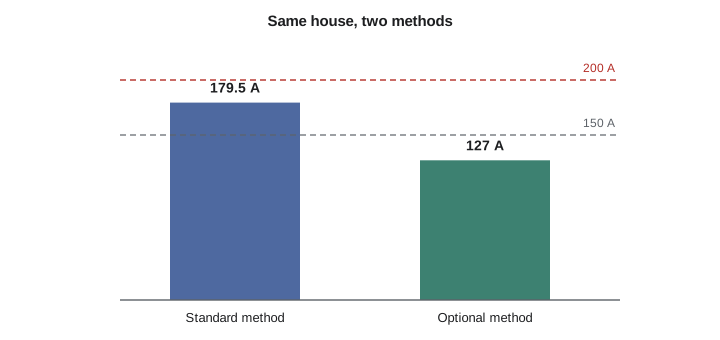
By the optional method Helen's house calculates at 127 amperes, comfortably under her existing 150-ampere service. The inspector would accept that calculation. Whether Ray recommends keeping the 150-ampere service is a separate question: the house is going all-electric, and a second vehicle or a hot tub would push it over. On an exam, though, the question is what the code permits, and the answer is that a 150-ampere service satisfies the optional calculation.
| Item | Standard method | Optional method |
|---|---|---|
| Range, 12 kW | 8,000 VA (table value) | 12,000 VA (nameplate) |
| Dryer, 5,500 W | 5,500 VA | 5,500 VA |
| Four fixed appliances | 75% of 8,100 = 6,075 VA | 100% = 8,100 VA |
| Lighting group demand | Table 220.42 factors | Inside the 10 kVA and 40% rule |
| Heating or cooling | Heat at 100% = 10,000 VA | A/C at 100% = 6,720 VA |
| Result | 43,090 VA = 179.5 A | 30,472 VA = 127.0 A |
Worked problem
A fourplex unit by the optional method
Run the Lesson 4 fourplex unit (1,050 sq ft, two small-appliance and one laundry circuit, dishwasher 1,200 VA, disposal 800 VA, water heater 4,500 VA, dryer 4,800 W, range 9.6 kW, heat pump compressor 4,200 VA with 5,000 W of central supplemental heat that can run with it) by the optional method.
Show solution
- General loads: 3,150 + 4,500 + 1,200 + 800 + 4,500 + 4,800 + 9,600 = 28,550 VA.
- Demand: 10,000 + 0.40 × 18,550 = 17,420 VA.
- Heating: compressor at 100% plus supplemental heat at 65%: 4,200 + 3,250 = 7,450 VA, larger than the 4,200 VA cooling load.
- Total: 17,420 + 7,450 = 24,870 VA; 24,870 ÷ 240 = 103.6 A.
Answer: About 103.6 A, compared with 138.9 A by the standard method.
Comparisons like this one show the general pattern. The optional method rewards houses with many large appliances, because the 40% factor applies to all of them together, while the standard method reduces only some loads and counts the range at a fixed table value. For a small house with gas appliances the two methods can come out close, and occasionally the standard method gives the smaller answer.
Two dwelling units on one feeder
Section 220.85 adds one more option that exam writers like. Where two dwelling units are supplied by a single feeder and the calculated load by the standard method exceeds that for three identical units calculated by the multifamily optional method of 220.84, the lesser of the two loads may be used. In practice this lets a duplex use the multifamily optional method, which Lesson 6 covers.
def optional_dwelling(sqft, sa_laundry, appliances, hvac_options):
    general = sqft * 3 + 1500 * sa_laundry + sum(appliances)
    demand = min(general, 10000) + 0.40 * max(general - 10000, 0)
    total = demand + max(hvac_options)
    return general, total, total / 240

g, t, a = optional_dwelling(2200, 3, [1200, 900, 4500, 1500, 5500, 12000, 7680],
                            [6720, 0.40 * 10000])
print("Brandt house: general", g, "VA; total", t, "VA =", round(a, 1), "A")
g, t, a = optional_dwelling(1050, 3, [1200, 800, 4500, 4800, 9600],
                            [4200, 4200 + 0.65 * 5000])
print("Fourplex unit: general", g, "VA; total", t, "VA =", round(a, 1), "A")Brandt house: general 44380 VA; total 30472.0 VA = 127.0 A Fourplex unit: general 28550 VA; total 24870.0 VA = 103.6 A
Choosing between the methods in practice
In Harlow, Gloria accepts either calculation on a permit, and so do most inspectors. Ray's habit is to run both and use the optional result when an existing service is in question, because it can save a customer the cost of an upgrade they do not need. For new construction, where the service is sized once and has to last decades, he often installs more capacity than either method requires. The exam never asks which you would prefer; it asks you to carry out the method it names.
A few situations make the optional method unavailable or less useful. A house fed by a two-wire 120-volt service, rare now but still tested, does not qualify. A dwelling whose service conductors have an ampacity under 100 amperes does not qualify. And a house with a single very large continuous load, such as a big electric boiler that the method would count at 100% anyway, may see little difference between the two methods. When a question gives you one of those situations, the expected answer is the standard method.
Exam writers also test the optional method's vocabulary. Separately controlled means each space heater has its own thermostat, not that they are on separate circuits. Nameplate rating means the value printed on the equipment, which for a range is in kilowatts and for an air conditioner may be given in amperes that you convert to volt-amperes at 240 volts. Supplemental heat means the electric resistance strips in a heat pump's air handler. When a question uses one of these terms, it is telling you which line of 220.82(C) to use.
A last practical point: the optional method's result is only as good as the nameplates behind it. Before relying on it for an existing service, Dana walks the house and reads the actual nameplates of the range, dryer, water heater and air conditioner, because older appliances are often larger than a homeowner remembers, and a replacement water heater may have been installed at a higher rating. Ten minutes with a flashlight can change a calculation by twenty amperes.
Common mistakes
MistakeApplying the Table 220.55 range demand in the optional method.
InsteadThe optional method takes the range at its nameplate rating; only the 10 kVA and 40% split reduces it.
MistakeApplying the 5,000 VA minimum to a smaller dryer.
InsteadThe optional method uses the dryer's nameplate rating.
MistakeAdding both heating and cooling.
InsteadUse only the largest value from the 220.82(C) list.
MistakeUsing the optional method for a whole apartment building.
InsteadUse 220.84 for multifamily buildings; 220.82 is for one dwelling unit.
MistakeCounting space heaters as one unit when each room has its own thermostat.
InsteadEach separately controlled heater counts toward the four-or-more threshold.
Summary and key terms
- The optional method in 220.82 may be used for a single dwelling unit served by 120/240 V or 208Y/120 V three-wire conductors of 100 A or more.
- General loads include lighting by floor area, 1,500 VA per small-appliance and laundry circuit, and every fixed appliance and motor at nameplate.
- The general loads are taken at 100% for the first 10 kVA and 40% for the remainder.
- Heating and cooling are added as the single largest value from the 220.82(C) list, such as A/C at 100% or four or more space heaters at a reduced value.
- The optional method usually gives a smaller result than the standard method for houses with large electric appliances.
- Section 220.85 lets two dwelling units on one feeder use the multifamily optional method where it gives the lesser load.
- Optional method
- The Part IV method of Article 220 for calculating dwelling loads with simplified demand factors.
- Nameplate rating
- The rating marked on equipment by the manufacturer.
- Separately controlled
- Having its own thermostat or control, as for individual room heaters.
- General loads
- In 220.82(B), the lighting, small-appliance, laundry, appliance and motor loads added at nameplate.
- Heat pump
- Equipment that moves heat for heating or cooling using a refrigeration cycle.
- Electric thermal storage
- Heating equipment that stores heat when power is cheap and releases it later.
Practice problems
Work each problem on paper first, then reveal the answer to check.
A house's general loads total 30,000 VA. Find the demand load before heating and cooling.
Show answer
10,000 + 0.40 × 20,000 = 18,000 VA.
Add a 5,000 VA air conditioner to the previous house. Find the total in amperes.
Show answer
23,000 ÷ 240 = 95.8 A.
A house has 8 kW of baseboard heat in three separately controlled rooms. What heating value is used?
Show answer
Fewer than four units: 0.65 × 8,000 = 5,200 VA.
May the optional method be used for a 12-unit apartment building's service?
Show answer
Not 220.82; use 220.84 for multifamily.
A house has general loads of 25,000 VA and a heat pump of 4,800 VA with 7,500 W of supplemental heat that can run together. Find the total.
Show answer
16,000 + 4,800 + 0.65 × 7,500 = 25,675 VA; ÷ 240 = 107.0 A.
Lesson quiz · 5 questions
Score 60% or more to complete this lesson.
Create a free account to save your progress, take quizzes and earn a certificate.