
LAWU-211 · Lesson 9 of 12 · 20 min
Judicial review
▶ Video coming soon A video version of this lesson is on the way.
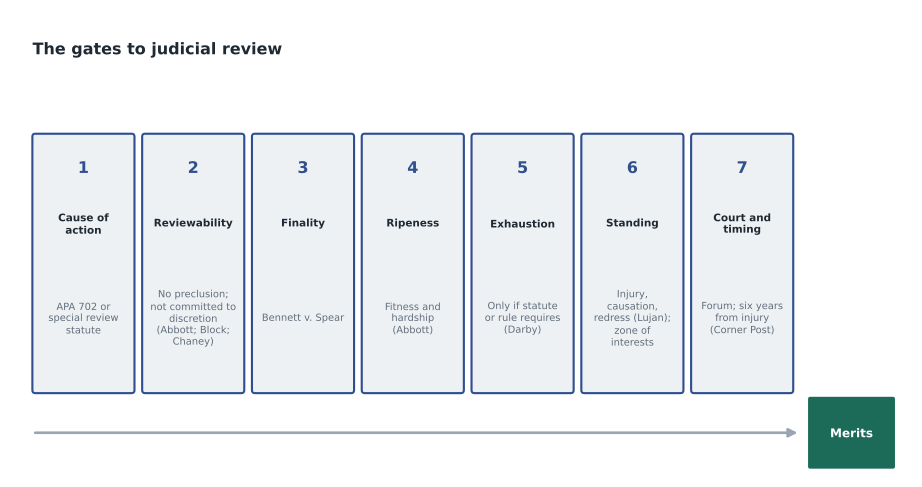
The scooter maker Ardent Mobility wants to sue the National Battery Safety Commission before any enforcement action begins. Its lawyer, a former student of Haverford's, calls him for advice. "Before you argue the merits," Haverford tells her, "you have to get through the gates. Is there a cause of action? Is the action reviewable? Is it final? Is it ripe? Have you exhausted? Do you have standing? Are you in the right court and on time?" Back in class, he draws a series of gates on the board and tells Section B that most administrative law cases are won or lost at one of them.
This lesson covers the threshold doctrines that govern access to judicial review of agency action: the APA's cause of action and presumption of reviewability, the exceptions for statutory preclusion and committed-to-discretion actions, final agency action, ripeness, exhaustion, standing, the zone of interests, statutes of limitations and the choice between district courts and courts of appeals.
The APA's cause of action and the presumption of reviewability
Section 702 of the APA gives a right of review to a person suffering legal wrong because of agency action, or adversely affected or aggrieved by agency action within the meaning of a relevant statute. It also waives the United States' sovereign immunity for suits seeking relief other than money damages. Section 704 makes reviewable agency action made reviewable by statute and final agency action for which there is no other adequate remedy in a court. Many statutes provide their own special review procedures, often petitions for review in a court of appeals; where they do not, a party may sue in district court under the APA itself, using the general federal question jurisdiction of 28 U.S.C. 1331.
Abbott Laboratories v. Gardner (1967) established a strong presumption that agency action is reviewable. Only upon a showing of clear and convincing evidence of a contrary legislative intent should courts restrict access to judicial review. Section 701(a) recognizes two exceptions: where statutes preclude judicial review, and where agency action is committed to agency discretion by law.
Preclusion and committed to discretion
Statutory preclusion may be express or implied from the statutory scheme. In Block v. Community Nutrition Institute (1984), the Court held that consumers could not challenge milk market orders because the statute's detailed scheme allowed review only at the behest of milk handlers. In Thunder Basin Coal Co. v. Reich (1994) and Elgin v. Department of the Treasury (2012), the Court held that detailed statutory review schemes implicitly channeled claims to the agency and then to a court of appeals. But in Axon Enterprise v. FTC (2023), discussed in Lesson 3, the Court held that structural constitutional claims against agency adjudication itself fall outside those schemes and can be brought in district court.
Action is committed to agency discretion by law only in rare instances where there is no law to apply, as Overton Park put it. In Heckler v. Chaney (1985), the Court held that an agency's decision not to bring an enforcement action is presumptively unreviewable, because such decisions involve a complicated balancing of factors peculiarly within agency expertise, including resource allocation and enforcement priorities. Prisoners on death row could not force the FDA to act against drugs used for lethal injection. In Webster v. Doe (1988), the CIA director's decision to fire an employee under a statute allowing termination whenever the director deemed it advisable was committed to discretion, though the Court allowed constitutional claims to proceed. In Lincoln v. Vigil (1993), allocation of funds from a lump-sum appropriation was committed to discretion. By contrast, in Department of Commerce v. New York (2019), the Secretary's census decision was reviewable because the Census Act provided meaningful standards.
Final agency action
Bennett v. Spear (1997) set the two-part test for final agency action. First, the action must mark the consummation of the agency's decision-making process, not be merely tentative or interlocutory. Second, it must be one by which rights or obligations have been determined, or from which legal consequences will flow. In Bennett, a Fish and Wildlife Service biological opinion was final because it had a powerful coercive effect on the action agency and determined the conditions under which ranchers' water could be used.
The Court has applied the test practically. In Sackett v. EPA (2012), an EPA compliance order declaring that a couple's lot contained wetlands, and exposing them to doubled penalties if they did not restore it, was final agency action reviewable before EPA sued to enforce it. In United States Army Corps of Engineers v. Hawkes Co. (2016), a jurisdictional determination that a property contained waters of the United States was final, because a negative determination would have given the owner a five-year safe harbor from enforcement and a positive one denied it. By contrast, in FTC v. Standard Oil Co. of California (1980), the filing of an administrative complaint was not final, because it was only a threshold determination that the agency had reason to believe the law had been violated.
Ripeness
Ripeness asks whether a dispute is ready for decision. Abbott Laboratories set a two-part test: the fitness of the issues for judicial decision and the hardship to the parties of withholding court consideration. In Abbott, drug manufacturers could challenge an FDA regulation requiring generic names on every label before enforcement, because the question was purely legal and the rule required immediate costly changes or risk of serious penalties. In a companion case, Toilet Goods Association v. Gardner (1967), a regulation allowing FDA inspectors access to cosmetic manufacturing facilities was not ripe, because how the agency would apply it was uncertain and the consequences of refusing inspection were not immediate. In Ohio Forestry Association v. Sierra Club (1998), a forest management plan was not ripe because it did not itself authorize any logging. In National Park Hospitality Association v. Department of the Interior (2003), the Court held unripe a challenge to an agency interpretation that had no immediate effect on concessioners' conduct.
Exhaustion
Exhaustion asks whether a party must use available administrative remedies before going to court. In APA cases, Darby v. Cisneros (1993) held that courts may not require exhaustion of administrative appeals unless a statute or agency rule makes the appeal mandatory and renders the action inoperative pending appeal. Where exhaustion is required, courts recognize exceptions for futility, inadequate remedies and some constitutional claims. A related doctrine of issue exhaustion asks whether a party must raise specific arguments before the agency. In Sims v. Apfel (2000), the Court held that Social Security claimants need not raise issues in their request for Appeals Council review, and in Carr v. Saul (2021), discussed in Lesson 3, it held they need not raise Appointments Clause challenges before ALJs. In rulemaking, by contrast, courts often refuse to consider objections that no commenter raised.
Standing
Article III standing requires injury in fact that is concrete and particularized and actual or imminent, causation fairly traceable to the defendant's conduct, and a likelihood that a favorable decision will redress the injury, as Lujan v. Defenders of Wildlife (1992) held. Regulated parties usually have standing to challenge rules that regulate them directly. Standing is harder for third parties who object to the government's regulation, or lack of regulation, of someone else. Lujan held that environmental groups lacked standing to challenge a rule limiting consultation obligations to domestic projects, because members' vague plans to return to see endangered species abroad someday did not establish imminent injury.
In FDA v. Alliance for Hippocratic Medicine (2024), the Court unanimously held that doctors and medical associations lacked standing to challenge the FDA's relaxation of restrictions on the drug mifepristone. Justice Kavanaugh's opinion explained that the doctors did not prescribe or use the drug and were not regulated by the FDA's actions; their claims that they might someday treat patients with complications were too speculative, and an organization cannot spend its way into standing by diverting resources to oppose a policy. Massachusetts v. EPA (2007), by contrast, gave states special solicitude in standing analysis when asserting quasi-sovereign interests, a doctrine whose scope remains contested.
The zone of interests test asks whether the plaintiff's interests are arguably within the zone of interests protected or regulated by the statute. Under the APA, the test is not especially demanding: in Match-E-Be-Nash-She-Wish Band v. Patchak (2012), a neighbor objecting to a casino could challenge the government's acquisition of land in trust for a tribe. Lexmark International v. Static Control Components (2014) clarified that the test is a matter of statutory interpretation, not prudential standing.
Challenging agency inaction
Sometimes the complaint is not that an agency acted but that it failed to act. Section 706(1) directs courts to compel agency action unlawfully withheld or unreasonably delayed. In Norton v. Southern Utah Wilderness Alliance (2004), the Court limited that remedy to cases where the agency failed to take a discrete action that it is required to take. A general statutory mandate to manage wilderness study areas so as not to impair their suitability for preservation was not specific enough, because a court cannot supervise an agency's day-to-day program management. A challenger must identify a particular act, such as issuing a decision on a pending application, that the law requires.
Unreasonable delay claims are judged under factors set out in Telecommunications Research and Action Center v. FCC (D.C. Cir. 1984), often called the TRAC factors. They ask whether the time the agency takes is governed by a rule of reason, whether Congress has set a timetable, whether human health and welfare are at stake, what effect expediting the action would have on higher priorities, what interests are prejudiced by delay and whether the agency has acted with impropriety, though impropriety is not required. Courts are reluctant to order agencies to jump the queue ahead of others waiting for decisions. A denial of a rulemaking petition, by contrast, is final action reviewable under a deferential standard, as Massachusetts v. EPA (2007) held, while Heckler v. Chaney's presumption of unreviewability covers decisions not to bring individual enforcement actions.
Timeliness and forum
Many special review statutes require petitions within a short period, often 60 days. For APA claims brought in district court, the general six-year statute of limitations in 28 U.S.C. 2401(a) applies. In Corner Post, Inc. v. Board of Governors of the Federal Reserve System (2024), the Court held that the claim accrues when the plaintiff is injured, not when the agency acts, so a business formed years after a rule was issued could challenge it within six years of its own injury. Justice Jackson's dissent warned that this would allow endless challenges to old rules.
In McLaughlin Chiropractic Associates v. McKesson Corp. (2025), the Court held that the Hobbs Act, which gives courts of appeals exclusive jurisdiction to review certain agency orders, does not bind district courts to an agency's interpretation in a later private enforcement action. District courts must independently determine the meaning of the statute, giving appropriate respect to the agency's interpretation. Justice Kavanaugh wrote for the majority, and Justice Kagan dissented, joined by Justices Sotomayor and Jackson. The case extends the logic of Loper Bright to the question of when parties are bound by agency interpretations they never challenged.
Worked problem
Ardent's pre-enforcement suit
Ardent Mobility sues the Commission in district court, challenging the FAQ on solid-state batteries and the inspector's notice of violation. The Act provides for review of final rules by petition in the court of appeals within 60 days. The notice of violation states that Ardent must recall its scooters or face a civil penalty proceeding. The Commission argues that the FAQ is not final, the notice is only the first step toward enforcement and Ardent must wait to raise its arguments as defenses.
Show solution
- Cause of action: the FAQ is not a final rule under the Act's special review provision, so Ardent sues under APA sections 702 and 704 in district court.
- Finality of the FAQ: if the FAQ binds inspectors and determines Ardent's obligations, it may be final under Bennett, as the jurisdictional determination was in Hawkes; if it is merely advisory, it is not.
- Finality of the notice: a notice that demands a recall or penalty exposure resembles the compliance order in Sackett more than the complaint in Standard Oil, though the Commission will argue it is only a step toward a hearing.
- Ripeness and standing: the question whether solid-state cells are lithium-ion cells is largely legal, and the hardship of recalling scooters or risking penalties is immediate, as in Abbott; Ardent's injury is direct because it is regulated.
Answer: Ardent has a good argument that it may sue now, especially if the FAQ and the notice together impose immediate obligations with legal consequences. The court will likely find the dispute ripe and Ardent's standing clear. The Commission's best argument is that the notice is only the start of an enforcement process in which Ardent can raise its defenses, so Ardent should emphasize the coercive effect of the recall demand.
Summary and key terms
- The APA provides a cause of action and a presumption of reviewability, subject to statutory preclusion and actions committed to discretion.
- Heckler v. Chaney makes decisions not to enforce presumptively unreviewable.
- Final agency action requires the consummation of decision making and legal consequences, as Bennett, Sackett and Hawkes apply the test.
- Ripeness weighs fitness and hardship; exhaustion is required in APA cases only when a statute or rule demands it.
- FDA v. Alliance for Hippocratic Medicine (2024) held that doctors who were not regulated lacked standing to challenge mifepristone rules.
- Corner Post (2024) starts the six-year limitations period at injury, and McLaughlin (2025) frees district courts from agency interpretations in enforcement cases.
Practice problems
Work each problem on paper first, then reveal the answer to check.
What are the two parts of the Bennett v. Spear test?
Show answer
The action must mark the consummation of the agency's decision-making process and must determine rights or obligations or produce legal consequences.
Why was the jurisdictional determination in Hawkes final?
Show answer
Because it had legal consequences: a negative determination would have provided a five-year safe harbor from enforcement, and a positive one denied it.
When may a court require exhaustion of administrative appeals in an APA case under Darby v. Cisneros?
Show answer
Only when a statute or agency rule makes the appeal mandatory and renders the agency action inoperative pending the appeal.
What did Corner Post hold about the APA statute of limitations?
Show answer
That a claim accrues when the plaintiff is injured, so the six-year period runs from the plaintiff's injury, not from the agency's action.
Lesson quiz · 5 questions
Score 60% or more to complete this lesson.
Create a free account to save your progress, take quizzes and earn a certificate.