
LAWU-211 · Lesson 7 of 12 · 20 min
Arbitrary and capricious review
▶ Video coming soon A video version of this lesson is on the way.
When the National Battery Safety Commission issues its final battery rule, the preamble runs to 212 pages in the Federal Register. A national retail association files a petition for review the same week, arguing that the rule is arbitrary and capricious. Haverford asks Section B what that phrase means. Jordan Kimura says it means the rule is irrational. Hannah Lindqvist says that sounds too easy for the agency. "It would be," Haverford says, "if the words meant what they say in ordinary English. In administrative law they have come to mean something much more demanding: the agency must show its work."
Section 706(2)(A) of the APA directs a court to hold unlawful and set aside agency action found to be arbitrary, capricious, an abuse of discretion or otherwise not in accordance with law. Arbitrary and capricious review applies to rules and to informal adjudications, and it is the main tool courts use to review the substance of agency policy choices and factual judgments in those proceedings. This lesson covers the hard look standard, the requirement of reasoned explanation, policy changes, the role of the administrative record and recent applications.
The hard look standard
The leading case is Motor Vehicle Manufacturers Association v. State Farm Mutual Automobile Insurance Co. (1983). The National Highway Traffic Safety Administration had required new cars to have passive restraints, either automatic seatbelts or airbags. After a change in administration, the agency rescinded the requirement, explaining that manufacturers planned to comply mostly with detachable automatic seatbelts, which many drivers would disconnect, so the rule would produce little safety benefit. The Supreme Court held the rescission arbitrary and capricious. Most importantly, the agency had not considered the obvious alternative of requiring airbags alone, or nondetachable belts, and it had not adequately explained why detachable belts would not increase usage given the inertia that keeps people from removing them.
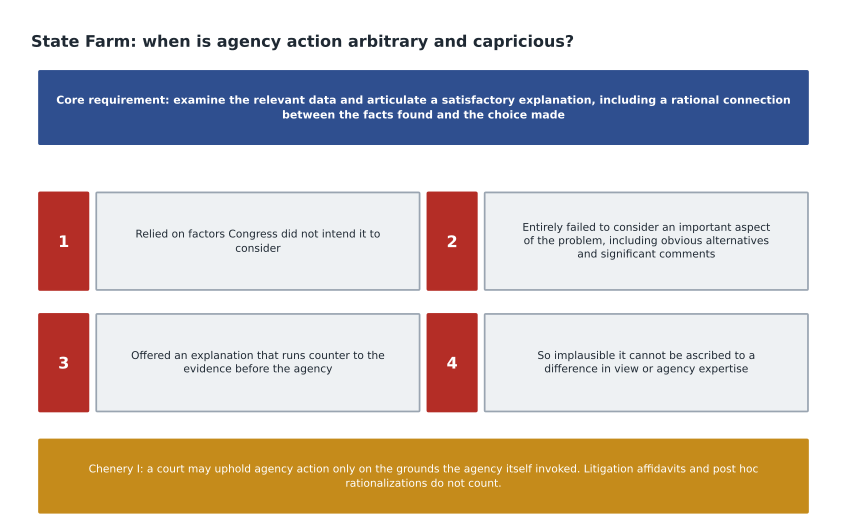
Justice White's opinion stated the test that courts still use. Normally, an agency rule is arbitrary and capricious if the agency has relied on factors which Congress has not intended it to consider, entirely failed to consider an important aspect of the problem, offered an explanation for its decision that runs counter to the evidence before the agency, or is so implausible that it could not be ascribed to a difference in view or the product of agency expertise. The court must not substitute its judgment for the agency's, but it must ensure that the agency examined the relevant data and articulated a satisfactory explanation, including a rational connection between the facts found and the choice made. A court may not supply a reasoned basis that the agency itself has not given.
The record and the reasons
Arbitrary and capricious review is review on the administrative record: the materials that were before the agency when it decided. In Overton Park, the Court rejected litigation affidavits as a substitute for the record, and in Camp v. Pitts (1973), it held that the focal point for review should be the administrative record already in existence, not some new record made initially in the reviewing court. Courts may look beyond the record only in narrow circumstances, such as a strong showing of bad faith or improper behavior.
Department of Commerce v. New York (2019) shows how narrow and how important that exception is. The Secretary of Commerce reinstated a citizenship question on the 2020 census, explaining that the Justice Department wanted the data to enforce the Voting Rights Act. Chief Justice Roberts's opinion held that the decision was reasonable on the record in most respects, but that the stated rationale was contrived, because evidence showed the Secretary had decided to add the question before seeking a rationale and that the Voting Rights Act explanation was not the real reason. The Court affirmed the district court's remand to the agency. Reasoned decision making, the Court said, requires that the agency disclose the basis of its action, and courts are not required to exhibit a naiveté from which ordinary citizens are free.
Department of Homeland Security v. Regents of the University of California (2020) reinforced the rule that agencies must defend their actions on their contemporaneous reasons. The Department had rescinded the Deferred Action for Childhood Arrivals program, citing the Attorney General's view that it was unlawful. The Court held the rescission arbitrary and capricious because the agency failed to consider whether to retain the program's forbearance from removal while ending its benefits, and failed to consider the reliance interests of recipients. A later memorandum offering additional policy reasons was rejected as a post hoc rationalization. If an agency wants to rely on new reasons, it must take new action.
Policy changes
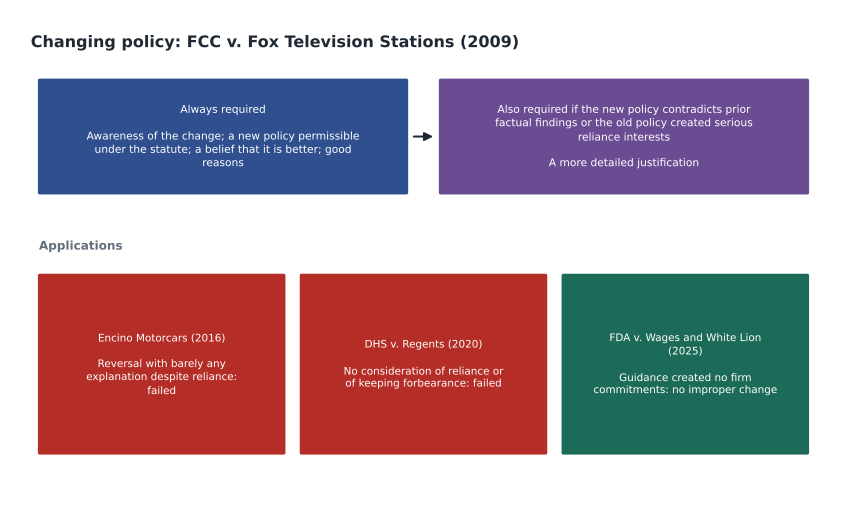
Agencies change policies, especially when administrations change. In FCC v. Fox Television Stations, Inc. (2009), Justice Scalia's opinion held that an agency changing course need not show that the new policy is better than the old one or meet a heightened standard of review. It must display awareness that it is changing position, show that the new policy is permissible under the statute, believe it is better and give good reasons for it. But when the new policy rests on factual findings that contradict those underlying the prior policy, or when the prior policy has engendered serious reliance interests, the agency must provide a more detailed justification. In Encino Motorcars, LLC v. Navarro (2016), the Court held that the Labor Department's reversal of a longstanding position on overtime for service advisors at car dealerships was arbitrary because the agency offered barely any explanation despite significant reliance interests.
In FDA v. Wages and White Lion Investments, LLC (2025), the Court applied the change-in-position doctrine to the Food and Drug Administration's denials of applications to market flavored e-cigarette products. Manufacturers argued that the agency had changed its requirements midstream. Justice Alito's opinion for a unanimous Court held that the agency's guidance had not created the firm commitments the manufacturers claimed and that the FDA had not impermissibly changed position in most respects, while sending back for further consideration a question about whether the agency's failure to consider marketing plans was harmless. The decision shows that the change-in-position doctrine protects reliance on actual agency commitments, not on regulated parties' hopes about how the agency will act.
Hard look in practice
Courts applying State Farm look for specific failures. Did the agency consider reasonable alternatives raised in comments or obvious from the problem? Did it respond to significant objections, as Ohio v. EPA required? Did it rely on data that do not support its conclusion, or ignore data that cut against it? Did it consider costs where the statute makes them relevant? In Michigan v. EPA (2015), the Court held that the EPA acted unreasonably in deciding that regulating power plants' hazardous air emissions was appropriate and necessary without considering cost, because no regulation is appropriate if it does far more harm than good. Did the agency consider reliance interests when changing course? And does its explanation actually connect the facts it found to the choice it made?
At the same time, arbitrary and capricious review is deferential on matters within the agency's expertise. Courts give particular deference to predictive judgments and scientific determinations at the frontiers of knowledge, as the Court said in Baltimore Gas and Electric Co. v. NRDC (1983), which upheld a Nuclear Regulatory Commission assumption about the long-term storage of nuclear waste. In FCC v. Prometheus Radio Project (2021), the Court unanimously upheld the FCC's relaxation of media ownership rules despite imperfect data, holding that the APA imposes no general obligation on agencies to conduct or commission their own empirical or statistical studies, and that the agency's reasoned analysis of the evidence it had was enough.
Haverford gives the class his rule of thumb: arbitrary and capricious review is not a test of whether the judge would have made the same choice. It is a test of whether the agency's explanation shows that it confronted the real problem, the real evidence and the real objections, and made a choice a reasonable agency could make. Agencies lose when they skip steps, not when they choose among defensible options.
Arbitrary and capricious review and statutory interpretation
Arbitrary and capricious review overlaps with, but is distinct from, review of whether the agency acted within its statutory authority. A rule may be within the agency's power but arbitrary because poorly reasoned, or well reasoned but beyond the agency's power. After Loper Bright, courts decide questions of statutory authority independently, as Lesson 10 explains, while arbitrary and capricious review continues to govern the agency's policy choices within whatever discretion the statute grants. Loper Bright itself noted that when a statute delegates discretionary authority, such as power to regulate appropriately or reasonably, a court's role is to ensure the agency engaged in reasoned decision making within the boundaries of that delegation.
| Ground | Leading example |
|---|---|
| Failure to consider an obvious alternative | State Farm (1983): airbag-only option ignored |
| Failure to respond to significant comments | Ohio v. EPA (2024): concern about states dropping out unaddressed |
| Failure to consider reliance interests or alternatives when changing policy | Regents (2020); Encino Motorcars (2016) |
| Failure to consider cost where relevant | Michigan v. EPA (2015) |
| Pretextual or contrived explanation | Department of Commerce v. New York (2019) |
| Post hoc rationalization | Regents (2020); Chenery I (1943) |
Treating like cases alike
Arbitrary and capricious review also requires consistency. An agency that treats similar cases differently without a reasoned explanation acts arbitrarily, as the D.C. Circuit has repeatedly held, for example in Westar Energy, Inc. v. FERC (2007). The principle applies in informal adjudication as well as rulemaking. In Judulang v. Holder (2011), a unanimous Supreme Court, in an opinion by Justice Kagan, held arbitrary and capricious the Board of Immigration Appeals' policy for deciding which noncitizens could seek discretionary relief from deportation. The Board compared the statutory category of the noncitizen's offense with the categories listed in a different provision of the immigration statute, so that eligibility turned on the chance overlap of two lists rather than on anything relevant to whether the person should be allowed to remain. The Court said that an agency's approach must be tied, even if loosely, to the purposes of the immigration laws or the appropriate operation of the immigration system, and that a method resembling a coin flip did not qualify.
Judulang is a useful reminder that arbitrary and capricious review is not limited to big rules with long records. Any agency policy for deciding cases, even one adopted through a series of decisions, must rest on factors relevant to the statute. A party who can show that the agency's method produces arbitrary distinctions between similarly situated people has a strong argument, whatever the formal label of the proceeding.
Worked problem
The retailers' petition
The retail association challenges the Commission's battery rule on four grounds. First, the Commission rejected a less costly alternative, requiring fuses only in batteries over 750 watt-hours, with a single sentence saying it was not protective enough. Second, the preamble estimated that the rule would prevent 1,900 fires a year, relying on a fire department survey that covered only three large cities. Third, the Commission ignored the association's comment that cell-level fuses would raise battery prices enough to push buyers toward cheaper uncertified imports sold online, which would increase fire risk. Fourth, after the petition was filed, the Commission's counsel submitted a declaration from an engineer offering new reasons why the 750 watt-hour threshold was unsafe.
Show solution
- Alternative: a one-sentence rejection may be inadequate if the alternative was significant and the record contains data on fires by battery size; the Commission must explain why the lower threshold was needed, though it need not prove its choice is best.
- Data: extrapolating from a three-city survey is not automatically arbitrary under Prometheus, but the Commission must acknowledge the limitation and explain why the data are a reasonable basis for national estimates.
- Substitution effect: a comment arguing that the rule will increase the very risk it targets is significant; failing to address it is the kind of error Ohio v. EPA and State Farm condemn.
- Declaration: the engineer's new reasons are post hoc rationalizations under Chenery I and Regents; the court will not consider them to uphold the rule.
Answer: The rule is most vulnerable on the third ground, the unanswered substitution-effect comment, and possibly the first, if the record shows the lower threshold was a serious option. The data argument is weaker because agencies may rely on imperfect evidence if they explain its limits. The engineer's declaration cannot save the rule. The likely result is a remand for further explanation, possibly without vacatur if the Commission can probably cure the defects, a remedy covered in Lesson 11.
Summary and key terms
- State Farm requires agencies to examine relevant data, consider important aspects of the problem and articulate a rational connection between facts and choices.
- Review is on the administrative record, and courts uphold action only on the agency's contemporaneous reasons, as Chenery I, Overton Park and Regents require.
- Department of Commerce v. New York (2019) set aside a decision whose stated rationale was contrived.
- Fox (2009) requires agencies changing policy to acknowledge the change and give good reasons, with more detail when facts or reliance interests are at stake.
- FDA v. Wages and White Lion (2025) held that the FDA had not impermissibly changed position because its guidance created no firm commitments.
- Courts defer to expert predictions and imperfect data, as in Baltimore Gas and Prometheus, but not to explanations that skip steps.
Practice problems
Work each problem on paper first, then reveal the answer to check.
What alternative did NHTSA fail to consider in State Farm?
Show answer
Requiring airbags alone, or nondetachable automatic seatbelts, rather than rescinding the passive restraint requirement entirely.
Why did the Court reject the Commerce Secretary's explanation in Department of Commerce v. New York?
Show answer
Because the evidence showed the Voting Rights Act rationale was contrived and not the real reason for reinstating the citizenship question.
What must an agency show when it changes policy under Fox?
Show answer
Awareness that it is changing position, that the new policy is permissible under the statute, that it believes the policy is better and good reasons for it, with more detail if prior factual findings or reliance interests are involved.
Must an agency conduct its own empirical studies before acting?
Show answer
No. FCC v. Prometheus Radio Project held the APA imposes no general obligation to conduct or commission new studies.
Lesson quiz · 5 questions
Score 60% or more to complete this lesson.
Create a free account to save your progress, take quizzes and earn a certificate.