
LAWU-211 · Lesson 3 of 12 · 21 min
Appointments and removal
▶ Video coming soon A video version of this lesson is on the way.
In the fictional National Battery Safety Act, section 101 creates a five-member Commission. The President appoints the commissioners with the advice and consent of the Senate, no more than three may belong to the same party, they serve staggered five-year terms, and the President may remove a commissioner only for inefficiency, neglect of duty or malfeasance in office. Haverford asks Section B whether that removal clause survived the Supreme Court's decision last June. Priya Natarajan, who read Trump v. Slaughter the week it came out, says almost certainly not. Daniel Reyes asks why anyone should care who can fire a commissioner. "Because whoever can fire you," Haverford says, "is the person you obey."
This lesson covers the two questions that decide who controls the people who wield delegated power. The Appointments Clause governs how federal officers are chosen. The President's removal power, inferred from Article II, governs how they can be dismissed. Both have been transformed in the last two decades, and both now shape everyday litigation, because a party can sometimes undo an agency decision by showing that the official who made it was not properly appointed.
The Appointments Clause
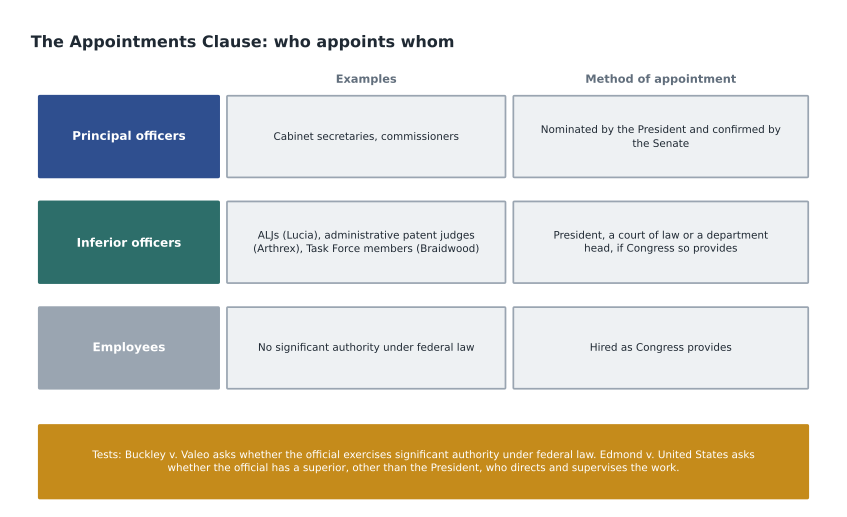
Article II, section 2, clause 2 provides that the President shall nominate, and by and with the advice and consent of the Senate shall appoint, ambassadors, judges of the Supreme Court and all other officers of the United States, but that Congress may by law vest the appointment of inferior officers in the President alone, in the courts of law or in the heads of departments. The clause sorts federal personnel into three groups. Principal officers must be nominated by the President and confirmed by the Senate. Inferior officers may be appointed the same way, or, if Congress chooses, by the President alone, a court or a department head. Employees, who are not officers at all, may be hired however Congress provides.
Who counts as an officer? Buckley v. Valeo (1976) held that any appointee exercising significant authority pursuant to the laws of the United States is an officer, and struck down a Federal Election Commission whose members were partly appointed by congressional leaders. Lucia v. SEC (2018) applied that test to the Securities and Exchange Commission's administrative law judges. Because they hold a continuing position established by law and exercise significant discretion in conducting hearings, ruling on evidence and issuing initial decisions, they are officers, and because they had been hired by agency staff rather than by the Commission itself, their appointments were invalid. The remedy was a new hearing before a different, properly appointed official.
The line between principal and inferior officers is harder. In Edmond v. United States (1997), the Court said that whether one is an inferior officer depends on whether he has a superior, and that inferior officers are those whose work is directed and supervised at some level by others who were appointed by presidential nomination with Senate consent. In United States v. Arthrex, Inc. (2021), the Court held that administrative patent judges could not constitutionally issue final decisions in patent challenges that no principal officer could review, because unreviewable final authority is the mark of a principal officer. The remedy was to let the Director of the Patent and Trademark Office review their decisions. In Kennedy v. Braidwood Management, Inc. (2025), the Court held that members of the U.S. Preventive Services Task Force, whose recommendations determine which preventive services insurers must cover without cost sharing, are inferior officers because the Secretary of Health and Human Services can remove them at will and review their recommendations, so the Secretary could appoint them.
The removal power: from Myers to Humphrey's Executor
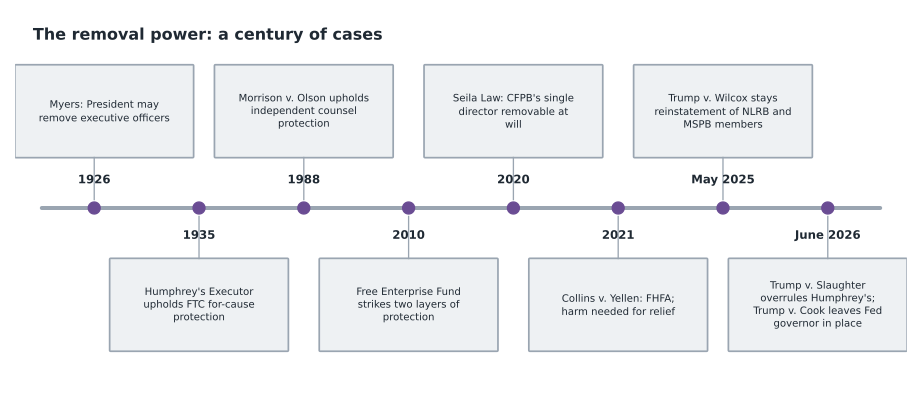
The Constitution says nothing explicit about removing executive officers other than by impeachment. In Myers v. United States (1926), Chief Justice Taft, a former President, wrote for the Court that the President has the exclusive power to remove executive officers he has appointed with Senate consent, and struck down a statute requiring Senate approval to remove a postmaster. The Court reasoned that the President's duty to take care that the laws be faithfully executed requires the power to remove those who execute them.
Nine years later, in Humphrey's Executor v. United States (1935), the Court unanimously upheld a statute allowing the President to remove Federal Trade Commissioners only for inefficiency, neglect of duty or malfeasance in office. The Court described the FTC as a body of experts that exercised quasi-legislative and quasi-judicial powers and acted as an agency of Congress and the courts rather than an arm of the executive. For ninety years, Humphrey's Executor was the constitutional foundation of the independent agencies. Wiener v. United States (1958) extended it to a war claims commission, and Morrison v. Olson (1988) upheld good-cause protection for an independent counsel, asking whether the restriction impeded the President's ability to perform his constitutional duty.
The modern cases
Beginning in 2010, the Court cut back on that framework step by step. In Free Enterprise Fund v. Public Company Accounting Oversight Board (2010), it held that Congress may not give two layers of for-cause protection to officers, because the President could not remove board members even if the SEC commissioners, themselves protected, refused to do so. In Seila Law LLC v. CFPB (2020), it held that the Consumer Financial Protection Bureau, led by a single director removable only for cause, violated the separation of powers. Chief Justice Roberts described the President's removal power as the rule, and Humphrey's Executor and Morrison as two exceptions: one for multimember expert agencies that do not wield substantial executive power, and one for inferior officers with limited duties. The Court severed the removal restriction and left the Bureau in place. In Collins v. Yellen (2021), it reached the same result for the Federal Housing Finance Agency's single director, and held that a challenger seeking to undo agency action because of an unconstitutional removal restriction must show that the restriction actually caused harm.
In 2024, in CFPB v. Community Financial Services Association, the Court rejected a different structural attack on the Bureau, holding that its funding mechanism, which draws money from the Federal Reserve rather than annual appropriations, satisfies the Appropriations Clause. The case is a reminder that the Court's structural decisions have not all gone one way.
Trump v. Slaughter (2026)
In March 2025, the President removed Rebecca Slaughter, a Federal Trade Commissioner whose term had not expired, without claiming any of the statutory grounds for removal. She sued, and the lower courts ordered her reinstated under Humphrey's Executor. In May 2025, in Trump v. Wilcox, the Supreme Court had already stayed similar reinstatement orders for members of the National Labor Relations Board and Merit Systems Protection Board, noting that the government was likely to show that those agencies exercised considerable executive power, while suggesting that the Federal Reserve might be different because of its unique structure and history. The Court then granted review in Slaughter's case.
On June 29, 2026, the Court held, six to three, that the statutory restriction on removing FTC commissioners is unconstitutional and that the President could remove Slaughter at will. Chief Justice Roberts's opinion overruled Humphrey's Executor, calling its account of the FTC as a body exercising no executive power a result in search of a rationale. The modern FTC, the Court explained, investigates, sues, issues binding rules and imposes penalties, all of which are executive functions, and the Constitution vests the executive power in the President alone. Justice Gorsuch wrote a concurrence. Justice Sotomayor, joined by Justices Kagan and Jackson, dissented, arguing that the decision overturned settled law on which Congress had built dozens of agencies and that it concentrated power in the presidency in a way the framers did not intend.
On the same day, in Trump v. Cook, the Court declined, by a vote of five to four, to allow the President to remove Lisa Cook, a member of the Federal Reserve Board of Governors, while her challenge proceeded. The majority emphasized the Federal Reserve's distinct history and the statute's for-cause requirement, and Justice Kavanaugh wrote separately. The two decisions together mean that most multimember regulatory commissions are now under presidential control, while the Federal Reserve's status remains a special case that the Court has treated differently.
What Slaughter leaves open
Haverford lists the questions lawyers will litigate next. First, what about removal protection for inferior officers, such as administrative law judges, who hold multiple layers of protection through the Merit Systems Protection Board? Lower courts had divided on that question before Slaughter, and the Court has not resolved it. Second, what about agencies whose functions are mostly adjudicative, such as tribunals that decide benefit claims or appeals? Third, what is the remedy when an official was unconstitutionally protected? Collins suggests that a party must usually show that the removal restriction caused its injury, for example because the President wanted to remove the official and could not. Fourth, what happens to party-balance requirements and staggered terms, which Slaughter did not directly address? And finally, how far does the Federal Reserve exception extend?
The practical effect for agency lawyers is significant. Executive Order 14215, issued in February 2025, had already directed independent regulatory agencies to submit significant regulatory actions to the White House Office of Information and Regulatory Affairs for review and declared that the President's and the Attorney General's interpretations of law bind executive branch employees, with an exception for the Federal Reserve's monetary policy functions. After Slaughter, commissioners at such agencies serve at the President's pleasure, and the practical independence of those agencies now depends mainly on custom and politics rather than law.
Inferior officers and the civil service
Slaughter concerned principal officers who head an agency. Removal of inferior officers and ordinary employees rests on a different line of authority. In United States v. Perkins (1886), the Court upheld limits that Congress placed on a department head's power to remove a naval cadet engineer, reasoning that when Congress vests appointment of inferior officers in department heads, it may also limit and regulate their removal. Morrison v. Olson relied on that principle, and Free Enterprise Fund left it in place for a single layer of protection. The modern civil service, built on the Pendleton Act of 1883 and the Civil Service Reform Act of 1978, protects most federal employees from removal except for cause and channels their challenges to the Merit Systems Protection Board.
Presidential control over the workforce has nonetheless expanded. Executive Order 14171, issued in January 2025, reinstated and renamed a category of policy-influencing positions, often called Schedule F, whose holders lose civil service protection against removal. Supporters argue that officials who shape policy must answer to elected leadership; critics argue that the change invites political patronage and undermines expert, nonpartisan administration. Litigation over these measures turns mostly on civil service statutes rather than the Constitution, but Slaughter's emphasis on presidential responsibility for executive power will shape how courts read those statutes.
Using appointments and removal arguments in litigation
A party facing an adverse agency decision should always ask whether the officials involved were properly appointed and supervised. An Appointments Clause defect can lead to a new proceeding, as in Lucia, if the party raised the objection in a timely way. Courts often require the objection to be raised before the agency, although Carr v. Saul (2021) held that Social Security claimants did not forfeit Appointments Clause challenges by failing to raise them in non-adversarial agency proceedings. A removal defect is less likely to undo past action because of Collins, but it can support prospective relief and, in some circumstances, a challenge to an ongoing proceeding. In Axon Enterprise, Inc. v. FTC (2023), discussed in Lesson 9, the Court held that parties may bring structural constitutional challenges directly in federal district court rather than waiting for the agency to finish.
Worked problem
The Commission's removal clause
In the fictional scenario, the President removes Commissioner Elena Brandt from the National Battery Safety Commission in January without giving a reason. Brandt sues for reinstatement. Meanwhile, Kestrel North America, facing an enforcement proceeding before the Commission, argues that the proceeding must stop because the Commission is unconstitutionally structured, and separately argues that the administrative law judge assigned to its case was hired by the Commission's chief of staff.
Show solution
- Brandt's claim: the Commission is a multimember body that writes binding rules, brings enforcement actions and imposes penalties, so under Slaughter its commissioners' for-cause protection is unconstitutional and the President could remove her at will.
- Kestrel's removal argument: even if the protection was unconstitutional, Collins suggests the remedy is to sever the protection; to undo the proceeding, Kestrel would need to show the restriction actually harmed it.
- Kestrel's appointments argument: under Lucia, an administrative law judge who exercises significant authority is an inferior officer who must be appointed by the head of the department, here the Commission itself, not its chief of staff.
- Timing and forum: under Axon, Kestrel may raise these structural claims in district court; under Lucia, a timely appointments objection entitles it to a new hearing before a different, properly appointed official.
Answer: Brandt will almost certainly lose after Slaughter. Kestrel's removal argument is unlikely to stop the case without a showing of harm, but its appointments argument is strong: if the judge was not appointed by the Commission, Kestrel is entitled to a new hearing before a properly appointed official, and the Commission can cure the problem going forward by ratifying or making the appointment itself.
Summary and key terms
- The Appointments Clause distinguishes principal officers, inferior officers and employees; officers exercise significant authority under federal law.
- Lucia held that SEC administrative law judges are officers, and Arthrex held that final unreviewable decisions require a principal officer.
- Kennedy v. Braidwood (2025) held that Preventive Services Task Force members are inferior officers appointable by the Secretary.
- Myers recognized the removal power; Humphrey's Executor upheld for-cause protection for FTC commissioners; Free Enterprise Fund, Seila Law and Collins narrowed that protection.
- Trump v. Slaughter (2026) overruled Humphrey's Executor, while Trump v. Cook left a Federal Reserve governor in office pending litigation.
- Appointments defects can require a new hearing; removal defects usually require a showing of harm for retrospective relief.
Practice problems
Work each problem on paper first, then reveal the answer to check.
Why were the SEC's administrative law judges improperly appointed in Lucia?
Show answer
They were officers exercising significant authority but had been hired by agency staff rather than by the Commission, the head of the department.
What did Arthrex hold about administrative patent judges?
Show answer
That they could not issue final unreviewable decisions as inferior officers; the remedy was to let the Director review their decisions.
What remedy limit did Collins v. Yellen announce?
Show answer
That a party seeking to undo agency action because of an unconstitutional removal restriction must show that the restriction caused it harm.
What did Trump v. Slaughter overrule?
Show answer
Humphrey's Executor v. United States (1935), the decision that had upheld for-cause protection for FTC commissioners.
Lesson quiz · 5 questions
Score 60% or more to complete this lesson.
Create a free account to save your progress, take quizzes and earn a certificate.