
LAWU-211 · Lesson 1 of 12 · 22 min
The administrative state and the APA
▶ Video coming soon A video version of this lesson is on the way.
Professor Leonard Haverford begins Administrative Law by holding up a single sheet of paper. It is a federal regulation, two paragraphs long, that tells manufacturers how to label a lithium-ion battery pack. "Congress did not write this," he tells Section B, now in the winter of their second year. "No judge wrote it either. An agency wrote it, after a process most citizens have never heard of, and it binds a company in Ohio as firmly as any statute. This course is about how that happens, who controls it and what a lawyer can do when it goes wrong."
Haverford spent nine years in the appellate section of the Justice Department's Civil Division defending agency rules in the courts of appeals, then six years in the general counsel's office of a federal regulatory commission, where he helped write the rules he used to defend. He tells the class that he has been on both sides of nearly every argument in the course, and that the best administrative lawyers can argue the agency's side and the challenger's side with equal conviction. The agencies, companies and people in his running examples are fictional. The statutes he cites as real, the Administrative Procedure Act and the Supreme Court cases are real.
His running file for the semester picks up a story Section B already knows. In Constitutional Law, Professor Whitford's capstone imagined a National Battery Safety Act creating a five-member National Battery Safety Commission. Haverford takes that fictional statute and imagines the Commission at work: writing a rule on e-bike battery storage, issuing guidance to retailers, bringing an enforcement case against Kestrel North America and fighting about whether its commissioners can be fired. Rosa Delgado, whose e-bike battery caught fire in her garage in the Civil Procedure course, appears as a commenter and later as a petitioner. All of it is fictional, and all of it runs on real doctrine.
What an agency is
An administrative agency is a government body, other than a court or a legislature, that has authority to affect the rights and duties of private parties through rules, orders, licenses, investigations or benefits. The Administrative Procedure Act defines an agency broadly as each authority of the government of the United States, whether or not it is within or subject to review by another agency, and then excludes Congress, the federal courts and a few others. The President is not an agency for APA purposes, as the Supreme Court held in Franklin v. Massachusetts (1992), which is why many challenges to presidential action proceed under the Constitution or the specific statute rather than the APA.
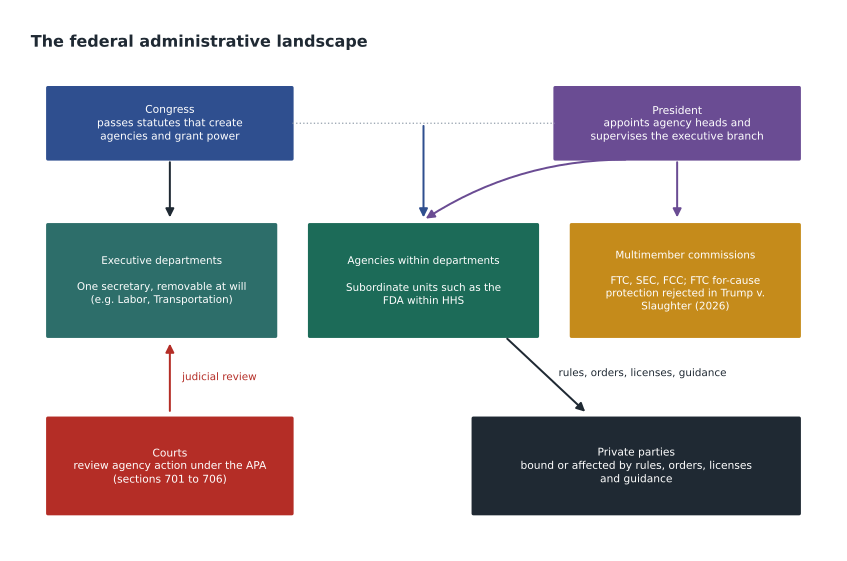
Federal agencies come in several shapes. Executive departments, such as the Department of Labor or the Department of Transportation, are headed by a single secretary who serves at the President's pleasure. Agencies inside departments, such as the Food and Drug Administration within the Department of Health and Human Services, report up through the department. So-called independent agencies, such as the Federal Trade Commission, the Securities and Exchange Commission and the Federal Communications Commission, are usually headed by multimember commissions with staggered terms and, traditionally, members who could be removed only for cause. Whether that protection is still constitutional is now one of the most important questions in the field, and Lesson 3 takes it up after the Supreme Court's June 2026 decision in Trump v. Slaughter.
Why Congress delegates
Congress creates agencies because it cannot do everything itself. It lacks the time to set safety standards for thousands of products, the expertise to decide how much of a chemical a river can safely carry, and the flexibility to update rules as technology changes. Agencies can hire scientists and economists, gather data, hold hearings and revise their rules. They can also act quickly when a new hazard appears, as the fictional Battery Safety Commission does when e-bike fires spike in apartment buildings.
Delegation also has political attractions. Congress can declare a broad goal, such as safe workplaces or clean air, and leave the hard tradeoffs to an agency, which then takes the blame for unpopular choices. Critics argue that this lets legislators avoid accountability and concentrates lawmaking, enforcement and adjudication in the same unelected hands. Defenders answer that agencies are accountable through presidential supervision, congressional oversight, the appropriations process and judicial review, and that modern government could not function without them. Haverford asks the class to keep both views in mind, because the Supreme Court's recent cases on nondelegation, major questions, removal and deference are all, in different ways, responses to that debate.
The three things agencies do
Agencies make rules, decide individual cases and enforce the law. A rule, as the APA defines it in 5 U.S.C. section 551(4), is an agency statement of general or particular applicability and future effect designed to implement, interpret or prescribe law or policy. Rules look like statutes: they are general and forward-looking. An order, under section 551(6), is the final disposition of an agency proceeding other than rulemaking, including licensing. Orders look like court judgments: they decide the rights of particular parties based on particular facts. The process that produces a rule is rulemaking; the process that produces an order is adjudication.
The line between rulemaking and adjudication matters because different procedures apply to each, and the Constitution treats them differently. Two classic cases from the early twentieth century still frame the distinction. In Londoner v. City and County of Denver (1908), the Supreme Court held that property owners assessed for the cost of paving their street were entitled to a hearing, because a small number of people were exceptionally affected on individual grounds. In Bi-Metallic Investment Co. v. State Board of Equalization (1915), the Court held that no hearing was required before a statewide increase in property valuations, because when a rule applies to more than a few people, they are protected by their political power over those who make the rule, not by individual hearings.
Enforcement includes investigation, inspection, subpoenas, warning letters and the decision to bring a case. Agencies have broad discretion about whom to investigate and whom to charge, and courts rarely review decisions not to enforce, as Lesson 9 explains. Many agencies also administer benefits, grants and licenses, which involve their own mix of rules and individual decisions.
The Administrative Procedure Act
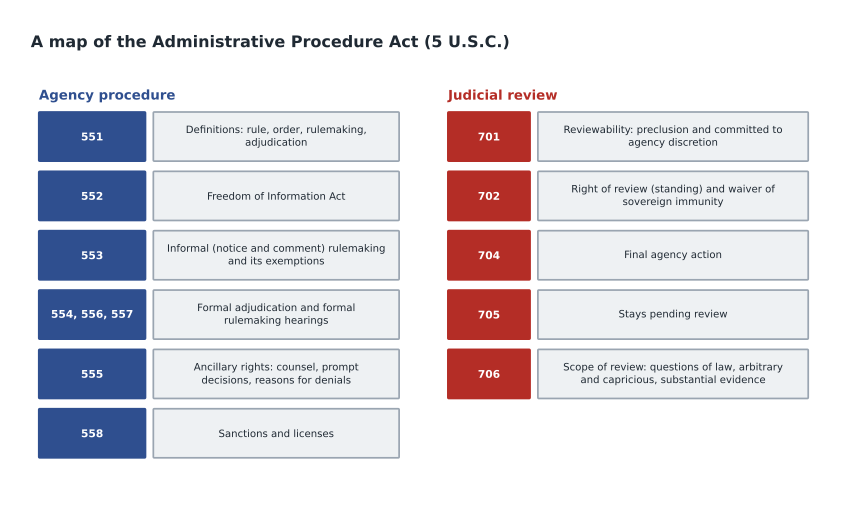
The Administrative Procedure Act of 1946 is the general framework for federal agency action. It was the product of a decade of debate over the New Deal agencies, and it was passed unanimously as a compromise between those who wanted to restrain agencies and those who wanted to protect them. The APA is codified mainly at 5 U.S.C. sections 551 through 559 (procedures) and 701 through 706 (judicial review). Agency-specific statutes often add to or modify the APA, and when they conflict, the specific statute usually controls, although section 559 says that later statutes do not supersede the APA except to the extent that they do so expressly.
The APA sets up four basic categories of agency action. Formal rulemaking, under sections 553(c), 556 and 557, requires a trial-type hearing on the record, but only when a statute requires rules to be made on the record after opportunity for an agency hearing. Informal, or notice-and-comment, rulemaking under section 553 requires public notice of a proposed rule, an opportunity to comment, and a concise general statement of basis and purpose. Formal adjudication, under sections 554, 556 and 557, applies when a statute requires adjudication to be determined on the record after opportunity for an agency hearing, and it looks much like a bench trial before an administrative law judge. Informal adjudication is everything else, and the APA says little about it beyond the minimal requirements of section 555 and the general provisions for judicial review.
| Category | Trigger | Main APA sections | What it looks like |
|---|---|---|---|
| Formal rulemaking | Statute requires rules made on the record after an agency hearing | 553(c), 556, 557 | Trial-type hearing; rare today |
| Informal (notice-and-comment) rulemaking | Default for legislative rules | 553 | Published notice, comments, statement of basis and purpose |
| Formal adjudication | Statute requires adjudication on the record after an agency hearing | 554, 556, 557 | Hearing before an administrative law judge |
| Informal adjudication | Everything else | 555 and general review provisions | Permits, grants, inspections, many benefit decisions |
Formal rulemaking has nearly disappeared because of a pair of Supreme Court decisions. In United States v. Allegheny-Ludlum Steel Corp. (1972) and United States v. Florida East Coast Railway Co. (1973), the Court held that statutory language requiring a hearing does not trigger formal rulemaking unless the statute uses the words on the record or something equivalent. Since then, agencies have used notice-and-comment rulemaking for almost all legislative rules. The Court later added, in Vermont Yankee Nuclear Power Corp. v. Natural Resources Defense Council (1978), that courts may not impose procedures beyond those the APA, other statutes or the Constitution require. That holding means the APA's text sets both a floor and, for courts, a ceiling on procedural requirements.
Judicial review in one paragraph
Section 702 gives a right of review to a person suffering legal wrong because of agency action, or adversely affected or aggrieved by agency action within the meaning of a relevant statute. Section 704 limits review to agency action made reviewable by statute and final agency action for which there is no other adequate remedy in a court. Section 701(a) withholds review where statutes preclude it or the action is committed to agency discretion by law. Section 706 tells the reviewing court what to do: decide all relevant questions of law and interpret statutory provisions, and hold unlawful and set aside agency action found to be arbitrary, capricious, an abuse of discretion or otherwise not in accordance with law, contrary to constitutional right, in excess of statutory authority, without required procedure, or unsupported by substantial evidence in on-the-record proceedings. Much of the course is an elaboration of those few sentences, and the Supreme Court's 2024 decision in Loper Bright Enterprises v. Raimondo rested heavily on section 706's command that courts decide all relevant questions of law.
Other sources of administrative law
The APA is not the only source. Agency-specific statutes, such as the Clean Air Act or the Communications Act, often set their own procedures and review provisions, including direct review in a court of appeals. The Constitution limits agencies through the separation of powers, the Appointments Clause, the Due Process Clause and the Seventh Amendment. Executive orders, especially Executive Order 12866 on regulatory planning and review, govern how executive agencies coordinate with the White House. Statutes such as the Regulatory Flexibility Act, the Paperwork Reduction Act, the National Environmental Policy Act and the Congressional Review Act add analytical or procedural steps. And agencies' own procedural regulations bind them; under the Accardi doctrine, from United States ex rel. Accardi v. Shaughnessy (1954), an agency must follow its own rules.
Congress also controls agencies directly. It can amend or repeal their statutes, cut their budgets, hold oversight hearings, confirm or reject nominees and, under the Congressional Review Act, disapprove recently issued rules by joint resolution. A rule disapproved under that Act has no force, and the agency may not reissue a substantially similar rule without new legislation. The Act sat largely unused until 2017, when Congress used it to overturn more than a dozen rules issued late in the previous administration, and it has been used at the start of later administrations as well.
Worked problem
Classifying the Commission's actions
Haverford gives Section B four actions by the fictional National Battery Safety Commission and asks them to classify each. First, after publishing a proposal and receiving 3,400 comments, the Commission issues a regulation requiring that e-bike batteries over 500 watt-hours sold after next July carry a thermal-runaway warning label. Second, after a hearing before an administrative law judge, it orders Kestrel North America to pay a civil penalty for selling noncompliant packs. Third, it posts a document on its website called Retailer Frequently Asked Questions explaining how it reads the word storage in its rule. Fourth, it grants a testing laboratory's application for accreditation after reviewing its paperwork.
Show solution
- Ask whether the action is general and forward-looking or a disposition of particular parties' rights: the labeling regulation is general and prospective, so it is a rule; the penalty order and the accreditation decision resolve particular parties' rights, so they are orders.
- For the rule, ask which rulemaking procedure applied: the Commission used notice and comment, so this is informal rulemaking under section 553.
- For the orders, ask whether a statute requires a hearing on the record: if the Battery Safety Act requires penalty hearings on the record, the penalty case is formal adjudication; the paper review of an accreditation application, with no such requirement, is informal adjudication.
- For the FAQ, ask whether it purports to bind: an explanation of how the agency reads its own rule is likely an interpretive rule or guidance document, exempt from notice and comment but also without the force of law, a subject for Lesson 8.
Answer: The labeling regulation is a legislative rule made through informal rulemaking. The penalty order is adjudication, formal if the statute requires an on-the-record hearing. The accreditation decision is informal adjudication. The FAQ is guidance or an interpretive rule. Classifying correctly matters because it determines the procedures the agency had to follow, the standard of review and, increasingly, the constitutional questions a challenger can raise.
The modern debate
Since about 2018, the Supreme Court has reshaped administrative law at a pace not seen since the New Deal. It has narrowed agency power to decide major questions without clear congressional authorization, expanded presidential control over agency officials, required jury trials for some agency penalty cases, overruled the Chevron doctrine of deference to agency statutory interpretations and, in 2026, overruled Humphrey's Executor's protection for multimember commissions. At the same time, it has refused some invitations to go further: in FCC v. Consumers' Research (2025), it upheld a broad delegation to the Federal Communications Commission, and in FCC v. AT&T (2026), it held that the Commission's penalty process did not violate the Seventh Amendment because a jury trial remained available before any forfeiture became binding.
Haverford tells Section B that the course will teach the law as it stands, but that they should read every case from the last decade with two questions in mind. What does it actually hold, as opposed to what its supporters or critics say it means? And what has the Court declined to decide? Administrative law moves quickly, and a lawyer who knows the open questions is more useful to a client than one who knows only the headlines.
Summary and key terms
- Agencies make rules, decide cases and enforce the law under power delegated by Congress, and they come in different structures, from single-headed departments to multimember commissions.
- Londoner and Bi-Metallic distinguish individualized adjudication, which may require a hearing, from general rulemaking, which does not.
- The APA sets four categories: formal and informal rulemaking and formal and informal adjudication; formal procedures apply only when a statute requires decisions on the record.
- Vermont Yankee bars courts from adding procedures beyond those the APA, other statutes or the Constitution require.
- Section 706 governs the scope of review and directs courts to decide all relevant questions of law.
- Statutes, the Constitution, executive orders, agency procedural rules and congressional controls such as the Congressional Review Act also shape agency action.
Practice problems
Work each problem on paper first, then reveal the answer to check.
Is the President an agency under the APA?
Show answer
No. Franklin v. Massachusetts held that the President is not an agency for APA purposes, so challenges to presidential action usually rest on the Constitution or the specific statute.
What distinguishes Londoner from Bi-Metallic?
Show answer
Londoner involved a few people exceptionally affected on individual grounds, who were entitled to a hearing; Bi-Metallic involved a general rule affecting many people, who are protected through the political process rather than individual hearings.
When does formal rulemaking apply?
Show answer
Only when a statute requires rules to be made on the record after opportunity for an agency hearing, as Florida East Coast Railway made clear.
What did Vermont Yankee hold?
Show answer
That courts may not require agencies to use procedures beyond those required by the APA, other statutes or the Constitution.
Lesson quiz · 5 questions
Score 60% or more to complete this lesson.
Create a free account to save your progress, take quizzes and earn a certificate.