
LAWU-211 · Lesson 2 of 12 · 20 min
Agencies and the Constitution
▶ Video coming soon A video version of this lesson is on the way.
Haverford opens the second session by reading Article I, section 1 aloud: all legislative powers herein granted shall be vested in a Congress of the United States. "If all legislative power belongs to Congress," he asks, "how can the Battery Safety Commission write a rule that binds Kestrel as tightly as a statute?" Hannah Lindqvist answers that the Commission is not legislating; it is filling in details Congress left open. Marcus Webb says that is just a label. "You have both found the doctrine," Haverford says. "The Court has spent a century deciding when filling in details becomes legislating, and for most of that century it has said almost never."
This lesson covers the constitutional limits on what Congress may give agencies to do: the nondelegation doctrine, its modern cousin the major questions doctrine, and the related question of delegations to private parties. Lesson 3 covers who controls the officials who exercise delegated power, and Lesson 5 covers the limits on agency adjudication imposed by Article III and the Seventh Amendment.
The intelligible principle
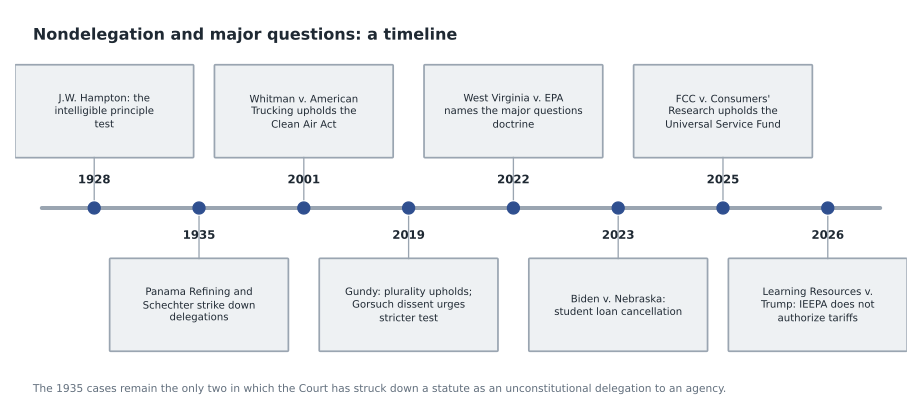
The nondelegation doctrine holds that Congress may not transfer its legislative power to anyone else. The modern test comes from J.W. Hampton, Jr. and Co. v. United States (1928), which upheld a statute allowing the President to adjust tariffs: if Congress lays down by legislative act an intelligible principle to which the person or body authorized to act is directed to conform, the delegation is not a forbidden delegation of legislative power. In practice, the intelligible principle test has been very forgiving. The Court has upheld delegations to regulate in the public interest, convenience or necessity, to set fair and equitable prices and to set air quality standards requisite to protect the public health.
The Court has struck down a federal statute as an unconstitutional delegation only twice, both in 1935. In Panama Refining Co. v. Ryan, it invalidated a provision letting the President prohibit interstate shipment of oil produced in excess of state quotas, because the statute gave no standard for when he should act. In A.L.A. Schechter Poultry Corp. v. United States, it struck down the National Industrial Recovery Act's scheme of codes of fair competition, written largely by trade groups and approved by the President with almost no guidance. Since then the Court has repeatedly rejected nondelegation challenges. In Whitman v. American Trucking Associations (2001), Justice Scalia's opinion for the Court upheld the Clean Air Act's command to set ambient air standards requisite to protect the public health with an adequate margin of safety, and added that the Court had almost never felt qualified to second-guess Congress on the degree of policy judgment that can be left to those executing the law.
Gundy and the call for a stricter test
In Gundy v. United States (2019), the Court considered a provision of the Sex Offender Registration and Notification Act that let the Attorney General specify the applicability of the registration requirements to offenders convicted before the Act's passage. Justice Kagan's plurality opinion read the statute to require the Attorney General to apply the requirements to pre-Act offenders as soon as feasible, and upheld it easily. Justice Alito concurred in the judgment but said he would support reconsidering the doctrine with a full Court. Justice Gorsuch, joined by Chief Justice Roberts and Justice Thomas, dissented. He argued that Congress may let others fill up the details, make application of a rule depend on fact-finding, or assign nonlegislative responsibilities, but may not hand over the power to write the rules themselves.
Gundy was decided by eight Justices, and Justice Kavanaugh later signaled interest in Justice Gorsuch's approach. Many observers expected the Court to revive the doctrine in the next suitable case. That case seemed to arrive in FCC v. Consumers' Research, decided in June 2025.
FCC v. Consumers' Research
The Communications Act directs the Federal Communications Commission to collect contributions from telecommunications carriers to fund universal service programs that subsidize phone and internet access for rural areas, low-income households, schools, libraries and rural health providers. The statute tells the Commission that the contributions should be sufficient to preserve and advance universal service, and it lists principles to guide the programs. The Commission relies on a private nonprofit, the Universal Service Administrative Company, to project program costs and calculate the contribution factor. Challengers argued that this was a double violation: a delegation of the taxing power to the Commission without an intelligible principle, and a further delegation to a private company.
Justice Kagan's opinion for a six-Justice majority rejected both arguments. The Court held that the statute gave the Commission sufficient guidance, because the words sufficient and the statutory principles set both a floor and a ceiling on how much it could collect and defined the services that could be supported. It held that the private administrator did not exercise governmental power, because the Commission retained final decision-making authority and the company's role was advisory and subordinate. The Court also rejected the idea that the statute should be judged under a stricter test because it involved the taxing power. Justice Gorsuch, joined by Justices Thomas and Alito, dissented, arguing that Congress had given the Commission the power to decide how much to tax with no meaningful limit. The decision confirmed that, for now, the intelligible principle test remains the law, although it was applied with more attention to the statutory text than in some older cases.
Private delegation
Delegations to private parties raise a separate concern: private entities are not accountable to the public and may use power for their own benefit. In Carter v. Carter Coal Co. (1936), the Court struck down a statute letting majorities of coal producers and miners set binding wages and hours for the whole industry, calling it legislative delegation in its most obnoxious form. Lower courts have since asked whether a private entity acts subordinately to a government agency that retains final authority. In Department of Transportation v. Association of American Railroads (2015), the Court held that Amtrak is a governmental entity for these purposes, and sent the case back for consideration of other constitutional questions. Consumers' Research applied the subordination test and found the private administrator's role permissible.
The major questions doctrine
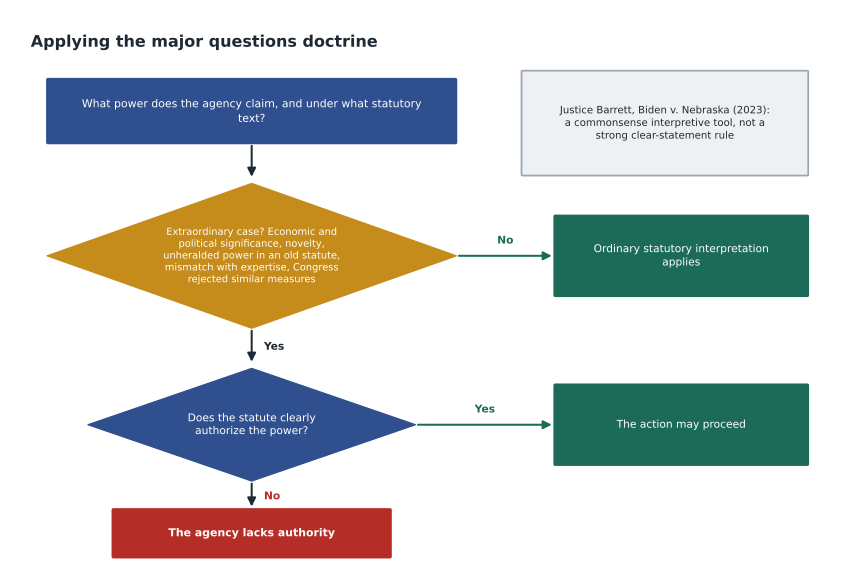
While the Court has kept the nondelegation doctrine largely dormant, it has developed a statutory rule that does much of the same work. The major questions doctrine holds that in extraordinary cases involving questions of vast economic and political significance, an agency must point to clear congressional authorization for the power it claims. Its roots include FDA v. Brown and Williamson Tobacco Corp. (2000), which held that Congress had not given the FDA power to regulate tobacco, and Utility Air Regulatory Group v. EPA (2014), which said the Court expects Congress to speak clearly if it wishes to assign an agency decisions of vast economic and political significance.
West Virginia v. EPA (2022) gave the doctrine its name. The Environmental Protection Agency's Clean Power Plan had set emissions limits for power plants based on shifting electricity generation from coal to natural gas and renewables. Chief Justice Roberts's opinion for the Court held that the EPA lacked clear authorization to adopt that generation-shifting approach under section 111 of the Clean Air Act, a rarely used provision. The Court emphasized that the agency claimed to discover in a long-extant statute an unheralded power representing a transformative expansion of its regulatory authority. Justice Gorsuch's concurrence tied the doctrine to nondelegation values. Justice Kagan's dissent argued that the majority had invented a get-out-of-text-free card.
In Biden v. Nebraska (2023), the Court applied the doctrine to the Education Department's plan to cancel roughly 430 billion dollars in student loan debt under the HEROES Act, which allows the Secretary to waive or modify statutory provisions in connection with a national emergency. Chief Justice Roberts wrote that the power to modify does not include the power to rewrite the statute from the ground up, and that the plan's economic and political significance confirmed the conclusion. Justice Barrett's concurrence offered a different account of the doctrine: not a clear statement rule that loads the dice against agencies, but a commonsense interpretive tool reflecting how a reasonable person would understand a delegation in context.
The doctrine applied to the President: Learning Resources
In February 2026, the Court decided Learning Resources, Inc. v. Trump together with Trump v. V.O.S. Selections, Inc. The President had imposed broad tariffs on imports from most countries under the International Emergency Economic Powers Act, which lets the President, after declaring a national emergency, regulate importation of property in which a foreign country has an interest. Chief Justice Roberts's opinion held that the statute does not authorize tariffs. In the parts of the opinion joined by a majority, the Court rested on ordinary statutory interpretation: the power to regulate importation, read in context, does not include the distinct power to tax imports, which the Constitution gives to Congress and which Congress has granted elsewhere in carefully limited terms. A plurality of three Justices also relied on the major questions doctrine. Justice Kagan, joined by Justices Sotomayor and Jackson, joined the statutory holding but wrote separately to explain why the major questions doctrine was unnecessary. Justice Kavanaugh, joined by Justices Thomas and Alito, dissented, and Justice Thomas also wrote a separate dissent.
Haverford points out two lessons from Learning Resources. First, the major questions doctrine has not settled into a stable majority approach; a majority reached the result through ordinary interpretation, while some Justices preferred the doctrine and others rejected it. Second, the case involved the President acting under a statute, not an agency under the APA, which shows that the interpretive questions are the same whoever exercises delegated power.
Using the doctrines in practice
For a challenger, the practical message is that nondelegation arguments almost never win alone, but they reinforce statutory arguments. A lawyer challenging a rule should first argue that the statute, read naturally, does not authorize what the agency did; second, that even if the text is ambiguous, the claimed power is so significant that clear authorization is required; and third, that reading the statute to allow the agency's action would raise serious nondelegation concerns that the court should avoid. For an agency lawyer, the defense is the mirror image: show the statutory text that grants the power, show that the agency has used similar authority before, show that the power fits the agency's expertise, and show that Congress has not rejected the agency's approach.
Worked problem
The Commission's battery buyback rule
Section 105 of the fictional National Battery Safety Act lets the Commission adopt rules reasonably necessary to eliminate or reduce an unreasonable risk of fire from consumer batteries. Relying on that section, the Commission issues a rule requiring every e-bike manufacturer to buy back, at full purchase price, any battery sold in the last seven years that lacks a cell-level fuse, at an estimated industry cost of 9 billion dollars. Kestrel's lawyers want to challenge it.
Show solution
- Start with the text: section 105 authorizes rules reasonably necessary to reduce an unreasonable risk of fire; ask whether a retroactive buyback of existing products is a rule reducing risk or a compensation scheme the statute does not mention.
- Look at the structure: if the Act contains a separate, narrower recall provision with procedural protections, using the general rulemaking power to order buybacks may evade those limits.
- Apply the major questions factors: the cost is large, the power is novel for this agency, and a general provision is being used for a transformative purpose; a court is likely to demand clear authorization.
- Add nondelegation only as reinforcement: section 105's standard is an intelligible principle under Consumers' Research, so the argument is that reading it to allow unlimited buybacks would raise serious constitutional questions that the court should avoid.
Answer: Kestrel's strongest argument is statutory: the general rulemaking power does not clearly authorize a retroactive industry-wide buyback, particularly if the Act has a specific recall provision. The major questions doctrine strengthens that argument because of the cost and novelty of the claim. A freestanding nondelegation claim is weak after Consumers' Research and would be raised mainly to support a narrow reading of the statute.
State nondelegation doctrines
State courts apply their own nondelegation doctrines under state constitutions, and some are much stricter than the federal version. Several state supreme courts have struck down delegations that lacked meaningful standards, especially during public health emergencies. A lawyer challenging a state agency's rule should always check the state's own cases, because a federal-style intelligible principle argument may be weaker than the state's actual test.
Summary and key terms
- Congress may delegate if it supplies an intelligible principle; the Court has struck down delegations only twice, both in 1935.
- Gundy (2019) left the test intact, but three Justices called for a stricter approach.
- FCC v. Consumers' Research (2025) upheld the Universal Service Fund delegation and the private administrator's subordinate role, keeping the intelligible principle test in place.
- The major questions doctrine requires clear congressional authorization in extraordinary cases, as in West Virginia v. EPA and Biden v. Nebraska.
- Learning Resources v. Trump (2026) held that IEEPA does not authorize tariffs, with a majority relying on ordinary interpretation and a plurality also invoking major questions.
- In practice, statutory arguments lead and nondelegation arguments support them; state nondelegation doctrines may be stricter.
Practice problems
Work each problem on paper first, then reveal the answer to check.
How many times has the Supreme Court struck down a federal statute under the nondelegation doctrine?
Show answer
Twice, both in 1935: Panama Refining and Schechter Poultry.
What did FCC v. Consumers' Research hold about the private administrator?
Show answer
That its role was permissible because it acted subordinately to the Commission, which retained final decision-making authority.
What factors suggest a case is a major question?
Show answer
Vast economic or political significance, a novel or unheralded claim of power in an old statute, a mismatch with the agency's expertise and congressional rejection of similar measures.
How did Justice Barrett describe the major questions doctrine in Biden v. Nebraska?
Show answer
As a commonsense interpretive tool that reflects how a reasonable person would understand a delegation in context, rather than a strong clear-statement rule.
Lesson quiz · 5 questions
Score 60% or more to complete this lesson.
Create a free account to save your progress, take quizzes and earn a certificate.