
LAWU-211 · Lesson 12 of 12 · 20 min
Capstone: solving an administrative law problem
▶ Video coming soon A video version of this lesson is on the way.
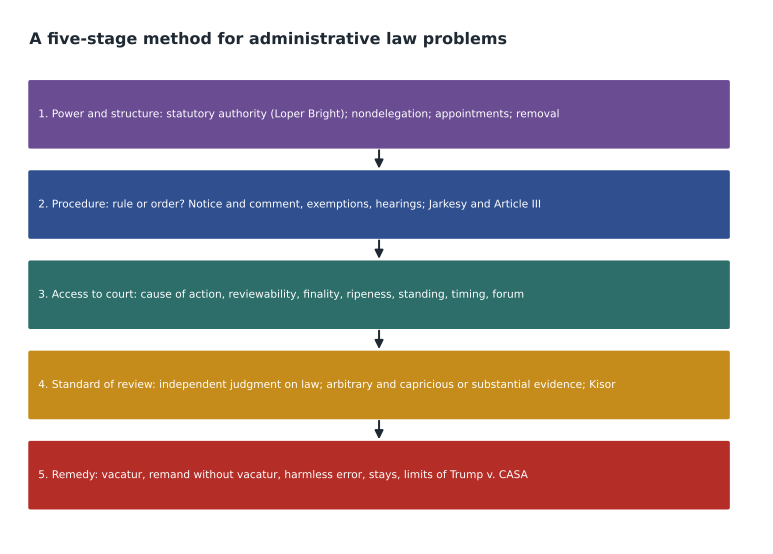
On the last day of the course, Haverford hands Section B a problem that has nothing to do with batteries. "Every administrative law exam," he says, "and most administrative law cases, can be organized with the same questions. Who acted, and did they have the power to act? What procedure did they use, and was it the right one? Can a court hear the challenge? What standard will the court apply? And if the challenger wins, what happens next?" This lesson walks through a complete problem using that method, drawing on every earlier lesson.
The problem
Congress enacted the fictional Hydrogen Pipeline Safety Act of 2021. It creates the Federal Pipeline Integrity Board, with three members appointed by the President with the advice and consent of the Senate for staggered five-year terms, removable only for inefficiency, neglect of duty or malfeasance in office. The Act authorizes the Board to prescribe such standards for the design and operation of hydrogen pipelines as the Board determines appropriate to protect public safety, taking into account the cost and technical feasibility of compliance. It authorizes civil penalties of up to 250,000 dollars per violation per day, imposed by the Board after a hearing before one of its administrative law judges, with review by petition in the court of appeals within 60 days.
In March, after a hydrogen leak caused an explosion near a school in a small town, the Board issued an interim final rule without notice and comment, invoking good cause. The rule requires all operators to install continuous electronic leak sensors at intervals of no more than one mile along every pipeline within 18 months. The preamble estimates compliance costs of 1.6 billion dollars over ten years and benefits of 2.1 billion dollars, but it does not respond to industry studies, submitted in earlier proceedings, showing that sensors at two-mile intervals capture nearly the same benefits at roughly half the cost. The Board solicited comments after publication and said it would consider them in a final rule.
In June, a Board ALJ held a hearing on a complaint charging Meridian Hydrogen, a mid-sized operator, with failing to report leaks on time under an older Board rule. The ALJ found that Meridian had concealed three leaks by falsifying inspection logs and recommended penalties of 4.5 million dollars. Meanwhile, in April, the President removed one Board member, citing disagreement with her votes on enforcement policy. Meridian petitions for review of the interim final rule and seeks to halt the penalty proceeding. Analyze its claims.
Step one: power and structure
Start with statutory authority. Under Loper Bright, the court decides independently whether the Act authorizes a sensor requirement. The Act's grant of power to prescribe standards for design and operation as the Board determines appropriate is an express delegation of discretion of the kind Loper Bright recognized. Leak sensors are plainly an operational safety measure, so the rule falls within the delegation's boundaries. The phrase taking into account cost and technical feasibility, however, sets a limit that matters at the arbitrary and capricious stage. Under Michigan v. EPA, an agency told to consider cost must actually do so.
Next, consider nondelegation and the major questions doctrine. The Act provides an intelligible principle, protection of public safety in light of cost and feasibility, well within Whitman and Consumers' Research. A safety rule for one industry with costs of about 160 million dollars a year is significant but not of the vast economic and political significance at issue in West Virginia v. EPA or Biden v. Nebraska, and the rule is within the Board's core function. Meridian's major questions argument is weak.
Then consider structure. The members' for-cause removal protection resembles the FTC protection that Trump v. Slaughter (2026) held unconstitutional when it overruled Humphrey's Executor. A multimember board exercising substantial executive power through rulemaking and enforcement is unlikely to survive under Slaughter. But under Collins v. Yellen, an unconstitutional removal restriction does not void the Board's actions unless the challenger shows that the restriction caused it harm. Here the President actually removed a member and the Board continued to act, so it is hard to show that the removal protection affected the rule or the enforcement action. The appointments themselves are proper because members are presidentially appointed and Senate confirmed. Meridian should check whether the ALJs are properly appointed by the Board under Lucia and whether their own removal protections raise issues, but the remedy question again limits the payoff.
Step two: procedure
The interim final rule is a legislative rule, so section 553 notice and comment is required unless an exemption applies. The Board invoked good cause. Courts read the exception narrowly and require a specific showing that notice and comment would be impracticable, unnecessary or contrary to the public interest. An explosion near a school suggests urgency, but the rule gives operators 18 months to comply, which undercuts the claim that the Board could not take the few months needed for notice and comment. Post-promulgation comment generally does not cure the failure, because an agency that has already adopted a rule is less likely to keep an open mind. Meridian has a strong procedural claim.
The penalty proceeding raises Jarkesy. The ALJ found that Meridian falsified inspection logs to conceal leaks. Civil penalties designed to punish and deter are a legal remedy, and a claim resting on falsification and concealment closely resembles common law fraud, as in Jarkesy. The Board will argue that the case is like Atlas Roofing, which involved new statutory safety obligations with no common law analog, and that the public rights exception applies. The key question is the gravamen of the charge. If the violation is simply late reporting under a regulatory duty, Atlas Roofing may control. If the charge is essentially that Meridian deceived the regulator, Jarkesy points toward a jury trial in an Article III court. Meridian should press that the findings of falsification show the case is about fraud.
Step three: access to court
For the interim final rule, the Act provides review by petition in the court of appeals within 60 days, so Meridian must file there and on time. The rule is final agency action under Bennett v. Spear, because it is in effect and imposes obligations, even though the Board has promised a final rule later. Meridian, as a regulated operator, has standing and is within the zone of interests. The question whether good cause existed is purely legal and fit for review, and compliance costs create hardship, so the challenge is ripe under Abbott Laboratories.
For the penalty proceeding, the Act channels review to the court of appeals after the Board issues a final order. Under Thunder Basin and Elgin, ordinary challenges must wait. But Axon Enterprise v. FTC allows structural constitutional claims, such as claims that the ALJs or the Board are unconstitutionally insulated from removal, to proceed in district court now. Whether a Seventh Amendment claim under Jarkesy fits within Axon is less clear, because it concerns the forum for a particular claim rather than the agency's structure as a whole. Meridian should file its structural claims in district court and preserve its jury trial claim before the Board.
Step four: standard of review
On the statutory authority question, the court exercises independent judgment under Loper Bright, giving the Board's view Skidmore respect. On the procedural question, the court decides whether good cause existed without deference to the agency's conclusion, as most circuits hold. On the substance, the court applies arbitrary and capricious review under State Farm. The Board's failure to respond to the two-mile studies is a failure to consider an obvious alternative, of exactly the kind State Farm condemned, made worse by the statute's command to consider cost. The cost-benefit estimate shows net benefits, but under Michigan v. EPA and the Act's text, the Board must explain why the more expensive option is appropriate when a cheaper one achieves nearly the same benefits.
In the penalty case, if it reaches the court of appeals, the ALJ's findings and the Board's final order would be reviewed for substantial evidence under Universal Camera, considering the whole record. Any question about the meaning of the older reporting rule would be governed by Kisor if the rule is genuinely ambiguous.
Step five: remedy
If Meridian wins on good cause, the usual remedy is vacatur of the interim final rule, restoring the prior regime. The Board will ask for remand without vacatur under Allied-Signal, arguing that the explosion shows a safety need. A court might accept that argument for the arbitrary and capricious defect, which the Board may cure with a better explanation, but is less likely to do so for a complete failure to provide notice and comment, which is a serious defect. The court could stay its vacatur briefly while the Board issues a properly noticed proposed rule. Because the remedy is vacatur under the APA, not an injunction, Trump v. CASA does not limit it to Meridian. In the penalty case, if Jarkesy applies, the Board cannot impose the penalties itself and must bring the claim in federal court before a jury.
Writing the answer
Haverford's advice for exams and briefs is the same: lead with the strongest claims, treat weak claims briefly and always state what remedy follows. Here, Meridian's strongest claims are the failure to provide notice and comment and the failure to consider the two-mile alternative. Its Jarkesy claim is strong if the charge is fraud based. Its removal claim is likely correct on the merits after Slaughter but probably yields no relief under Collins. Its major questions and nondelegation claims are weak. A good answer says all of this in that order, with the cases that support each conclusion.
Common mistakes
Haverford ends with the mistakes he sees most often on exams. The first is citing Chevron as current law. After 2024, a statutory question is decided by the court, and the right citations are Loper Bright and Skidmore, along with any express delegation in the statute. The second is treating every agency document as a rule needing notice and comment, or the reverse. Students should classify the document first, using the legislative, interpretive and policy statement categories from Lesson 8.
The third mistake is confusing standards of review. Questions of law get independent judgment; findings of fact in formal proceedings get substantial evidence review; policy choices and informal factual judgments get arbitrary and capricious review; and an agency's reading of its own ambiguous regulation may get Kisor deference. Mixing these up leads to wrong answers even when the analysis is otherwise strong. The fourth is forgetting the threshold doctrines. A brilliant merits argument in the wrong court, after the deadline or against a nonfinal action goes nowhere.
The fifth mistake is ignoring the remedy. Students often stop after finding a constitutional or statutory defect, but Collins, Allied-Signal, harmless error and Trump v. CASA can turn a winning argument into little practical relief. Finally, students sometimes rely on dicta or dissents from recent cases as if they were holdings. In a field changing as fast as administrative law did between 2022 and 2026, it is essential to know what each decision actually held and by what majority, and to say so precisely.
| Claim | Likely outcome |
|---|---|
| Statutory authority | Within the Board's delegated discretion under Loper Bright |
| Nondelegation and major questions | Weak; intelligible principle and ordinary safety rule |
| Removal protection | Likely unconstitutional after Slaughter but no relief without harm under Collins |
| Good cause for interim final rule | Strong; 18-month compliance period undercuts urgency |
| Failure to consider two-mile alternative | Strong under State Farm and Michigan v. EPA |
| Jury trial for penalties | Strong if the charge is fraud based under Jarkesy; weaker if purely regulatory under Atlas Roofing |
Worked problem
A variation
Suppose the Board had used notice and comment, responded to the two-mile studies by finding that sensor gaps longer than one mile would miss leaks in densely populated areas, and limited the one-mile requirement to pipelines within five miles of homes or schools. Meridian still challenges the rule as arbitrary and capricious and argues that the Board should have required two-mile intervals everywhere. What result?
Show solution
- Procedure: notice and comment eliminates the good cause claim.
- Alternatives: the Board considered the two-mile option and gave a reason tied to the evidence, satisfying State Farm.
- Cost: tailoring the requirement to populated areas shows the Board took account of cost as the Act requires.
- Deference: under Baltimore Gas and Prometheus, courts defer to reasonable expert predictions on technical questions.
Answer: The rule would likely be upheld. Arbitrary and capricious review asks whether the agency confronted the evidence and alternatives and explained its choice, not whether the court would have chosen the cheaper option.
Summary and key terms
- Analyze administrative law problems in five stages: power and structure, procedure, access to court, standard of review and remedy.
- Statutory authority is decided independently under Loper Bright, but express delegations of discretion are honored.
- Removal defects after Slaughter usually require a showing of harm under Collins to yield relief.
- Good cause is construed narrowly, and long compliance periods undercut claims of urgency.
- Jarkesy requires a jury for penalty claims resembling common law fraud, while Atlas Roofing covers purely statutory obligations.
- Every answer should end with the remedy, including whether vacatur or remand without vacatur is appropriate.
Practice problems
Work each problem on paper first, then reveal the answer to check.
Why does the 18-month compliance period hurt the Board's good cause claim?
Show answer
Because it suggests there was time for notice and comment, undercutting the claim that prior procedure was impracticable or contrary to the public interest.
Why might Meridian get no relief from its removal claim?
Show answer
Because Collins v. Yellen requires a showing that the unconstitutional removal restriction caused harm, and the President was able to remove a member anyway.
Which claims can Meridian bring in district court before the penalty proceeding ends?
Show answer
Structural constitutional claims under Axon, such as challenges to the removal protections of the Board or its ALJs.
Why does Trump v. CASA not limit vacatur of the rule to Meridian?
Show answer
Because CASA addressed universal injunctions and expressly left open the scope of vacatur under the APA.
Lesson quiz · 5 questions
Score 60% or more to complete this lesson.
Create a free account to save your progress, take quizzes and earn a certificate.