
LAWU-211 · Lesson 5 of 12 · 21 min
Juries, Article III and agency enforcement
▶ Video coming soon A video version of this lesson is on the way.
The fictional National Battery Safety Act gives the Commission two ways to punish a company that sells unsafe batteries. Under section 120, it may bring a civil action in federal district court for penalties of up to 50,000 dollars per violation. Under section 121, it may instead hold an administrative hearing before its own administrative law judge, impose the same penalties by order and, if the company does not pay, collect them by offsetting federal payments owed to the company. The Commission has chosen section 121 for Kestrel North America. Kestrel's lawyers say that choice is unconstitutional after SEC v. Jarkesy. "They might be right," Haverford tells Section B. "And two years ago, almost nobody would have said so."
This lesson covers the constitutional limits on agency adjudication that come from Article III, which vests the judicial power in courts whose judges have life tenure and protected salaries, and from the Seventh Amendment, which preserves the right to a jury trial in suits at common law. The Supreme Court's 2024 decision in Jarkesy and its 2026 decision in FCC v. AT&T have made these limits central to how agencies enforce the law.
Public rights and private rights
Since the nineteenth century, the Court has allowed Congress to assign some matters to agencies and other non-Article III tribunals. In Murray's Lessee v. Hoboken Land and Improvement Co. (1856), the Court distinguished matters that are inherently judicial from public rights, which arise between the government and others and which Congress may assign to executive officers for decision. In Crowell v. Benson (1932), the Court upheld an agency's adjudication of workers' compensation claims between private parties, subject to judicial review, while insisting that courts decide certain jurisdictional facts themselves.
The public rights category grew over the twentieth century. In Atlas Roofing Co. v. Occupational Safety and Health Review Commission (1977), the Court held that Congress could assign the imposition of civil penalties for workplace safety violations to an agency without a jury, because the case involved a new statutory obligation enforced by the government in its sovereign capacity. In Thomas v. Union Carbide Agricultural Products Co. (1985) and Commodity Futures Trading Commission v. Schor (1986), the Court upheld agency adjudication of disputes closely tied to federal regulatory schemes, including, in Schor, a state-law counterclaim the party had consented to have the agency decide. In Oil States Energy Services, LLC v. Greene's Energy Group, LLC (2018), it held that inter partes review of patents by the Patent and Trademark Office involves public rights, because granting a patent is a matter of public franchise.
On the other side of the line, the Court has insisted that some matters must go to Article III courts. In Northern Pipeline Construction Co. v. Marathon Pipe Line Co. (1982), it struck down a scheme letting bankruptcy judges without life tenure decide state-law contract claims. In Granfinanciera, S.A. v. Nordberg (1989), it held that a bankruptcy trustee's suit to recover a fraudulent conveyance from a party who had not filed a claim required a jury, because the action was a traditional legal claim. In Stern v. Marshall (2011), it held that a bankruptcy court lacked authority to enter final judgment on a state-law counterclaim for tortious interference.
SEC v. Jarkesy (2024)
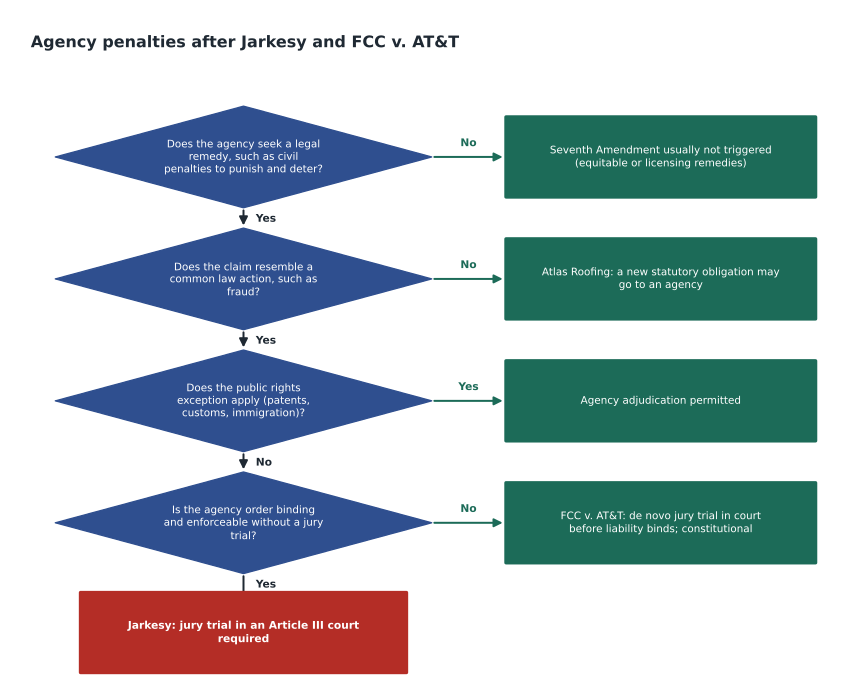
George Jarkesy, an investment adviser, was found by the Securities and Exchange Commission, after an in-house hearing, to have committed securities fraud, and was ordered to pay a 300,000 dollar civil penalty. The Fifth Circuit held the proceeding unconstitutional on several grounds. The Supreme Court affirmed on one: the Seventh Amendment. Chief Justice Roberts's opinion for six Justices held that the SEC's antifraud provisions target the same basic conduct as common law fraud, that civil penalties designed to punish and deter are a legal remedy traditionally tried to juries, and that the public rights exception does not apply simply because Congress assigned the claim to an agency. The action had to be brought in federal court, where Jarkesy would be entitled to a jury.
The Court distinguished Atlas Roofing on the ground that the workplace safety obligations in that case were new statutory duties with no common law analog, whereas securities fraud closely resembles common law fraud. Justice Gorsuch, joined by Justice Thomas, concurred, emphasizing due process and Article III. Justice Sotomayor, joined by Justices Kagan and Jackson, dissented, arguing that the decision overturned decades of precedent and threatened the enforcement authority of many agencies.
Jarkesy left several questions open. It did not decide whether the SEC's administrative law judges were unconstitutionally protected from removal, whether the delegation to the SEC to choose between court and agency proceedings was valid, or how far the common law analog test reaches. After the decision, agencies that impose civil penalties for conduct resembling fraud, negligence or other common law wrongs faced challenges to in-house penalty proceedings, and some agencies began bringing more penalty cases in court.
FCC v. AT&T (2026)
The Federal Communications Commission fined AT&T, Verizon and other carriers more than 100 million dollars in total for failing to protect customer location data. Under the Communications Act, the Commission may issue a notice of apparent liability and then a forfeiture order. A carrier that pays may seek review in a court of appeals. A carrier that does not pay faces nothing further unless the Justice Department sues to recover the forfeiture under 47 U.S.C. section 504, and in that suit the carrier receives a trial de novo with a jury. The carriers paid and then argued that the Commission's process violated the Seventh Amendment under Jarkesy.
On June 4, 2026, the Court rejected that argument, eight to one, in an opinion by Chief Justice Roberts. The Court held that the Seventh Amendment does not dictate the stage at which a jury must be involved. A nonjury agency proceeding that makes initial findings is permissible if those findings are subject to de novo determination by a jury before they become binding. Unlike the SEC in Jarkesy, which could collect its penalties directly, the FCC has no power to execute on a forfeiture order. Its orders carry no penalty for nonpayment and accrue no interest, and the agency may not hold an unpaid forfeiture against a carrier unless a court has ordered payment. Because the orders were not binding, the carriers' jury right was never triggered. The Court compared the carriers' choice, between paying and seeking deferential appellate review or refusing and facing a possible jury trial, to choices it has upheld in plea bargaining. Justice Thomas dissented on the remedy, agreeing with the Seventh Amendment analysis but arguing that the carriers, who paid believing payment was required, should receive refunds and a chance to respond under a correct understanding of the law.
The same day, in Sripetch v. SEC, the Court unanimously held that the SEC need not prove that investors suffered actual financial losses before obtaining disgorgement in a civil enforcement action, because disgorgement is an equitable remedy measured by the wrongdoer's gain. That decision builds on Liu v. SEC (2020), which limited disgorgement to the wrongdoer's net profits awarded for victims, and Kokesh v. SEC (2017), which treated disgorgement as a penalty for purposes of the statute of limitations.
Haverford sums up the line the Court has drawn. If an agency can impose a binding penalty for conduct that resembles a common law wrong and collect it without the defendant ever having a jury, Jarkesy says the scheme is unconstitutional unless the public rights exception applies. If the agency's order is only a first step and the government must go to court, where a jury decides the facts afresh before any liability becomes enforceable, FCC v. AT&T says the scheme is permissible.
Juries and the amount of penalties
Jarkesy builds on earlier cases about when statutory claims carry a jury right. In Curtis v. Loether (1974), the Court held that a damages action under the Fair Housing Act was a legal claim requiring a jury, because the Seventh Amendment applies to statutory actions that enforce legal rights and remedies, not only to claims known at common law in 1791. In Tull v. United States (1987), the Court held that the government's suit for civil penalties under the Clean Water Act required a jury on liability, because civil penalties are a type of remedy at common law that could only be enforced in courts of law. But the Court also held that the judge, not the jury, could set the amount of the penalty, because determining the amount is not a fundamental element of a jury trial.
Those cases matter for agencies after Jarkesy. When an agency must go to court for penalties, a jury will decide whether the defendant violated the statute, but the amount may still be set by the judge within statutory limits, often informed by the agency's penalty guidelines. And remedies that are equitable in nature, such as injunctions or properly limited disgorgement under Liu, do not trigger a jury right at all, which gives agencies some room to choose remedies that keep enforcement within administrative proceedings.
Getting into court early: Axon
Before 2023, a party facing an agency enforcement proceeding usually had to wait until the agency issued a final order before raising constitutional objections in a court of appeals, because statutes that channel review to the courts of appeals were read to strip district courts of jurisdiction. In Axon Enterprise, Inc. v. FTC (2023), the Supreme Court held that district courts may hear structural constitutional challenges to agency proceedings, such as claims that administrative law judges are unconstitutionally insulated from removal or that the agency's combination of functions violates due process. Applying the factors from Thunder Basin Coal Co. v. Reich (1994), the Court reasoned that being subjected to an unconstitutionally structured proceeding is a here-and-now injury that cannot be remedied after the fact, that such claims are collateral to the agency's review scheme and that they fall outside the agency's expertise.
Axon does not allow parties to bring ordinary challenges, such as disputes about the facts or the meaning of the statute, in district court before the agency finishes. It is limited to structural claims about the legitimacy of the proceeding itself. But it gives defendants a powerful tool: they can seek to enjoin an agency case at the start, and the question whether a proceeding violates Jarkesy can be raised immediately.
Applying the doctrine to the Commission
Section 121 of the fictional Battery Safety Act lets the Commission impose penalties by order and collect them by offset. A battery safety obligation might seem like a new statutory duty in the mold of Atlas Roofing, but selling a dangerous product also resembles common law negligence and products liability, which are traditional jury claims. And unlike the FCC in AT&T, the Commission can collect its penalties without going to court. Haverford asks Section B to work through it.
Worked problem
Kestrel's Seventh Amendment challenge
Kestrel North America faces a section 121 proceeding seeking 4.2 million dollars in penalties for selling 84 battery packs that allegedly failed the thermal-runaway standard. Kestrel files suit in federal district court seeking to enjoin the proceeding, arguing that it violates the Seventh Amendment and that the Commission's administrative law judge is unconstitutionally protected from removal.
Show solution
- Jurisdiction: under Axon, structural constitutional claims, including the removal claim, may be heard in district court before the agency proceeding ends; the Seventh Amendment claim also attacks the forum itself, so Kestrel can argue it falls within Axon's reasoning.
- Legal remedy: the Commission seeks civil penalties designed to punish and deter, a legal remedy under Jarkesy.
- Common law analog: selling a defective product that causes a risk of fire resembles negligence and strict products liability; the Commission will answer that the standard is a technical, statutory requirement like the workplace rules in Atlas Roofing, but the analogy to products liability is strong.
- Binding effect: unlike the FCC scheme upheld in AT&T, section 121 lets the Commission collect by offset without a court ever involving a jury, so the AT&T rationale is unavailable.
- Public rights: battery safety regulation is not a traditional public rights category like customs, immigration or patents.
Answer: Kestrel has a strong argument that section 121 violates the Seventh Amendment as applied to it, because the Commission seeks binding, collectible penalties for conduct resembling a common law tort without any jury. The Commission's best options are to proceed under section 120 in district court, where Kestrel gets a jury, or to argue that its standard creates a new statutory obligation under Atlas Roofing. The removal claim is weaker as a basis for stopping the proceeding, because Collins requires a showing of harm, but it can be raised now under Axon.
The broader stakes
Many federal agencies impose civil penalties in-house, including agencies that regulate banking, labor, environmental compliance, transportation safety and trade. After Jarkesy, each must ask whether its penalties resemble common law claims and whether its orders are binding without a jury. FCC v. AT&T offers a template: an agency can keep its in-house process if its orders are not self-executing and the government must sue in court to collect. Congress could restructure statutes along those lines, and some agencies may shift enforcement to court. Haverford tells the class that this is likely to be one of the busiest areas of administrative litigation during their early careers.
Summary and key terms
- Congress may assign public rights matters to agencies without a jury, as in Atlas Roofing and Oil States, but not traditional private rights, as in Northern Pipeline, Granfinanciera and Stern.
- SEC v. Jarkesy (2024) held that the SEC's in-house civil penalties for securities fraud violated the Seventh Amendment because the claim resembles common law fraud.
- FCC v. AT&T (2026) upheld the FCC's forfeiture process because its orders are not binding until a court, with a jury trial de novo, orders payment.
- Sripetch v. SEC (2026) held that disgorgement does not require proof of investor loss.
- Axon (2023) allows structural constitutional challenges to agency proceedings in district court before the proceeding ends.
- Agencies with self-executing penalty powers face Jarkesy challenges; non-binding orders followed by court enforcement are the safer model.
Practice problems
Work each problem on paper first, then reveal the answer to check.
Why did Jarkesy distinguish Atlas Roofing?
Show answer
Atlas Roofing involved new statutory workplace safety duties with no common law analog, while securities fraud closely resembles common law fraud.
What made the FCC's process constitutional in FCC v. AT&T?
Show answer
Its forfeiture orders are not binding or collectible; the government must sue, and the defendant gets a jury trial de novo before any liability becomes binding.
What kind of claims did Axon allow in district court?
Show answer
Structural constitutional challenges to the agency proceeding itself, such as removal or combination-of-functions claims, not ordinary disputes about facts or statutory meaning.
What did Sripetch v. SEC hold?
Show answer
That the SEC need not prove investors suffered actual losses to obtain disgorgement, because disgorgement is measured by the wrongdoer's gain.
Lesson quiz · 5 questions
Score 60% or more to complete this lesson.
Create a free account to save your progress, take quizzes and earn a certificate.