
LAWU-211 · Lesson 4 of 12 · 20 min
Adjudication
▶ Video coming soon A video version of this lesson is on the way.
Haverford's fourth session begins with two documents. The first is a forty-page decision by an administrative law judge after a four-day hearing on whether Kestrel North America sold battery packs that failed the Commission's thermal-runaway standard. The second is a one-page letter from the Commission's staff denying a small importer's request to extend a compliance deadline. "Both of these are adjudications," he says. "Both decide the rights of a particular party on particular facts. One looks like a trial. The other looks like an email. Today we learn why, and what the law requires of each."
Adjudication is the process agencies use to decide individual cases: enforcement actions, license applications, benefit claims, permits and countless smaller decisions. It is by volume the largest part of administrative law. The Social Security Administration alone decides hundreds of thousands of disability appeals a year at the hearing level, and immigration judges in the Justice Department carry enormous caseloads. This lesson covers the procedures for formal and informal adjudication under the APA, the constitutional floor set by the Due Process Clause, and the agency's choice between making policy by adjudication and by rulemaking.
Formal adjudication under the APA
Formal adjudication applies when a statute requires an adjudication to be determined on the record after opportunity for an agency hearing. Courts have generally required the on-the-record language or its clear equivalent, following the approach of Florida East Coast Railway in rulemaking, although some circuits once read hearing requirements in adjudication more generously. When the trigger applies, sections 554, 556 and 557 impose a set of trial-like protections.
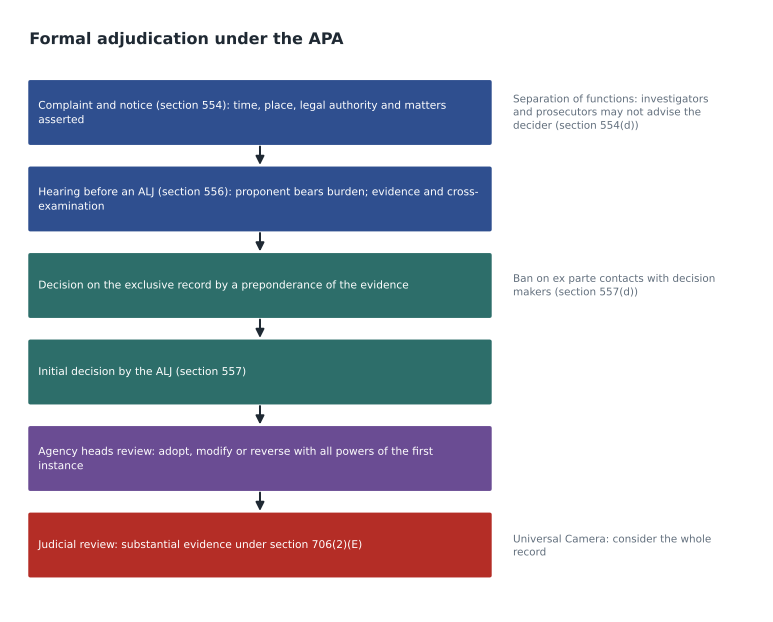
Under section 554, the agency must give notice of the time, place and nature of the hearing, the legal authority and the matters of fact and law asserted. Employees who investigate or prosecute a case may not participate in deciding it or advise the decision maker, except as witnesses or counsel in public proceedings, a principle known as separation of functions; the agency heads themselves are exempt from this rule. Under section 556, the hearing is presided over by the agency, one or more of its members, or an administrative law judge. The proponent of a rule or order has the burden of proof, which the Supreme Court in Director, OWCP v. Greenwich Collieries (1994) read to mean the burden of persuasion. A party may present its case by oral or documentary evidence, submit rebuttal evidence and conduct such cross-examination as may be required for a full and true disclosure of the facts. The decision must rest on the exclusive record, and in Steadman v. SEC (1981) the Court held that the standard of proof is a preponderance of the evidence unless a statute provides otherwise.
Section 557 governs the decision. The administrative law judge usually issues an initial or recommended decision, which the agency may adopt, modify or reverse, and on review the agency has all the powers it would have had in making the initial decision. The decision must include findings and conclusions, and the reasons or basis for them, on all material issues of fact, law or discretion. Section 557(d) forbids ex parte communications relevant to the merits between interested persons outside the agency and the decision makers, and requires any prohibited communication to be placed on the public record.
Administrative law judges
Administrative law judges are agency employees who preside over formal hearings. The APA protects their decisional independence in several ways: agencies may not evaluate their performance or tie their pay to their decisions, cases are assigned in rotation so far as practicable, and they may be removed only for good cause established and determined by the Merit Systems Protection Board after a hearing. After Lucia held that administrative law judges are officers, Executive Order 13843 (2018) moved their hiring into the excepted service, so that agency heads now select them directly rather than from a competitive list. Their removal protections are under constitutional challenge after Free Enterprise Fund and Slaughter, as Lesson 3 explained.
Many agencies also use adjudicators who are not administrative law judges, such as immigration judges, administrative judges at various departments and hearing officers. They often decide cases under agency-specific statutes and regulations rather than the APA's formal provisions, and their procedures vary widely. A lawyer appearing before an agency must learn its procedural rules, which are usually found in the Code of Federal Regulations and in the agency's practice manuals.
The substantial evidence standard
Findings of fact in formal adjudication are reviewed under section 706(2)(E) for substantial evidence. In Universal Camera Corp. v. NLRB (1951), the Supreme Court held that substantial evidence means such relevant evidence as a reasonable mind might accept as adequate to support a conclusion, and that the reviewing court must consider the record as a whole, including evidence that detracts from the agency's finding. Where the agency rejects its administrative law judge's credibility findings, the court must take that disagreement into account, because the judge saw the witnesses. More recently, in Biestek v. Berryhill (2019), the Court repeated that the threshold for substantial evidence is not high: it means more than a mere scintilla.
Informal adjudication
Informal adjudication covers the vast range of agency decisions that are not required to be made on the record: grants and denials of permits, licenses, waivers, benefits and requests. The APA says little about them. Section 555 gives a person compelled to appear the right to counsel, requires agencies to conclude matters within a reasonable time and requires prompt notice and a brief statement of grounds when an application is denied. Section 558 adds some protections for licensees. Beyond that, the procedures come from the agency's own statute, its regulations and the Due Process Clause.
Courts may not impose additional procedures in informal adjudication beyond those required by law. In Pension Benefit Guaranty Corp. v. LTV Corp. (1990), the Court applied Vermont Yankee's reasoning to adjudication and rejected a lower court's demand that the agency give a party notice of the materials on which it relied and an opportunity to respond. But informal adjudications are still reviewable under the arbitrary and capricious standard, and the agency must explain its decision. In Citizens to Preserve Overton Park v. Volpe (1971), the Court required the Secretary of Transportation to justify his approval of a highway through a Memphis park on the basis of the administrative record that existed when he decided, not post hoc rationalizations prepared for litigation. Under SEC v. Chenery Corp. (1943), known as Chenery I, a court may uphold agency action only on the grounds the agency itself invoked.
The Due Process Clause
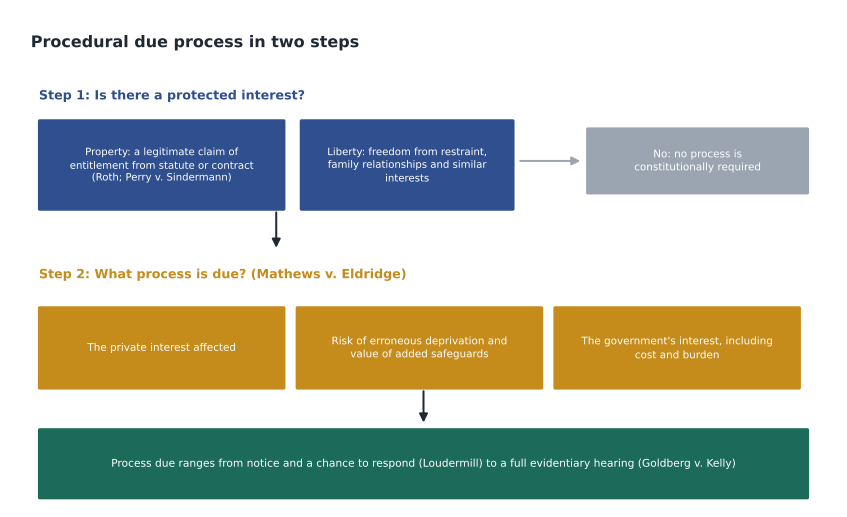
When no statute requires a hearing, the Due Process Clause may. The Fifth Amendment, for federal agencies, and the Fourteenth, for states, forbid depriving any person of life, liberty or property without due process of law. The analysis asks two questions: is there a protected interest, and if so, what process is due?
Protected property interests are not limited to traditional property. In Goldberg v. Kelly (1970), the Court held that welfare recipients were entitled to an evidentiary hearing before their benefits were terminated. In Board of Regents v. Roth (1972), it explained that property interests are created by independent sources such as state law and require a legitimate claim of entitlement, not merely a unilateral expectation; an untenured professor on a one-year contract had none. In Perry v. Sindermann (1972), decided the same day, a professor with a de facto tenure system could have a property interest. Liberty interests include freedom from bodily restraint, important family relationships and, in some circumstances, reputation combined with the loss of some other tangible interest.
What process is due depends on balancing. Mathews v. Eldridge (1976), which held that a hearing was not required before disability benefits were terminated, set out three factors: the private interest affected; the risk of an erroneous deprivation through the procedures used and the probable value of additional safeguards; and the government's interest, including the fiscal and administrative burdens of additional procedures. The Mathews test governs most administrative due process questions today. In Cleveland Board of Education v. Loudermill (1985), the Court held that a tenured public employee is entitled to notice and an opportunity to respond before termination, with a fuller hearing afterward.
Bias and the combination of functions
Due process also requires a neutral decision maker. A decision maker with a direct financial stake in the outcome is disqualified, as the Court held in Gibson v. Berryhill (1973), where a state optometry board composed of private optometrists sought to revoke the licenses of optometrists employed by a competing corporation. But the mere combination of investigative and adjudicative functions in the same agency does not by itself violate due process. In Withrow v. Larkin (1975), the Court held that a state medical board could investigate a doctor and then hold a hearing to suspend his license; there is a presumption of honesty and integrity in those serving as adjudicators. Prejudgment of the facts of a particular case, as distinct from a general policy view, can disqualify an adjudicator.
Choosing between adjudication and rulemaking
Agencies with both rulemaking and adjudicative power usually may choose which to use to make policy. In SEC v. Chenery Corp. (1947), known as Chenery II, the Court held that the SEC could announce a new standard in an individual adjudication rather than by rule, because the choice between proceeding by general rule or by individual, ad hoc litigation is one that lies primarily in the informed discretion of the administrative agency. In NLRB v. Bell Aerospace Co. (1974), the Court reaffirmed that the National Labor Relations Board, which makes most of its policy through adjudication, could decide whether buyers were managerial employees in a case rather than by rule. In NLRB v. Wyman-Gordon Co. (1969), a divided Court nonetheless criticized the Board for announcing a rule in an adjudication that it then applied only prospectively, without following the APA's rulemaking procedures.
Making policy through adjudication has costs. Regulated parties may lack fair notice, the new standard may be applied retroactively to conduct that predated it, and the public has no chance to comment. Courts can respond by refusing to apply a new rule retroactively when that would be unfair, or by refusing to defer to an interpretation that comes as an unfair surprise. In FCC v. Fox Television Stations, Inc. (2012), the Court held that the FCC violated due process by sanctioning broadcasters under an indecency policy announced after the broadcasts occurred, without fair notice.
Agencies can also use rulemaking to simplify mass adjudication. In Heckler v. Campbell (1983), the Court upheld the Social Security Administration's medical-vocational guidelines, a set of grids that determine whether jobs exist in the national economy for claimants of a given age, education, work experience and physical capacity. The claimant argued that the statute required individualized proof in every hearing. The Court held that an agency may rely on rulemaking to resolve issues that do not require case-by-case consideration, so long as claimants can still show that the grids do not fit their particular circumstances. The case illustrates a general strategy: by deciding recurring questions once, through rulemaking, agencies make large adjudication programs faster and more consistent, while individual hearings focus on genuinely individual facts.
Worked problem
The importer's extension request
Volta Imports, a fictional small company, asks the Battery Safety Commission's staff for a ninety-day extension of the deadline for certifying its packs to the new standard. Staff denies the request in a one-paragraph email saying only that extensions are not appropriate at this time. Volta's inventory, worth 2 million dollars, cannot legally be sold after the deadline. Volta asks whether it was entitled to a hearing and whether the denial can be challenged.
Show solution
- Classify the action: the denial resolves a particular party's request and the statute does not require a hearing on the record, so it is informal adjudication.
- Check the APA: section 555(e) requires prompt notice of the denial and, except when affirming a prior denial or when the denial is self-explanatory, a brief statement of the grounds; the one-line email may not satisfy even that.
- Check due process: Volta has no legitimate claim of entitlement to an extension unless the statute or regulations create one; if they set criteria for granting extensions, Volta may have a protected interest, and Mathews would require at least notice and an opportunity to respond.
- Plan the challenge: if the denial is final agency action, Volta can seek review under the arbitrary and capricious standard; Overton Park and Chenery I require the Commission to defend the denial on the reasons it actually gave, which here are almost none.
Answer: Volta probably had no constitutional right to a formal hearing, but it was entitled to a brief statement of reasons under section 555(e), and the denial is vulnerable on review because the agency gave no reasoned explanation. A court would likely remand for the Commission to explain itself, and Volta should ask the Commission to reconsider with a fuller record before suing.
Summary and key terms
- Formal adjudication applies when a statute requires decisions on the record after a hearing; sections 554, 556 and 557 impose notice, separation of functions, burden of persuasion on the proponent, the exclusive record and a ban on ex parte contacts.
- Findings in formal adjudication are reviewed for substantial evidence on the whole record under Universal Camera.
- Informal adjudication requires little procedure under the APA, and courts may not add procedures, but agencies must explain decisions on the contemporaneous record under Overton Park and Chenery I.
- Due process requires a protected interest and then the process Mathews balancing demands, from a chance to respond to a full hearing.
- Combining investigative and adjudicative functions does not alone violate due process, but financial interest or prejudgment can.
- Under Chenery II and Bell Aerospace, agencies may usually choose adjudication or rulemaking to make policy, subject to limits on unfair retroactivity and lack of fair notice.
Practice problems
Work each problem on paper first, then reveal the answer to check.
Who bears the burden of persuasion in a formal APA adjudication?
Show answer
The proponent of the rule or order, as Greenwich Collieries held in interpreting section 556(d).
What did Pension Benefit Guaranty Corp. v. LTV Corp. hold?
Show answer
That courts may not impose procedures in informal adjudication beyond those required by statute, regulation or the Constitution.
What are the three Mathews v. Eldridge factors?
Show answer
The private interest affected, the risk of erroneous deprivation and the value of additional safeguards, and the government's interest, including burdens of extra procedures.
Does combining investigation and adjudication in one agency violate due process?
Show answer
Not by itself. Withrow v. Larkin recognized a presumption of honesty and integrity in adjudicators.
Lesson quiz · 5 questions
Score 60% or more to complete this lesson.
Create a free account to save your progress, take quizzes and earn a certificate.