
LAWU-211 · Lesson 6 of 12 · 21 min
Rulemaking
▶ Video coming soon A video version of this lesson is on the way.
On a Tuesday in Haverford's imagined spring, the National Battery Safety Commission publishes a notice of proposed rulemaking in the Federal Register. The proposal would require that e-bike and e-scooter batteries over 500 watt-hours sold for residential use include a cell-level fuse and a thermal-runaway warning label, and it asks for comment on whether apartment buildings should be required to provide fire-rated charging rooms. Within ninety days the Commission receives 3,400 comments: from manufacturers, retailers, fire chiefs, tenant groups, insurers and individuals, including Rosa Delgado, who writes about the night her battery caught fire in her garage. "Every one of those comments is now part of a legal record," Haverford says. "Whether this rule survives depends on what the Commission does with them."
Rulemaking is the process by which agencies make legislative rules, which have the force and effect of law. Most federal rules are made through informal, or notice-and-comment, rulemaking under section 553 of the APA. This lesson covers the steps of that process, the courts' interpretation of each step, the exemptions from notice and comment, and the additional requirements imposed by other statutes and executive orders. Lesson 7 covers how courts review the substance of the rule once it is issued.
The steps of notice-and-comment rulemaking
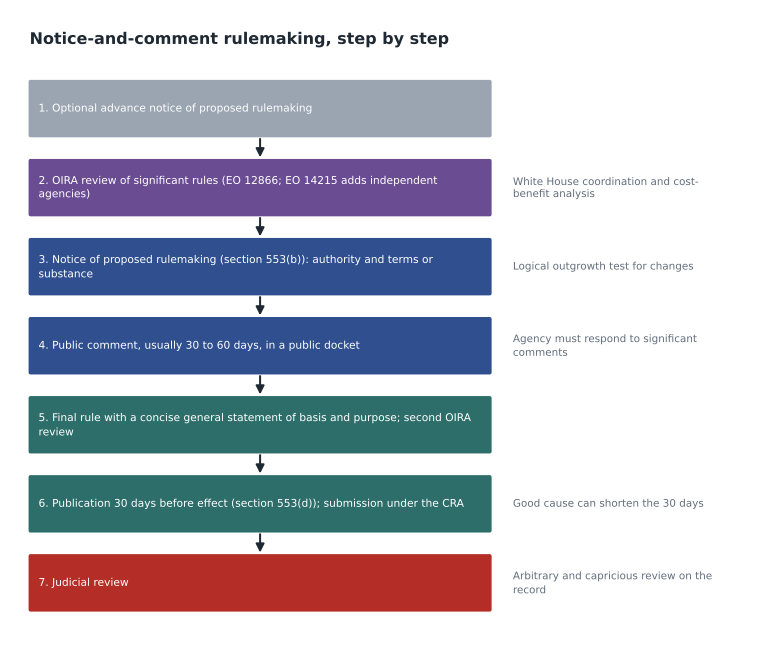
Section 553(b) requires general notice of proposed rulemaking to be published in the Federal Register, including a statement of the time, place and nature of public rulemaking proceedings, reference to the legal authority under which the rule is proposed, and either the terms or substance of the proposed rule or a description of the subjects and issues involved. Section 553(c) requires the agency to give interested persons an opportunity to participate through submission of written data, views or arguments, and, after considering the relevant matter presented, to incorporate in the rule adopted a concise general statement of its basis and purpose. Section 553(d) generally requires publication of the final rule at least thirty days before its effective date, with exceptions for rules that grant exemptions, interpretive rules and policy statements, and rules for which the agency finds good cause.
In practice, the process is longer. Agencies often begin with an advance notice of proposed rulemaking to gather information. Significant rules from executive agencies go through review by the Office of Information and Regulatory Affairs before the proposal and again before the final rule, a process now extended to independent agencies by Executive Order 14215. Comments are submitted through regulations.gov and placed in a public docket. The final rule, published in the Federal Register with a preamble responding to comments, is then codified in the Code of Federal Regulations.
Adequate notice and the logical outgrowth test
Final rules often differ from proposals, as they should if comments are taken seriously. But a final rule that departs too far from the proposal deprives the public of a meaningful opportunity to comment. Courts ask whether the final rule is a logical outgrowth of the proposal. In Long Island Care at Home, Ltd. v. Coke (2007), the Supreme Court described the test as whether the agency's notice fairly apprised interested persons of the subjects and issues before the agency, so that they should have anticipated that the change was possible. If the proposal discussed alternatives or asked about a specific issue, a final rule adopting one of those alternatives usually passes. If the final rule takes a direction the proposal never mentioned, it may fail.
The notice requirement also extends to the data and studies on which an agency relies. In Portland Cement Association v. Ruckelshaus (1973) and later cases, the D.C. Circuit held that an agency must disclose the technical studies and data underlying a proposed rule so that commenters can criticize them. Some judges and commentators have questioned whether that requirement is consistent with Vermont Yankee's bar on judge-made procedures, but the D.C. Circuit has continued to apply it, reasoning that it flows from the APA's requirement of meaningful notice and opportunity to comment.
Responding to comments
The concise general statement of basis and purpose is shorter in name than in practice. Courts require agencies to respond to significant comments, those that raise points relevant to the agency's decision and which, if adopted, would require a change in the rule. An agency that ignores a significant objection may have failed to consider an important aspect of the problem, which is grounds for invalidation under the arbitrary and capricious standard. In Ohio v. EPA (2024), the Supreme Court stayed the Environmental Protection Agency's interstate ozone transport rule, known as the Good Neighbor Plan, because the agency had not reasonably responded to comments warning that the rule's emissions controls might not work as designed if many states dropped out of the plan. Justice Gorsuch's opinion for five Justices held that the agency's failure to address that concern made the rule likely arbitrary and capricious. Justice Barrett, joined by three others, dissented, arguing that the agency's response was adequate and that the emergency posture did not justify the stay.
Agencies need not respond to every comment individually. Form letters and duplicative comments can be grouped. But the response must show that the agency actually considered the substance of significant objections. Haverford tells the class that the response-to-comments section of a rule's preamble is often where the litigation is won or lost, and that a skilled commenter writes with a future petition for review in mind.
Ex parte contacts and prejudgment in rulemaking
The APA's ban on ex parte communications applies to formal proceedings, not informal rulemaking. Contacts between agency officials and interested parties outside the comment process are therefore not prohibited by the APA, although agencies often adopt their own disclosure policies. In Sierra Club v. Costle (1981), the D.C. Circuit held that meetings between EPA officials and the White House or members of Congress during a rulemaking were permissible, emphasizing the value of executive coordination, while noting that the rule must be justified on the record. In Home Box Office, Inc. v. FCC (1977), the same court had taken a stricter view of ex parte contacts in rulemaking, but later decisions have largely confined it to rulemakings that resolve competing claims to a valuable privilege.
A decision maker's views on policy do not disqualify him from rulemaking. In Association of National Advertisers v. FTC (1979), the D.C. Circuit held that a commissioner may be disqualified from a rulemaking only on a clear and convincing showing that he has an unalterably closed mind on matters critical to its disposition. Policy views and public statements are expected of officials who make rules.
Exemptions from notice and comment
Section 553 does not apply to every rule. Section 553(a) exempts rules involving military or foreign affairs functions and matters relating to agency management or personnel or to public property, loans, grants, benefits or contracts, although many agencies have voluntarily waived the last exemption. Section 553(b)(A) exempts interpretive rules, general statements of policy and rules of agency organization, procedure or practice. Lesson 8 covers interpretive rules and policy statements. Procedural rules are exempt if they do not alter the rights or interests of parties, although they may change the manner in which parties present themselves to the agency.
Section 553(b)(B) creates the good cause exception, available when the agency for good cause finds, and incorporates the finding and a brief statement of reasons in the rule, that notice and public procedure are impracticable, unnecessary or contrary to the public interest. Courts read the exception narrowly. Impracticable usually means that the delay of notice and comment would cause real harm, as in an emergency. Unnecessary usually means the rule is minor or technical. Contrary to the public interest usually means that advance notice would defeat the rule's purpose, as when announcing a price freeze would cause a rush to raise prices. Agencies often issue interim final rules under the good cause exception, taking comments after the rule takes effect.
| Exemption | Text | How courts read it |
|---|---|---|
| Subject matter | Military or foreign affairs; agency management or personnel; public property, loans, grants, benefits or contracts | Applied according to the function involved; some agencies have waived the benefits and contracts exemption |
| Interpretive rules and policy statements | Section 553(b)(A) | Exempt if they do not have the force of law; see Lesson 8 |
| Procedural rules | Rules of agency organization, procedure or practice | Exempt if they do not alter substantive rights, even if they affect parties |
| Good cause | Prior notice and comment impracticable, unnecessary or contrary to the public interest | Read narrowly; the agency must state its reasons in the rule |
The good cause exception and deregulation
In April 2025, a presidential memorandum titled Directing the Repeal of Unlawful Regulations told agencies to identify rules that conflicted with recent Supreme Court decisions and suggested that those decisions gave agencies ample cause and legal authority to repeal such rules immediately without notice and comment. In October 2025, the acting administrator of the Office of Information and Regulatory Affairs issued guidance encouraging agencies to rely on the good cause exception to repeal rules they considered facially unlawful and shortening OIRA review times for deregulatory actions. Haverford tells the class that the legality of repealing a legislative rule without notice and comment on the theory that it was unlawful from the start is contested, because courts have long held that repealing a rule is itself rulemaking subject to section 553, and because whether a rule is unlawful is often precisely what comments would address. Challenges to such repeals will turn on whether the agency's good cause finding is supported.
Other analytical requirements
Rulemaking has accumulated requirements beyond the APA. The Regulatory Flexibility Act requires agencies to analyze the effects of proposed rules on small businesses and other small entities and to consider less burdensome alternatives, unless the agency certifies that the rule will not have a significant economic impact on a substantial number of them. The Paperwork Reduction Act requires approval from the Office of Management and Budget for information collections. The National Environmental Policy Act requires environmental review of major federal actions; in Seven County Infrastructure Coalition v. Eagle County (2025), the Supreme Court unanimously emphasized that courts should give substantial deference to agencies' judgments about the scope of that review and held that an agency need not study the effects of separate projects beyond its regulatory authority. The Unfunded Mandates Reform Act requires analysis of significant costs imposed on state and local governments and the private sector.
For executive agencies, and now independent agencies under Executive Order 14215, Executive Order 12866 requires a regulatory impact analysis for economically significant rules, including an assessment of costs and benefits. Executive Order 14192, issued in early 2025, added a requirement that agencies identify at least ten existing rules for repeal for every new rule and that the total incremental cost of new regulations be significantly less than zero, with exceptions. These executive orders are enforced inside the executive branch and generally create no rights that private parties may enforce in court, although a flawed cost-benefit analysis that an agency relies on can make a rule arbitrary and capricious.
Petitions and the duty to act
Section 553(e) gives interested persons the right to petition for the issuance, amendment or repeal of a rule. An agency must respond, and its denial is reviewable, though deferentially. In Massachusetts v. EPA (2007), the Court held that the EPA's refusal to regulate greenhouse gas emissions from new motor vehicles was reviewable and that the agency had to ground its refusal in the statute rather than in policy reasons the statute did not permit. Section 706(1) also lets courts compel agency action unlawfully withheld or unreasonably delayed, but in Norton v. Southern Utah Wilderness Alliance (2004), the Court held that this applies only to a discrete action the agency is required to take.
Worked problem
The charging-room provision
The Commission's proposed rule required fuses and labels and asked for comment on whether apartment buildings should be required to provide fire-rated charging rooms. After comments from fire chiefs, the final rule requires buildings with more than twenty units to provide charging rooms within two years, and also, for the first time, requires landlords to install battery-specific fire suppression in those rooms, which the proposal never mentioned. A landlords' association challenges both requirements, and also argues that the Commission ignored its comment estimating compliance costs at 1.2 billion dollars.
Show solution
- Charging rooms: the proposal specifically asked for comment on charging rooms, so a final requirement is a logical outgrowth; landlords should have anticipated it.
- Fire suppression: the proposal never mentioned suppression systems; unless the notice described the subject broadly enough that suppression was a foreseeable option, this requirement likely fails the logical outgrowth test and must be reproposed.
- Cost comment: a detailed cost estimate is a significant comment; if the preamble does not respond to it, the rule may be arbitrary and capricious under Ohio v. EPA for failing to consider an important aspect of the problem.
- Remedy: the court may remand the suppression requirement for new notice and comment while leaving the rest in place if it is severable.
Answer: The charging-room requirement likely survives the procedural challenge, but the fire-suppression requirement likely fails because the public had no fair notice of it. The Commission's failure to answer the landlords' cost estimate is a substantive vulnerability under the arbitrary and capricious standard. A court is likely to remand the suppression requirement and require a reasoned response to the cost comment.
Summary and key terms
- Section 553 requires notice of proposed rulemaking, an opportunity to comment, a concise general statement of basis and purpose and publication thirty days before the effective date.
- Final rules must be a logical outgrowth of the proposal, and agencies must disclose key data and respond to significant comments.
- Ohio v. EPA (2024) stayed a rule because the agency failed to respond reasonably to a significant comment.
- Ex parte contacts are not barred in informal rulemaking, and policy views do not disqualify a rulemaker absent an unalterably closed mind.
- Exemptions cover certain subject matters, interpretive rules, policy statements, procedural rules and good cause, which courts read narrowly.
- Statutes and executive orders add analytical requirements; 2025 directives encouraged deregulation and use of good cause, which remains contested.
Practice problems
Work each problem on paper first, then reveal the answer to check.
What is the logical outgrowth test?
Show answer
Whether the notice fairly apprised interested persons of the subjects and issues so that they should have anticipated the change in the final rule, as described in Long Island Care at Home v. Coke.
Why did the Supreme Court stay the EPA's Good Neighbor Plan in Ohio v. EPA?
Show answer
Because the agency likely failed to respond reasonably to significant comments about whether the rule's controls would work if many states dropped out.
What must an agency do to invoke the good cause exception?
Show answer
Find that notice and comment are impracticable, unnecessary or contrary to the public interest, and incorporate the finding and a brief statement of reasons in the rule.
When may a court compel agency action under section 706(1)?
Show answer
Only when the agency has failed to take a discrete action it is legally required to take, as Norton v. Southern Utah Wilderness Alliance held.
Lesson quiz · 5 questions
Score 60% or more to complete this lesson.
Create a free account to save your progress, take quizzes and earn a certificate.