
LAWU-211 · Lesson 10 of 12 · 20 min
Deference after Loper Bright
▶ Video coming soon A video version of this lesson is on the way.
Haverford begins the lesson by reading aloud a sentence from a 1984 opinion: when a statute is silent or ambiguous with respect to a specific issue, the question for the court is whether the agency's answer is based on a permissible construction of the statute. "For forty years," he says, "that sentence was the most cited in American public law. In 2024 the Supreme Court overruled it. Your job in practice will be to argue statutory questions to judges who decide them for themselves, while agencies still play a real but different role."
This lesson traces the rise and fall of Chevron deference, explains what Loper Bright Enterprises v. Raimondo (2024) held and did not hold, and works through the questions courts and lawyers now face: the respect owed to agency views under Skidmore, statutes that delegate discretion, the status of past decisions that relied on Chevron and the relationship between Loper Bright and the major questions doctrine.
The Chevron framework
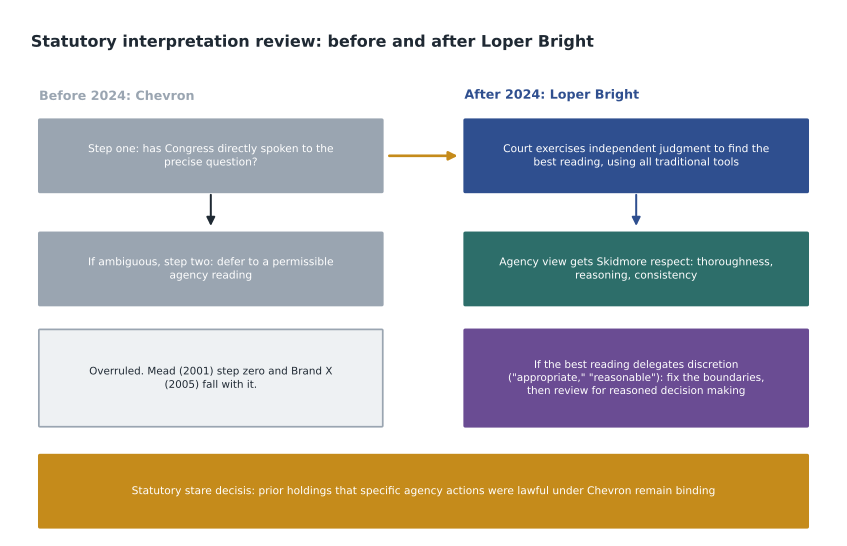
In Chevron U.S.A., Inc. v. Natural Resources Defense Council (1984), the Court upheld EPA's bubble concept, which allowed a plant to treat all its pollution-emitting devices as a single stationary source under the Clean Air Act. Justice Stevens's opinion set out what became a two-step test. At step one, the court asks whether Congress has directly spoken to the precise question at issue; if the intent of Congress is clear, that is the end of the matter. At step two, if the statute is silent or ambiguous, the court asks whether the agency's answer is based on a permissible construction. The Court explained that ambiguity reflects an implicit delegation to the agency, which is politically accountable and expert, to fill gaps.
Over time the Court refined Chevron. United States v. Mead Corp. (2001) added what scholars called step zero: Chevron applied only when Congress had delegated authority to make rules carrying the force of law and the agency's interpretation was issued in the exercise of that authority. National Cable and Telecommunications Association v. Brand X Internet Services (2005) held that an agency could adopt a reading different from a prior judicial interpretation unless the court had held the statute unambiguous. City of Arlington v. FCC (2013) applied Chevron to questions about the scope of an agency's own jurisdiction. King v. Burwell (2015) declined to apply Chevron to a question of deep economic and political significance under the Affordable Care Act. In the years before Loper Bright, the Court had not deferred under Chevron in any case since 2016.
Loper Bright
Loper Bright Enterprises v. Raimondo (2024) and its companion, Relentless, Inc. v. Department of Commerce, involved a National Marine Fisheries Service rule requiring herring fishermen to pay for federal observers on their boats. The Court held that Chevron was overruled, by a vote of 6 to 2 in Loper Bright, from which Justice Jackson was recused because she had heard the case on the D.C. Circuit, and 6 to 3 in Relentless. Chief Justice Roberts's opinion rested on section 706 of the APA, which directs reviewing courts to decide all relevant questions of law and interpret statutory provisions. That command, the Court held, requires courts to exercise independent judgment in deciding whether an agency has acted within its statutory authority. Courts may not defer to an agency interpretation simply because a statute is ambiguous.
The Court gave several reasons. Chevron was inconsistent with the APA and with the traditional understanding of the judicial role going back to Marbury v. Madison. Ambiguity is not a reliable sign of delegation; statutory gaps more often reflect the limits of drafting foresight. Agencies have no special competence in resolving statutory ambiguities, which is what courts do. Chevron had proved unworkable, generating endless disputes about whether statutes were ambiguous and how much deference to give. And reliance on Chevron did not justify keeping it, because the doctrine itself encouraged agencies to change positions, undermining stability.
Justice Thomas concurred, arguing that Chevron also violated the separation of powers. Justice Gorsuch's concurrence traced the history of judicial interpretation and argued that Chevron conflicted with stare decisis principles properly understood. Justice Kagan dissented, joined by Justice Sotomayor and, in Relentless, by Justice Jackson. She argued that Chevron reflected sound judgments about agency expertise and accountability, that Congress had legislated against its background for forty years and that the decision transferred power over regulatory policy to courts.
What Loper Bright did not do
The decision did not end all respect for agency views. Courts may seek aid from the interpretations of those responsible for implementing particular statutes, the Court said, quoting Skidmore. Interpretations issued roughly contemporaneously with enactment and consistently maintained deserve particular respect. And when a particular statutory question depends on factual or technical matters, the agency's expertise can inform the court's judgment.
Nor did the decision deny that Congress can delegate. The Court recognized that some statutes expressly delegate to an agency the authority to give meaning to a particular term, empower an agency to prescribe rules to fill up the details of a statutory scheme, or use terms like appropriate or reasonable that leave agencies flexibility. When the best reading of a statute is that it delegates discretionary authority, the court's role is to independently interpret the statute and effectuate the will of Congress by fixing the boundaries of the delegated authority and ensuring that the agency has engaged in reasoned decision making within those boundaries. That last step is the arbitrary and capricious review covered in Lesson 7.
Finally, the Court held that Loper Bright does not call into question prior cases that relied on the Chevron framework. The holdings of those cases, that specific agency actions are lawful, are still subject to statutory stare decisis despite the change in interpretive method. Mere reliance on Chevron is not a special justification for overruling such a holding. Lower courts have since debated how far that protection extends: whether it covers only the specific agency action upheld or the court's reading of the statute more broadly, and whether an agency may now change a position a court previously upheld as permissible but not compelled.
Applying Loper Bright
In practice, Loper Bright shifts the center of statutory litigation from whether a statute is ambiguous to what its best reading is. Lawyers must argue text, structure, history and purpose as they would in any statutory case. Agency interpretations still matter as evidence, particularly when longstanding and consistent, when they rest on technical expertise or when they were issued close to enactment. But an agency's new reading of an old statute, especially one that departs from its prior views, gets little weight. Because courts no longer defer, agencies can no longer count on changing interpretations with each administration, which may produce more stability in some areas and more litigation in others.
McLaughlin Chiropractic Associates v. McKesson Corp. (2025), covered in Lesson 9, applied Loper Bright's reasoning to the Hobbs Act, holding that district courts in enforcement proceedings must independently interpret statutes rather than treat agency orders as binding. Several lower courts have also reconsidered decisions that had deferred to agencies. In Ohio Telecom Association v. FCC (6th Cir. 2025), for example, the Sixth Circuit vacated the FCC's net neutrality rules, holding after Loper Bright that broadband internet access is an information service rather than a telecommunications service under the Communications Act.
Delegation clauses and mixed questions
Because Loper Bright preserves express delegations, much litigation now asks whether a statute delegates interpretive or policy authority. The Court cited Batterton v. Francis (1977), where the Social Security Act authorized the Secretary to prescribe standards for determining what counted as unemployment, as an example of an express delegation to define a term. Statutes that authorize an agency to act as it determines necessary, to set standards it finds appropriate or to define terms by regulation give the agency real discretion, though the court still decides the outer limits. Statutes that simply use a term without such language leave its meaning to the court. Drafters in Congress have begun to consider whether to write more explicit delegations into new statutes, and several bills introduced since 2024 have proposed either codifying Chevron or confirming its demise; none had been enacted by the end of the 2025 to 2026 Term.
Loper Bright concerns questions of law. Agency findings of fact remain subject to deferential substantial evidence or arbitrary and capricious review. Mixed questions, which apply a legal standard to settled facts, fall in between. In Wilkinson v. Garland (2024), the Court held that whether settled facts satisfy the statutory standard of exceptional and extremely unusual hardship in immigration cancellation of removal is a mixed question of law that courts of appeals may review, but that because it is primarily factual, the review is deferential. Lawyers should therefore characterize issues carefully: framing a point as a pure question of statutory meaning invites independent judicial review, while framing it as an application of law to fact or a policy choice invites deference.
State courts are not bound by Loper Bright, which interpreted the federal APA. Many states had already rejected Chevron-style deference to state agencies before 2024, either by judicial decision or by statute, and the trend has continued. Lesson 11 returns to state administrative law.
Loper Bright and the major questions doctrine
The major questions doctrine, covered in Lesson 2, requires clear congressional authorization for agency assertions of power of vast economic and political significance. Before Loper Bright, it operated partly as an exception to Chevron: even if a statute was ambiguous, a court would not defer on a major question. After Loper Bright, courts decide all statutory questions independently, so the doctrine's role is different. Some justices, like Justice Barrett in Biden v. Nebraska, describe it as a tool for finding the best reading of a statute, reflecting the common sense that Congress normally makes big decisions itself. Others treat it as a substantive canon requiring clear statements. In Learning Resources v. Trump (2026), the majority relied on ordinary statutory interpretation to hold that the emergency powers statute does not authorize tariffs, while only a plurality of three Justices also invoked the major questions doctrine and others rejected it as unnecessary.
Kisor after Loper Bright
Loper Bright addressed interpretations of statutes, not regulations. Kisor v. Wilkie, covered in Lesson 8, still allows limited deference to agency interpretations of their own genuinely ambiguous regulations. Some argue that Loper Bright's reading of section 706, which requires courts to decide all relevant questions of law, applies equally to regulations and dooms Kisor. Others note that regulations are the agency's own work product and that the Court in Kisor rejected that argument. The Supreme Court has not yet resolved the question, and lawyers should brief both Kisor and its possible erosion.
| Case | Holding |
|---|---|
| Skidmore v. Swift (1944) | Agency views receive weight according to their power to persuade |
| Chevron v. NRDC (1984) | Defer to permissible agency reading of ambiguous statute (overruled) |
| United States v. Mead (2001) | Chevron applies only to interpretations carrying the force of law |
| Kisor v. Wilkie (2019) | Limited deference to agency readings of genuinely ambiguous regulations |
| Loper Bright v. Raimondo (2024) | Courts exercise independent judgment on statutory questions; Chevron overruled |
| McLaughlin v. McKesson (2025) | District courts not bound by agency orders under the Hobbs Act in enforcement cases |
Worked problem
What is a lithium-ion cell?
In Ardent's case, the court must decide whether the Act's authorization to regulate rechargeable lithium battery products covers solid-state batteries, and whether the Commission's rule, which speaks of lithium-ion cells, applies to them. The Commission points to its FAQ and to a 2019 Commission report describing solid-state cells as an emerging form of lithium-ion technology. Ardent points to industry standards that treat solid-state and lithium-ion cells as distinct categories and notes that the Act was enacted in 2016, before solid-state scooters were sold.
Show solution
- Statutory question: under Loper Bright, the court decides independently whether solid-state batteries are rechargeable lithium battery products under the Act; the phrase is broad and probably covers them, since they are rechargeable and contain lithium.
- Agency views: the 2019 report is an interpretation issued before the dispute and may receive some Skidmore weight; the FAQ, issued informally after the rule, receives less.
- Regulatory question: whether the rule's term lithium-ion cell covers solid-state cells is a question about the Commission's own regulation, governed by Kisor if the term is genuinely ambiguous.
- Kisor conditions: an informal website FAQ may not be the agency's authoritative position, and industry standards treating the cells as distinct support an unfair surprise argument.
Answer: The Commission likely has statutory authority to regulate solid-state batteries, but it is less likely to prevail on the claim that its existing rule already covers them. The court will probably read lithium-ion cell in light of industry usage and refuse Kisor deference to the FAQ. The Commission can solve the problem by amending the rule through notice and comment.
Summary and key terms
- Chevron required deference to permissible agency readings of ambiguous statutes from 1984 until 2024.
- Loper Bright held that section 706 requires courts to exercise independent judgment on statutory questions.
- Agency views still receive Skidmore respect, especially when longstanding, consistent and expert.
- Where Congress delegates discretion, courts fix its boundaries and review the agency's choice for reasoned decision making.
- Prior holdings that relied on Chevron remain binding under statutory stare decisis.
- Kisor deference for agency readings of regulations survives for now but faces challenge.
Practice problems
Work each problem on paper first, then reveal the answer to check.
What statutory text did Loper Bright rely on?
Show answer
Section 706 of the APA, which directs reviewing courts to decide all relevant questions of law and interpret statutory provisions.
What happens to earlier cases that upheld agency action under Chevron?
Show answer
Their specific holdings remain subject to statutory stare decisis, and reliance on Chevron alone is not a special justification for overruling them.
What role does an agency's interpretation play after Loper Bright?
Show answer
It may inform the court's judgment under Skidmore, with weight depending on thoroughness, reasoning, consistency and expertise.
How does a court review an agency action under a statute that delegates discretion to act reasonably?
Show answer
It fixes the boundaries of the delegation through independent interpretation and then reviews whether the agency engaged in reasoned decision making within them.
Lesson quiz · 5 questions
Score 60% or more to complete this lesson.
Create a free account to save your progress, take quizzes and earn a certificate.