
LAWU-211 · Lesson 8 of 12 · 20 min
Guidance documents and interpretive rules
▶ Video coming soon A video version of this lesson is on the way.
Six months after the battery rule takes effect, the National Battery Safety Commission posts a twelve-page document on its website titled Frequently Asked Questions on Cell-Level Fusing. It says that batteries using a newer type of solid-state cell "must" include fuses even though the rule's text speaks only of lithium-ion cells, and it tells field inspectors to treat any battery without fuses as noncompliant. A maker of solid-state scooters asks whether the document is law. Haverford tells Section B that the question is one of the most practical in administrative law. "Most of what agencies say to the public is not in the Code of Federal Regulations," he says. "It is in manuals, letters, bulletins, frequently asked questions and enforcement policies. The question is when those documents need notice and comment and what weight they carry."
This lesson covers the APA's exemptions for interpretive rules and general statements of policy, the tests courts use to tell them from legislative rules, the deference owed to an agency's interpretation of its own regulations, executive branch policy on guidance and the effect of Loper Bright on interpretive documents.
Legislative rules and nonlegislative rules
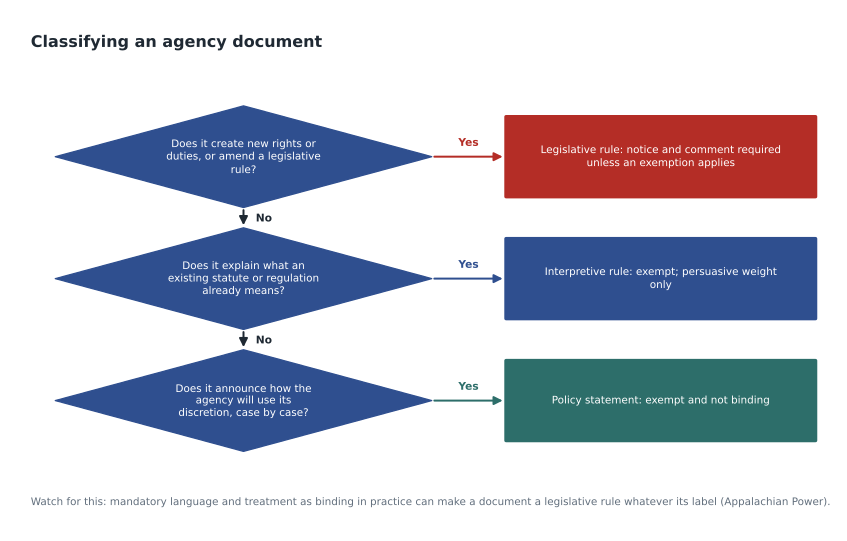
A legislative rule is one that an agency issues under delegated power to make law, after the procedures the statute and section 553 require. It has the force and effect of law: it binds the public and the agency, and it can be the basis for enforcement. Section 553(b)(A) exempts from notice and comment interpretive rules, general statements of policy and rules of agency organization, procedure or practice. These are often called nonlegislative rules or guidance. They do not need notice and comment, but they also cannot create new legal obligations.
The Supreme Court described the categories in Perez v. Mortgage Bankers Association (2015). Interpretive rules are issued by an agency to advise the public of its construction of the statutes and rules which it administers. They do not have the force and effect of law and are not accorded that weight in the adjudicatory process. A general statement of policy advises the public prospectively of the manner in which the agency proposes to exercise a discretionary power. The Court held in Perez that an agency may change an interpretive rule without notice and comment, rejecting the D.C. Circuit's Paralyzed Veterans doctrine, which had required notice and comment when an agency significantly revised a definitive interpretation. Because interpretive rules do not have the force of law, the Court said, changing them does not require the procedures used to make law.
Telling the categories apart
Labels do not control. An agency cannot avoid notice and comment by calling a binding rule guidance. Courts look to substance. For interpretive rules, the leading test comes from American Mining Congress v. Mine Safety and Health Administration (D.C. Cir. 1993), which asks whether, in the absence of the rule, there would be an adequate legislative basis for enforcement action; whether the agency published the rule in the Code of Federal Regulations; whether the agency explicitly invoked its general legislative authority; and whether the rule effectively amends a prior legislative rule. If any answer is yes, the rule is legislative. The core idea is that an interpretive rule explains what an existing statute or regulation already requires, while a legislative rule adds something new.
For policy statements, the leading test asks whether the document binds the agency or the public. In Appalachian Power Co. v. EPA (D.C. Cir. 2000), the court held that EPA guidance on monitoring under air permits was a legislative rule because it read like a ukase: it commanded, required, ordered and dictated, and state permitting authorities treated it as binding. A genuine policy statement leaves the agency free to exercise discretion in individual cases and does not establish a binding norm. Courts look at the document's language (must and shall versus may and should), whether the agency treats it as conclusive in practice and whether it has legal consequences for regulated parties. In Community Nutrition Institute v. Young (D.C. Cir. 1987), action levels for contaminants in food were held to be legislative rules because the agency treated them as binding.
Procedural rules
The third exemption covers rules of agency organization, procedure or practice. The idea is that agencies should be able to manage their own internal processes, such as filing deadlines, the order of hearings or the format of applications, without public comment. The line between procedure and substance is not always clear, because procedural choices can affect outcomes. The D.C. Circuit asks whether the rule encodes a substantive value judgment or alters the rights or interests of parties, even if it also affects how they present themselves to the agency. In JEM Broadcasting Co. v. FCC (D.C. Cir. 1994), the court treated the FCC's hard look rules, which dismissed broadcast license applications that contained errors without a chance to amend them, as procedural despite their harsh effect, because they did not change the substantive standards by which applications were judged.
In Batterton v. Marshall (D.C. Cir. 1980), by contrast, the court held that a Labor Department methodology for calculating state unemployment rates, which determined how federal funds were distributed, was a substantive rule requiring notice and comment because it had a direct effect on the rights of states and individuals. Haverford's practical advice is to ask what a regulated party would lose if the rule were changed without notice. If the answer is only some convenience in dealing with the agency, the rule is probably procedural. If the answer is a benefit, a license or protection from a penalty, the rule is probably substantive.
Guidance and judicial review
Whether guidance can be challenged in court is a separate question from whether it needed notice and comment. A challenge usually requires final agency action, discussed in Lesson 9. In some cases, guidance that has binding legal consequences is final and reviewable; in others, courts hold that guidance is not yet final because it has no direct consequences until the agency applies it in an enforcement proceeding. Regulated parties often face a dilemma: comply with guidance they believe is unlawful, or violate it and challenge it as a defense in enforcement. The ripeness and finality doctrines in Lesson 9 shape when they can sue first.
Deference to agency interpretations of their own regulations
When an agency interprets its own ambiguous regulation, a different deference doctrine applies. In Bowles v. Seminole Rock and Sand Co. (1945) and Auer v. Robbins (1997), the Court held that an agency's interpretation of its own regulation controls unless plainly erroneous or inconsistent with the regulation. Critics argued that Auer deference encouraged agencies to issue vague regulations through notice and comment and then fill in the details through guidance, avoiding procedural requirements.
In Kisor v. Wilkie (2019), the Court declined to overrule Auer but narrowed it significantly. Justice Kagan's opinion held that a court should not defer unless the regulation is genuinely ambiguous after the court exhausts all the traditional tools of construction. Even then, the agency's reading must be reasonable, must be the agency's authoritative or official position rather than an ad hoc statement, must implicate its substantive expertise and must reflect fair and considered judgment, not a convenient litigating position or post hoc rationalization. An interpretation that creates unfair surprise to regulated parties does not get deference. Chief Justice Roberts joined the key parts of the opinion on the basis of stare decisis, and Justice Gorsuch, joined by Justice Thomas and in part by Justices Kavanaugh and Alito, would have overruled Auer.
Loper Bright Enterprises v. Raimondo (2024) overruled Chevron deference for agency interpretations of statutes but did not address Kisor, which concerns regulations. Lower courts have continued to apply Kisor, though some judges and commentators argue that Loper Bright's reasoning about section 706 undermines it as well. Haverford tells the class to treat Kisor as current law with an asterisk: a doctrine the Supreme Court has narrowed sharply and might revisit.
| Type of interpretation | Standard |
|---|---|
| Agency reading of a statute (after 2024) | Court decides independently; agency view may inform the court under Skidmore (Loper Bright) |
| Agency reading of its own genuinely ambiguous regulation | Deference if reasonable, authoritative, expert and considered (Kisor) |
| Informal guidance on a statute | Persuasive weight depending on thoroughness, validity of reasoning and consistency (Skidmore) |
| Litigating position or post hoc rationalization | No deference (Kisor; Bowen v. Georgetown University Hospital) |
Skidmore weight
Skidmore v. Swift and Co. (1944) held that the Administrator's interpretations of the Fair Labor Standards Act, though not controlling, constitute a body of experience and informed judgment to which courts and litigants may properly resort for guidance. The weight of such a judgment depends on the thoroughness evident in its consideration, the validity of its reasoning, its consistency with earlier and later pronouncements and all those factors which give it power to persuade. United States v. Mead Corp. (2001) held that tariff classification rulings by Customs were not entitled to Chevron deference because Congress had not delegated authority to make rules carrying the force of law through that process, but could receive Skidmore weight. After Loper Bright, Skidmore describes the respect courts give agency interpretations of statutes generally, as Lesson 10 explains.
Executive branch policy on guidance
Presidents have regulated guidance through executive orders and budget office bulletins. The Office of Management and Budget's 2007 Final Bulletin for Agency Good Guidance Practices required agencies to follow procedures for significant guidance documents, including public access and, for economically significant guidance, notice and comment. Executive Order 13891 (2019) required agencies to post guidance in searchable databases and stated that guidance documents do not bind the public except as authorized by law or incorporated into a contract. President Biden revoked that order in 2021. In 2025, President Trump issued Executive Order 14219, directing agencies to identify regulations for rescission, and later orders and memoranda pressed agencies not to use guidance to impose obligations not found in statutes or regulations. Several agencies issued policies in 2025 stating that they would not treat guidance as binding in enforcement actions.
The Justice Department has long been central to this issue because it brings many enforcement actions. A 2018 department memorandum barred its civil litigators from using guidance documents to create binding requirements in affirmative civil enforcement cases; the department withdrew it in 2021. Such memoranda do not change the APA, but they shape how guidance is used in practice. For regulated parties, guidance remains extremely important as an indicator of how the agency will act, even when it cannot legally bind them.
Due process and fair notice
Guidance raises fair notice concerns when an agency penalizes conduct based on an interpretation that the regulated party could not have anticipated. In Christopher v. SmithKline Beecham Corp. (2012), the Court refused to defer to the Labor Department's interpretation classifying pharmaceutical sales representatives as entitled to overtime, because the agency announced it for the first time in amicus briefs after decades of industry practice to the contrary, creating unfair surprise. In General Electric Co. v. EPA (D.C. Cir. 1995), the court held that an agency could not impose a fine based on an interpretation of a regulation of which the company lacked fair notice, even though the court deferred to the interpretation itself. FCC v. Fox Television Stations (2012), covered in Lesson 4, applied the same principle under the Due Process Clause.
Worked problem
The solid-state scooter FAQ
The scooter maker, Ardent Mobility, receives a notice of violation from a Commission inspector citing the FAQ's statement that solid-state batteries must have cell-level fuses. The rule itself requires fuses in each lithium-ion cell. Ardent's batteries use solid-state cells with a lithium metal anode, and Ardent argues they are not lithium-ion cells as the industry uses that term. The Commission's general counsel says the FAQ is only interpretive guidance and needed no notice and comment. Classify the FAQ and assess Ardent's position.
Show solution
- Ask whether the FAQ explains existing law or adds a new duty: if solid-state cells are fairly within the term lithium-ion cell, the FAQ is interpretive; if not, it extends the rule to new products and amends it, making it legislative under American Mining Congress.
- Look at how the FAQ functions: mandatory language and instructions to inspectors to treat all unfused batteries as noncompliant suggest a binding norm, as in Appalachian Power.
- Deference: if the FAQ interprets the regulation, Kisor deference applies only if the term is genuinely ambiguous, the FAQ is the Commission's authoritative position and it reflects considered judgment; a website FAQ posted without review may fail the authoritative-position requirement.
- Fair notice: even if the reading is permissible, Christopher and General Electric suggest Ardent cannot be penalized for past conduct if it lacked fair notice that solid-state cells were covered.
Answer: If the industry does not treat solid-state cells as lithium-ion cells, the FAQ likely amends the rule and is a legislative rule issued without required notice and comment, so it cannot be enforced. Even if it is interpretive, it is unlikely to receive Kisor deference as an informal FAQ, and penalties for past sales raise fair notice problems. The Commission's safer course is to propose an amendment to the rule covering solid-state cells.
Summary and key terms
- Interpretive rules and policy statements are exempt from notice and comment but lack the force of law.
- Perez v. Mortgage Bankers (2015) held that agencies may change interpretive rules without notice and comment.
- Courts classify documents by substance, asking whether they create new duties or bind the agency and the public.
- Kisor v. Wilkie (2019) preserved but narrowed deference to agency interpretations of their own regulations.
- Loper Bright did not address Kisor, but Skidmore now governs the weight given agency views of statutes.
- Fair notice limits penalties based on interpretations regulated parties could not anticipate.
Practice problems
Work each problem on paper first, then reveal the answer to check.
What did Perez v. Mortgage Bankers Association hold?
Show answer
That an agency may revise an interpretive rule without notice and comment, rejecting the Paralyzed Veterans doctrine.
What are the main conditions for Kisor deference?
Show answer
Genuine ambiguity after using all traditional tools, a reasonable reading, an authoritative agency position, substantive expertise and fair and considered judgment without unfair surprise.
Why was the EPA guidance in Appalachian Power treated as a legislative rule?
Show answer
Because it was written in mandatory terms and treated as binding, establishing a binding norm rather than leaving room for discretion.
Why did the Court refuse deference in Christopher v. SmithKline Beecham?
Show answer
Because the agency announced its interpretation for the first time in litigation after decades of contrary industry practice, creating unfair surprise.
Lesson quiz · 5 questions
Score 60% or more to complete this lesson.
Create a free account to save your progress, take quizzes and earn a certificate.