
HSE-352 · Lesson 2 of 12 · 21 min
Employer duties and state and local rules
In the United States there is no federal rule written specifically for working alone. Instead, employers have a general duty to protect workers from serious, recognized hazards, and a few states have their own rules for late-night retail. This lesson explains the federal duties that apply at Northfield in Billings, Montana, the guidance OSHA publishes for late-night retail, and the state rules in Washington and Florida that show what more detailed requirements look like.
Laws change, and the summary here was checked in 2026. Always check the current federal, state and local rules for your own location before relying on them, and remember that the law sets a minimum, not a target.
Who makes the rules in the United States
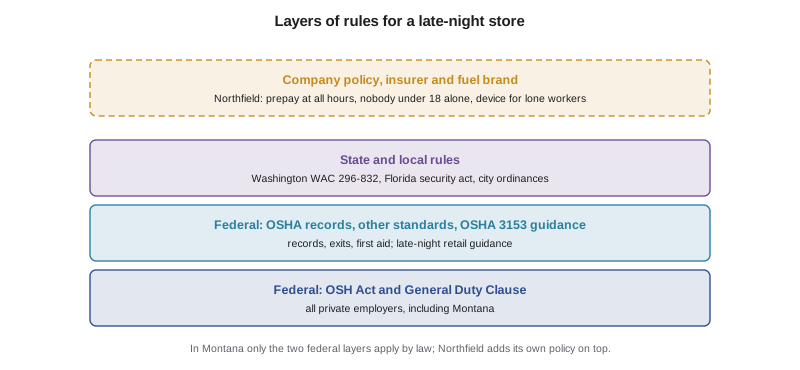
Under the federal Occupational Safety and Health Act (OSH Act), private-sector workplaces are covered either by federal OSHA or by a state plan that OSHA has approved. Montana does not run a state plan for private employers, so Northfield is covered by federal OSHA (checked in 2026). States with their own plans, such as Washington, can and do set rules that go beyond OSHA's. Cities and counties can also pass ordinances that affect late-night stores, for example on lighting, staffing or hours.
The General Duty Clause
Because OSHA has no standard for working alone or for workplace violence in retail, the main federal duty comes from Section 5(a)(1) of the OSH Act, known as the General Duty Clause. It requires every employer to provide a workplace free from recognized hazards that are causing or are likely to cause death or serious physical harm. OSHA has used the General Duty Clause to cite employers for workplace violence hazards that were recognized in their industry and that had feasible ways of being reduced. Robbery-related violence at late-night stores is a well-known hazard, so a station that does nothing about it is exposed. The employer also must:
- Record serious work-related injuries and illnesses, including those from violence, on the OSHA 300 log if the business is not exempt, and report fatalities within 8 hours and in-patient hospitalizations, amputations and eye losses within 24 hours.
- Follow OSHA's other standards that apply at a station, such as those for exit routes, emergency action plans, fire extinguishers, first aid, walking surfaces and hazard communication.
- Not retaliate against a worker who reports an injury or raises a safety concern; Section 11(c) of the OSH Act protects workers who do.
Workers in the United States also have the right to ask OSHA for an inspection if they believe there is a serious hazard, and the right to see their own injury records.
OSHA's late-night retail recommendations
OSHA publishes Recommendations for Workplace Violence Prevention Programs in Late-Night Retail Establishments (OSHA 3153). They are guidance, not a standard, but they describe what a reasonable program looks like and are often used to judge whether an employer took the hazard seriously. They have five parts:
- Management commitment and employee involvement: managers fund and support the program, and workers help design it.
- Worksite analysis: look at records, the store layout, the neighborhood and the work practices to find risk factors.
- Hazard prevention and control: environmental design such as lighting, visibility and cash limits; administrative controls such as procedures and staffing; and the use of barriers and alarms.
- Safety and health training for workers and supervisors.
- Recordkeeping and program evaluation: keep records of incidents and review the program.
Montana does not have a late-night retail rule of its own like those in Washington and Florida (checked in 2026). At Northfield, OSHA's recommendations are therefore the main yardstick, along with the requirements of the company's insurer and the practices of the fuel brand.
State rules: Washington
Washington's Department of Labor and Industries has a rule for late-night retail, WAC 296-832 (checked in 2026). It applies to retail businesses open between 11 p.m. and 6 a.m., with exemptions such as restaurants, hotels and taverns. Before employees work in that period, they must be given crime prevention training, with written materials, a signed and dated record, and a refresher every year. The training covers keeping the store clean and uncluttered, keeping the register visible from outside, running the minimum number of registers at night, keeping register cash to a minimum, after-dark precautions and what to do during a robbery. The store must also have a drop safe or limited-access safe, post a notice that employees cannot open the safe and that the register holds only the cash needed, and light the approach and parking area all night, for example to at least 1 foot-candle.
State rules: Florida
Florida's Convenience Business Security Act (sections 812.17 and following of the Florida Statutes) is one of the oldest and most detailed late-night retail laws (checked in 2026). It applies to convenience businesses and requires, among other things, a security camera system, a drop safe, a sign saying the cash register holds $50 or less, parking lot lighting of at least 2 foot-candles measured 18 inches above the surface, a clear view of the sales area from outside, height markers at the entrance, a cash management policy for the hours from 11 p.m., a silent alarm and robbery deterrence training. If a store has a serious qualifying crime, it must add one of several measures between 11 p.m. and 5 a.m.: two employees on duty, a bullet-resistant enclosure, a security guard, operating behind locked doors with a pass-through window, or closing during those hours.
Other states and some cities have rules of their own, and some insurers and fuel brands set requirements in their contracts. A chain with stores in several states needs a program that meets the strictest rule where each store is, and many simply apply the strictest rule everywhere.
Young workers
The federal Fair Labor Standards Act limits the hours of 14- and 15-year-olds, who may not work after 7 p.m. for most of the year or after 9 p.m. from June 1 to Labor Day. It does not limit the hours of 16- and 17-year-olds, though it bars them from hazardous jobs, and many states set stricter rules (checked in 2026). Northfield sets its own, stricter policy: no one under 18 works alone at any time, and no one under 18 works after 9 p.m. That rules Grace, who is 17, out of closing shifts and the new overnight shift.
| Rule | Where | Hours covered | Key measures |
|---|---|---|---|
| General Duty Clause | All states | All hours | Protect workers from recognized serious hazards |
| OSHA 3153 guidance | All states | Late night | Program with analysis, controls, training and records |
| WAC 296-832 | Washington | 11 p.m. to 6 a.m. | Training, drop safe, notice, visibility, lighting |
| Convenience Business Security Act | Florida | Mainly from 11 p.m. | Camera, drop safe, sign, lighting, alarm, training |
| Child labor rules | Federal and state | Varies by age | Limits on hours and tasks for minors |
Turning the rules into a checklist
When Northfield's owners planned the new 24-hour site, Leah wanted to know how the plan would measure up against the more detailed state rules, even though Montana does not require them, because the company may open stores in other states later. The program below checks the plan against a short paraphrase of each rule set. The plan is illustrative.
# Compare the new site's plan with a paraphrase of three rule sets.
rules = {
    "Montana (federal OSHA only)": ["violence program", "training", "injury records"],
    "Washington WAC 296-832": ["violence program", "training", "injury records", "annual refresher",
                               "drop safe", "safe notice", "register visible", "lot lighting 1 fc"],
    "Florida security act": ["violence program", "training", "injury records", "camera", "drop safe",
                             "cash sign", "lot lighting 2 fc", "clear view", "height markers",
                             "silent alarm", "cash policy after 11 pm"],
}
plan = {"violence program", "training", "injury records", "camera", "drop safe", "safe notice",
        "cash sign", "register visible", "clear view", "lot lighting 2 fc", "lot lighting 1 fc",
        "cash policy after 11 pm"}

for name, needs in rules.items():
    gaps = [n for n in needs if n not in plan]
print(f"{name:30} met {len(needs) - len(gaps):2} of {len(needs):2}", "gaps: " + ", ".join(gaps) if gaps else "")Montana (federal OSHA only) met 3 of 3 Washington WAC 296-832 met 7 of 8 gaps: annual refresher Florida security act met 9 of 11 gaps: height markers, silent alarm
The plan meets everything a Montana store needs, and almost everything Washington would require. The gaps are the annual refresher, which Northfield had not written into its training plan, and, for Florida, height markers at the door and a silent alarm. Leah added the refresher at once, because it costs little and helps everywhere, and noted the other two for any future Florida store. The comparison is also a useful reminder that the federal duty is broad: meeting a checklist does not by itself show the hazard has been controlled.
For supervisors: when rules overlap
Supervisors should know which rules apply to their own site and keep a copy of the current versions with the working alone procedure. Where more than one employer is involved, such as the station and the fuel hauler, agree in writing who checks on whom. When Mike delivers at night, his own company monitors him, but Northfield's procedure also tells the cashier to note when he arrives and leaves and to call the hauler's dispatcher if his truck sits at the fill ports longer than expected.
Worked problem
Can Grace cover the last hour?
Ben calls in sick at 8 p.m. on a Friday. Tyler can stay until 11 p.m. but not to closing at midnight. Grace, who is 17, offers to come in at 10 p.m. and close with Tyler, then stay alone for the last hour. What do the rules and Northfield's policy allow?
Show solution
- Federal law does not limit the hours of a 17-year-old, so the answer depends on state law and on Northfield's own policy.
- Northfield's policy says no one under 18 works after 9 p.m. or alone at any time, so Grace cannot cover the shift, even if the law would allow it.
- Options: Leah or Raj comes in to close, Tyler stays to close if he can, or the store switches to the night window or closes early while pay-at-the-pump stays on.
Answer: No. Northfield policy does not allow it; an adult must close, or the store closes early.
Working with OSHA and the state
OSHA inspections at stations usually follow a complaint, a serious injury report or a fatality. An inspector will ask what the employer knew about the hazard, what the industry knows, and what feasible steps were available. That is why a written violence prevention program, a hazard assessment, training records and check-in logs matter: they show that the hazard was recognized and that reasonable steps were taken. Montana's workers' compensation system also matters: a worker hurt in a robbery or injured while working alone is generally covered, and the insurer may ask for the same records. Leah keeps the assessment, the procedure, the training records and the check-in logs in one binder, so that she can answer an inspector's or an insurer's questions on the spot and so that a new manager can see at a glance what has been done. She also reviews the binder whenever the company opens a store in another state, because the state layer is where the rules differ most. Local rules can matter too: some cities have passed ordinances for late-night stores on lighting, cameras, staffing or opening hours after a run of robberies, and the police may ask a store with repeated incidents to adopt measures of this kind. Before the new highway site opened, Leah asked the city and county whether any such rules applied there. None did, but the call also put her in touch with the local crime prevention officer, who later reviewed the site's design.
Common mistakes
MistakeThinking there are no rules because OSHA has no working alone standard.
InsteadThe General Duty Clause still applies to recognized hazards.
MistakeTreating OSHA guidance as optional reading.
InsteadUse it to build the program; it shows what a reasonable employer does.
MistakeLetting a 17-year-old close alone because federal law allows it.
InsteadCheck state law and follow company policy.
MistakeApplying one state rule to every store in a chain.
InsteadMeet the rule where each store is, or the strictest rule everywhere.
MistakeTreating the law as the target.
InsteadThe law is the minimum; the assessment may call for more.
Summary and key terms
- There is no federal working alone standard, but the General Duty Clause covers recognized serious hazards such as late-night robbery.
- Montana private employers are covered by federal OSHA.
- OSHA 3153 describes a late-night retail violence prevention program in five parts.
- Washington WAC 296-832 and the Florida Convenience Business Security Act add specific late-night measures.
- Federal child labor rules limit hours for 14- and 15-year-olds; states and employers may go further.
- Check the current rules and treat them as a minimum.
- General Duty Clause
- Section 5(a)(1) of the OSH Act, requiring a workplace free from recognized serious hazards.
- State plan
- A state workplace safety program approved by OSHA.
- OSHA 3153
- OSHA guidance on violence prevention in late-night retail.
- WAC 296-832
- The Washington rule on late-night retail worker crime prevention.
- Drop safe
- A safe with a slot so cash can be dropped in but not taken out by the worker.
- Foot-candle
- A unit of light on a surface, about 10.8 lux.
Practice problems
Work each problem on paper first, then reveal the answer to check.
Which agency covers private employers in Montana?
Show answer
Federal OSHA.
What does the General Duty Clause require?
Show answer
A workplace free from recognized hazards that are causing or likely to cause death or serious physical harm.
Name the five parts of OSHA 3153.
Show answer
Management commitment and employee involvement, worksite analysis, hazard prevention and control, training, and recordkeeping and evaluation.
What hours does Washington WAC 296-832 cover?
Show answer
11 p.m. to 6 a.m.
Name three measures in the Florida Convenience Business Security Act.
Show answer
For example, a camera system, a drop safe, a $50 or less sign, parking lot lighting, a silent alarm and training.
Can a 17-year-old work alone at Northfield at 11:30 p.m.?
Show answer
No; Northfield policy bars anyone under 18 from working alone or after 9 p.m.
Lesson quiz · 5 questions
Score 60% or more to complete this lesson.
Create a free account to save your progress, take quizzes and earn a certificate.