
HSE-352 · Lesson 9 of 12 · 22 min
Fatigue, getting home and support after an incident
A working alone program usually focuses on the hours at the store. But the lone worker's day does not start at the shift start or end at the door. Night work changes how people sleep and how alert they are, the trip home after a late shift is a risk in its own right, and a frightening incident can affect a worker for weeks after the police have left. This lesson covers looking after the worker: fatigue, breaks, getting home safely, and support after a robbery or assault.
Why night work is tiring
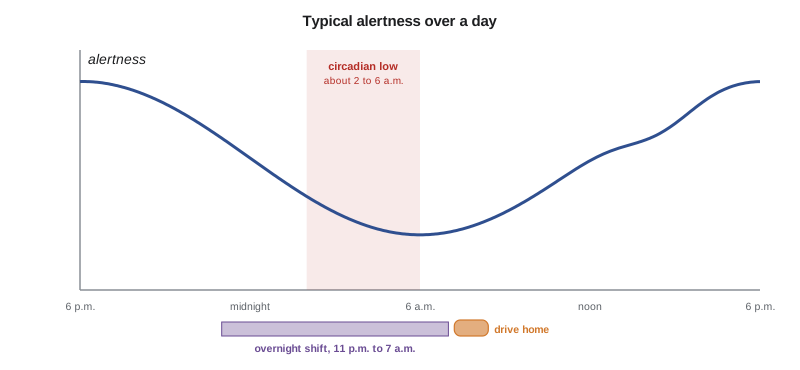
The human body runs on a daily rhythm, the circadian rhythm, that makes most people sleepy at night and alert during the day, whatever their schedule. Alertness falls to its lowest in the early hours, roughly between 2 a.m. and 6 a.m., with a smaller dip in the early afternoon. Night workers are working through their body's low point and then trying to sleep while their body expects to be awake.
The effects are well known. Night workers sleep less on average than day workers, often by an hour or two a day, because daytime sleep is lighter and more broken by light, noise and family life. Over several nights in a row, the missing sleep builds up as a sleep debt. Being awake for 17 to 19 hours has been found to affect performance about as much as a blood alcohol level around the legal driving limit in many places. For a lone worker, fatigue means slower reactions, poorer judgment, more mistakes with cash and procedures, and a greater chance of nodding off on the drive home.
Designing schedules that limit fatigue
Schedules are the employer's biggest lever on fatigue. Research on shift work and common guidance from safety agencies point to a few principles:
- Limit the number of night shifts in a row; many guides suggest no more than three or four before a break.
- Leave enough time between shifts for travel and a full sleep; at least 11 hours is a common minimum.
- Rotate forward, from days to evenings to nights, rather than backward, because the body adjusts more easily to a later schedule.
- Avoid quick returns, such as a closing shift that ends at midnight followed by an opening shift at 5:30 a.m.
- Give at least two full days off after a block of nights.
- Keep shifts to a sensible length, and avoid overtime at the end of a night shift.
- Let workers have a say in their schedule, and give notice of changes.
Some workers prefer permanent nights and adapt well; others never adjust. A worker who is struggling should be able to say so without fear of losing hours.
The program below checks a two-week illustrative schedule for the overnight position at the new site against three of these principles: no more than four nights in a row, at least 11 hours between shifts, and no shift longer than 10 hours.
# Check a two-week schedule for fatigue risks. Shifts are (day, start hour, end hour);
# an end hour above 24 means the shift ends the next morning. Illustrative.
shifts = [(1, 23, 31), (2, 23, 31), (3, 23, 31), (4, 23, 31), (5, 23, 31),
          (8, 23, 31), (9, 23, 31), (10, 15, 23), (11, 7, 15), (13, 22, 33)]
MAX_NIGHTS, MIN_REST, MAX_LEN = 4, 11, 10

problems = []
run = 0
for i, (day, start, end) in enumerate(shifts):
    if end - start > MAX_LEN:
        problems.append(f"day {day}: shift of {end - start} h is longer than {MAX_LEN} h")
    is_night = start >= 22
    prev = shifts[i - 1] if i else None
    consecutive = prev and prev[0] == day - 1 and prev[1] >= 22
    run = run + 1 if is_night and (consecutive or run == 0) else (1 if is_night else 0)
    if run > MAX_NIGHTS:
        problems.append(f"day {day}: night {run} in a row")
    if prev:
        rest = (day * 24 + start) - (prev[0] * 24 + prev[2])
        if rest < MIN_REST:
            problems.append(f"day {day}: only {rest} h rest after the previous shift")
for p in problems:
    print(p)
print(f"{len(problems)} problems found in {len(shifts)} shifts")day 5: night 5 in a row day 10: only 8 h rest after the previous shift day 11: only 8 h rest after the previous shift day 13: shift of 11 h is longer than 10 h 4 problems found in 10 shifts
The check finds four problems. The first block has five nights in a row, one more than the limit. Days 9 to 11 show a backward rotation squeezed into too little time: the worker finishes a night shift at 7 a.m. on day 10 and is back for an evening shift 8 hours later, then returns for a day shift at 7 a.m. after another 8 hours. And the shift on day 13 runs 11 hours, past the limit, because it was extended to cover a late arrival. None of these is unusual in retail, which is exactly why a quick check is useful. Leah fixed the schedule by ending the first block after four nights, giving the worker two days off before switching to days, and asking the day worker to start early rather than extending the night shift.
Workers can help themselves too, and training should say how. Sleeping at the same time each day, in a dark, quiet and cool room with blackout curtains and the phone silenced, gives the best chance of a full sleep. A short nap before a night shift helps alertness in the early hours. Wearing sunglasses on the drive home in the morning and avoiding bright screens before bed make it easier to fall asleep. Heavy meals and alcohol before sleep make daytime sleep worse, not better. None of this removes the effect of working through the circadian low, but together these habits can win back much of the lost sleep.
Breaks when you are alone
Workers alone still need breaks, but taking one is harder when there is no one to cover. A worker who never takes a break gets more tired as the night goes on; a worker who goes out to sit in their car leaves the store unattended and puts themselves alone in the dark lot. Northfield's procedure lets the overnight worker take breaks inside, in a seat behind the counter with a view of the door and the monitor, switch to the night window during a meal break, and check in at the start and end of each break. Workers should bring food and water, since leaving to buy a meal is not an option, and avoid relying on large amounts of caffeine late in the shift, which makes daytime sleep harder.
Getting home safely
The end of a late shift combines several risks: the worker is tired, it is dark or just getting light, they may be carrying a bag, and they walk alone to a car or a bus stop. Some simple measures help:
- Staff parking close to the front door, in the light and in view of the cameras.
- A last check of the lot on the monitor before leaving, and staying inside if anyone is hanging around.
- A final check-in when the worker reaches home, so that the contact knows they arrived; a worker who does not check in from home within the agreed time is followed up like any missed check-in.
- For workers who use transit, waiting inside until the bus is due, or a ride arrangement or taxi paid by the employer for the riskiest hours.
- For workers who are very tired, a place to rest before driving, or a ride home, without any stigma.
Drowsy driving after a night shift is a real hazard. The drive home often comes right after the circadian low and after a long time awake. Workers should know the warning signs, such as yawning, heavy eyelids, drifting out of the lane and missing exits, and know that pulling over for a short nap is better than pushing on.
After an incident
A robbery, an assault or a serious threat can affect a worker deeply, even if they were not physically hurt. Common reactions in the days and weeks afterwards include trouble sleeping, replaying the event, feeling jumpy or on edge, avoiding the store or the shift, anger, guilt and difficulty concentrating. These are normal reactions to an abnormal event, and for most people they ease over time with support. For some, they persist and develop into anxiety, depression or post-traumatic stress disorder, which need professional help.
What the employer does in the first hours and days makes a large difference:
- Make sure the worker is safe and not left alone after the incident. A manager or co-worker should come to the store as soon as possible, and the worker should not have to finish the shift alone.
- Look after physical needs first: first aid, water, somewhere to sit.
- Offer psychological first aid: listen, reassure, give practical help such as calling family or arranging a ride home, and do not press the worker to relive details beyond what police need.
- Give the worker time off if they want it, with pay, and let them decide when to return.
- Do not schedule them alone, or on the same shift, until they feel ready, and offer a buddy for the first shifts back.
- Offer the employee and family assistance program or professional counseling, and check in with them in the following weeks.
- Report the incident and the injury, including psychological injury, through the proper channels.
In Montana, workers' compensation covers physical injuries from a robbery or assault at work. Coverage for a purely psychological injury, with no physical injury, is much more limited under Montana law, so ask the insurer early and make sure the worker knows about the employee assistance program, which does not depend on a claim (checked in 2026). Serious injuries must also be reported to OSHA within the deadlines in Lesson 2.
Co-workers matter too. Other staff may feel anxious about working the same shift, and some will want to talk about what happened. A short team meeting, with facts, the changes being made and how to get support, helps to stop rumors and shows that the employer takes it seriously. It is also the time to review the hazard assessment and the procedures, which Lesson 12 covers.
For supervisors: noticing fatigue and distress
Watch for signs of fatigue and distress in lone workers: more mistakes, late check-ins, irritability, frequent sick days, or a worker who suddenly asks to avoid nights. Raise it privately and kindly, and focus on what support or schedule change would help. A worker who has been through an incident may say they are fine on the night and struggle a week later, so keep checking in for a month or more.
Worked problem
The first shift after a robbery
Three weeks after a robbery at the original store, Ben says he is ready to go back to the evening shift, but on his first night he checks in late twice and calls Leah at 11 p.m. saying he feels shaky every time the door opens. What should Leah do?
Show solution
- Treat his call seriously and do not tell him to push through. Shaky reactions to the door are a common, normal response after a robbery.
- Arrange for someone to join him for the rest of the shift, or close early, so he is not left alone feeling unsafe.
- Agree a gradual return: shifts with a second worker for the next two weeks, then a review together. Remind him about the employee assistance program and offer to help him make the first call.
- Check that the changes from the robbery review, such as the night window hours and a lower register limit, are in place so that he can see what is different.
Answer: Support him now with company or an early close, plan a gradual return with a buddy, connect him to counseling and show him the safety changes.
Common mistakes
MistakeScheduling five or more nights in a row, then a quick return to days.
InsteadLimit runs of nights, rotate forward and leave at least 11 hours between shifts.
MistakeLetting a lone worker take breaks in their car in the dark lot.
InsteadTake breaks inside with a view of the door, using the night window if needed.
MistakeEnding check-ins when the worker locks the store.
InsteadFinish with a check-in from home.
MistakeAsking a worker to finish the shift alone after a robbery.
InsteadSend someone at once and let the worker go home.
MistakeAssuming a worker who says they are fine has recovered.
InsteadKeep checking in for weeks and offer counseling.
Summary and key terms
- Night work runs through the circadian low, causing sleep debt, slower reactions and drowsy driving.
- Good schedules limit consecutive nights, rotate forward, leave at least 11 hours between shifts and avoid quick returns.
- Lone workers need breaks inside, with a view of the door and check-ins.
- Plan the trip home: close parking, a last check of the lot, and a check-in on arrival.
- After an incident, keep the worker safe and not alone, give psychological first aid, time off and a gradual return.
- Offer counseling and report injuries, including psychological ones, through the proper channels.
- Circadian rhythm
- The body's daily cycle of sleepiness and alertness.
- Circadian low
- The period of lowest alertness, roughly 2 a.m. to 6 a.m.
- Sleep debt
- Missing sleep that builds up over several days.
- Quick return
- A short gap between the end of one shift and the start of the next.
- Forward rotation
- Changing shifts from days to evenings to nights.
- Psychological first aid
- Practical, calm support for someone right after a frightening event.
Practice problems
Work each problem on paper first, then reveal the answer to check.
Between roughly what hours is alertness lowest?
Show answer
About 2 a.m. to 6 a.m.
Give three principles of a schedule that limits fatigue.
Show answer
For example, few nights in a row, at least 11 hours between shifts, forward rotation, no quick returns and days off after nights.
Why should a lone worker not take breaks in their car?
Show answer
It leaves the store unattended and puts the worker alone in the dark lot.
What is the last check-in of a late shift?
Show answer
The check-in when the worker arrives home.
Name four common reactions after a robbery.
Show answer
For example, trouble sleeping, replaying the event, feeling jumpy, avoiding the store, anger and guilt.
Give three things an employer should do right after a robbery.
Show answer
Send someone so the worker is not alone, look after physical needs and give psychological first aid, offer time off and counseling.
Lesson quiz · 5 questions
Score 60% or more to complete this lesson.
Create a free account to save your progress, take quizzes and earn a certificate.