
HSE-352 · Lesson 6 of 12 · 21 min
Fuel theft and prepayment
A driver fills up, hangs up the nozzle and drives off without paying. In the trade it is called a gas-and-dash or a drive-off. For the station it is a loss of money. For the worker on shift it can be something far worse, because the natural reaction is to run out and try to stop the car. Workers have been dragged, run over and killed doing exactly that, for amounts as small as the price of a few liters of fuel. This lesson is about the one rule that matters most, never chase, and the measure that removes the hazard almost completely: making customers pay before they pump.
Two deaths that changed the law
In March 2005, Grant De Patie, a 24-year-old attendant at a station in Maple Ridge, British Columbia, tried to stop a driver who was leaving without paying for $12.30 of gas. He was caught by the car and dragged for about 7.5 km. He was working alone on a night shift. His death led British Columbia to require fuel prepayment from February 1, 2008, a rule often called Grant's Law.
In October 2017, Ki Yun Jo, who owned and worked at a small station in Thorsby, Alberta, was struck and killed by a vehicle while trying to stop a driver leaving without paying. Within weeks the Alberta government announced that it would make prepayment mandatory, and the requirement took effect on June 1, 2018, together with the other late-night retail rules in Lesson 2.
Both men were trying to do the right thing for their business. Neither amount was worth a life. The lesson for every station is the same: the money is replaceable and the worker is not, so the procedure must make sure no worker ever puts their body between a moving vehicle and a fuel debt.
The never-chase rule
Every station, whatever the law where it is, should have a written rule that workers never chase, block, stand in front of, reach into or hold on to a vehicle that is leaving without paying. The rule should also cover the moments before a drive-off. Workers should not walk out to confront a driver who is still fueling and looks likely to leave, should not try to take keys, and should not follow the vehicle in their own car.
What the worker can do safely is observe and record from inside the store. Northfield's procedure lists the details to note, if they can be seen without going outside: the license plate, the make, model and color of the vehicle, the number of people in it, the direction it left in, the pump number and the time. The cameras will usually have much of this, so the worker should not take risks to get a better look. The worker then follows the station's reporting steps: tell the manager, keep the camera footage, and report the theft to police if the policy says so.
A station must also never take the cost of a drive-off out of a worker's pay. Federal law does not allow deductions that bring pay below the minimum wage, and many states restrict deductions for shortages further, so check state law before any deduction (checked in 2026). Apart from the law, a worker who fears losing pay has a strong reason to chase, which is exactly what the procedure is trying to prevent. Northfield's policy is simple: drive-offs are a cost of the business, never of the worker.
How prepayment works
Prepayment means the customer pays, or guarantees payment, before the pump will dispense fuel. There are several ways to do it:
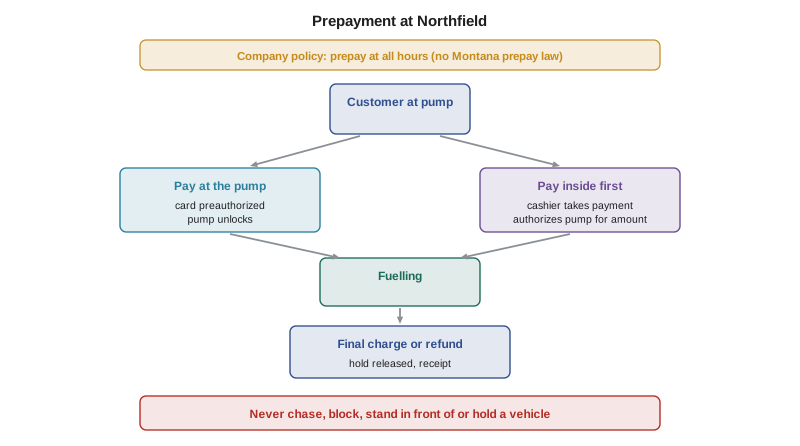
- Pay at the pump: the customer inserts or taps a credit or debit card, and the card is preauthorized for an amount before fueling starts. After fueling, the actual amount is charged and the hold is released.
- Pay inside first: the customer pays the cashier a set amount in cash or by card, and the cashier authorizes the pump for that amount. If the customer pumps less, the cashier refunds the difference.
- Fleet or account cards and apps: the customer is identified and authorized before fueling through a fleet card, a loyalty app or a business account.
Prepayment changes the hazard completely. Because no fuel flows until payment is guaranteed, there is nothing to steal and nothing to chase. A few problems remain, such as stolen cards and customers who argue about refunds, but these are handled at the counter and do not put the worker in front of a moving vehicle.
Prepayment in Montana and elsewhere
Montana has no state law requiring fuel prepayment (checked in 2026), and neither do most states. Many stations nonetheless use prepayment, at all hours or at night, because pay-at-the-pump with card preauthorization is now normal and drive-offs cost money. When Northfield's owners planned the new 24-hour site, they decided to require prepayment at all hours at both stores, mainly for worker safety, after reading about the Canadian cases. Signs at each pump tell customers to pay first or pay at the pump.
In Canada, British Columbia has required prepayment since 2008 and Alberta since 2018. In the United States, prepayment is usually a business decision, sometimes encouraged by insurers or local police. A chain with stores in several states can set its own rule, and many now require prepayment at least at night.
Doing the numbers
Some station owners resist prepayment because they worry it will drive away customers who prefer to pay inside after fueling, or reduce sales in the store. It helps to look at the actual numbers. The program below uses illustrative figures for a year at the new site to compare the expected number of drive-offs, and the losses, under three policies. The most important number is not the dollars but the count of drive-offs, because each one is a moment when a worker might be tempted to chase.
# Expected drive-offs and losses in a year at the new site under three policies.
# Illustrative figures.
fills_per_day = {"day (7 a.m.-11 p.m.)": 620, "night (11 p.m.-7 a.m.)": 90}
avg_fill = 58.0                      # dollars per fill
rate_per_1000 = {"day (7 a.m.-11 p.m.)": 0.4, "night (11 p.m.-7 a.m.)": 2.5}   # drive-offs per 1,000 unprepaid fills
residual = 0.02                      # drive-offs per 1,000 prepaid fills (card fraud, errors)

def year(prepay_day, prepay_night):
    n = 0.0
    for band, fills in fills_per_day.items():
        prepaid = prepay_night if band.startswith("night") else prepay_day
        rate = residual if prepaid else rate_per_1000[band]
        n += fills * 365 * rate / 1000
    return n, n * avg_fill

for name, d, nt in [("no prepayment", False, False),
                    ("prepay at night only", False, True),
                    ("prepay at all hours", True, True)]:
    n, loss = year(d, nt)
print(f"{name:22} {n:5.1f} drive-offs a year ${loss:8,.0f} lost")no prepayment 172.6 drive-offs a year $ 10,013 lost prepay at night only 91.2 drive-offs a year $ 5,288 lost prepay at all hours 5.2 drive-offs a year $ 301 lost
Without prepayment, the illustrative site would expect about 173 drive-offs a year, roughly one every two days, and lose about $10,000. Prepayment at night only removes most of the night-time drive-offs, the ones that happen when the worker is alone, but still leaves about 91 day-time drive-offs. Prepayment at all hours brings the expected number down to about 5, almost all of them card problems that are dealt with later, not at the pump. For a lone worker, prepayment at night is the minimum; at all hours it removes the hazard for everyone and avoids confusion about when the rule starts.
Handling disputes at the counter
Prepayment moves some friction to the counter. Customers may be annoyed at having to come in before fueling, may argue about a refund, or may not understand why their card shows a hold for more than they spent. A few simple practices help:
- Explain briefly and politely: "We need payment first; it's the law here" or "It's our policy at all our stores, for safety."
- Keep the refund process quick and clear: print a receipt for the prepaid amount and another for the refund.
- Never leave the counter or the night window to argue at the pump.
- If a customer becomes aggressive, follow the de-escalation and refusal steps in Lesson 11 and HSE-341, and use the panic device if needed.
A worker should never feel obliged to make an exception, for example by turning on a pump for a regular customer who promises to pay afterwards. That one exception is exactly the situation in which a drive-off happens, and it undermines the rule for everyone else. The procedure should say plainly that no one, including managers, authorizes a pump without payment.
Other kinds of fuel theft
Prepayment stops simple drive-offs but not every kind of fuel theft. Workers may see card skimmers fitted to pumps, people filling large tanks or containers with stolen cards, or tampering with pumps to dispense fuel without registering it. The rule for all of these is the same as for drive-offs: observe and record from a safe place, do not confront, and report to the manager and, if needed, police. Checking the pumps for skimmers is a day-time task, done when two workers are on site.
After a drive-off or a fuel theft
What happens after the vehicle has gone matters too. The worker should first make sure they are safe and that nothing else needs attention at the pumps, such as a nozzle left on the ground or fuel spilled where the driver pulled away. Then they record what they saw while it is fresh, using the station's incident form rather than a scrap of paper, and tell the manager at the next check-in or sooner if the procedure says so.
The manager keeps the camera footage before it is overwritten, decides whether to report the theft to police using the non-emergency line, and logs the incident. A log of drive-offs and other fuel thefts, with the time, the pump and what happened, often shows patterns: one pump that the cashier cannot see well, a time of night when thefts cluster, or a lapse in prepayment after a pump was reset. Each pattern points to a fix. The log also shows whether prepayment is working, and gives the owner real numbers when deciding whether the policy is worth keeping.
For supervisors: making never-chase real
A never-chase rule only works if workers believe it. Say it clearly in training, put it in writing, and back it up: never criticize a worker for letting a drive-off go, never ask why they did not stop the car, and never link drive-offs to pay, bonuses or performance reviews. When a drive-off happens, thank the worker for following the procedure. Workers notice how managers react after the first drive-off much more than what the policy says.
Worked problem
A regular asks for a favor
At 1:30 a.m. a regular customer at the new site says his card has been declined at the pump and asks Ben to turn on pump 4 so he can fill up and pay cash inside afterwards, as he did before Northfield started prepayment. What should Ben do?
Show solution
- Northfield's policy requires payment first at all hours, and the procedure says no one authorizes a pump without payment, however well they know the customer.
- Ben explains politely, through the night window, that the company requires payment first, and offers the options: pay cash inside first for a set amount, then collect any change, or try another card at the pump.
- If the customer becomes angry, Ben stays inside, does not argue, and follows the de-escalation steps. If he is threatened, he uses the panic device.
Answer: No exceptions: company policy requires prepayment, so the customer must pay first, inside or with another card.
Common mistakes
MistakeRunning out to stop a driver leaving without paying.
InsteadNever chase, block or hold a vehicle; observe and record from inside.
MistakeDeducting drive-off losses from a worker's pay.
InsteadTreat drive-offs as a business cost; deductions encourage chasing and may be illegal.
MistakeTurning on a pump for a trusted regular.
InsteadNo one authorizes a pump without payment, ever.
MistakeRequiring prepayment only when the worker feels uneasy.
InsteadSet it by policy or law, ideally at all hours.
MistakeGoing out to the pump to argue about a refund.
InsteadHandle disputes at the counter or night window.
Summary and key terms
- Drive-offs have killed station workers, including Grant De Patie in 2005 and Ki Yun Jo in 2017.
- The never-chase rule: never chase, block, stand in front of or hold a leaving vehicle; observe and record from inside.
- Never deduct drive-off losses from pay.
- Prepayment, at the pump or inside first, removes the drive-off hazard almost completely.
- Montana has no prepayment law; Northfield requires prepayment at all hours by policy.
- Make no exceptions, and handle disputes at the counter.
- Drive-off
- Fueling and leaving without paying; also called a gas-and-dash.
- Prepayment
- Paying, or guaranteeing payment, before fuel is dispensed.
- Preauthorization
- A hold placed on a card before fueling, replaced by the actual charge afterwards.
- Never-chase rule
- The rule that workers never try to stop a vehicle leaving without paying.
- Grant's Law
- The common name for British Columbia's 2008 prepayment and lone worker rules, after Grant De Patie.
Practice problems
Work each problem on paper first, then reveal the answer to check.
What happened to Grant De Patie, and what did it lead to?
Show answer
He was dragged and killed in 2005 trying to stop a $12.30 drive-off; British Columbia made prepayment mandatory from 2008.
List four details a worker can note about a drive-off from inside.
Show answer
For example, license plate, make, model and color, number of people, direction of travel, pump number and time.
Why should drive-off losses never come out of a worker's pay?
Show answer
It may be illegal, and it gives the worker a reason to chase.
Name three ways a customer can prepay.
Show answer
Card preauthorization at the pump, paying the cashier first, or a fleet card, account or app.
Why does prepayment at night only still leave a hazard?
Show answer
Day-time drive-offs still happen, and workers may still be tempted to chase then.
What should a worker do if a customer argues about a prepayment refund?
Show answer
Stay at the counter or night window, explain calmly and use de-escalation and the panic device if needed.
Lesson quiz · 5 questions
Score 60% or more to complete this lesson.
Create a free account to save your progress, take quizzes and earn a certificate.