
HSE-352 · Lesson 11 of 12 · 22 min
Responding to emergencies
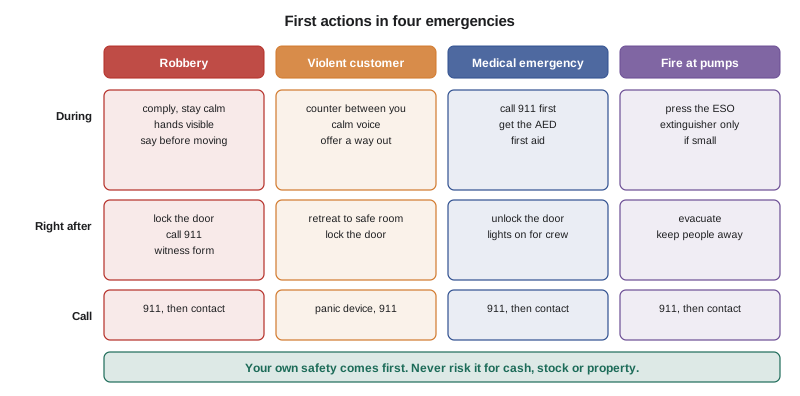
Everything in this course so far aims to stop emergencies from happening and to make sure help comes quickly when they do. This lesson is about the minutes in between: what a lone worker should actually do during a robbery, a violent customer, a medical emergency, a fire or a sudden illness of their own. With no one beside them, a worker has to act on what they have practiced. Clear, simple responses, learned in advance, make the difference between a frightening event and a tragedy.
During a robbery
The goal during a robbery is simple: get through it without anyone being hurt. Property can be replaced. Research on convenience store robberies and the advice of police services agree on the core of the response:
- Stay calm and do what the robber asks. Do not argue, resist or try to be a hero.
- Keep your hands where the robber can see them, and move slowly.
- Tell the robber before you move: "I'm going to open the till now," or "The cigarettes are behind me; I'm going to turn around."
- Do not make sudden movements, reach under the counter or press a fixed panic button if the robber might see it. Use the wearable device only if you can do so without being noticed.
- Do not chase or follow the robber when they leave, and do not try to stop their vehicle.
- Observe what you safely can: height against the door markers, clothing, voice, words used, weapon, direction of escape and vehicle. Do not stare, which can feel threatening.
Most robberies are over in about a minute. Workers often feel afterwards that they should have done something more. They should not: complying, staying calm and getting through it is exactly the right response, and it is what the procedure asks of them.
Some situations call for extra care. If there is more than one robber, assume that one may be out of sight, perhaps by the door or in a car outside. If a robber orders the worker into the back room or the cooler, the worker should comply if refusing seems dangerous, and can take comfort that a missed check-in or a silent device will start the escalation steps even if they cannot call. And if a robber seems agitated, intoxicated or unpredictable, the worker should keep their voice even and their answers short, and avoid anything that could sound like a challenge, including saying that the safe cannot be opened in a tone that sounds defiant.
After the robber leaves
Once the robber has gone, the worker has a short list of actions, in this order:
- Lock the door and do not let anyone in except police and emergency services.
- Check yourself and anyone else for injuries, and call 911 for police, and an ambulance if anyone is hurt. Stay on the line if asked.
- Press the panic device if you have not already, or tell the contact what happened.
- Do not touch anything the robber touched, and keep the area around the counter clear for police.
- Ask any customers who saw it to stay and give their names to police, but do not stop anyone who wants to leave.
- Write down what you remember before talking to anyone else, using the witness form kept at the counter.
- Do not post about it on social media or talk to the media; refer any questions to the manager.
The manager, alerted by the contact or the worker, comes to the store as soon as possible (Lesson 9). The worker should not have to finish the shift alone.
A violent or threatening customer
Not all violence is robbery. A customer who is intoxicated, angry about a refused sale, or in a mental health crisis may become threatening. HSE-341 covers de-escalation in detail; the key points for a lone worker are:
- Keep the counter or the night window between yourself and the customer, and know your way out to the office or another safe room.
- Speak calmly and slowly, listen, and avoid arguing about rules or blaming the customer.
- Offer a simple way out, such as directions to another store or a call for a ride.
- Do not touch the customer or try to remove them yourself.
- Use the panic device as soon as you feel threatened, not after the situation has turned violent.
- If the customer becomes violent, get away if you can: go to the safe room, lock the door and call 911.
Northfield's new site has a back office with a solid door that locks from the inside and a phone, which serves as the safe room. Workers practice getting there quickly from the counter.
A medical emergency, a customer's or your own
If a customer collapses, the lone worker is the first aider, the person who calls 911 and the person who must keep the store safe, all at once. The priorities are:
- Call 911 first, or use the speaker phone, so that help is on the way and the dispatcher can guide you.
- Get the automated external defibrillator (AED), if the store has one, and follow its spoken instructions for someone who is unresponsive and not breathing normally.
- Give first aid within your training.
- Unlock the door and turn on the outside lights for paramedics, and tell the contact what is happening.
The harder case is when the lone worker is the one who becomes ill. Workers with a condition that could suddenly leave them unable to call for help, such as diabetes, epilepsy or a heart condition, may choose to tell the manager so that the procedure can take it into account, but they do not have to. Every lone worker should know the early signs that something is wrong, such as chest pain, sudden weakness, confusion, faintness or a severe allergic reaction, and act early: press the device, call 911, unlock the door if they can, and sit or lie down near the counter where they can be seen. It is far better to call for help and be fine than to wait and be unable to call at all.
Fire and fuel emergencies
HSE-350 and HSE-351 cover fire and spills at the pumps in detail. For a lone worker, the key points are:
- For a fire at a pump, press the emergency shut-off (ESO) to stop fuel flowing to all dispensers.
- Use a fire extinguisher only if the fire is small, you have been trained, and you have a clear way out behind you. Otherwise, leave it.
- Call 911 and evacuate the store, taking customers with you to the muster point.
- For a fire inside the store, raise the alarm, get out, and call 911 from outside.
- For a fuel spill, stop the source if it is safe, keep people and ignition sources away, and follow the spill procedure.
A lone worker should never stay in a dangerous place to save property, stock or cash. The building is insured; the worker is not replaceable.
Weather, power cuts and other events
Some emergencies build slowly. A blizzard, a wildfire evacuation, a flood, a power cut or a nearby police incident can each leave the lone worker isolated or in danger. The procedure should say when the worker may close the store and leave, and who decides. At Northfield, the overnight worker may close at any time they judge it unsafe to stay open, telling the contact and the on-call manager, without needing permission first. If roads are closed, the worker stays in the store, which has food, water and heat, and checks in more often.
Checking the response
After any incident, the timeline is worth looking at. How long did it take to lock the door, call 911, tell the contact and get help on site? The program below takes an illustrative timeline recorded after a robbery at the original store and checks each step against Northfield's targets.
# Check an incident timeline against response targets. Times are minutes after the robber left.
timeline = {
    "door locked": 1.0,
    "911 called": 2.5,
    "contact told": 4.0,
    "witness form started": 18.0,
    "police on site": 11.0,
    "manager on site": 34.0,
}
targets = {
    "door locked": 2,
    "911 called": 3,
    "contact told": 5,
    "witness form started": 15,
    "police on site": None,       # depends on police, not the store
    "manager on site": 30,
}
for step, t in sorted(timeline.items(), key=lambda x: x[1]):
    target = targets[step]
    if target is None:
        verdict = "(not under the store's control)"
    else:
        verdict = "ok" if t <= target else f"late by {t - target:.1f} min"
print(f"{step:22} {t:5.1f} min {verdict}")door locked 1.0 min ok 911 called 2.5 min ok contact told 4.0 min ok police on site 11.0 min (not under the store's control) witness form started 18.0 min late by 3.0 min manager on site 34.0 min late by 4.0 min
The worker locked the door, called 911 and told the contact well within the targets, which is what matters most in the first minutes. The witness form was started 3 minutes later than the target, because police arrived and began asking questions first, which is understandable and easily fixed by keeping the form at the counter so the worker can start it while waiting. The manager arrived 4 minutes after the 30-minute target, because the on-call manager was at the far end of town; the review led Northfield to add the senior cashier, who lives closer, as a backup responder for the original store.
Training and drills
People under stress fall back on what they have practiced. Reading a procedure once at induction is not enough. Northfield's training for lone workers includes:
- A walk-through of each emergency response at the store, including where the AED, extinguishers, ESO, safe room and witness forms are.
- Practice using the lone worker device and the duress signal.
- Short role-plays of a robbery and a threatening customer, led by someone trained to do them without frightening the worker.
- First aid and AED training for every worker who works alone.
- A refresher every year, and after any incident or change in procedure.
Washington's late-night retail rule requires crime prevention training before workers start nights and a refresher every year, and OSHA's guidance includes training as one of the five parts of a program (Lesson 2). Northfield follows the same pattern at both sites.
For supervisors: after the emergency
After any emergency, follow the support steps in Lesson 9 for the worker first. Then review the response with the worker and the contact once they are ready: what happened, what went well, what was hard, and what should change. Report the incident as required, review the hazard assessment, and share the lessons, without names or blame, with the other workers. Every incident is a chance to make the program stronger.
Worked problem
A customer collapses at 3 a.m.
At 3 a.m. at the new site, with the night window in use, a man at the window says his friend has collapsed in their car at pump 2 and is not breathing. The overnight worker is alone. What should she do?
Show solution
- Call 911 at once on the store phone or device, giving the site card details and saying a person is not breathing at pump 2. Tell the contact through the device.
- Decide whether it is safe to go out. The situation is a medical emergency, not a threat, and the friend is asking for help, so she takes the AED and the device and goes out, keeping the store door locked behind her.
- Follow the dispatcher's instructions and the AED's prompts, and ask the friend to watch for the ambulance and wave it in.
- When paramedics arrive, she returns to the store, checks in with the contact, records what happened, and calls the manager. If at any point the situation feels unsafe, she returns inside and waits for help.
Answer: Call 911 and the contact first, take the AED and device out if it is safe, follow the dispatcher, then record and report. Her own safety still comes first.
Common mistakes
MistakeResisting or arguing with a robber.
InsteadComply, keep hands visible and say what you are going to do before you move.
MistakeFollowing the robber outside to get the plate.
InsteadStay inside, lock the door and call 911.
MistakeWaiting to see if chest pain passes when alone.
InsteadPress the device and call 911 early.
MistakeFighting a large fire to save the pumps.
InsteadPress the ESO, leave and call 911; use an extinguisher only on a small fire with a way out.
MistakeTreating one read-through as training.
InsteadWalk through, practice and refresh every year.
Summary and key terms
- During a robbery, comply, stay calm, keep hands visible, say before you move and never chase.
- Afterwards, lock the door, call 911, tell the contact, protect the scene and write down what you saw.
- With a threatening customer, keep a barrier between you, stay calm, offer a way out and use the panic device early.
- For a medical emergency, call 911 first, use the AED and unlock the door for paramedics.
- If you feel ill while alone, press the device and call 911 early.
- For fire, press the ESO, use an extinguisher only on a small fire, evacuate and call 911.
- Practice responses, review every incident and never risk safety for property.
- Safe room
- A room with a lockable door and a phone where a worker can retreat from danger.
- Witness form
- A form for recording what was seen, filled in as soon as possible after an incident.
- AED
- Automated external defibrillator: a device that guides a bystander to treat cardiac arrest.
- ESO
- Emergency shut-off: the switch that stops fuel to all dispensers.
- De-escalation
- Calming a tense situation through words, tone and space.
Practice problems
Work each problem on paper first, then reveal the answer to check.
Give four things a worker should do during a robbery.
Show answer
Stay calm and comply, keep hands visible, tell the robber before moving and avoid sudden movements.
What is the first thing to do after the robber leaves?
Show answer
Lock the door.
Why write down what you remember before talking to others?
Show answer
Memories change quickly and can be affected by what others say.
When should a lone worker use a fire extinguisher?
Show answer
Only on a small fire, if trained and with a clear way out.
What should a lone worker do if they feel chest pain?
Show answer
Press the device and call 911 early, unlock the door if possible and stay where they can be seen.
What is a safe room?
Show answer
A room with a lockable door and a phone where the worker can retreat from danger.
Lesson quiz · 5 questions
Score 60% or more to complete this lesson.
Create a free account to save your progress, take quizzes and earn a certificate.