
HSE-352 · Lesson 4 of 12 · 22 min
Check-in procedures
A check-in procedure is the backbone of protection for a lone worker. It is a simple promise: at agreed times, the worker makes contact with someone, and if they do not, that person acts. Done well, it means a worker who is hurt, ill or in trouble will be found within a known time, even if they cannot call for help themselves. Done badly, it becomes a ritual that no one watches, and a missed call goes unnoticed until morning.
No federal rule requires a check-in procedure, but OSHA's late-night retail guidance treats communication and procedures as part of hazard control, and several provinces and states with lone work rules require one. This lesson looks at how to design one that works in practice at a station.
The parts of a check-in procedure
A complete procedure answers six questions, and each answer should be written down:
- Who checks in, and with whom? The lone worker, with a named contact person or service that is awake, reachable and able to act.
- When? At the start of the shift, at set intervals, before and after higher-risk tasks, and at the end of the shift, including after the worker gets home.
- How? By phone call, text, app, radio or a visit, with a backup method if the first one fails.
- What is said? A short, standard message, and a way to signal trouble without the person in front of the worker knowing.
- What counts as missed? The grace period after the agreed time, after which the contact starts the escalation steps.
- What happens then? The escalation steps in Lesson 10, ending with someone going to the site or calling police.
The questions are easy. The hard part is making the answers fit the real shift, so that the worker can keep the check-ins without rushing a customer, and the contact can keep watching without falling asleep or forgetting.
Choosing the contact
The contact must be someone who will notice a missed check-in and act on it, every time. Possible contacts include:
- A manager or supervisor on call. Common at small stations, but the manager must stay awake and reachable for the whole night, which is hard to sustain night after night.
- Another store in the chain that is staffed at the same time. The overnight cashier at one site checks on the overnight cashier at another, and each has the other's escalation list.
- A monitoring service. A commercial alarm or lone worker monitoring center staffed around the clock, often linked to a device or app (Lesson 5).
- A family member or friend. Sometimes suggested, but not a good choice on its own: they are not trained, may not know the escalation steps, and may hesitate to call police.
At Northfield, Leah first thought of being the contact herself. She quickly realized she could not stay awake every night, and that a missed check-in at 3 a.m. while she slept would defeat the whole procedure. The new site now checks in with the monitoring center through the lone worker app, and the original store's late cashier checks in with the overnight worker at the new site until midnight, so that each knows the other is there.
Setting the times
Check-in times come from the hazard assessment (Lesson 3). A practical schedule usually combines fixed times with event-based check-ins:
- At the start of the shift, once the worker has arrived, looked around and locked any doors that should be locked.
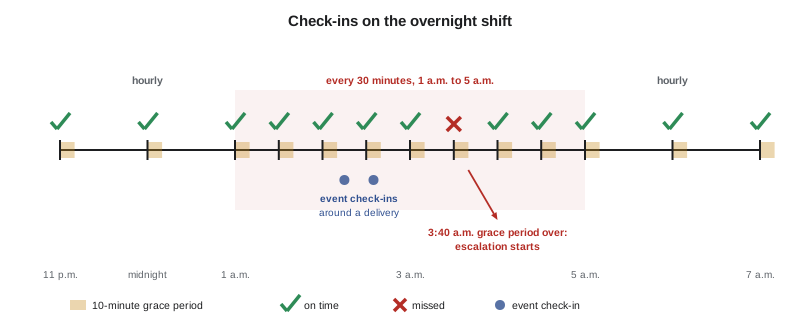
- At fixed intervals: for example, every 2 hours in the day band, every hour in the evening and every 30 minutes in the late-night band.
- Before and after a higher-risk task, such as taking out garbage, receiving a night delivery, checking the pumps or going into the car wash bay. The worker says what they are about to do and how long it should take.
- At the end of the shift, when the store is locked and the worker is leaving.
- When the worker arrives home or at their car, the last check-in of the night (Lesson 9).
The interval can be shortened when the risk rises. If a customer has been threatening, if the power has gone out, or if the weather has closed the highway, the worker can ask for a shorter interval for the rest of the shift, and the contact should agree without question.
Grace periods
A check-in rarely happens exactly on the minute. A worker may be serving a line of customers or helping someone at the pumps when the time comes. A grace period gives some slack: the check-in counts as on time if it arrives within, say, 10 minutes of the agreed time. If nothing arrives by the end of the grace period, the contact starts escalation.
The grace period adds directly to how long a hurt worker could wait for help. With hourly check-ins and a 10-minute grace period, a worker who collapses just after a check-in could wait 70 minutes before anyone even starts trying to reach them, and longer before help arrives. That is why high-risk periods need shorter intervals, or a device that raises an alarm by itself.
What to say, and how to signal trouble
A check-in message should be short and standard, so that it is easy to give and easy to recognize: the worker's name, the site, the time and "all fine", or a few words on what they are about to do. Using the same words each time means anything different stands out.
Most procedures also include a duress signal: a word or phrase that sounds ordinary but means the worker is in trouble and cannot say so openly, for example because a robber is standing in front of them and has told them to answer the phone normally. At Northfield the duress phrase is a question about a delivery that never comes, which sounds natural in a station. When the contact hears it, they do not react on the line; they end the call normally and call police at once, then follow the escalation steps.
A duress signal only works if it is kept private, practiced and changed if it becomes known. It should never be written on a sticky note by the till. Apps and devices often have an equivalent: a separate duress PIN or a hidden button that cancels the alarm on screen but silently tells the monitoring center that the worker is under threat.
Keeping a log
Every check-in, missed check-in and escalation should be logged with the time. The log does three jobs. During the shift, it shows the contact at a glance when the next check-in is due. After the shift, it shows whether the procedure was followed. And over weeks and months, it shows patterns: check-ins that are always late at the same time of night, for example, may show that the schedule clashes with the busiest hour, or that the worker is too busy alone to keep up.
The program below reads one night's illustrative check-in log at the new site, compares each check-in with the schedule and the 10-minute grace period, and reports late and missed check-ins and the longest time the worker went without contact.
# Compare one night's check-in log with the schedule at the new site.
# Times are minutes after 11:00 p.m.; the shift runs to 7:00 a.m. (480 minutes).
def clock(m):
    h, mm = divmod(23 * 60 + m, 60)
    h %= 24
    return f"{(h - 1) % 12 + 1}:{mm:02d} {'a.m.' if h < 12 else 'p.m.'}"

schedule = [0, 60, 120, 150, 180, 210, 240, 270, 300, 330, 360, 420, 480]
log = [2, 60, 126, 149, 183, 213, 241, 309, 331, 362, 418, 481]   # actual check-in times
GRACE = 10

missed, late = [], []
for due in schedule:
    near = [t for t in log if due - 15 <= t <= due + GRACE]
    if not near:
        missed.append(due)
    elif min(near, key=lambda t: abs(t - due)) > due + 5:
        late.append(due)

times = sorted([0] + log)
gaps = [(b - a, a, b) for a, b in zip(times, times[1:])]
longest = max(gaps)
print(f"scheduled {len(schedule)}, logged {len(log)}")
print("missed (escalation should start):", ", ".join(clock(d + GRACE) for d in missed) or "none")
print("more than 5 min late:", ", ".join(clock(d) for d in late) or "none")
print(f"longest time without contact: {longest[0]} min, {clock(longest[1])} to {clock(longest[2])}")scheduled 13, logged 12 missed (escalation should start): 3:40 a.m. more than 5 min late: 1:00 a.m., 4:00 a.m. longest time without contact: 68 min, 3:01 a.m. to 4:09 a.m.
The log shows that the 3:30 a.m. check-in was missed, so the contact should have started escalation at 3:40 a.m. In fact the worker next checked in at 4:09 a.m., after 68 minutes without contact, which also made the 4:00 a.m. check-in late. The 1:00 a.m. check-in was 6 minutes late too. When Leah asked about the missed check-in, the worker said a fuel delivery had arrived early and she had been at the fill ports with the driver. The fix was to make the delivery an event check-in, before and after, and to ask the monitoring center to confirm that its escalation had actually started at 3:40 a.m., which it had: the center had called the worker's phone twice and was about to call the store line when she answered.
When the worker cannot keep up
If check-ins are often late or missed, do not simply remind the worker to try harder. Late check-ins are information. They may mean the schedule clashes with busy times, the method is awkward, the worker is doing too much alone, or the worker does not see the point. Ask why, and change the procedure or the staffing. A procedure that the worker cannot keep is a procedure that will fail on the night it matters.
Equally, a contact who does not act on a missed check-in breaks the whole system. If the log shows missed check-ins with no escalation, treat it as seriously as a near miss: find out why, retrain, and if the contact cannot reliably do the job, change the contact.
Training and practice
Everyone in the procedure needs training: the lone worker, the contact, the backup contact and the manager. Training should cover the times, the method, the words, the duress signal, the grace period and the escalation steps, with a walk-through of a missed check-in from both ends. New workers should do a few supervised shifts in which they practice check-ins with someone beside them before they work alone.
Test the procedure from time to time with a planned missed check-in, agreed in advance with the worker and the contact. Time how long it takes for escalation to start and for someone to reach the worker. Lesson 10 covers escalation and these tests in detail.
For supervisors: reading the log
Look at the check-in log every week, not only after an incident. Count missed and late check-ins, look for patterns by time of night and by worker, and check that every missed check-in was followed by escalation. Share what you find with the workers and ask for their ideas. Workers who see that the log is read and acted on take the check-ins seriously; workers who never hear about it soon assume no one is watching.
Worked problem
Designing a check-in for the night delivery
The fuel delivery at the new site sometimes arrives at night. The overnight worker must go out to the fill area to meet the driver and check the tank levels, which takes about 25 minutes, out of sight of the cameras by the till. Design the check-ins around it.
Show solution
- Before going out, the worker checks in: name, site, "going out to the fuel delivery, back in about 25 minutes". The contact notes the expected return time.
- The worker takes the lone worker device with them and keeps the store door locked behind them, using the night window for any customers who come.
- On returning, the worker checks in again. The contact treats no check-in within 10 minutes of the expected return as missed and starts escalation, calling the worker, then the driver's dispatcher.
- Longer term, ask the hauler to deliver to the new site in daylight when two workers are on, which removes the lone task altogether.
Answer: Check in before and after with an expected return time, keep the device on and the door locked, and treat a late return as a missed check-in. Better still, move the delivery to staffed hours.
Common mistakes
MistakeUsing a family member as the only contact.
InsteadUse a trained contact who will act every time, such as a monitoring service or a staffed store.
MistakeSetting one check-in per shift.
InsteadSet intervals from the assessment, with extra check-ins around risky tasks.
MistakeWriting the duress word on a note by the till.
InsteadKeep it private, practice it and change it if it becomes known.
MistakeIgnoring late check-ins because the worker was fine.
InsteadTreat late and missed check-ins as information and find out why.
MistakeNever testing the procedure.
InsteadRun planned missed check-ins and time the response.
Summary and key terms
- A check-in procedure says who checks in with whom, when, how, what is said, what counts as missed and what happens then.
- The contact must be reliably awake and able to act; a monitoring service or a staffed store is better than a family member.
- Combine fixed intervals with check-ins at the start and end of shift, around risky tasks and on arrival home.
- The grace period adds to how long a hurt worker may wait, so keep intervals short in high-risk periods.
- A private duress signal lets a worker ask for help without the person in front of them knowing.
- Log every check-in, review the log weekly and act on patterns.
- Train everyone involved and test the procedure.
- Check-in
- Planned contact between a lone worker and a designated contact.
- Contact person
- The person or service who receives check-ins and acts when one is missed.
- Grace period
- The time allowed after a scheduled check-in before it counts as missed.
- Event check-in
- A check-in before and after a specific higher-risk task.
- Duress signal
- A word, phrase or code that secretly signals the worker is in danger.
- Check-in log
- A record of check-in times, missed check-ins and escalations.
Practice problems
Work each problem on paper first, then reveal the answer to check.
Name the six questions a check-in procedure must answer.
Show answer
Who checks in with whom, when, how, what is said, what counts as missed and what happens then.
Why is a family member a poor choice as the only contact?
Show answer
They are untrained, may not know the escalation steps and may hesitate to call police.
Give three times when an event check-in makes sense.
Show answer
For example, before and after taking out garbage, receiving a night delivery or checking the pumps.
With hourly check-ins and a 10-minute grace period, how long could a worker who collapses just after a check-in wait before escalation starts?
Show answer
About 70 minutes.
What should a contact do on hearing the duress phrase?
Show answer
End the call normally, then call police at once and follow the escalation steps.
What can a pattern of late check-ins at the same hour tell a supervisor?
Show answer
That the schedule clashes with a busy time or the worker has too much to do alone.
Lesson quiz · 5 questions
Score 60% or more to complete this lesson.
Create a free account to save your progress, take quizzes and earn a certificate.