
HSE-352 · Lesson 7 of 12 · 22 min
Store design for safety
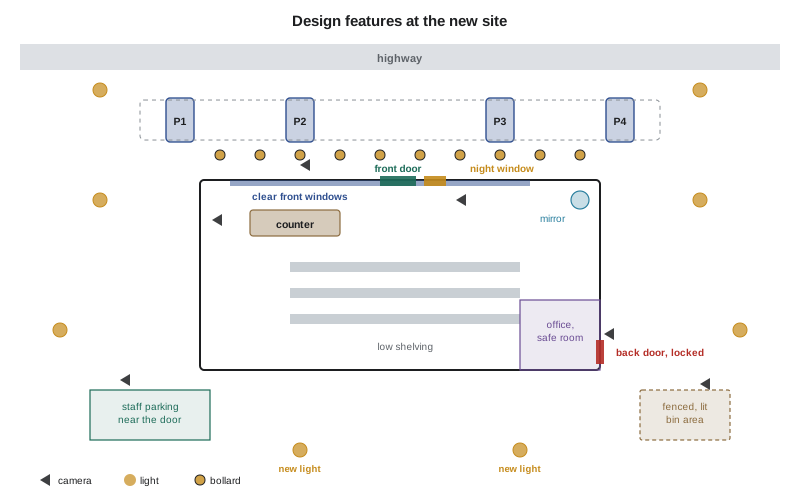
The building itself can protect a lone worker, or it can work against them. A store with clear windows, bright lights, a counter that can be seen from the road and a single entrance at night tells a would-be robber that they will be seen and that there is little to gain. A store with windows covered in posters, a dark lot, shelves that hide the till and an unlocked back door tells them the opposite. Most design measures cost little compared with the harm they help prevent, and they work every hour of every night without anyone having to remember them.
This lesson looks at the design of the new 24-hour site, which Northfield's owners were able to plan from scratch, and at the changes they made to the original store, which they could not rebuild.
Crime prevention through environmental design
Much of what is known about safe store design comes under the heading of crime prevention through environmental design, usually shortened to CPTED and pronounced sep-ted. Its main ideas are:
- Natural surveillance: arrange the site so that people inside can see out and people outside can see in, and so that there are few places to hide. Robbers prefer not to be watched.
- Natural access control: guide people along clear routes, limit the ways in and out, and keep unwanted visitors away from staff-only areas.
- Territorial reinforcement: make it obvious that the space is cared for and controlled, with clear boundaries, signs and well-defined entrances.
- Maintenance: keep the site clean, repaired and well lit, because neglect signals that no one is watching or cares.
Studies of convenience store robberies since the 1970s have repeatedly found that stores with good visibility, little cash on hand, good lighting and a single clear entrance are robbed less often. OSHA's late-night retail guidance and the provincial and state rules in Lesson 2 draw on the same ideas.
Help is often available for free. Many police services have officers trained in CPTED who will walk a business at night and suggest changes, and some insurers and fuel brands offer security reviews as part of their contracts. Before the new site was built, Leah asked the local police for a review of the drawings, and the officer's suggestions on the bin enclosure, the side lighting and the position of the counter all made it into the final design. A fresh pair of eyes, especially one that has seen many robberies, catches things that owners who know the site well tend to overlook.
Seeing in and seeing out
Visibility works in both directions. A clear view into the store means a passing police patrol, a driver at the pumps or someone across the road can see what is happening at the counter. A clear view out means the worker can see who is approaching, watch the pumps and spot trouble early.
- Keep windows clear: limit posters, signs and displays so that most of the glass at eye level stays open. Many chains set a rule, such as no signs between waist and head height on the main windows.
- Put the counter where it can be seen from the road and the pumps, not tucked behind shelving.
- Keep shelving low near the windows and the counter, so that the worker can see the whole sales floor.
- Use convex mirrors to cover corners and aisles that cannot be seen directly from the till.
- Avoid tinted or mirrored glass, which hides the inside at night.
At the original Northfield store, a large lottery display and two ice machine posters covered half of the front window. Removing them cost nothing and opened a clear view of the counter from the pumps and the highway.
Lighting
Lighting does several jobs at once: it lets the worker see out, lets others see in, makes cameras useful, and reduces trips and falls on the lot. Light the store interior, the pump islands, the approaches, the parking area, the sides and back of the building, the bin enclosure and the path to staff parking.
Montana does not set a minimum light level for stations, but Florida requires at least 2 foot-candles in the parking area and Washington's late-night retail rule gives 1 foot-candle as an example (Lesson 2). A foot-candle is about 10.8 lux. Northfield chose 2 foot-candles (about 20 lux) on the lot as its own minimum at both sites, and measures it with a light meter.
Even, steady light is better than a few very bright spots with deep shadow between them. Lights should be checked every week and replaced quickly when they fail; a single dark corner at the side of the building is enough to hide someone. Light inside the store should not be so bright, compared with the lot, that the windows turn into mirrors at night.
The program below checks a set of illustrative light meter readings taken across the new site's lot at night against Northfield's 20 lux minimum, and reports the points that fall short and the evenness of the lighting.
# Check night-time light meter readings (lux) across the lot against a 20 lux minimum.
# Grid points are named by row (A front, D back) and column (1 to 5). Illustrative.
readings = {
    "A": [62, 75, 80, 71, 58],     # pump islands
    "B": [41, 55, 60, 48, 35],
    "C": [24, 31, 29, 22, 12],
    "D": [ 9, 18, 26, 21,  6],     # back of lot and bin enclosure
}
MIN_LUX = 20
low = [(f"{r}{i + 1}", v) for r, row in readings.items() for i, v in enumerate(row) if v < MIN_LUX]
values = [v for row in readings.values() for v in row]
avg = sum(values) / len(values)
print(f"points checked: {len(values)}, average {avg:.0f} lux, minimum {min(values)} lux")
print(f"uniformity (min/avg): {min(values) / avg:.2f}")
print("below minimum:", ", ".join(f"{p} ({v} lux)" for p, v in low))points checked: 20, average 39 lux, minimum 6 lux uniformity (min/avg): 0.15 below minimum: C5 (12 lux), D1 (9 lux), D2 (18 lux), D5 (6 lux)
Four points fall below 20 lux, and three of them are in the back row, by the bin enclosure and the staff parking, exactly the places a worker walks to alone at the end of a shift. The uniformity, the darkest point divided by the average, is about 0.15, which means the lot has very bright pump islands next to dark corners. Rather than adding more light at the pumps, which were already bright, Northfield added two fixtures at the back and moved one at the side, then measured again. Taking readings at night, on a grid, with the same meter each time, turns a vague sense that the back is a bit dark into a list of points to fix.
Controlling access
Fewer ways in means fewer surprises. At night, a lone worker should only have to watch one entrance.
- Keep side and back doors locked at all times from the outside, while still opening freely from the inside for escape. Never prop them open.
- Fit staff-only doors, such as the office and stockroom, with locks, and keep them shut.
- Use bollards or planters along the front of the store, which also stop vehicles from driving into the building in a ram raid.
- Mark the entrance clearly, with height markers on the door frame so that the worker and cameras can judge a person's height.
- Fence the bin enclosure and keep it lit, so that no one can wait inside it.
Night windows and barriers
A night window, sometimes called a pass-through or transaction window, lets the worker serve customers without unlocking the door. The store is locked, the customer stands outside and orders, and the worker passes goods and change through a slot or a small drawer. It is one of the strongest controls for late-night lone work, because it keeps the worker separated from anyone who means harm.
Night windows have limits. Customers dislike them, sales of in-store items fall, and the worker must still go outside for some tasks. Many stations use them only in the riskiest hours, for example from 1 a.m. to 5 a.m., with the door locked and a sign explaining why. Northfield's new site was built with a night window from the start, and it is used from 1 a.m. to 5 a.m. and at any time the worker feels unsafe.
Some stores use a full barrier instead, such as a bullet-resistant enclosure around the counter. These protect well but can feel isolating, can make customers more hostile, and do not help a worker who has to come out from behind them. They are most common in stores with a history of armed robbery.
Cameras
Cameras deter some robberies, help police after an incident, and let a monitoring center or manager see the store remotely when a check-in is missed. To do those jobs well:
- Cover the counter, the entrance from both sides, the pumps, the back door, the bin enclosure and the lot.
- Place a monitor near the entrance showing what the camera records, so that people entering see themselves on screen.
- Record in enough detail to identify faces at the door and the counter, and keep footage long enough to be useful, such as 30 days.
- Post signs saying that the site is under video surveillance, which may also be required by privacy law where you are.
- Check every week that each camera works and is recording, and that the clock on the recorder is correct.
Video recording of workers and customers raises privacy questions. Video of public areas of a business is generally allowed, but audio is different: Montana law generally requires the consent of everyone in a conversation before it is recorded, so most stations record video only. Signs, a clear purpose and limited access to the footage help a station stay within the rules (checked in 2026).
Keeping it up
Design measures decay. Posters creep back onto windows, light fixtures fail, a camera is knocked out of line, the back door closer breaks and someone props the door with a box. Northfield added a short weekly walk-around to the supervisor's checklist: windows clear, lights working, cameras recording and pointed correctly, doors closing and locking, bin enclosure lit and empty of hiding places, and the night window working. Problems go on a repair list with a date.
For supervisors: the view from outside
Once a month, stand at the pumps and at the road at night and look at the store as a stranger would. Can you see the counter and the worker clearly? Can you see the whole lot? Are there dark spots, hiding places or doors propped open? Then go inside and look out from the counter. If you cannot see the pumps or the door from the till, neither can the worker, and neither can the cameras that cover only the till.
Worked problem
Fixing the original store
The original Northfield store was built in the 1990s. The counter is at the back, behind two rows of tall shelving, and cannot be seen from the road. There is a side door to the stockroom that staff use for smoke breaks. Rebuilding is not affordable this year. What can be done?
Show solution
- Moving the counter is not possible this year, so improve sight lines instead: replace the two tall shelving rows nearest the front with low units, and add a convex mirror and a camera monitor at the counter showing the front door and pumps.
- Clear the front windows of signs at eye level, and add lighting inside near the windows so that the counter can be seen from outside.
- Lock the side door from the outside at all times, fit a closer and an alarm contact, and move smoke breaks to the front of the store where the camera covers them, or to times when two workers are on.
- Put the counter move on the plan for the next renovation.
Answer: Improve sight lines with low shelving, mirrors and a camera monitor, clear the windows, secure the side door, and plan to move the counter at the next renovation.
Common mistakes
MistakeCovering windows with posters and displays.
InsteadKeep the glass at eye level clear so that people can see in and out.
MistakeLighting the pumps brightly and leaving the back dark.
InsteadLight the whole site evenly, especially routes the worker uses.
MistakePropping the back door open for convenience.
InsteadKeep it locked from outside and closed, with a closer and alarm.
MistakeInstalling cameras and never checking them.
InsteadCheck every week that they work, record and point the right way.
MistakeDesigning in the office from drawings only.
InsteadLook at the site at night, from outside and from the counter.
Summary and key terms
- Store design protects a lone worker every hour without anyone having to remember it.
- CPTED rests on natural surveillance, access control, territorial reinforcement and maintenance.
- Clear windows, a visible counter, low shelving and mirrors let people see in and out.
- Light the whole site evenly; measure it on a grid at night against a minimum.
- One entrance at night, locked back doors, bollards, height markers and a fenced, lit bin area control access.
- A night window separates the worker from customers in the riskiest hours.
- Cameras need full coverage, a monitor at the entrance, signs and weekly checks.
- CPTED
- Crime prevention through environmental design: designing places to discourage crime.
- Natural surveillance
- Arranging a site so that people can see and be seen.
- Night window
- A window or drawer for serving customers while the store door stays locked.
- Lux
- A unit of illuminance; one foot-candle is about 10.8 lux.
- Uniformity
- The darkest light reading divided by the average; higher is more even.
- Height markers
- Marks on a door frame that show the height of a person walking through.
Practice problems
Work each problem on paper first, then reveal the answer to check.
Name the four main ideas of CPTED.
Show answer
Natural surveillance, natural access control, territorial reinforcement and maintenance.
Why does visibility work in both directions?
Show answer
People outside can see trouble at the counter, and the worker can see who is approaching.
A lot averages 40 lux and its darkest point is 8 lux. What is the uniformity?
Show answer
0.2.
Give three ways to control access to a store at night.
Show answer
For example, one entrance, locked back doors, staff-only doors locked, bollards, a fenced bin area and a night window.
What is a night window and when is it most useful?
Show answer
A window or drawer for serving customers with the door locked, most useful in the riskiest late-night hours.
List three things to check about cameras every week.
Show answer
That each camera works, is recording, points the right way and has the correct time.
Lesson quiz · 5 questions
Score 60% or more to complete this lesson.
Create a free account to save your progress, take quizzes and earn a certificate.