
HSE-352 · Lesson 3 of 12 · 24 min
Assessing the hazards of working alone
Every good working alone program rests on a hazard assessment. It is the step where a manager stops assuming and starts looking: at the tasks a lone worker actually does, at the place and the hours, at what could go wrong and at how quickly help could arrive. The rest of the program, from the check-in interval to the choice of device and the store layout, follows from what the assessment finds. A program built without one tends to protect the worker against the hazards the manager happened to think of, and not against the ones that are really there.
This lesson walks through the assessment Leah Morin did for the new 24-hour site on the highway at the edge of Billings. OSHA's late-night retail guidance calls this step worksite analysis, and OSHA's recommended practices for safety programs treat hazard identification as the core of any program, so the lone work assessment is part of that, not a separate exercise.
The steps of an assessment
Most hazard assessments follow the same basic steps, whatever the workplace. For lone work at a station, they look like this:
- List the lone work: who works alone, when, where on the site and doing which tasks. Lesson 1 showed how to count lone-worker hours from the schedule.
- Identify the hazards of each task, and what could go wrong if the worker is alone when it does.
- Rate the risk of each hazard, usually by combining how likely it is with how bad the result could be, and by asking how long help would take to arrive.
- Choose controls, starting with removing the lone work or the hazard and working down to procedures and equipment.
- Rate the risk again with the controls in place, to see whether it is now acceptable.
- Write it down, tell the workers what was found and what will be done, and train them.
- Review it at set times and whenever something changes.
No federal rule sets the format of the assessment, but OSHA's guidance expects it to look at records, the layout, the neighborhood and the work practices, and to involve workers. Writing it down and dating it makes it easy to show an inspector or an insurer what was found and what was done.
Hazards a lone worker faces
Robbery is the hazard most people think of first at a late-night station, and it is serious. But a lone worker faces every other hazard of the job too, and each one is worse when there is no one to help. When Leah sat down with Ben, Raj and the new overnight hires, they listed the following:
- Violence: robbery, assault by an angry or intoxicated customer, threats, harassment, and violence from someone the worker knows who comes to the store.
- Fuel theft: drivers leaving without paying, and the danger of trying to stop them (Lesson 6).
- Medical emergencies: a heart attack, a seizure, a diabetic low, a severe allergic reaction or fainting, which may leave the worker unable to call for help.
- Slips, trips and falls: ice on the lot at 5:30 a.m., a wet floor after mopping, a fall from a step stool while stocking a high shelf.
- Fire and fuel: a fire at a dispenser, a spill at the pumps or a leak during a night delivery (HSE-350 and HSE-351).
- Vehicles: being struck on the lot in the dark while picking up litter or checking the pumps.
- Manual handling: lifting cases of drinks, bags of ice or garbage alone.
- Chemicals: cleaning products in the washrooms and the car wash.
- Fatigue: the low point of alertness in the early hours, and the drive home after a night shift (Lesson 9).
- Weather and power: a blizzard that cuts the highway, or a power cut that turns off the lights, the cameras and the card readers.
The list is long, but writing it out is useful in itself. It reminds everyone that a check-in system that only works for robbery, for example a panic button under the counter, does nothing for a worker who has slipped on ice in the dark at the back of the building.
What makes the risk higher or lower
The same hazard can carry very different risk at two stations, or at the same station at different times. The assessment should look at the factors that change it:
- Time of day: late night and early morning carry more risk of violence and more fatigue, and fewer people pass by to notice trouble.
- Location: an isolated highway site, a site near a bar strip, or a site with a history of incidents. Local police can often share crime data for the area.
- Response time: how long it would take police, an ambulance or the contact person to arrive. A site 25 minutes from the nearest police patrol needs more than a site across the road from a fire hall.
- Cash and goods: how much cash, tobacco, lottery tickets and other high-value goods are on site at night.
- The building: visibility into the store, lighting, the number of entrances, hiding places and whether there is a back room with an outside door.
- The task: tasks that take the worker outside, into the back or up a ladder carry more risk when alone.
- The worker: experience, training, age, any medical condition that could suddenly stop them from calling for help, and whether they are comfortable working alone at all.
- Past incidents: near misses and incidents at this site and at similar sites in the chain.
Talking to the workers matters here as much as anywhere. Ben told Leah that the riskiest moment of his shift was not the last hour, as she had assumed, but the moment he unlocked the back door to take the cardboard out to the bin, because the bin enclosure was dark and anyone could be waiting behind it. That one comment changed the plan.
Rating the risk
A simple way to rate risk is to give each hazard two scores from 1 to 5. Likelihood asks how often it could happen, from 1 (very unlikely in the life of the store) to 5 (expected several times a year). Severity asks how bad the worst realistic result would be, from 1 (first aid only) to 5 (death or permanent injury). Multiplying them gives a risk score from 1 to 25, and bands turn the score into a decision: low risk can be managed with normal procedures, medium risk needs specific controls, high risk needs strong controls before the work goes ahead, and very high risk means the work should not be done alone until the risk is reduced.
Being alone usually raises both scores. Likelihood goes up for robbery, because a single worker is a softer target. Severity goes up for almost everything, because an injury that a co-worker could deal with in minutes can become life-threatening when no one finds the worker for an hour. That is why a slip on ice, which might be a 2 for severity with two people on shift, can be a 4 when the worker is alone in the dark at 5:30 a.m. and may lie on the ground until the first customer arrives.
The scores are judgments, not measurements. Two people rating the same hazard will often disagree by a point, and that is fine. The value of the exercise is that it makes people think about each hazard in turn and puts the most serious ones at the top of the list. Where opinions differ, choose the higher score until there is a reason not to.
Scoring the new site
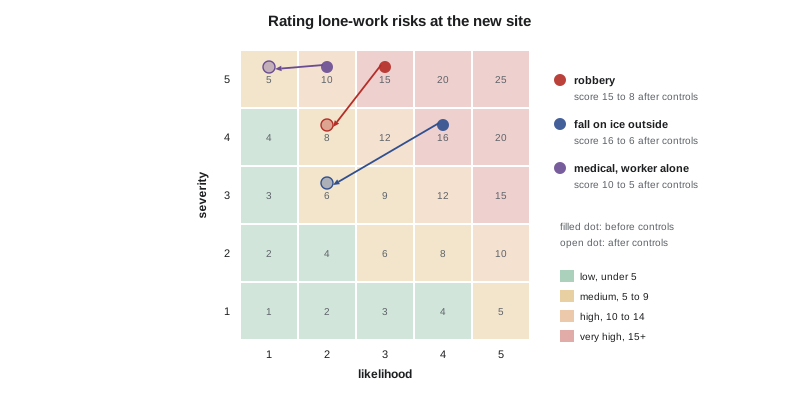
The program below scores a short list of the hazards Leah identified at the new site, before and after the controls she chose, and sorts them so that the highest residual risks come first. The scores are illustrative. A real assessment would list more hazards, but the method is the same.
# Score lone-work hazards at the new 24-hour site, before and after controls.
# Each entry: hazard, (likelihood, severity) before, controls, (likelihood, severity) after.
hazards = [
    ("Robbery at the counter", (3, 5), "prepay, time lock safe, cash limits, cameras, panic device", (2, 4)),
    ("Fall on ice outside at night", (4, 4), "outside tasks moved to day shift, de-icing, device with fall alert", (2, 3)),
    ("Medical emergency, worker alone", (2, 5), "check-ins, device with no-motion alert, first aid training", (1, 5)),
    ("Fuel drive-off and chase", (4, 4), "prepayment, never-chase rule, training", (1, 4)),
    ("Assault by intoxicated customer", (3, 4), "night window after 1 a.m., refusal policy, panic device", (2, 3)),
    ("Back door to garbage bin", (3, 4), "garbage run before 9 p.m., bin enclosure lit, door kept locked", (1, 4)),
    ("Lifting ice bags alone", (3, 2), "ice delivered and stocked on day shift, small bags only", (2, 2)),
]

def band(score):
    if score >= 15: return "very high"
    if score >= 10: return "high"
    if score >= 5:  return "medium"
    return "low"

rows = []
for name, (l0, s0), controls, (l1, s1) in hazards:
    rows.append((l1 * s1, l0 * s0, name))
rows.sort(reverse=True)
print(f"{'hazard':34} before        after")
for after, before, name in rows:
    print(f"{name:34} {before:2} {band(before):9}  {after:2} {band(after)}")
high = [n for a, b, n in rows if a >= 10]
print("still high or very high after controls:", ", ".join(high) if high else "none")hazard before after Robbery at the counter 15 very high 8 medium Fall on ice outside at night 16 very high 6 medium Assault by intoxicated customer 12 high 6 medium Medical emergency, worker alone 10 high 5 medium Fuel drive-off and chase 16 very high 4 low Back door to garbage bin 12 high 4 low Lifting ice bags alone 6 medium 4 low still high or very high after controls: none
Before controls, five of the seven hazards score high or very high, which is a clear sign that the new site could not open with a single overnight worker and only the ordinary procedures. After controls, nothing is left in the high band, and the hazards with the highest residual scores are robbery and the medical emergency, both at 5 or more because their severity stays high however unlikely they become. Those are the hazards the check-in system and the lone worker device in Lessons 4 and 5 must handle well. A worker who collapses at 3 a.m. will be found only as fast as the system notices that something is wrong.
Choosing controls
Controls should follow the hierarchy of controls, from the most effective to the least. For lone work, it looks like this:
- Eliminate the lone work or the hazard: schedule a second worker, close at night, or move risky tasks such as deliveries, garbage runs and ladder work to staffed hours.
- Substitute: replace a risky way of working with a safer one, such as pay-at-the-pump only after 1 a.m., or smaller bags of ice that one person can lift.
- Engineering controls: physical changes such as a night window, a time lock safe, better lighting, bollards, cameras and a door that locks behind the worker.
- Administrative controls: procedures, cash limits, check-ins, training and signs.
- Personal protective equipment and devices: high-visibility clothing for outside tasks and the lone worker device.
Check-ins and devices sit near the bottom of the hierarchy. They do not stop anything from happening; they make sure help comes when it does. They are essential for lone work, but they are not a substitute for removing hazards higher up. A station that hands a lone worker a panic pendant and changes nothing else has done the easy part and left the hard part undone.
Setting the contact interval
Because the risk of lone work rises and falls through the shift, the assessment is also where the check-in interval comes from. A reasonable approach is to tie the interval to the highest residual risk the worker faces during that part of the shift: for example, every 2 hours in the day band, every hour in the late evening and every 30 minutes, or before and after each outside task, in the late-night band. Lesson 4 looks at check-ins in detail.
The interval is a trade-off. Short intervals find a hurt worker sooner but interrupt the work and can become a box-ticking chore that people stop taking seriously. Long intervals are easy to keep but leave a worker who has collapsed alone for longer. A device that raises an alarm by itself, for example when it detects a fall or no motion, lets the interval be longer without leaving the worker unprotected in between.
For supervisors: walking the site at night
Do part of the assessment at the hours the lone worker actually works. A site that looks fine at 2 p.m. can look very different at 2 a.m.: lights that are out or blocked by signs, a bin enclosure that is pitch dark, windows covered by posters so that no one can see in, and a car wash bay where anyone could wait out of sight. Leah walked the new site with Ben at 1 a.m. before it opened and found three dark corners that the day-time plan had missed.
Worked problem
Rating the opener's walk-around
At 5:30 a.m. in January the opener at the original store walks around the outside of the building alone, in the dark, to check the pumps, the propane cage and the bin enclosure before unlocking the front door. The lot is often icy. Rate the hazard of a fall with the worker alone, then suggest controls and rate it again.
Show solution
- Likelihood: falls on ice are common in a Red Deer or Billings winter; a fall on some morning in the season is likely, so 4.
- Severity: a fall alone in the dark could mean a head injury or a broken hip with no one to help for an hour or more, so 4. The score is 16, very high.
- Controls: move the outside check to after the second worker arrives at 7 a.m. and do only a look from the lit front door on arrival; have the snow contractor sand the walkway by 5 a.m.; wear ice grips; carry the device with fall detection; check in on arrival.
- With the outside walk moved to staffed hours, likelihood falls to 2, and the device and check-in cut how long a fallen worker would wait, so severity falls to 3. The new score is 6, medium.
Answer: Very high before controls (16); medium (6) once the walk-around is moved to staffed hours and the worker has a fall alert and check-in.
Common mistakes
MistakeAssessing only robbery.
InsteadAssess every hazard of the job, because each is worse when alone.
MistakeDoing the assessment in the office in daylight.
InsteadWalk the site at the hours the lone worker works.
MistakeLeaving out the workers who do the shifts.
InsteadAsk them; they know which moments feel unsafe.
MistakeStarting with devices and check-ins.
InsteadWork down the hierarchy of controls from elimination.
MistakeWriting the assessment once and filing it.
InsteadReview it at set times and whenever something changes.
Summary and key terms
- The hazard assessment is the foundation of a working alone program.
- List the lone work, identify hazards, rate the risk, choose controls, rate again, record, train and review.
- A lone worker faces every hazard of the job, not only robbery, and each is worse without help nearby.
- Time, location, response time, cash, the building, the task and the worker all change the risk.
- Likelihood times severity gives a simple risk score; being alone usually raises both.
- Choose controls from the top of the hierarchy; check-ins and devices are needed but come last.
- The check-in interval should follow from the residual risk.
- Hazard assessment
- A written look at the hazards of the work, the risks they carry and the controls chosen.
- Likelihood
- How often a hazard could cause harm, scored here from 1 to 5.
- Severity
- How bad the worst realistic harm would be, scored here from 1 to 5.
- Residual risk
- The risk that remains after controls are in place.
- Hierarchy of controls
- The order of preference for controls: eliminate, substitute, engineer, administer, protect.
- Response time
- How long it would take help to reach the worker.
Practice problems
Work each problem on paper first, then reveal the answer to check.
List the main steps of a hazard assessment.
Show answer
List the lone work, identify hazards, rate the risk, choose controls, rate again, record and train, and review.
Give four hazards a lone station worker faces besides robbery.
Show answer
For example, medical emergencies, falls on ice, fire at the pumps, being struck by a vehicle, manual handling, chemicals and fatigue.
Why does being alone raise the severity of a fall?
Show answer
Because no one may find or help the worker for a long time, so a treatable injury can become much worse.
A hazard has likelihood 3 and severity 4. What is its score and band in this lesson?
Show answer
12, high.
Why do check-ins and devices sit low in the hierarchy of controls?
Show answer
They do not stop the event; they only make sure help comes after it happens.
Why walk the site at night as part of the assessment?
Show answer
Lighting, visibility and hiding places look different at night, and day-time plans can miss them.
Lesson quiz · 5 questions
Score 60% or more to complete this lesson.
Create a free account to save your progress, take quizzes and earn a certificate.