
HSE-352 · Lesson 10 of 12 · 21 min
When contact is lost
A check-in procedure or a lone worker device is only half a system. The other half is what happens when the expected contact does not come: when a check-in is missed, a device alarm goes off or a worker simply stops answering. That is the escalation procedure. It turns a silence into action, step by step, until either the worker is found safe or help is on the way. Without a written, practiced escalation procedure, a missed check-in can sit unnoticed for hours while the contact wonders whether to bother anyone.
Why a written procedure matters
When a check-in is missed at 3 a.m., the contact faces an awkward choice. Most missed check-ins turn out to be harmless: the worker was busy with a customer, the phone battery died, or they forgot. Calling police feels like an overreaction, and calling the manager at home feels like a nuisance. Left to their own judgment, many people wait, try again later, and hope. A written procedure removes the guesswork. It says exactly what to do and when, so that the contact does not have to decide whether a situation is serious enough. Following the steps is never an overreaction.
The escalation steps
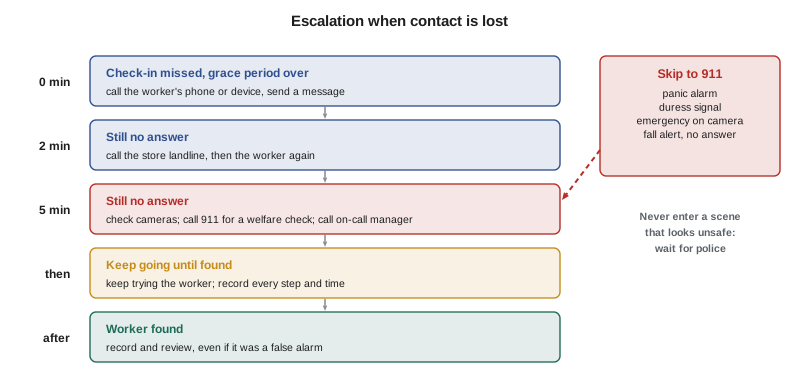
Northfield's escalation procedure for the new site has six steps. The times are counted from the end of the grace period of the missed check-in, or from the moment a device alarm is received.
- Step 1, at once: try to reach the worker. Call their phone or device, and send a message. Wait 2 minutes.
- Step 2, after 2 minutes: call the store's landline, then call the worker's phone again.
- Step 3, after 5 minutes: look at the store cameras remotely, if the contact has access, to see whether the worker is at the counter and whether anything looks wrong.
- Step 4, after 5 minutes, if the worker is still not reached: call 911 for police to attend for a welfare check, and give them the site details. Do not wait to complete step 3 if it is slow.
- Step 5, at the same time: call the on-call manager, who goes to the site or sends a second person, never alone if there is any sign of violence.
- Step 6: keep trying the worker, record each step and its time, and stay in contact with police and the manager until the worker is found.
If at any point the contact hears the duress signal, sees an emergency on the cameras or receives a panic alarm, they skip straight to calling 911. A device alarm from a fall or no-motion alert also goes straight to calling the worker through the device's two-way voice, and to 911 if there is no clear answer within a minute.
What to tell police and the responder
When the contact calls 911, the dispatcher needs clear, quick information. Northfield keeps a site card for each store with the details ready to read out:
- The site name and full address, with the nearest cross street or highway landmark.
- That a lone worker has not responded to a scheduled check-in or has raised an alarm, and when they were last heard from.
- The worker's name and a brief description.
- The entrances: which door is locked, whether there is a night window, and where a key or code can be obtained.
- Any known risk: a threatening customer earlier in the night, a robbery at the site last month, or a medical condition the worker has shared.
- The contact's name and call-back number.
The site card also helps the on-call manager or second person who goes to the site. They should be told to look from their car first, as in the opening routine (Lesson 8). If they see signs of a robbery or violence, such as a broken door, a stranger inside or the worker on the floor with someone standing over them, they should not go in, but stay at a safe distance, call 911 and wait for police. If the scene looks safe and the worker needs help, they give first aid and call for an ambulance.
The on-call list behind the site card needs as much care as the card itself. Each night, one named manager is on call, with a backup if they cannot be reached, and the monitoring center and the original store both hold the current list. The person on call must keep their phone on and loud, stay within a reasonable drive of the site, and avoid alcohol while on call. Northfield rotates the duty weekly among Leah, Raj and a senior cashier, and the rota is sent to the monitoring center every Friday.
How fast is fast enough?
Every minute in the escalation adds to the time a hurt worker waits. The program below compares the time from a collapse until someone reaches the worker under three versions of the procedure, using illustrative times: a slow procedure where the contact tries several times over 30 minutes before calling anyone, Northfield's procedure, and Northfield's procedure with a device that raises an alarm by itself.
# Time from a worker's collapse until help reaches them, under three procedures.
# Check-ins every 30 min with a 10-min grace period; collapse at a random time between check-ins.
import random
random.seed(5)
POLICE = 12          # police travel time to the site, minutes (illustrative)
MANAGER = 25         # on-call manager travel time

def check_in_detection():
    return random.uniform(0, 30) + 10       # time until the grace period ends

procedures = {
    "slow: retry for 30 min, then call": lambda: check_in_detection() + 30 + POLICE,
    "Northfield: 5 min of calls, then 911": lambda: check_in_detection() + 5 + POLICE,
    "device no-motion alert + 911":         lambda: 2.5 + 1 + POLICE,
}
for name, f in procedures.items():
    times = sorted(f() for _ in range(10000))
    avg = sum(times) / len(times)
    p90 = times[int(0.9 * len(times))]
    print(f"{name:38} average {avg:5.1f} min, 9 in 10 within {p90:5.1f} min")
print(f"manager alone, if sent first instead of police: +{MANAGER - POLICE} min")slow: retry for 30 min, then call average 67.1 min, 9 in 10 within 79.1 min Northfield: 5 min of calls, then 911 average 42.0 min, 9 in 10 within 54.0 min device no-motion alert + 911 average 15.5 min, 9 in 10 within 15.5 min manager alone, if sent first instead of police: +13 min
The slow procedure, which is how many informal arrangements work in practice, means a worker waits on average more than an hour, and 1 in 10 waits more than 79 minutes. Northfield's written procedure cuts the average to about 42 minutes, simply by calling police after 5 minutes instead of 30. The device with an automatic alert brings it down to under 16 minutes, because the alarm does not wait for the next check-in. The last line is a reminder of why police are called rather than waiting for the manager: at this site, the manager lives 25 minutes away.
False alarms are part of the system
Most escalations will end with the worker found safe and a little embarrassed: their phone was in the back, they were busy with a customer, or they forgot. That is fine. A procedure that never produces false alarms is a procedure that waits too long. The contact should never be criticized for following the steps, and the worker should not be punished for a genuine mistake. Instead, the cause should be recorded and fixed: a phone that does not work in the cooler, a check-in time that clashes with a busy period, or a worker who needs a reminder.
At the same time, frequent false alarms are a problem, because they wear down the contact, annoy the police and tempt everyone to slow the procedure down. If false alarms are common, look for the pattern in the log (Lesson 4) and fix the cause, rather than adding a longer wait before calling 911. Some police services ask businesses with repeated false alarms to review their systems, so it is worth keeping them low.
Lost contact for other reasons
Contact can be lost without anything being wrong at the store: a power cut takes out the phone line, a mobile network goes down, a blizzard stops the overnight worker from getting home, or the monitoring center's system fails. The procedure should cover these too:
- Power cut: the worker uses the mobile phone or device, which should be charged, and checks in to say the power is out. Lights, cameras and card readers may be down, so the worker switches to the night window or closes until power returns, and check-ins become more frequent.
- Network outage: if both phone and data are down, the worker and contact follow a pre-agreed plan, such as the manager driving to the site or the worker closing and leaving for a safe place if it is safe to do so.
- Monitoring center failure: the center should tell the employer at once, and the employer should have a backup contact, such as another staffed store or the on-call manager.
- Weather: if the highway is closed and the worker cannot get home, they check in from the store and arrange a safe place to stay. No one should be told to drive home through a storm after a night shift.
Testing the escalation procedure
An escalation procedure that has never been tested will usually have a gap somewhere: a wrong phone number on the site card, a manager who did not know they were on call, a monitoring center that calls the wrong store. Planned tests find these gaps before a real emergency does.
- Run a planned missed check-in at least every few months. The worker and the contact know in advance; the test checks the steps, not anyone's nerves.
- Agree with the monitoring center how to test without sending police, for example by stopping at step 4 and recording the time it would have been called.
- Time each step and compare it with the procedure.
- Check the site card details, phone numbers and on-call list each time.
- Record what was found and fix it.
When Northfield ran its first planned test at the new site, the monitoring center followed the steps well, but the on-call manager's number on the site card was Leah's old phone. It took 9 minutes longer than planned to reach anyone, and the fix took 30 seconds.
For supervisors: after every escalation
After every escalation, real or false, spend a few minutes with the worker and the contact. What happened? Did the steps work as written? How long did each one take? What would have made it faster or prevented it? Record the answers. Over time, these short reviews are the best source of improvements to the whole working alone program.
Worked problem
A silent store at 2:40 a.m.
The overnight worker at the new site misses the 2:30 a.m. check-in. At 2:40 a.m., the end of the grace period, the monitoring center operator calls the worker's device and gets no answer. Walk through what should happen next.
Show solution
- 2:40 a.m.: the operator calls the device again and sends a message. No answer.
- 2:42 a.m.: the operator calls the store landline. It rings out. The operator calls the device once more.
- 2:45 a.m.: the operator calls 911, reads the site card and says the lone worker has not responded since 2:00 a.m. The operator then calls the on-call manager, Raj, and tells him police are on the way and not to enter if anything looks wrong.
- 2:58 a.m.: police arrive and find the worker in the back office, conscious but confused after a diabetic low. They call an ambulance. Raj arrives and closes the store. The operator records each step and its time.
Answer: Try the worker twice, call the store line, then call 911 and the on-call manager at the 5-minute mark, and record each step.
Common mistakes
MistakeWaiting and retrying for half an hour before calling anyone.
InsteadFollow the written steps and call 911 after a few minutes.
MistakeSending the manager in alone to a possible robbery.
InsteadCall police; the manager looks from outside and does not enter if anything looks wrong.
MistakeCriticizing the contact for a false alarm.
InsteadThank them for following the steps and fix the cause.
MistakeLengthening the wait before calling 911 to cut false alarms.
InsteadFind and fix the causes of false alarms instead.
MistakeNever testing the escalation procedure.
InsteadRun planned tests and check the site card each time.
Summary and key terms
- An escalation procedure turns a missed check-in or alarm into action, step by step.
- A written procedure removes the guesswork; following it is never an overreaction.
- Try the worker, try the store, check the cameras, then call 911 and the on-call manager within minutes.
- A panic alarm, duress signal or emergency on camera goes straight to 911.
- A site card gives police and responders the address, entrances, risks and contacts.
- False alarms are part of the system; fix their causes rather than slowing the response.
- Plan for power cuts, network outages, monitoring failures and weather, and test the procedure.
- Escalation procedure
- The written steps taken when contact with a lone worker is lost.
- Welfare check
- A visit by police or another responder to check that someone is safe.
- Site card
- A sheet with a site's address, entrances, risks and contacts for responders.
- On-call manager
- The manager responsible for responding to problems outside normal hours.
- False alarm
- An escalation or alarm that turns out not to involve an emergency.
Practice problems
Work each problem on paper first, then reveal the answer to check.
Why should escalation steps be written down?
Show answer
So that the contact does not have to judge whether the situation is serious; they just follow the steps.
List the first three steps of Northfield's escalation procedure.
Show answer
Call the worker, call the store landline and the worker again, then check the cameras.
When does the contact skip straight to 911?
Show answer
On a panic alarm, the duress signal or an emergency seen on camera.
Name four items on a site card.
Show answer
For example, address and landmark, entrances, the worker's name, known risks and the contact's number.
What should a manager do if they arrive and see a stranger standing over the worker?
Show answer
Not go in; stay at a safe distance, call 911 and wait for police.
Why are false alarms acceptable?
Show answer
A procedure that never has false alarms waits too long; the cost of a false alarm is small.
Lesson quiz · 5 questions
Score 60% or more to complete this lesson.
Create a free account to save your progress, take quizzes and earn a certificate.