
HSE-352 · Lesson 8 of 12 · 21 min
Cash handling and late-night procedures
Robbers want cash and goods that are easy to carry and easy to sell. The less of both there is within reach of the counter at night, the less a robbery is worth, and the less likely it becomes. This lesson covers how a late-night station handles cash and high-value goods, and the routines that take a lone worker through the riskiest moments of a shift: opening, closing, taking out garbage, receiving deliveries and dealing with people who want to come in after hours.
Keeping little cash at the till
The single most effective cash control is a low limit on the amount in the register at night, backed by a safe the worker cannot open. Card payments have made this much easier: at Northfield, more than nine in ten night-time sales are by card, so the till only needs a small float to make change.
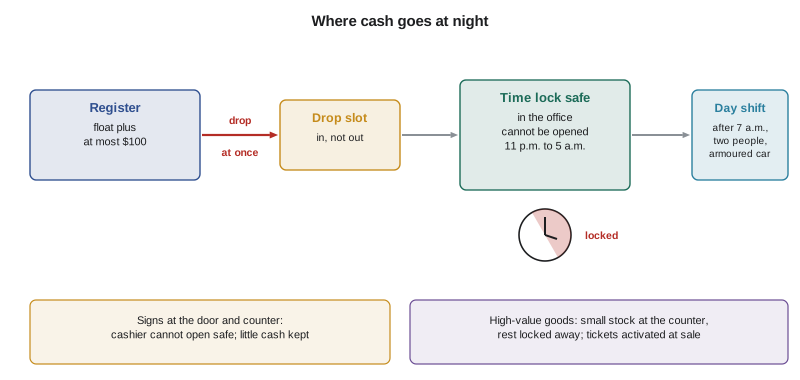
- Set a register limit for the night, such as $100 above the float, and a rule to drop any cash above it into the safe straight away.
- Use a drop safe: a safe with a slot or chute so that cash can be put in but not taken out by the worker.
- Use a time lock safe for the main cash: a safe that cannot be opened during set hours, even by someone with the code.
- Post signs at the door and the counter saying that the worker cannot open the safe and that the till holds little cash.
- Never count cash in view of customers or the windows; do it in the office, away from the glass, or leave it for the day shift.
Montana does not require a drop or time lock safe, but Washington and Florida do for late-night stores (Lesson 2), and OSHA's guidance recommends keeping little cash on hand. Northfield chose time lock safes at both sites, locked from 11 p.m. to 5 a.m., and a register limit of $100 above the float.
The signs only work if they are true. A robber who is told the till holds little cash and then finds $600 in it learns that the signs at this station are bluffs, and so does everyone they talk to.
Simulating cash at the till
How often the worker needs to make drops, and how much cash is at risk at any moment, depends on the limit and on how many cash sales come in. The program below simulates one night at the new site with illustrative cash sales and compares three register limits. It reports the largest amount above the float that would ever be in the till, and how many drops the worker would make.
# Simulate cash above the float in the register overnight under three drop limits.
import random
random.seed(11)
# One night: cash sales arrive at random; most sales are by card. Illustrative.
cash_sales = []
for minute in range(0, 480):
    if random.random() < 0.035:                       # about 17 cash sales a night
        cash_sales.append(round(random.uniform(4, 60), 2))

for limit in (50, 100, 250):
    till, peak, drops = 0.0, 0.0, 0
    for sale in cash_sales:
        till += sale
        peak = max(peak, till)
        if till > limit:
            drops += 1
            till = 20.0 if limit >= 100 else 0.0      # keep a little for the next change, or drop it all
    print(f"limit ${limit:>3}: peak above float ${peak:6.2f}, {drops} drops")
print(f"cash sales tonight: {len(cash_sales)}, total ${sum(cash_sales):.2f}")limit $ 50: peak above float $ 89.78, 9 drops limit $100: peak above float $158.04, 5 drops limit $250: peak above float $272.99, 2 drops cash sales tonight: 19, total $655.82
With a $100 limit, the most the till ever holds above the float is under $160, because a single large sale can push it over the limit just before the drop. A $250 limit means fewer drops but much more cash at risk, and a $50 limit keeps the risk lowest but means the worker is at the drop slot every few sales. Northfield chose $100 as a balance, with the rule that the drop is made at once, not at the end of the hour. Card sales make all of these numbers small compared with stations a generation ago, when tills routinely held hundreds of dollars at night.
Getting cash to the bank
Cash that leaves the store is at risk too. A worker carrying a bank bag to a car at the end of a night shift is an easy target, and robbers sometimes watch stations to learn the routine. Northfield uses an armored car service that collects from the safe during the day. Where that is not possible, deposits should be made in daylight by two people, at varied times and by varied routes, with the cash in an ordinary bag rather than a marked bank pouch. No one should ever take the night's cash home to deposit the next day, and no one on the overnight shift should be given the means to open the time lock safe early.
High-value goods
Cigarettes, vaping products, lottery tickets, phone cards and gift cards are worth a great deal for their size and are easy to sell. Robbers increasingly ask for them along with, or instead of, cash.
- Keep only a small stock of high-value goods at the counter at night, with the rest locked away.
- Northfield's policy limits cigarettes at the counter overnight to one carton of each of the ten most popular brands, with the rest in a locked cabinet in the office, and posts a sign saying so.
- Activate lottery tickets and gift cards only at the point of sale, so that stolen ones are worth nothing.
- Restock high-value displays on the day shift.
Opening the store
Opening alone in the dark is one of the riskiest routines. An opener who walks into a store where someone is waiting, or who is followed in from the lot, has no one to help. A safe opening routine at Northfield looks like this:
- Before arriving, the opener checks in with the contact: "arriving to open".
- Park in the lit space nearest the front door, not at the back.
- Before getting out, look around the lot, the building and the doors from the car. If anything looks wrong, such as a broken window, an open door, a stranger waiting or a car that does not belong, do not go in. Drive away to a safe place and call the manager or police.
- Enter by the front door only, lock it behind you, and turn on the lights.
- Walk through the store, washrooms and back rooms to check that no one is inside, then check in again: "inside, all clear".
- Leave the outside walk-around until the second worker arrives or it is light (Lesson 3).
Closing the store
Closing is the other high-risk routine: the worker handles the day's cash, locks up and walks to their car alone, often near midnight. Where possible, closing should be done by two people; Northfield's original store keeps the evening cashier and a second worker together until the doors are locked. When one person must close:
- About 30 minutes before closing, check the washrooms and back areas for anyone hiding, and start shutting down areas the worker does not need.
- At closing time, lock the door, turn off the open sign, and do not unlock it again for anyone, including people who say they know the worker.
- Do the cash-out away from the windows, drop the cash in the safe and leave the till open and empty if that is the policy.
- Check that all doors are locked and the alarm is set.
- Check in with the contact before leaving: "locking up, leaving now".
- Look out through the windows and on the camera monitor before opening the door. If anyone is hanging around, stay inside and call the contact or police.
- Walk straight to the car with keys ready, lock the doors once inside, and check in again when home (Lesson 9).
Garbage, deliveries and other trips outside
Every trip outside alone at night is a moment of exposure. The simplest rule is to avoid them: move garbage runs, cardboard, ice-machine filling, pump checks and window cleaning to staffed hours or daylight. At Northfield, Ben's garbage run moved from 11:30 p.m. to 8:30 p.m. after the hazard assessment (Lesson 1).
When a night trip outside cannot be avoided, the worker should check in before and after with an expected return time, carry the lone worker device, look at the camera monitor before going out, lock the door behind them and keep the trip short. Deliveries at night should be avoided where possible. When they happen, drivers should be expected and identified before the door is opened, and the worker should never open the back door to someone who simply knocks and says they are making a delivery.
Refusing entry and handling difficult customers
At night, the worker decides who comes in. The procedure should support them in refusing service and entry, without argument, to anyone who is threatening, clearly intoxicated or acting in a way that makes them feel unsafe. When the night window is in use, no one comes in at all, and the worker should not unlock the door for anyone except emergency services, even someone who claims to be a manager, a technician or a police officer, until they have checked by phone.
HSE-341 covers de-escalation in detail. The basics for a lone worker are to stay calm, keep the counter between themselves and the customer, avoid arguing about rules, offer a simple way out such as "I can't serve you tonight, but the station in town is open," and use the panic device if they feel threatened. Lesson 11 covers what to do if a situation turns into a robbery or an assault.
For supervisors: checking the routines
Watch an opening and a closing from time to time, ideally on camera rather than in person, so that you see the routine as it is really done. Check the cash records for drops: a till that regularly goes far above the limit before a drop means the rule is not being followed, or that something about the night makes it hard to follow. Check that the time lock settings and the signs match, and that high-value stock at the counter stays within the limit.
Worked problem
Someone knocking after closing
At 12:20 a.m., after the original store has closed and Ben is finishing the cash-out, a man knocks on the front door. He says he is a friend of Raj's, his car has broken down on the highway and he needs to use the phone. What should Ben do?
Show solution
- The store is closed and Ben is alone with the cash-out. The rule is not to unlock the door for anyone after closing, however reasonable the story sounds.
- Ben speaks through the glass or the night window: he cannot open the store, but he will call a tow service or 911 for the man if he wants. He does not argue.
- Ben finishes the cash-out away from the windows, calls the contact to say what happened, and checks the camera monitor and the lot before leaving. If the man is still there, he stays inside and calls police.
Answer: Do not unlock the door. Offer to call for help through the glass, tell the contact, and do not leave until the lot is clear.
Common mistakes
MistakeLetting the register build up through the night and dropping at the end of the shift.
InsteadDrop cash above the limit straight away.
MistakePosting a low-cash sign that is not true.
InsteadKeep the signs accurate, or they lose their value.
MistakeWalking into the store before looking around from the car.
InsteadCheck the lot and doors first; if anything looks wrong, leave and call.
MistakeUnlocking the door after closing for someone with a good story.
InsteadHelp through the glass by calling for them; do not open.
MistakeTaking garbage out alone at midnight.
InsteadMove outside tasks to staffed hours or daylight.
Summary and key terms
- Low cash at the till, a drop safe and a time lock safe make robbery less rewarding.
- Drop cash above the register limit at once, and keep the low-cash signs true.
- Limit high-value goods at the counter at night and lock the rest away.
- Open by looking first from the car, entering by the front, locking up and checking inside before checking in.
- Close with two people where possible; otherwise lock up, cash out away from windows and check before leaving.
- Avoid trips outside at night; when needed, check in before and after with the device and the door locked.
- The worker decides who comes in at night and should never unlock for a story.
- Register limit
- The most cash allowed in the till above the float before a drop.
- Float
- The small amount of cash kept in the till to make change.
- Drop safe
- A safe that accepts cash through a slot but cannot be opened by the worker.
- Time lock safe
- A safe that cannot be opened during set hours.
- High-value goods
- Small, easily sold items such as cigarettes, lottery tickets and gift cards.
- Point-of-sale activation
- Making a card or ticket valid only when it is sold.
Practice problems
Work each problem on paper first, then reveal the answer to check.
Why are low-cash signs only useful if they are true?
Show answer
A robber who finds more cash than the sign says learns that the store's signs are bluffs.
What is the difference between a drop safe and a time lock safe?
Show answer
A drop safe accepts cash but the worker cannot open it; a time lock safe cannot be opened by anyone during set hours.
Name three high-value goods robbers ask for.
Show answer
For example, cigarettes, vaping products, lottery tickets, phone cards and gift cards.
What should an opener do if a window is broken when they arrive?
Show answer
Not go in; drive to a safe place and call the manager or police.
Give three steps in a safe closing routine.
Show answer
For example, check washrooms before closing, lock the door, cash out away from the windows, check in, look out before leaving and walk straight to the car.
Why avoid unlocking the door for someone who says they are a technician?
Show answer
The story cannot be checked from inside; confirm by phone first or do not open.
Lesson quiz · 5 questions
Score 60% or more to complete this lesson.
Create a free account to save your progress, take quizzes and earn a certificate.