
HSE-352 · Lesson 2 of 12 · 21 min
Working alone rules in Canada
Working alone is covered by law in most of Canada, but the rules are not the same everywhere. Each province and territory makes its own occupational health and safety (OHS) law for most workplaces, including fuel stations and convenience stores. Some provinces have detailed rules for working alone, and a few have extra rules for late-night retail and for fuel prepayment. This lesson explains Alberta's rules in detail, because Northfield is in Red Deer, and then compares them with other provinces.
Laws change, and the summary here was checked in 2026. Always check the current rules for your own province before relying on them, and remember that the law sets a minimum, not a target.
Who makes the rules in Canada
About nine in ten Canadian workers are covered by provincial or territorial OHS law. The rest work for federally regulated employers, such as banks, airlines, telecommunications companies and trucking firms that cross provincial borders, and are covered by Part II of the Canada Labour Code. A fuel station is provincially regulated. A fuel hauler whose trucks regularly cross provincial lines may be federally regulated, so Mike's employer may follow different working alone rules from Northfield's, even when he is standing on Northfield's lot.
Alberta's working alone rules
Alberta's OHS Act sets out general duties: employers must ensure, as far as reasonably practicable, the health and safety of their workers, and workers must take reasonable care of themselves and others. The OHS Code then has a part dedicated to working alone, Part 28 (checked in 2026). It applies when a worker is working alone at a work site and assistance is not readily available if there is an emergency, the worker is injured or ill, or the worker is subject to violence. The main duties are:
- Do a hazard assessment of the lone work, as part of the general hazard assessment the Code requires, and put controls in place for the hazards found.
- Provide an effective communication system between the lone worker and someone who can respond, such as a phone, radio or other electronic means (section 394, checked in 2026).
- Where electronic communication is not practicable, arrange contact by other means, such as regular visits or the worker making contact at agreed times.
- Set the interval between contacts according to the hazards: the more dangerous the work, the more often contact is needed.
- Make sure the worker knows the procedure and that it is followed.
Alberta's Code does not set a fixed interval, such as every hour. It leaves the employer to judge it from the hazard assessment, which is why Lesson 3 spends so long on that assessment. Workers also have the rights set out in the OHS Act: to know about hazards, to take part in health and safety, and to refuse dangerous work without reprisal.
Alberta's rules for fuel stations and convenience stores
After the death of Ki Yun Jo in 2017, Alberta added rules aimed at retail fuel outlets and convenience stores, which took effect on June 1, 2018. As described by the Alberta government (checked in 2026), they include:
- Mandatory fuel prepayment: customers must pay before fuelling, at the pump or inside, by preauthorizing a card, leaving cash with the attendant or using an account (Lesson 6).
- A violence and harassment prevention plan, which every Alberta employer needs under Part 27 of the OHS Code, with extra items for these stores: safe cash-handling procedures, good visibility into and out of the store, limits on public access to the building, video monitoring with signs, and personal emergency transmitters.
- A personal emergency transmitter for anyone working alone, monitored by the employer or someone the employer designates (Lesson 5).
- For stores open between 11 p.m. and 5 a.m.: a time lock safe that workers cannot open during those hours, limited quantities of high-value items such as cigarettes and lottery tickets, secure storage for the rest, and signs saying so.
Alberta's rules do not require a second worker at night. Instead, they rely on prepayment, the time lock safe, cash and high-value item limits, visibility, video, signs and the personal emergency transmitter. A store can still choose to schedule two workers if its assessment shows it needs them.
Young workers in Alberta
Alberta's employment standards limit the hours young people can work in retail, and retail includes selling gasoline, diesel and propane. Young persons aged 15 to 17 may work between 9 p.m. and midnight only with adult supervision, and may not work between 12:01 a.m. and 6 a.m. at all (checked in 2026). At Northfield that rules Grace out of closing shifts and the new overnight shift completely, and it means she can never be the last worker in the store after 9 p.m. Younger workers face stricter limits still.
Other provinces
British Columbia has rules for working alone or in isolation and a section of its OHS Regulation on late-night retail, section 4.22.1 (checked in 2026). For gas stations and other retail stores open between 11 p.m. and 6 a.m., it requires a written check-in procedure, a written cash-handling procedure with a time lock safe, video surveillance, signs, training, a personal emergency transmitter, a security audit every two years and annual reviews of procedures. Workers alone in that period must be at least 19, and the store must be locked down with a barrier such as a transaction window, or rely on a risk-based violence prevention program. British Columbia also requires fuel prepayment.
Saskatchewan added late-night retail rules that took effect on January 8, 2013. They cover retail premises open to the public between 11 p.m. and 6 a.m., such as convenience stores and gas stations, and require a hazard assessment reviewed at least every three years, written safe cash-handling procedures, video cameras, good visibility, signs, a written violence policy and plan, and, for a worker alone, a check-in system with a written procedure and a personal emergency transmitter provided at no cost to the worker.
Manitoba's Workplace Safety and Health Regulation has a part on working alone or in isolation, with a code of practice. Employers must reduce lone work where they can, identify the risks, write a working alone procedure with the safety and health committee or representative, provide a reliable communication device and a monitoring system, set check-in intervals by risk and use a buddy system where possible. Ontario has no regulation specific to working alone; employers rely on the general duty to take every reasonable precaution and the workplace violence program the Occupational Health and Safety Act requires. An Ontario bill to make prepayment mandatory, Bill 88, passed second reading in April 2023 and was sent to committee, but it had not become law when this was checked in 2026. Most other provinces and territories have working alone provisions of their own.
Each province sets its own rules for young workers, too, so a 17-year-old who can close a store in one province may not be allowed to in another.
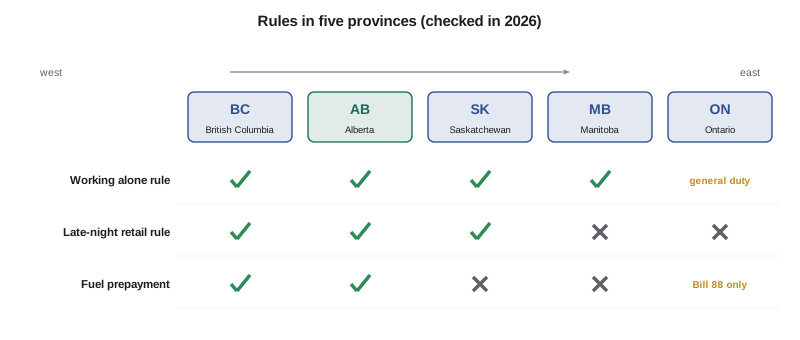
| Province | Working alone rule | Late-night retail rule | Fuel prepayment |
|---|---|---|---|
| Alberta | Yes, OHS Code Part 28 | Yes, extra plan items; 11 p.m. to 5 a.m. safe and stock limits | Required since June 1, 2018 |
| British Columbia | Yes | Yes, 11 p.m. to 6 a.m., section 4.22.1 | Required since February 1, 2008 |
| Saskatchewan | Yes | Yes, 11 p.m. to 6 a.m., since January 8, 2013 | No provincial requirement found |
| Manitoba | Yes, with a code of practice | No separate rule found | No provincial requirement found |
| Ontario | No specific rule; general duty and violence program | No separate rule | Proposed in Bill 88 (2023), not law |
Turning the rules into a checklist
When Northfield's owners planned the new 24-hour site, Leah turned Alberta's requirements into a checklist and compared it with the plan. The program below does the same thing. The requirements are a short paraphrase of the rules above, and the plan is illustrative.
# Compare the new site's plan with a paraphrase of Alberta's requirements.
requirements = {
    "hazard assessment of lone work": "assessment",
    "effective communication system": "check-in app",
    "contact interval set by hazard": "interval rule",
    "fuel prepayment": "prepay",
    "violence and harassment prevention plan": "violence plan",
    "safe cash-handling procedure": "cash procedure",
    "visibility into and out of store": "clear windows",
    "limits on public access": "night window",
    "video monitoring and signs": "cameras",
    "personal emergency transmitter": "transmitter",
    "time lock safe (11 p.m. to 5 a.m.)": "time lock safe",
    "limited high-value items, secured": "stock limits",
    "no young persons after midnight": "age rule",
}
plan = {"assessment", "check-in app", "prepay", "violence plan", "cash procedure",
        "clear windows", "night window", "cameras", "time lock safe", "age rule"}

gaps = [req for req, item in requirements.items() if item not in plan]
print(f"met {len(requirements) - len(gaps)} of {len(requirements)} requirements")
for g in gaps:
print(" gap:", g)met 10 of 13 requirements gap: contact interval set by hazard gap: personal emergency transmitter gap: limited high-value items, secured
The check finds three gaps. The contact interval had not been decided, because the hazard assessment was not finished; that is the subject of Lesson 3. The plan had no personal emergency transmitter, which Alberta requires for anyone working alone at these stores; the check-in app on the worker's phone is not enough on its own unless it works as a monitored emergency transmitter (Lesson 5). And there was no written limit on high-value items such as cigarettes and lottery tickets at night. Leah added all three before the site opened.
For supervisors: when rules overlap
Supervisors should know which rules apply to their own site and keep a copy of the current versions with the working alone procedure. Where more than one set of rules applies, such as the station's provincial rules and a federally regulated hauler's rules, agree in writing who checks on whom. When Mike delivers at night, his own company monitors him, but Northfield's procedure also tells the cashier to note when he arrives and leaves and to call the hauler's dispatcher if his truck sits at the fill ports longer than expected.
Worked problem
Can Grace cover the last hour?
Ben calls in sick at 8 p.m. on a Friday. Tyler can stay until 11 p.m. but not to closing at midnight. Grace, who is 17, offers to come in at 10 p.m. and close with Tyler, then stay alone for the last hour. What do Alberta's rules allow?
Show solution
- Alberta allows a 15- to 17-year-old to work in retail between 9 p.m. and midnight only with adult supervision.
- From 11 p.m. to midnight Grace would be alone, with no adult present, which the rule does not allow. The closing routine after midnight would also be past 12:01 a.m., when she may not work at all.
- Options: Leah or Raj comes in to close, Tyler stays to close if he can, or the store switches to the night window or closes early while pay-at-the-pump stays on.
Answer: No. Grace cannot work alone after 9 p.m. or after midnight; an adult must close, or the store closes early.
Working with the regulator
Alberta OHS officers can inspect a station, ask to see the hazard assessment and the working alone procedure, and issue orders when something is missing. Serious injuries and incidents, including some violent incidents, must be reported to Alberta OHS, and the scene left undisturbed except to help the injured or make it safe. Leah keeps the working alone assessment, the procedure, the training records and the check-in logs in one binder, so that she can answer an officer's questions on the spot and so that a new manager can see at a glance what has been done.
Common mistakes
MistakeAssuming every province has the same working alone rules.
InsteadCheck the current rules for your own province.
MistakeTreating a check-in app as meeting every requirement.
InsteadCheck whether your rules also require a monitored emergency transmitter.
MistakeLetting a 17-year-old close alone because they are capable.
InsteadFollow the young worker rules on hours and supervision.
MistakeThinking no fixed check-in interval means checks are optional.
InsteadSet the interval from the hazard assessment.
MistakeTreating the law as the target.
InsteadThe law is the minimum; the assessment may call for more.
Summary and key terms
- Most Canadian workplaces, including fuel stations, are covered by provincial OHS law.
- Alberta OHS Code Part 28 requires a hazard assessment, an effective communication system and contact at intervals set by the hazard.
- Alberta requires fuel prepayment, extra violence plan items, a monitored personal emergency transmitter for lone workers and, from 11 p.m. to 5 a.m., a time lock safe and high-value item limits.
- Young persons aged 15 to 17 in Alberta retail need adult supervision from 9 p.m. to midnight and may not work from 12:01 a.m. to 6 a.m.
- British Columbia and Saskatchewan have late-night retail rules; Manitoba has detailed working alone rules; Ontario relies on general duties.
- Check the current rules and treat them as a minimum.
- OHS Code Part 28
- The part of the Alberta OHS Code on working alone.
- Effective communication system
- A reliable way for a lone worker to reach someone who can respond.
- Personal emergency transmitter
- A device a lone worker wears to call for help, monitored by the employer or a designate.
- Time lock safe
- A safe that cannot be opened during set hours, even by the worker.
- Late-night retail rule
- A rule with extra measures for stores open in set overnight hours.
- Young person
- In Alberta employment standards, a worker aged 15 to 17.
Practice problems
Work each problem on paper first, then reveal the answer to check.
Who makes OHS law for a fuel station in Canada?
Show answer
The province or territory where it is located.
What does Alberta require for communication with a lone worker?
Show answer
An effective communication system, or other contact such as visits or scheduled calls, at intervals set by the hazard.
Name three extra items Alberta requires in a fuel or convenience store violence plan.
Show answer
For example, safe cash handling, visibility, limits on public access, video and signs, and personal emergency transmitters.
What must an Alberta store open between 11 p.m. and 5 a.m. have?
Show answer
A time lock safe workers cannot open, limited high-value items, secure storage for the rest and signs.
Can a 17-year-old work alone in an Alberta store at 11:30 p.m.?
Show answer
No; from 9 p.m. to midnight they need adult supervision.
Which province requires lone late-night retail workers to be at least 19?
Show answer
British Columbia.
Lesson quiz · 5 questions
Score 60% or more to complete this lesson.
Create a free account to save your progress, take quizzes and earn a certificate.