
HSE-217 · Lesson 8 of 12 · 28 min
Access, egress, spoil and edges
A trench with a perfect protective system can still kill people who cannot get out of it quickly, who are struck by a load swung over it, who fall into it, or who are buried when a spoil pile or a parked truck pushes the edge in. This lesson covers the ground around and above the excavation: ladders and ramps, spoil and surcharge, mobile equipment, falling loads, barriers and covers, and protecting the public and nearby structures.
Getting in and out
Workers need a safe way in and a safe way out, close enough that they can escape quickly if water rushes in, a wall starts to move, gas is detected or someone is injured. Climbing the walls, riding the bucket, using shoring members as a ladder or jumping in from the edge are all prohibited.
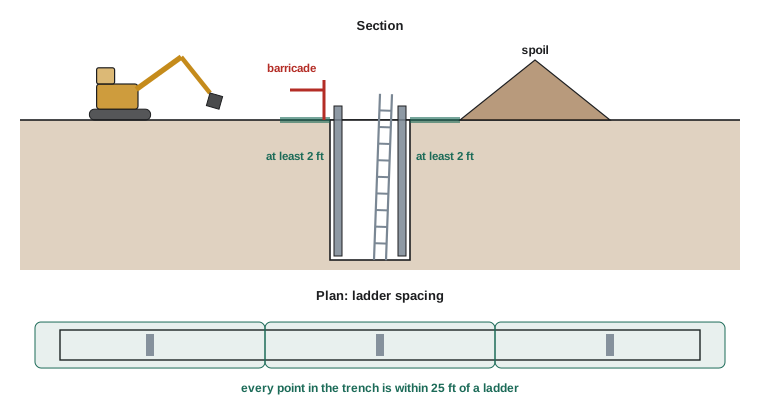
OSHA 1926.651(c)(2) requires a stairway, ladder, ramp or other safe means of egress in trench excavations 4 ft or more deep, located so that no worker has more than 25 ft of lateral travel to reach it. Ladders must meet Subpart X: portable ladders used for access to an upper landing must extend at least 3 ft above the landing or be secured at the top with a grab rail, and must be secured against displacement. Structural ramps used only by workers must be designed by a competent person; ramps used by equipment must be designed by a competent person qualified in structural design.
Worked problem
How many ladders?
A 120 ft length of trench 6 ft deep is open at once. Workers may be anywhere along it. What is the minimum number of ladders, and where should they go?
Show solution
- No worker may have more than 25 ft of lateral travel, so each ladder covers 25 ft on either side: a 50 ft stretch.
- \( 120 / 50 = 2.4 \), so at least three ladders are needed.
- One arrangement: ladders at about 20 ft, 60 ft and 100 ft from one end, leaving no point more than 25 ft from a ladder.
- In a trench shield, the ladders must be inside the shield, so ladders move with the shield as the work advances.
Answer: Three ladders, spread so that every point in the trench is within the allowed distance of one.
Worked problem
Choosing a ladder length
A trench is 10 ft deep. The ladder will be set at a slope of 4 vertical to 1 horizontal and must extend 3 ft above the top. Roughly what ladder length is needed?
Show solution
- At 4:1, the ladder's length along the rails is about 1.03 times the vertical height: \( \sqrt{4^2 + 1^2} / 4 \approx 1.03 \).
- Length to the top of the trench: \( 10 \times 1.03 \approx 10.3 \) ft.
- Add the extension above the landing: \( 10.3 + 3 = 13.3 \) ft.
- Choose the next standard size up, such as a 14 ft or 16 ft ladder, and secure it top and bottom.
Answer: About 13.3 ft of usable length; use a 14 ft ladder or longer.
Spoil and surcharge
Excavated soil, called spoil, is heavy and close at hand, which is exactly why it ends up in the wrong place. A spoil pile at the edge adds weight to the wall, can slide or roll back into the trench, and hides cracks that would warn of movement. Materials such as pipe, precast structures, bedding stone and timber, and equipment such as compactors and pumps, create the same problems.
OSHA 1926.651(j)(2) requires employees to be protected from excavated or other materials or equipment that could fall or roll into the excavation, by placing and keeping such materials or equipment at least 2 ft from the edge, by using retaining devices sufficient to prevent them from falling or rolling in, or both. Materials that add load near the edge must also be considered when choosing a protective system, and 1926.651(i) requires support systems or other protection where adjacent structures could be undermined.
These distances are minimums. Heavy surcharges such as large spoil piles, loaded trucks, cranes and stacked precast should be kept further back, and their effect on the protective system considered. A practical guide used by many engineers is that loads within a distance from the edge roughly equal to the depth of the excavation affect the walls, and that a protective system designed without a surcharge allowance may not be adequate when heavy equipment works alongside.
Worked problem
Where does the spoil go?
A trench 3 ft wide and 8 ft deep is dug for a 60 ft run. The soil swells by 25 percent when excavated. If the spoil is piled in a ridge with 45-degree sides beside the trench, how high and how wide is the ridge, and how far from the trench edge does it extend once the 2 ft setback is added?
Show solution
- Volume in place per foot of trench: \( 3 \times 8 = 24 \) ft³.
- Loose volume per foot: \( 24 \times 1.25 = 30 \) ft³.
- A triangular ridge with 45-degree sides has a cross-section area of \( h^2 \), where \( h \) is its height. So \( h = \sqrt{30} \approx 5.5 \) ft, and the base width is \( 2h \approx 11 \) ft.
- Adding the 2 ft setback, the spoil reaches about \( 2 + 11 = 13 \) ft from the trench edge.
Answer: A ridge about 5.5 ft high and 11 ft wide, reaching about 13 ft from the edge; plan for this space before digging.
Mobile equipment near the edge
Excavators, loaders, dump trucks, concrete trucks and cranes are heavy, vibrate the ground and can tip into the excavation if the edge gives way. Operators often cannot see the edge from the cab.
OSHA 1926.651(f) requires a warning system, such as barricades, hand or mechanical signals, or stop logs, when mobile equipment is operated next to an excavation or must approach its edge and the operator does not have a clear and direct view of the edge. 1926.651(d) requires workers exposed to vehicular traffic to wear high-visibility warning vests.
Excavators should normally dig from the side opposite the spoil pile, track at right angles to the trench rather than along the edge, and set their outriggers or tracks well back from any unsupported wall. Trucks being loaded should stay outside the surcharge zone or the protective system should be designed for them.
Falling loads and swinging buckets
OSHA 1926.651(e) prohibits employees from being underneath loads handled by lifting or digging equipment, and requires them to stand away from vehicles being loaded or unloaded to avoid being struck by spillage or falling materials. Workers in a trench must stand clear of pipe being lowered and of the excavator bucket as it swings, and should be outside the swing radius of the machine when they are on the surface. A pipe lowered on a sling can swing, slip or drop; workers should guide it with tag lines and receive it only when it has been set down or is under control.
The bucket is not a work platform, a man-lift or a means of access, and lifting with an excavator requires a machine rated for lifting, a lift chart, approved attachment points and, in most jurisdictions, an operator trained for lifting. HSE-219 covers rigging and lifting in more detail.
Falls into the excavation
Open excavations are also fall hazards for workers walking past, for equipment operators stepping off machines and for the public. OSHA 1926.501(b)(7) requires each employee at the edge of an excavation 6 ft or more deep to be protected from falling by guardrail systems, fences or barricades when the excavation is not readily seen because of plant growth or another visual barrier, and requires wells, pits and shafts to be guarded. 1926.651(l) requires walkways where employees or equipment cross over excavations, with guardrails where the walkway is 6 ft or more above the lower level.
Protecting the public
Many excavations are dug in streets, sidewalks, yards and parks where the public cannot be expected to recognize the hazard. Children are particularly at risk around open trenches and water-filled holes. Excavations left unattended, especially overnight, should be fenced or covered with steel road plates designed for the traffic, secured against sliding, and lit or marked as needed. Traffic control on public roads follows Part 6 of the Manual on Uniform Traffic Control Devices (MUTCD) and any state supplement.
Adjacent structures
Excavating beside a building, retaining wall, utility pole, sidewalk or road can remove the soil that supports it. The structure may settle, crack or collapse into the trench, and the extra load it places on the excavation can overwhelm a protective system designed without it. Before digging near a structure, the competent person should identify its foundation depth and type, consider whether the excavation will extend below a line drawn down and out from the foundation at a safe slope, and obtain an engineer's design for underpinning, bracing or a supported excavation where needed. Utility poles near trenches may need to be braced or held by the utility before digging.
| Hazard | Key OSHA controls |
|---|---|
| Access and exit | Egress within 25 ft lateral travel in trenches 4 ft or deeper |
| Spoil | At least 2 ft back from the edge, or retaining devices |
| Mobile equipment | A warning system when the operator cannot see the edge |
| Falls into excavation | Guardrails, fences or barricades at edges 6 ft or deeper not readily seen |
| Falling loads | No employee beneath loads handled by lifting or digging equipment |
Housekeeping in and around the trench
Good housekeeping is easy to neglect in an excavation and has a large effect on safety. Tools, offcuts of pipe and fittings, rocks and clods left on the trench floor create tripping hazards in a confined space where workers often look upward at loads and equipment. Loose material at the edge can be kicked or knocked in. Hoses and cables for pumps and saws should be routed so they do not cross access points or snag on equipment. At the end of each shift, the trench floor should be clear, ladders in place, materials stored back from the edge and the excavation secured for the night.
Common mistakes
MistakePlacing the ladder at the end of the trench outside the trench box.
InsteadPut ladders inside the protected area so workers never climb through an unprotected section.
MistakeStockpiling bedding stone at the trench edge for convenience.
InsteadKeep materials at least 2 ft back, and further for heavy loads.
MistakeLetting dump trucks back up to the edge of an unsupported trench.
InsteadKeep trucks outside the surcharge zone or design the protective system for them.
MistakeStanding in the trench to guide a pipe as it is lowered.
InsteadStay clear of suspended loads; use tag lines and receive the pipe once it is controlled.
MistakeLeaving an excavation open and unfenced overnight in a residential street.
InsteadFence, plate or barricade unattended excavations and protect the public.
Summary and key terms
- OSHA requires egress within 25 ft of lateral travel in trenches 4 ft or deeper, with ladders extending 3 ft above the landing.
- Spoil and materials stay at least 2 ft from the edge; heavy loads stay further back.
- Plan space for spoil before digging; loose spoil occupies more volume than soil in place.
- Keep mobile equipment back from edges and guide operators who cannot see them.
- Nobody stands beneath loads or within the swing of the bucket.
- Barriers, covers and walkways prevent falls into excavations.
- Protect the public and adjacent structures, especially overnight.
- Egress
- A means of exiting an excavation, such as a ladder, stairway or ramp.
- Spoil
- Soil and rock removed from an excavation.
- Surcharge zone
- The area near the edge where loads add pressure on the excavation walls.
- Clear area
- The strip along the edge of an excavation kept free of spoil, materials and equipment.
- Stop log
- A timber or barrier placed to stop vehicles from approaching an excavation edge.
- Signaler
- A worker who directs an equipment operator who cannot see a hazard.
- Tag line
- A rope attached to a load so it can be controlled from a distance.
- Road plate
- A steel plate used to cover an excavation in a traffic area.
- Underpinning
- Extending or strengthening a foundation to support it during nearby excavation.
Practice problems
Work each problem on paper first, then reveal the answer to check.
How far may a worker have to travel to reach egress in a trench 4 ft or deeper?
Show answer
No more than 25 ft of lateral travel.
What is the minimum spoil setback under OSHA?
Show answer
2 ft, unless retaining devices are used.
Why is spoil at the edge dangerous?
Show answer
It loads the wall, can roll back in and hides cracks.
When does OSHA require guardrails or barricades at an excavation edge?
Show answer
At edges 6 ft or more deep that are not readily seen.
A trench box moves along a long trench. What happens to the ladder?
Show answer
It moves with the box and stays inside it.
What should be used when an operator cannot see the edge?
Show answer
A signaler, barricades or stop logs.
Why should excavators track at right angles to a trench?
Show answer
To keep their weight away from the edge.
What is the swell factor and why does it matter?
Show answer
Loose soil takes more space, often 20 to 30 percent more, so spoil needs more room than expected.
Name two ways to protect the public overnight.
Show answer
Fencing, steel road plates, barricades, lighting and signs.
What should be done before digging next to a building foundation?
Show answer
Determine foundation depth and get an engineer's design for support if needed.
Lesson quiz · 5 questions
Score 60% or more to complete this lesson.
Create a free account to save your progress, take quizzes and earn a certificate.