
HSE-217 · Lesson 5 of 12 · 27 min
Soil mechanics and soil classification
Every decision about protecting an excavation starts with the soil. The slope you may cut, the shoring you may use and the depth a trench box is rated for all depend on the soil type. Classifying soil is therefore one of the competent person's most important jobs, and one of the easiest to get wrong. This lesson explains how soil behaves, how the regulations classify it, and the field tests used to decide which class applies.
What soil is made of
Soil is a mixture of mineral particles, water, air and sometimes organic matter. The particles are grouped by size:
- Gravel: particles larger than about 2 mm (roughly the size of a pea or bigger).
- Sand: particles from about 0.075 mm to 2 mm, gritty to the touch and visible individually.
- Silt: fine particles that feel smooth or floury when dry and are too small to see individually.
- Clay: the finest particles, which are sticky and plastic when wet and very hard when dry.
Real soils are mixtures, described by their main components: silty sand, sandy clay, clayey silt, gravelly loam and so on. Glacial till, common across much of Canada and the northern United States, is a dense, poorly sorted mix of everything from clay to boulders. Fill, placed by people, can contain anything, including old foundations, construction debris and voids.
Cohesive and granular soils
Soils fall into two broad behavior groups:
- Cohesive soils, such as clay and clayey silt, hold together because of the attraction between their fine particles. They can stand in a vertical face for a time, which is exactly what makes them treacherous. A vertical clay face that stands for an hour may fail without warning as it dries and cracks, absorbs water, or relaxes under its own weight.
- Granular soils, such as sand and gravel, have little or no cohesion. Their strength comes from friction between grains. Dry granular soil runs until it reaches its natural angle of repose, typically around 30 to 35 degrees from horizontal. A thin film of moisture can make sand appear to stand vertically, but the apparent cohesion vanishes when the soil dries out or becomes saturated.
Water changes everything. Below the water table, granular soils can flow into a trench as fast as they are dug out, and pressure from groundwater pushes on supports. Clay softens as it absorbs water and loses strength. Freezing creates temporary strength that disappears on thawing, and frost can mask fissures and weak layers that will fail in the spring.
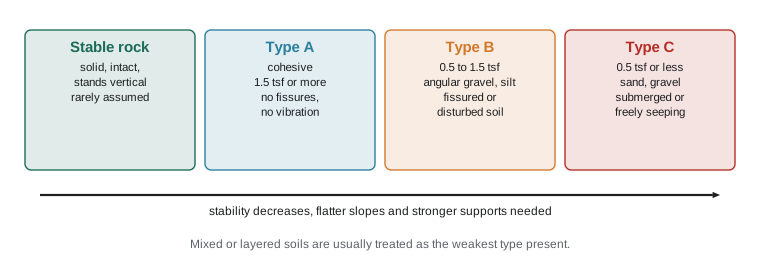
How the regulations classify soil
OSHA Appendix A to Subpart P classifies soil and rock into four categories, using both descriptions and the unconfined compressive strength, the load per unit area at which an unconfined sample fails in compression:
- Stable rock: natural solid mineral matter that can be excavated with vertical sides and remain intact while exposed. In practice rock is rarely stable without engineering assessment, because joints and fractures allow blocks to slide.
- Type A: cohesive soils with an unconfined compressive strength of 1.5 tons per square foot (tsf), about 144 kPa, or greater, such as clay, silty clay, sandy clay and clay loam. Soil cannot be Type A if it is fissured, subject to vibration from heavy traffic or pile driving, previously disturbed, part of a layered system sloping into the excavation at 4 horizontal to 1 vertical or steeper, or subject to other factors such as seeping water.
- Type B: cohesive soil with an unconfined compressive strength greater than 0.5 tsf (about 48 kPa) but less than 1.5 tsf; granular cohesionless soils such as angular gravel, silt, silt loam and sandy loam; previously disturbed soils not classified as Type C; soils that would be Type A but are fissured or subject to vibration; and dry rock that is not stable.
- Type C: cohesive soil with an unconfined compressive strength of 0.5 tsf or less; granular soils including gravel, sand and loamy sand; submerged soil or soil from which water is freely seeping; submerged rock that is not stable; and material in a sloped, layered system where the layers dip into the excavation at 4 horizontal to 1 vertical or steeper.
Classification must be based on at least one visual and at least one manual analysis, made by a competent person. In a layered system, each layer may be classified separately, but a weaker layer beneath a stronger one governs the system's stability; in practice most competent persons classify the whole excavation as the weakest type present. If conditions change, for example rain makes soil seep, the competent person must reclassify.
Visual tests
Visual assessment starts before digging and continues as the excavation deepens:
- Look at the spoil as it comes out. Does it come out in large clumps that hold together, suggesting cohesive soil, or does it run and crumble, suggesting granular soil?
- Look at the walls for layers, especially sloping layers and layers of sand or gravel between clays, which can act as slip planes or water paths.
- Look for cracks parallel to the excavation, fissures in the face and chunks of soil falling off.
- Look for water: seepage from the face, pooling on the floor, a sheen on the walls, a nearby water table or a recent storm.
- Look for signs of previous excavation: old trenches, backfill of different color or texture, buried utilities, foundations.
- Look at the surroundings: traffic, railways, pile driving or other sources of vibration, nearby buildings and their foundations, and surcharge loads.
Manual tests
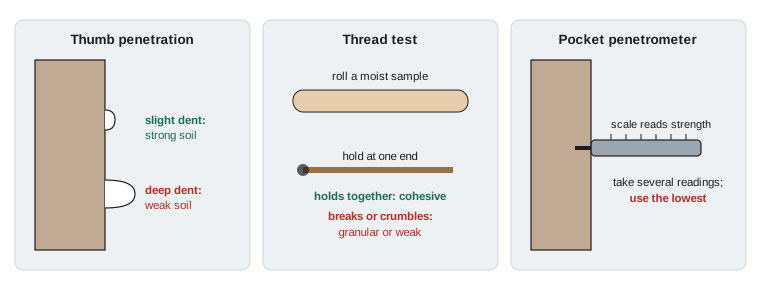
Manual tests give a more objective reading of soil strength and plasticity. They are done on a fresh sample taken from the excavation wall, not on dried spoil.
- Thumb penetration test: press a thumb firmly into a fresh face. Soil that can be indented by the thumb only with very great effort is consistent with the strongest cohesive class. Soil that the thumb penetrates several centimeters easily is weak.
- Plasticity or thread test: roll a moist sample between the palms into a thread about 1/8 in thick and 2 in long. If it can be held at one end without breaking, it is cohesive.
- Dry strength test: a dry clump that is very hard to crumble, or that breaks into clumps that cannot be crushed further by hand, is cohesive. A dry sample that crumbles easily into individual grains is granular.
- Pocket penetrometer: a small spring-loaded instrument pushed into the soil face to a marked depth. It reads unconfined compressive strength directly. Several readings should be taken at different points and depths, and the lowest values used.
- Torvane or shear vane: a small vane device pressed into the soil and rotated to measure shear strength, which can be converted to compressive strength.
- Wet shaking or drying tests: shaking a wet sample to see whether water rises to the surface, which indicates silt or fine sand, or drying a sample to see whether it cracks and how it breaks apart.
Worked problem
Classifying from penetrometer readings
A competent person takes five pocket penetrometer readings in the wall of an 8 ft trench in clay: 1.7, 1.6, 1.0, 1.5 and 1.6 tsf. The lowest reading came from a silty layer 6 ft below grade, which is damp and shows a few fine cracks. How should the soil be classified?
Show solution
- Use the lowest reading: 1.0 tsf, which is between 0.5 and 1.5 tsf.
- Cracks mean the soil is fissured, which by itself rules out Type A even where readings exceed 1.5 tsf.
- Both facts point to Type B for the silty layer and, by extension, for the excavation.
- If water begins to seep freely from the silty layer, it becomes Type C and the protective system must be upgraded.
Answer: Type B, governed by the lowest reading and the fissures; reclassify as Type C if water seeps freely.
Worked problem
Converting strength units
A penetrometer is scaled in kilograms per square centimeter (kg/cm²) and reads 1.4. Convert this to kilopascals and to tons per square foot.
Show solution
- 1 kg/cm² is about 98.1 kPa, so \( 1.4 \times 98.1 \approx 137 \) kPa.
- 1 tsf is about 95.8 kPa, so \( 137 / 95.8 \approx 1.43 \) tsf.
- Many pocket penetrometers are scaled so that 1 kg/cm² is treated as roughly equal to 1 tsf, which is close enough for field use.
- This sits just below the 1.5 tsf Type A threshold, so the soil cannot be Type A on strength alone.
Answer: About 137 kPa, or 1.4 tsf.
Factors that override the tests
A strong reading is not the end of the analysis. Several conditions automatically downgrade soil regardless of strength:
- Previous excavation. Backfill is never as strong as undisturbed soil, even if it has been in place for decades. Utility corridors are full of it.
- Fissures and cracks. They form planes along which blocks of soil slide.
- Vibration. Heavy traffic, railways, compaction equipment and pile driving break down soil structure.
- Water. Seepage, a high water table, a nearby watercourse or a leaking main weakens soil and can turn a granular soil into a flowing one.
- Layers dipping into the excavation. A sloping bed of sand or silt between clays can act as a slide plane, especially when wet.
- Surcharge. Spoil piles, buildings, roads and equipment near the edge add load.
| Observation | Effect on classification |
|---|---|
| Soil previously disturbed | Not Type A; Type B or C |
| Fissures, or vibration from traffic or pile driving | Not Type A; at best Type B |
| Water freely seeping, or soil submerged | Type C |
| Granular soil such as sand or gravel | Type C (angular gravel may be Type B) |
| Layers dipping into the excavation at 4H:1V or steeper | Type C |
| Cohesive, unfissured, 1.5 tsf or more, no downgrading factor | Type A |
When to call a geotechnical engineer
Field classification is adequate for most routine trenches, but some situations need a geotechnical engineer's assessment: deep excavations, excavations next to buildings or roads, high groundwater, organic soils and peat, sensitive clays such as the Leda clay found in the Ottawa and St. Lawrence valleys, permafrost, contaminated ground, or any time the competent person is unsure. A geotechnical report from the design stage, if one exists, should be on site and read before excavation starts. It may describe soil layers, groundwater levels and recommended slopes.
Classifying from the geotechnical report
Where a geotechnical report exists, it should be the starting point, not the final answer. Boreholes are typically a hundred feet or more apart and describe the soil only at those points; the trench will cross ground between them that may be quite different. Use the report to anticipate what the excavation should encounter, then confirm with visual and manual tests as the excavation proceeds, and treat any difference between what the report predicted and what the walls show as a reason to slow down and reassess.
Common mistakes
MistakeClassifying soil from the spoil pile after it has dried in the sun.
InsteadTest fresh samples taken from the excavation wall.
MistakeUsing the average of penetrometer readings.
InsteadUse the lowest readings, and the weakest layer, to classify the excavation.
MistakeTreating a vertical clay face that has stood all morning as proof of stable soil.
InsteadCohesive soil can fail suddenly as it dries, cracks or absorbs water; classify by tests and observations.
MistakeClassifying backfill in a utility corridor as strong native soil.
InsteadPreviously excavated soil is always downgraded.
MistakeKeeping the morning classification after an afternoon rainstorm.
InsteadReclassify whenever conditions change.
Summary and key terms
- Soil is a mix of gravel, sand, silt, clay, water and air; behavior depends on the mix.
- Cohesive soils can stand temporarily but fail suddenly; granular soils run and rely on friction.
- Water, freezing, thawing and drying all change soil strength.
- OSHA classifies soil as stable rock and Types A, B and C, using compressive strength thresholds of 1.5 and 0.5 tsf.
- Classification uses visual and manual tests on fresh samples from the walls.
- Previous excavation, fissures, vibration, water and dipping layers downgrade soil.
- Mixed soils are treated as the least stable type present.
- Cohesive soil
- Soil whose fine particles stick together, such as clay, allowing it to stand temporarily in a vertical face.
- Granular soil
- Soil made of sand or gravel with little or no cohesion, relying on friction between grains.
- Unconfined compressive strength
- The load per unit area at which an unconfined soil sample fails in compression.
- Angle of repose
- The steepest angle at which loose granular material remains stable.
- Fissured
- Containing cracks or planes of weakness along which soil can separate.
- Pocket penetrometer
- A hand instrument that estimates unconfined compressive strength.
- Water table
- The level below which the ground is saturated with water.
- Glacial till
- A dense, unsorted mix of clay, silt, sand, gravel and boulders deposited by glaciers.
- Sensitive clay
- Clay that loses most of its strength when disturbed, such as Leda clay.
Practice problems
Work each problem on paper first, then reveal the answer to check.
What is the difference between cohesive and granular soils?
Show answer
Cohesive soils hold together by particle attraction; granular soils rely on friction between grains.
What compressive strength range defines Type B cohesive soil?
Show answer
Greater than 0.5 tsf and less than 1.5 tsf.
How is a thread test performed?
Show answer
Roll a moist sample into a 1/8 in thread about 2 in long and see if it holds together when held at one end.
Which penetrometer reading should guide classification?
Show answer
The lowest reading from several locations and depths.
Name three factors that downgrade soil regardless of strength.
Show answer
Previous excavation, fissures, vibration, water seepage, dipping layers, surcharge.
How is a mixed soil classified?
Show answer
As the least stable type present.
Why can moist sand appear to stand vertically?
Show answer
Surface tension gives temporary apparent cohesion that disappears when it dries or saturates.
Convert 1.5 tsf to kilopascals.
Show answer
About 144 kPa.
When should a geotechnical engineer be consulted?
Show answer
For deep excavations, high groundwater, sensitive or organic soils, nearby structures, or uncertainty.
What should happen to the soil classification after heavy rain?
Show answer
The competent person reassesses and reclassifies if conditions have changed.
Lesson quiz · 5 questions
Score 60% or more to complete this lesson.
Create a free account to save your progress, take quizzes and earn a certificate.