
HSE-217 · Lesson 2 of 12 · 27 min
Law, responsibilities and the competent person
Excavation is one of the most heavily regulated activities on a construction site, because the hazards are well understood and the controls are well known. When a trench collapses, investigators rarely find a hazard nobody could have foreseen. They find a rule that was not followed. This lesson sets out who is responsible for what, the main legal requirements, and the role of the competent person who makes day-to-day decisions about the excavation.
This lesson summarizes the law for training purposes. Always work from the current regulation in your jurisdiction and your employer's procedures, and ask when the two seem to conflict.
The duty holders
Under the Occupational Safety and Health Act, each employer is responsible for protecting its own employees, and OSHA's multi-employer citation policy allows citations against the creating, exposing, correcting and controlling employers on a site. A general contractor that controls the site can be cited for a trench hazard even if a subcontractor dug the trench. Workers have the right to report hazards and to refuse work that poses an imminent danger of death or serious injury when there is no time to get the hazard corrected through normal channels.
Owners also matter. The owner of a buried facility, whether a gas utility, a telecommunications carrier, a municipality or a pipeline company, has duties under one-call and damage prevention laws to mark its facilities accurately and on time. The owner of the land or project often decides the budget and schedule that determine whether a crew can afford to do the job safely.
The Canadian framework
Canada's provinces each regulate excavations under their own construction or OHS regulations. Ontario's rules, in Part III of O. Reg. 213/91, require support for trench walls deeper than 1.2 m, a clear area 1 m wide at the edge and engineered support for trenches deeper than 6 m. Alberta's OHS Code, Part 32, uses a 1.5 m threshold and an 8 m limit on distance to an exit. Canadian provinces also run one-call centers similar to 811. Workers who move between the two countries need to retrain on the numbers, because almost none of them match.
The rest of this section summarizes the US framework in more detail.
- OSHA 29 CFR 1926.650 defines terms, including competent person, protective system and trench.
- 1926.651 sets general requirements: surface encumbrances, underground installations, access and egress, exposure to vehicles and falling loads, warning systems for mobile equipment, hazardous atmospheres, water accumulation, stability of adjacent structures, protection from loose rock and soil, inspections and fall protection.
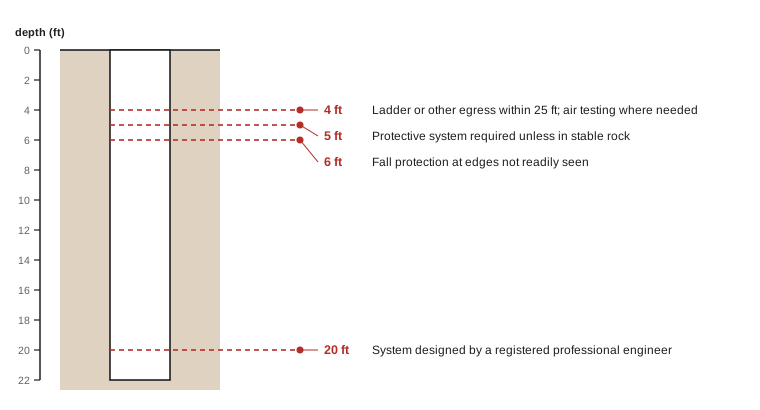
- 1926.652 requires a protective system for every excavation 5 ft or deeper unless it is made entirely in stable rock, and requires excavations 20 ft or deeper to have a protective system designed by a registered professional engineer.
- Appendix A sets out soil classification into stable rock and Types A, B and C.
- Appendix B gives maximum allowable slopes and benching configurations, Appendix C gives timber shoring tables, Appendix D gives aluminum hydraulic shoring tables, Appendix E illustrates alternatives such as trench shields, and Appendix F is a selection flow chart.
State-plan states such as California, Washington, Oregon and Michigan run their own programs, which must be at least as effective as federal OSHA and sometimes go further. California, for example, requires an annual permit from Cal/OSHA before employees enter trenches or excavations 5 ft or deeper.
Underground utility protection is mainly a matter of state law. Every state has a one-call or damage prevention statute requiring excavators to call 811 before digging, setting how long they must wait, how long marks remain valid and how close they may dig with power equipment. The federal Pipeline and Hazardous Materials Safety Administration (PHMSA) can enforce damage prevention requirements against excavators near interstate pipelines in states whose enforcement programs it finds inadequate, under 49 CFR Part 196.
The competent person
OSHA 1926.650 defines a competent person as one who is capable of identifying existing and predictable hazards in the surroundings, or working conditions which are unsanitary, hazardous or dangerous to employees, and who has authorization to take prompt corrective measures to eliminate them. Both halves matter: knowledge without authority is not enough, and a person with authority who cannot recognize soil types or protective system limits does not qualify. Subpart P gives the competent person specific tasks, including classifying soil, inspecting excavations daily and after rain, monitoring water removal, approving structural ramps and deciding when to test the atmosphere.
In practice the competent person for an excavation should be able to:
- Classify soil using visual and manual tests and recognize when conditions change.
- Select a protective system and know its limits, including manufacturer's tabulated data for shields and hydraulic shores.
- Recognize when an engineer is needed.
- Inspect the excavation, the protective system and the surrounding area, and document the inspection.
- Stop work and remove workers when conditions are unsafe, without needing someone else's permission.
Being the most senior person present, or the operator with the most years in the seat, does not make someone competent. The designation belongs to a person whose training and knowledge can be shown, and whose authority to stop work is real.
Worked problem
Which OSHA rules apply?
A contractor digs three trenches on one project: (a) 4 ft deep for an irrigation line, (b) 7 ft deep in Type B soil for a water service, and (c) 22 ft deep for a sanitary sewer. For each, identify the key protective system requirement.
Show solution
- (a) At 4 ft, a protective system is not mandatory under 1926.652(a)(1) unless the competent person sees any indication of a potential cave-in. A ladder or other means of egress is required because the trench is 4 ft deep.
- (b) At 7 ft in Type B soil, a protective system is required: sloping at 1H:1V, benching, timber or hydraulic shoring, or a trench shield used within its tabulated data.
- (c) At 22 ft, the protective system must be designed by a registered professional engineer, because Appendix B and the tabulated options stop at 20 ft.
- All three need 811 locates, spoil at least 2 ft from the edge and competent person inspections.
Answer: (a) egress but protection only if indicated; (b) any appropriate protective system; (c) engineer-designed system.
| Requirement | OSHA (1926 Subpart P) | Typical state one-call law |
|---|---|---|
| Protection threshold | 5 ft unless in stable rock | Not applicable |
| Engineered design | Deeper than 20 ft | Not applicable |
| Spoil setback | At least 2 ft from the edge, or retaining devices | Not applicable |
| Access and exit | Within 25 ft of lateral travel in trenches 4 ft or deeper | Not applicable |
| Locating utilities | Estimate locations and contact owners before opening (1926.651(b)) | Call 811 and wait the required period, often 2 to 3 working days |
| Hand digging near marks | Determine exact location by safe and acceptable means | Tolerance zone, often 18 to 24 in each side of marks |
Enforcement and consequences
OSHA can issue citations with penalties adjusted for inflation each year. In 2025, the maximum was more than $16,000 per serious violation and more than $165,000 per willful or repeat violation. Under the trenching National Emphasis Program, inspectors are expected to initiate inspections whenever they observe an open trench or excavation, whether or not a complaint was filed. A willful violation that causes a death can be referred for criminal prosecution, and several states have charged employers with manslaughter after trench deaths. Civil lawsuits, insurance costs, project delays and debarment from public contracts follow serious incidents as well.
Worked problem
Spotting the responsible parties
A subcontractor's laborer is injured when the wall of an 8 ft trench collapses. The trench was dug by the subcontractor on a site controlled by a general contractor. No protective system was installed. Which parties could be cited?
Show solution
- The subcontractor is the exposing and creating employer: it dug the trench and its employee was exposed.
- The general contractor is the controlling employer: it had authority over the site and could have required correction.
- Any employer whose employees entered the trench could be cited as an exposing employer.
- Supervisors and foremen are not cited personally by OSHA, but their decisions decide whether the employer complies.
Answer: The subcontractor and the general contractor could both be cited under the multi-employer policy.
The right to refuse
OSHA recognizes a worker's right to refuse work when there is a reasonable belief of imminent danger of death or serious harm, the worker has asked the employer to correct the hazard, there is no time to fix it through normal enforcement channels, and the refusal is made in good faith. Section 11(c) of the Act protects workers from retaliation for reporting hazards. An unprotected trench deeper than 5 ft is a textbook imminent danger, and OSHA inspectors treat it as one.
A culture that welcomes refusals and stop-work calls is worth more than any rule. Foremen who thank a laborer for refusing to enter an unshored trench, rather than sending someone else, create crews that speak up before people get hurt.
Documents that should be on site
OSHA inspectors and courts look for written evidence that an excavation was planned and controlled. Documents commonly expected at the excavation include the 811 ticket and utility responses, any private locate records, the soil classification and the basis for it, the tabulated data for any shield or hydraulic shoring in use, any registered professional engineer's design, inspection records, atmospheric test results where testing is needed, and training records for the competent person and crew. The standard specifically requires tabulated data and engineer designs to be kept at the jobsite while the system is in use. Keeping these in a single site binder or digital folder means the supervisor can answer an inspector's questions on the spot and the crew can check the limits of the equipment they are using.
Training records deserve particular attention. A competent person designation is only as good as the evidence behind it: course certificates, documented field experience, and a written appointment that states the person's authority to stop work. Crews should also have documented instruction on the specific protective system in use, because a worker who has never been shown how a hydraulic shore is installed or why the box must stay in contact with the work cannot be expected to use it correctly.
Common mistakes
MistakeNaming the most experienced operator as the competent person by default.
InsteadDesignate a person whose training and knowledge are documented and who has real authority to stop work.
MistakeAssuming the subcontractor alone is responsible for its trench.
InsteadControlling employers such as general contractors can also be cited.
MistakeApplying rules from another province or country by memory.
InsteadDepth thresholds and setbacks differ; check the regulation where the work is done.
MistakeTreating a trench below the protection threshold as exempt from all rules.
InsteadLocates, assessment, access and water control still apply, and protection is needed if the ground is unstable.
MistakeSending another worker into the trench after one refuses.
InsteadInvestigate and correct the hazard; the refusal process exists to fix the problem, not move it.
Summary and key terms
- Employers protect their own workers, and controlling employers share responsibility on multi-employer sites.
- OSHA 1926 Subpart P requires protection at 5 ft and engineer design beyond 20 ft.
- State one-call laws govern locating and digging near utilities.
- A competent person needs both knowledge of the hazards and authority to correct them.
- Rules differ between jurisdictions; always check the one that applies.
- Penalties, criminal charges and civil liability follow serious trench incidents.
- Workers may refuse unsafe excavation work without reprisal.
- Competent person
- A person able to identify existing and predictable hazards who is authorized to take prompt corrective measures.
- Controlling party
- A controlling employer, one with general supervisory authority over a worksite, including the power to correct hazards.
- Protective system
- A method of protecting workers from cave-ins, such as sloping, benching, shoring or shielding.
- Support system
- Shoring, sheathing or a prefabricated system that holds the walls of an excavation in place.
- Tabulated data
- Manufacturer or engineer tables that state the depth and soil limits for a protective system.
- Professional engineer
- A licensed engineer who may design protective systems and give opinions on excavation stability.
- Right to refuse
- The legal right of a worker to refuse work believed to be dangerous, without reprisal.
- National Emphasis Program
- An OSHA program that targets inspections at a particular hazard, such as trenching.
- Due diligence
- Taking every reasonable precaution in the circumstances to prevent harm.
Practice problems
Work each problem on paper first, then reveal the answer to check.
At what depth does OSHA require a protective system?
Show answer
5 ft, unless the excavation is entirely in stable rock.
When must an OSHA protective system be engineer-designed?
Show answer
When the excavation is deeper than 20 ft, or the chosen system is not covered by the appendices or tabulated data.
What two qualities does a competent person need?
Show answer
Knowledge to recognize hazards and authority to correct them.
Which OSHA section sets the general requirements for excavations?
Show answer
1926.651.
What is the maximum lateral travel distance to a ladder in a trench 4 ft or deeper?
Show answer
25 ft.
Name three parties with duties on a construction excavation.
Show answer
Creating, exposing, correcting and controlling employers, plus workers.
Why might a general contractor be liable for a subcontractor's trench?
Show answer
It controls the site and has a duty to ensure compliance.
What can happen after a willful violation causes a death?
Show answer
Referral for federal criminal prosecution, and possibly state charges.
Is a trench below the depth threshold exempt from locates?
Show answer
No; buried facilities must be located for any ground disturbance.
What should happen when a worker refuses to enter an unprotected trench?
Show answer
The supervisor investigates and corrects the hazard; nobody else is sent in.
Lesson quiz · 5 questions
Score 60% or more to complete this lesson.
Create a free account to save your progress, take quizzes and earn a certificate.