
HSE-217 · Lesson 3 of 12 · 27 min
Buried utilities, 811 and locates
Almost every piece of ground in a town or city, and much of the ground in rural and industrial areas, carries buried utilities: natural gas mains and services, electrical cables, oil and gas pipelines, water mains, sanitary and storm sewers, telephone, cable and fiber optic lines, traffic signal cables, street lighting and steam lines. Striking one can kill, as with a gas line that ignites or a high-voltage cable that arcs through an excavator bucket, or can cause enormous cost and disruption. This lesson covers how buried utilities are found and marked before digging. Lesson 4 covers how to dig safely once the marks are on the ground.
The one-call system
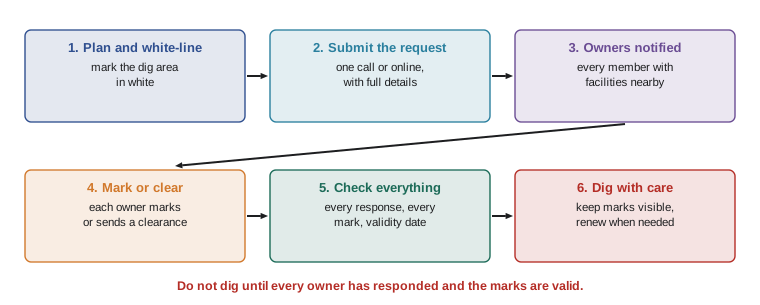
The national 811 number connects excavators to the one-call center for their state. The excavator submits one request, often called a ticket, by phone or online, and the center sends it to every member utility whose facilities may be affected. Each utility then either marks its lines on the ground or responds that it has nothing in the area. Every state requires a call to 811 before digging, with exemptions that vary from state to state for things like hand gardening. The Common Ground Alliance publishes the Best Practices guide that most damage prevention programs follow.
Each state's damage prevention law sets its own rules, so excavators who work across state lines must check each one. Common features include a waiting period of two or three full working days after the request before digging may begin, a ticket life after which the request must be renewed, a requirement to keep marks visible and to request remarks when they are lost, a tolerance zone within which power equipment may not be used without first exposing the utility, and penalties for digging without a valid ticket. Some states require the excavator to outline the proposed dig area in white paint or flags before calling.
What a locate request needs
A good locate request is specific. The person requesting it should give:
- The exact address or legal description, the nearest intersection and, for rural work, GPS coordinates or a land location.
- A clear description of the work area: which side of the road, how far from the building, the length and width of the trench.
- The type of work, such as a water service, fence posts, a sewer replacement or directional drilling.
- The method of excavation, the expected depth and the start date.
- Contact details for someone on site who can answer the locator's questions.
White lining, marking the proposed excavation area on the ground with white paint, flags or stakes, removes most of the guesswork. It tells the locator exactly where the digging will be, so the marks cover the right area and the locator does not waste time marking the whole property.
Worked problem
Planning around the locate timeline
A contractor in a state with a two-full-working-day waiting period plans to dig on Monday morning. The request must be made by the excavator, and weekends and holidays do not count. What is the latest the request can be made?
Show solution
- Two full working days must pass between the request and the start of digging.
- If the request is made on Wednesday, Thursday and Friday are the two full working days, so digging may begin on Monday.
- A request made on Thursday gives only Friday as a full working day before the weekend; Monday would be the second full day, so digging could not start until Tuesday.
- The latest request is therefore Wednesday, provided every utility responds by Friday.
Answer: Wednesday at the latest; do not dig until every utility has responded, even if the waiting period has passed.
How locators find buried facilities
A locator is a trained technician who works for the facility owner or a contract locating company. Locators combine records with detection equipment:
- Records: maps and as-built drawings show where a facility was intended to be installed, but are often inaccurate by several feet, especially for older installations.
- Electromagnetic locating: a transmitter puts a signal on a conductive line, either by direct connection or by induction, and a receiver traces the signal along the ground. It works well on metallic pipes and cables, and on plastic pipes only when a tracer wire was installed with them.
- Passive locating: a receiver picks up signals already present on some lines, such as power cables carrying current.
- Ground-penetrating radar: radar pulses reflect off buried objects. It can find non-metallic pipes but struggles in wet clay and gives results that require skilled interpretation.
- Acoustic and other methods: used for specific problems such as plastic water mains.
No method is perfect. Signals can bleed onto adjacent lines, tracer wires break, records are wrong, and depth readings are estimates at best. That is why the marks show the approximate location of a facility and why lesson 4 insists on careful exposure within the tolerance zone.
The marking codes
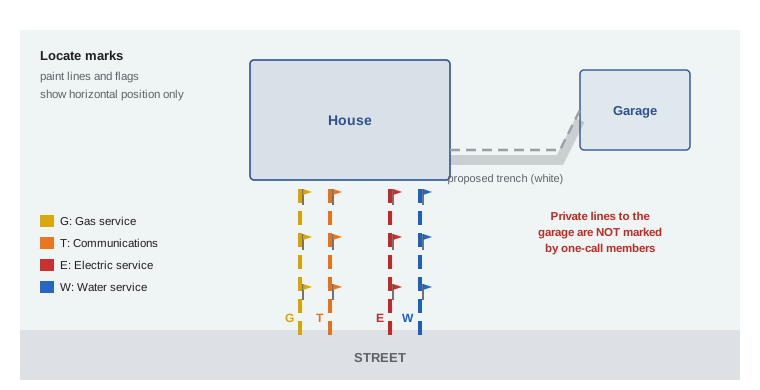
Locators use a standard set of colors so that anyone on site can read the marks. The American Public Works Association codes, adopted in the CGA Best Practices and ANSI Z535.1, are used nationwide. The color identifies the type of utility, and symbols or letters next to the marks can show the owner, the size, the number of ducts and the direction of the line.
| Color | Facility type |
|---|---|
| Red | Electric power lines, cables, conduit and lighting cables |
| Yellow | Gas, oil, steam, petroleum or other gaseous or flammable material |
| Orange | Communications, alarm or signal lines, cables or conduit, including fiber |
| Blue | Potable water |
| Purple | Reclaimed water, irrigation and slurry lines |
| Green | Sewers and drain lines |
| Pink | Temporary survey markings |
| White | Proposed excavation limits or route |
Reading the locate package
The locate is not just paint on the ground. Each owner provides a locate sheet or electronic response describing what was marked, the area covered, any facilities that could not be marked and the expiry date. The excavator must collect a response from every owner on the notification list and check that:
- The locate covers the whole work area, including spoil and equipment areas if those will be disturbed.
- Every listed owner has marked or cleared. A missing response means the excavator cannot dig.
- The marks on the ground match the sheets. If a sheet shows a gas service and there is no yellow paint, stop and call.
- The locates are still valid and the marks still visible. Rain, traffic, snow clearing and earlier digging erase paint and flags.
- Any notes, such as a requirement for the owner to be present when its line is exposed, are understood by the crew.
Private facilities
One-call members mark the facilities they own. They do not usually mark private facilities, which can include a homeowner's buried electrical cable to a garage, site lighting in a parking lot, irrigation lines, private water and sewer services, gas lines beyond the meter, and the extensive buried networks inside industrial plants, campuses, hospitals and airports. On many sites these private lines outnumber the public ones.
Private facilities must be located by a private locating company hired by the property owner or contractor, or by the facility owner's own records and staff. A one-call clearance that says no conflicts does not mean nothing is buried there. It means none of the member owners has anything there.
Worked problem
Checking a locate package before digging
A crew arrives to dig an 80 ft trench for a new electrical service to a detached garage. The ticket shows responses from gas (marked), the power utility (marked to the meter), telephone (clear) and cable (marked). The garage feed will run from the house panel. What is missing?
Show solution
- The public owners have all responded, so the one-call portion is complete.
- The existing private lines on the property, such as an old feed to the garage, a sprinkler system, a private gas line to a barbecue or a buried pool cable, are not covered.
- A private locate is needed for the route between the house and the garage.
- The crew should also confirm the marks are still visible and the locates have not expired.
Answer: A private locate. The one-call members only marked their own facilities up to the meter or property line.
Abandoned, unknown and unlocatable facilities
Old facilities that are no longer in service are often left in the ground. Some are truly dead; others are still live under a different owner, or have been reconnected. Unless the owner has confirmed in writing that a line is abandoned and safe, treat every uncovered pipe or cable as live. If an excavation uncovers a facility that was not marked, stop work near it, protect it, and contact the one-call center and the likely owners before continuing.
Some facilities cannot be located by electronic means, such as plastic pipes without tracer wire. The owner may mark them from records with a note that the location is approximate, or may require that the excavator expose them by hand or vacuum excavation before mechanical digging. Treat these as higher risk.
Keeping marks alive on a long job
Locate marks are fragile. Paint fades under traffic and sun, flags are pulled up by curious passers-by and lawn mowers, and the excavation itself removes the ground the marks were painted on. On a job that lasts more than a few days, the crew should protect the marks from the start. Useful practices include offsetting marks, where stakes are set a measured distance to one side of each line so its position can be re-established after the original paint is dug away; photographing the marks with a tape measure in the frame before digging begins; recording the positions on the site drawing; and requesting a re-mark as soon as marks become unclear rather than relying on memory.
When the ticket is close to expiry, or the work moves outside the area originally described, a new ticket is needed. Most state laws require marks to be maintained or a remark requested when they are no longer visible. A crew that keeps digging after the marks have vanished has, in effect, no locate at all.
Directional drilling and boring add a special challenge, because the drill head travels underground where nobody can see it cross other facilities. Every crossing along a bore path should be exposed by vacuum excavation so the crew can watch the drill head pass, and the bore path should be planned with clearances agreed with the facility owners.
Common mistakes
MistakeDigging as soon as the waiting period has passed, even though one owner has not responded.
InsteadDo not dig until every listed owner has marked or cleared the area.
MistakeTreating a one-call clearance as proof that nothing is buried.
InsteadPrivate facilities are not marked by one-call members; arrange a private locate.
MistakeUsing one locate for a different part of the site or a later job.
InsteadA locate covers only the described area and remains valid only for the stated period.
MistakeAssuming the marks show depth.
InsteadMarks show approximate horizontal location only; depth must be found by careful exposure.
MistakeContinuing to dig after marks have faded or been destroyed.
InsteadRequest a re-mark or a new locate before digging further.
Summary and key terms
- Every state requires a call to 811 before digging.
- Waiting periods, ticket lives and tolerance zones vary from state to state.
- Accurate requests and white lining help locators mark the right area.
- Locators use records, electromagnetic tracing and radar, none of which is perfect.
- Standard marking codes identify the type of facility.
- Check every response and every mark before digging.
- Private facilities need a private locate; unknown facilities must be treated as live.
- One-call center
- The service that notifies all member facility owners of a planned excavation.
- Locate
- The marking of buried facilities on the ground, together with the owner's written response.
- Clearance
- A response from an owner saying it has no facilities in the requested area.
- White lining
- Marking the proposed excavation area in white so locators know where digging will occur.
- Tracer wire
- A conductive wire installed with a non-metallic pipe so it can be located electronically.
- Ground-penetrating radar
- A detection method using radar pulses to find buried objects.
- Private facility
- A buried line owned by the property owner or a non-member, not marked by the one-call system.
- Locate validity
- The period during which a locate may be relied upon before it must be renewed.
- As-built drawing
- A drawing showing where a facility was actually installed, which may still be inaccurate.
Practice problems
Work each problem on paper first, then reveal the answer to check.
What does a yellow mark indicate?
Show answer
Gas, oil, steam or other flammable products.
What does an orange mark indicate?
Show answer
Communications lines, including fiber.
What is white lining?
Show answer
Marking the proposed excavation area in white paint or flags.
What is a ticket life?
Show answer
The period during which a locate request remains valid before it must be renewed.
Why can a one-call clearance be misleading?
Show answer
It does not cover private facilities.
Why is electromagnetic locating unreliable on some plastic pipes?
Show answer
Plastic does not carry a signal unless a tracer wire was installed and is intact.
What should you do if an unmarked pipe is uncovered?
Show answer
Stop, protect it, treat it as live and contact the one-call center and likely owners.
Do locate marks show the depth of a facility?
Show answer
No; they show approximate horizontal location only.
Name three pieces of information a locate request should include.
Show answer
Exact location, work description, method, depth, start date and site contact.
What should happen if a locate sheet lists a facility that has no marks on the ground?
Show answer
Stop and contact the owner before digging.
Lesson quiz · 5 questions
Score 60% or more to complete this lesson.
Create a free account to save your progress, take quizzes and earn a certificate.