
HSE-217 · Lesson 10 of 12 · 29 min
Inspections and changing conditions
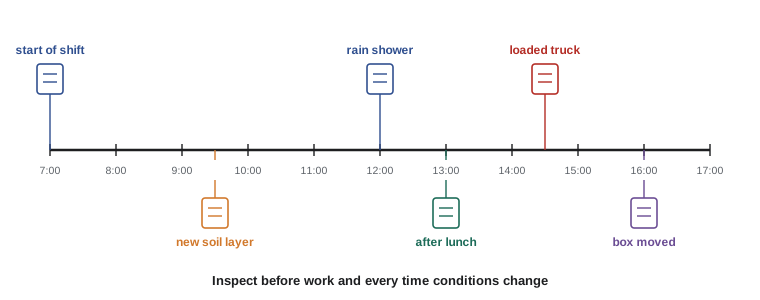
An excavation is not a fixed structure. It changes from hour to hour as it deepens, as the weather changes, as soil dries or soaks, as equipment moves around it and as the crew installs and removes protection. A protective system chosen correctly at seven in the morning can be inadequate by noon. Inspection is how the competent person keeps the protection matched to the conditions. This lesson covers when to inspect, what to look for, how to record it, and what to do when conditions change.
The duty to inspect
OSHA 1926.651(k) requires daily inspections of excavations, the adjacent areas and protective systems by a competent person for evidence of a situation that could result in possible cave-ins, indications of failure of protective systems, hazardous atmospheres or other hazardous conditions. An inspection must be conducted before the start of work and as needed throughout the shift, and after every rainstorm or other hazard-increasing occurrence. Inspections are only required when employee exposure can reasonably be anticipated. Where the competent person finds evidence of a hazardous situation, exposed employees must be removed from the hazardous area until the necessary precautions have been taken.
When to inspect
Inspection is triggered by time and by events:
- Before work starts each shift, including after the excavation has been left overnight, over a weekend or during a shutdown.
- After rain, snowmelt or any other event that adds water, including a broken water line or a pump failure.
- After freezing and thawing. Frozen walls can look solid but lose their strength as they thaw, and the soil behind the frost may be saturated.
- After vibration from blasting, pile driving, heavy traffic or a compactor working nearby.
- When the excavation is deepened, widened or extended, or when a new soil layer is reached.
- When loads near the edge change: a new spoil pile, a delivery of pipe, a crane setting up.
- When any part of the protective system is moved, adjusted, damaged or removed.
- After any incident, near miss or minor collapse, including sloughing of soil from a wall.
- Whenever a worker raises a concern.
What to look for
A thorough inspection covers the excavation, the protective system, the surroundings and the work practices. A practical checklist includes:
Soil and walls:
- Has the soil classification changed? New layers, seepage, softening, drying cracks or previously disturbed soil.
- Tension cracks at the surface parallel to the edge.
- Sloughing, spalling or bulging of the walls, and soil at the base of the walls that was not there before.
- Slopes that have slumped, eroded or been undercut.
- Heave or boiling of the floor.
Water:
- Water seeping, pooling or rising; pumps running and keeping up; discharge clear rather than carrying fines.
- Surface water diverted away from the excavation.
Protective system:
- Shoring in place at the required spacing, struts tight, hydraulic pressure maintained, no cracked or bowed members.
- Trench boxes undamaged, pins and spreaders in place, used within their tabulated data, gaps controlled.
- Workers inside the protected area; no unprotected sections where people are working.
Edges and surroundings:
- Spoil and materials at least 2 ft back from the edge; no equipment at the edge.
- Adjacent structures, pavement and utility poles showing no new cracks or settlement.
- Barriers, covers and fencing in place.
Access, air and buried facilities:
- Ladders in place, secured, extending above the edge and within the required distance of every worker.
- Atmospheric testing done where required, with readings recorded.
- Exposed facilities supported and protected; locate marks still visible and valid.
Worked problem
Is that crack a warning?
At the start of a shift, the competent person finds a crack in the ground parallel to an 8 ft deep trench in Type A soil, 5 ft back from the edge. The lower wall is vertical for 3 1/2 ft and sloped above. What does this mean, and what should happen?
Show solution
- The crack is \( 5 / 8 \approx 0.6 \) of the depth from the edge, within the zone where a failure wedge typically forms.
- A tension crack shows that the soil is fissured and moving. Fissured soil cannot be Type A.
- Exposed employees must be removed from the hazardous area under 1926.651(k)(2).
- Options: reclassify as Type B and re-slope at 1:1 with no vertical lower portion, install shoring or a shield, or have an engineer assess it.
Answer: The wall is moving; get people out, downgrade the soil and add protection before re-entry.
After rain
Rain is the single most common trigger for collapse after an excavation has stood safely for days. Water adds weight, lubricates fissures, softens clay and erodes slopes. Collapses often happen not during the storm, when nobody is in the trench, but the next morning when the crew returns to walls that have been soaking all night.
A practical routine after rain includes: keep everyone out until the competent person has inspected; pump out standing water from the surface without entering; look for new cracks, slumping and soil at the toe of walls; check that slopes still have their designed angle; check shoring pressure and box positions; reclassify the soil if seepage has started; and only then allow entry, with closer monitoring through the day.
Worked problem
Re-entry after an overnight storm
A sloped trench in clay was left open overnight. An inch of rain fell. In the morning there is 8 in of water in the bottom, a small slump on one slope and water seeping from a sand layer halfway down the wall. The foreman wants to pump out the water and get the pipe crew back in by 8:00. What should the competent person decide?
Show solution
- Standing water and seepage from a sand layer mean the soil must be reclassified to a weaker type.
- Freely seeping water makes the soil Type C, which needs a 1 1/2:1 slope or a support or shield system rated for Type C.
- The slumped slope no longer has its designed angle and must be re-cut or supported.
- Water should be pumped from the surface; nobody enters until the walls are re-sloped or protection is installed and the competent person has re-inspected.
Answer: No entry at 8:00. Reclassify, re-slope or install protection for the weaker soil, then inspect again before anyone enters.
Winter and frost
In the northern states, excavation in frozen ground is common for part of the year. Frost gives soil temporary strength and can make walls appear to stand vertically, but that strength disappears as the frost thaws, whether from daytime sun, a warm spell or heaters used for curing. Frost can also mask fissures and weak layers. Frozen chunks can fall from the top of walls as the ground thaws, and thawing ground behind the frost line may be saturated. Excavations dug in winter should be classified as if the soil were thawed, and inspected closely during thaws and in spring.
Recording inspections
A written record shows what was checked, what was found and what was done about it. It also provides evidence of due diligence. A useful record includes the date, time, location and depth of the excavation, the soil classification and its basis, the protective system in use, weather and water conditions, atmospheric readings, defects found and corrective actions, and the name and signature of the competent person. Photographs at each inspection help show conditions over time. Many employers use digital forms that time-stamp entries and attach photos.
Recording is not the goal, however. An inspection that ticks every box on a form but misses the crack behind the crest has failed. The form is a prompt to look carefully, not a substitute for looking.
| Trigger | What to check first | Typical response |
|---|---|---|
| Start of shift | Walls, water, protective system, edges, ladders, air | Correct defects before entry; record |
| Heavy rain or thaw | Standing water, seepage, slumping, cracks, slope angle | No entry until reinspected; reclassify if needed |
| New soil layer reached | Layer type, seepage, dip of layers | Reclassify; adjust protective system |
| Heavy load near edge | Distance from edge, cracks, system rating | Move load or upgrade protection |
| Box or shores moved | Position, pins, spreaders, pressure, gaps | Confirm within tabulated data before entry |
| Minor sloughing | Source, size, whether more is loose | Treat as a warning; reassess protection |
Stopping the work
The competent person's authority to stop work is what makes inspection meaningful; OSHA's definition requires that authority. When an inspection finds a hazard, workers come out first and the discussion happens afterwards. Production pressure is a constant on excavation jobs, and a competent person who needs permission from a project manager before clearing a trench is not exercising the authority the role requires. Employers should make it clear, in writing and in practice, that stop-work decisions will be supported.
Worked problem
Planning inspections for a two-shift job
A sewer contractor runs two 10-hour shifts with a 4-hour gap overnight. The trench is in clay with a sand seam, and showers are forecast. How should inspections be organized?
Show solution
- Each shift needs its own competent person, or one person who is present at the start of both shifts.
- Inspect before each shift starts, because conditions can change during the overnight gap.
- Inspect again after every shower and whenever the excavation reaches the sand seam or a new depth.
- Hand over between shifts with the inspection record, current soil classification, any concerns and the status of pumps and protective systems.
Answer: At least two scheduled inspections a day, one before each shift, plus event-driven inspections after rain and changes, with a written handover.
Inspecting adjacent ground and structures
Inspections should extend beyond the excavation itself. Walk the surface for a distance at least equal to the depth of the excavation on each side, looking for cracks in pavement and sidewalks, settlement of curbs, tilting of fences, poles and signs, and cracks or doors sticking in nearby buildings. These are signs that the ground around the excavation is moving, even if the walls themselves look unchanged. Where an excavation passes close to a building or a sensitive structure, simple monitoring points, such as painted marks or survey targets whose levels are checked each day, give early warning of movement. Any new crack or settlement should be reported to the supervisor and, where structures are involved, to the engineer, before work continues.
Pumps, generators and other equipment supporting the excavation are part of the inspection too. A pump that has stopped overnight, a generator that is out of fuel or a detector that failed its bump test can turn a safe trench into a dangerous one without any change to the soil.
Common mistakes
MistakeRelying on yesterday's inspection when the trench was left open overnight.
InsteadInspect before each shift, every time.
MistakeLetting the crew pump out water from inside the trench after a storm.
InsteadPump from the surface and keep everyone out until the competent person inspects.
MistakeTreating frozen walls as stable soil.
InsteadClassify as if thawed and inspect closely during thaws.
MistakeFilling in the inspection form without walking the excavation.
InsteadLook at the walls, edges, water and system in person every time.
MistakeAsking a project manager for permission before removing workers from a hazard.
InsteadRemove workers immediately; discuss afterwards.
Summary and key terms
- OSHA requires daily inspections before work, as needed during the shift, and after rain or other hazard-increasing events.
- Check soil, water, the protective system, edges, access, air and buried facilities.
- Tension cracks, sloughing, bulging and seepage mean the soil must be reassessed.
- Rain is the most common trigger for collapses in trenches that had stood for days.
- Frozen soil gains temporary strength that vanishes on thawing.
- Record inspections, but treat the form as a prompt, not a substitute.
- The competent person must be able to stop work without seeking permission.
- Daily inspection
- An inspection of the excavation, surroundings and protective system before work each day.
- Hazard-increasing occurrence
- An event such as rain, vibration or a new load that could reduce excavation stability.
- Sloughing
- Soil peeling or falling from the face of a wall.
- Spalling
- Pieces breaking off a rock or hard soil face.
- Slump
- A section of slope that has slid down and lost its shape.
- Frost line
- The depth to which the ground freezes.
- Handover
- The transfer of information on conditions and hazards from one shift or person to another.
- Corrective action
- The step taken to remove or control a hazard found during inspection.
- Stop-work authority
- The power to halt work immediately when a hazard is found.
Practice problems
Work each problem on paper first, then reveal the answer to check.
Name five events that should trigger an inspection.
Show answer
Rain, thaw, vibration, deepening, new loads, system changes, incidents, worker concerns.
What should happen when a tension crack is found?
Show answer
Remove workers, reassess the soil and add protection before re-entry.
Why are collapses common the morning after rain?
Show answer
Walls have soaked overnight and lost strength.
How should standing water be removed after a storm?
Show answer
By pumping from the surface without entering the trench.
Why should frozen soil be classified as if thawed?
Show answer
Frost strength disappears on thawing and can mask weaknesses.
List four items on a trench inspection record.
Show answer
Date and time, location and depth, soil type, protective system, conditions, readings, defects and actions, name.
What should be checked on a hydraulic shoring system during inspection?
Show answer
Spacing, pressure, tightness and any damaged members.
What is the purpose of a shift handover?
Show answer
To pass on conditions, classification, concerns and equipment status.
Under OSHA, what must happen when a hazardous condition is found?
Show answer
Exposed employees must be removed until precautions are taken.
Why is the form not enough on its own?
Show answer
Ticking boxes without looking can miss real hazards.
Lesson quiz · 5 questions
Score 60% or more to complete this lesson.
Create a free account to save your progress, take quizzes and earn a certificate.