
HSE-217 · Lesson 1 of 12 · 27 min
Why excavations kill
This course is for laborers, pipelayers, equipment operators, utility and landscaping crews, foremen, site supervisors and the engineers and safety staff who plan work below grade. It covers both halves of excavation safety: avoiding the buried utilities that run under almost every site, and protecting the people who work inside the hole. It assumes the general hazard recognition covered in HSE-103. It does not designate anyone as an OSHA competent person, and it does not replace the training, site orientation and supervision your employer and the utility owners require.
Excavation looks like ordinary, low-technology work. A machine digs a hole, a crew lays pipe, the hole is backfilled. That familiarity is exactly why it remains one of the deadliest activities in construction. Most trench deaths happen in shallow, short-duration trenches dug by experienced crews who had dug hundreds of similar trenches without incident. The soil held every time before, so nobody expected it to fail this time.
The scale of the problem
OSHA and the construction research center CPWR reported 39 trenching and excavation deaths in 2022, up from 15 in 2021 and the worst year in almost two decades. That spike led OSHA to step up enforcement under its National Emphasis Program on trenching and excavation, with inspectors directed to stop and inspect any open trench they see. Construction workers accounted for about 85 percent of trench fatalities over the previous decade. Strikes on buried utilities add a second category of harm: damaged gas lines that ignite, cut electrical cables, flooded basements and communities left without phone or internet service. The Common Ground Alliance's annual damage reports have recorded roughly 200,000 reported utility damages a year in recent years.
The numbers matter less than the pattern behind them. Investigations of trench deaths show the same factors again and again: no protective system at all, a trench box that was on site but not in the trench, a worker who stepped outside the protected area for a moment, spoil piled at the edge, a trench left open overnight in rain, or a would-be rescuer who jumped in after a buried co-worker and became a second victim.
Why soil fails
Undisturbed soil stands up because of its internal strength. That strength comes from two sources: cohesion, the attraction between fine clay particles, and friction between grains, which depends on how tightly the grains are packed and how much load presses them together. When you dig a trench you remove the soil that was supporting the walls sideways. The soil in the walls is suddenly unconfined on one side. It begins to relieve that stress by moving toward the opening, slowly at first and then, if nothing stops it, all at once.
Several things make the walls weaker over time:
- Water. Rain, groundwater seepage or a leaking water main add weight to the soil and reduce the friction between grains. Saturated sand behaves almost like a liquid.
- Drying. Clay that looked strong when freshly cut can shrink and crack as it dries in the sun, opening fissures that become failure planes.
- Vibration. Traffic, compactors, pile driving and the excavator itself shake the soil and break down its structure.
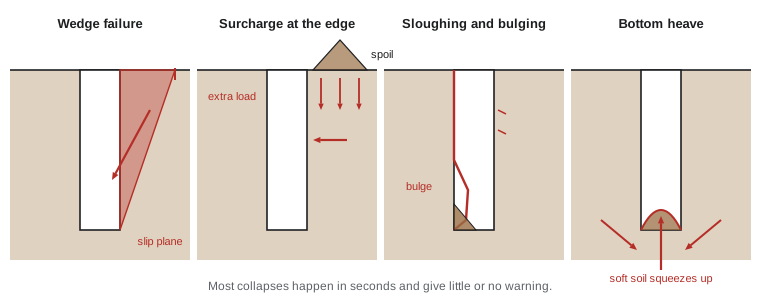
- Surcharge loads. Spoil piles, stacked pipe, parked equipment and nearby building foundations push down on the soil near the edge and add sideways pressure on the wall.
- Previously disturbed ground. Backfill from earlier utility trenches has much less strength than native soil, and old trenches often cross new ones.
- Time. A wall that stands for an hour may not stand overnight. Many collapses happen when a crew returns to a trench that had been fine the day before.
How a collapse injures and kills
The most common failure is a wedge of soil breaking away along a diagonal plane and sliding into the trench. It happens in seconds. A worker standing in the trench has no time to climb out; the soil arrives faster than anyone can react. Other failures include sloughing, where the face of the wall peels away in slabs, and bottom heave, where soft soil squeezes up from the floor of the trench under the weight of the surrounding ground.
Soil is heavy. A cubic yard of typical soil weighs about 2,500 to 3,400 lb, roughly the weight of a small car. A worker buried to the chest cannot expand their lungs against that weight, so suffocation can occur even when the head stays clear. Victims also suffer crushing injuries, and the release of pressure during rescue can cause a dangerous drop in blood pressure and kidney damage from crush syndrome. Even a partial burial to the waist pins a worker so firmly that co-workers cannot pull them free.
Worked problem
Weight of a modest collapse
A 6 ft deep trench is 3 ft wide. A wedge of soil 10 ft long breaks off one wall with a triangular cross-section 6 ft high and 3 ft wide at the top. The soil weighs 110 lb/ft³. Estimate the weight of soil that falls into the trench.
Show solution
- Cross-sectional area of the wedge: \( A = \tfrac{1}{2} \times 6 \times 3 = 9 \) ft².
- Volume: \( V = 9 \times 10 = 90 \) ft³, about 3.3 cubic yards.
- Weight: \( W = 90 \times 110 = 9{,}900 \) lb.
- That is close to five tons, landing in a space 3 ft wide where a worker is standing.
Answer: About 9,900 lb, or nearly 5 tons. Even a small wedge from a shallow trench is enough to bury and crush a worker.
Shallow trenches are not safe trenches
OSHA's 5 ft threshold marks the point at which a protective system becomes mandatory unless the excavation is entirely in stable rock. It does not mean that shallower trenches cannot kill. A worker kneeling or bending in a 4 ft trench to make a pipe connection has their head and chest below grade. A collapse at that moment can bury them completely. The standard requires a competent person to examine trenches less than 5 ft deep too, and to require protection whenever there is any indication of a potential cave-in.
Worked problem
Head height in a shallow trench
A pipelayer kneels on the floor of a 4 ft deep trench to join a pipe. With a kneeling head height of about 4 ft above the trench floor, how much of the worker's body is below grade?
Show solution
- The trench floor is 4 ft below grade.
- The kneeling worker's head is about 4 ft above the floor, level with grade.
- The chest, about 16 in below the top of the head, is roughly 16 in below grade.
- Soil from either wall would bury the chest and the face.
Answer: Nearly all of the worker's body, including the chest. The depth threshold is a legal trigger, not a safety guarantee.
Signs of movement, and why you cannot rely on them
Experienced workers sometimes say they can tell when a trench is about to go. Certain signs do suggest trouble:
- Tension cracks parallel to the trench edge, often at a distance from the edge of about half to three-quarters of the trench depth.
- Soil trickling, crumbling or sloughing from the face.
- Bulging of the lower part of the wall.
- Water seeping from the face or pooling on the floor.
- Cracks or settlement in nearby pavement, foundations or sidewalks.
- Bowing or creaking shoring members.
The problem is that many collapses give no warning at all, or give a warning only seconds before the soil moves. These signs are a reason to get out immediately and reassess; their absence is never a reason to stay in an unprotected trench.
The two hazards of ground disturbance
Every excavation carries two distinct families of hazard, and this course treats both:
| Hazard family | What goes wrong | Main controls | Lessons |
|---|---|---|---|
| Buried facilities | Striking gas lines, electrical cables, pipelines, water mains, sewers, fiber and communications lines | Locate requests, accurate marking, hand exposure or vacuum excavation in the tolerance zone, safe work near pipelines | 3 and 4 |
| The excavation itself | Cave-ins, falling loads, falls into the hole, water accumulation, hazardous atmospheres, mobile equipment near the edge | Soil classification, sloping, benching, shoring or shielding, safe access, spoil control, testing, inspection | 5 to 10 |
| Both | Delayed or improvised rescue, poor planning, production pressure | Planning, competent supervision, emergency plans, a stop-work culture | 2, 11 and 12 |
In the United States the same two hazards are usually divided between state one-call laws, which govern locating and protecting underground utilities, and OSHA's excavation standard, 29 CFR 1926 Subpart P, which governs the safety of workers in and around the excavation. Pipeline operators add their own requirements, and some states regulate excavation near high-pressure lines more tightly than others.
Who dies, and why
Investigations of trench deaths show that victims are often young or new workers, often employed by small contractors, and often working on short jobs such as service connections and repairs that seemed too small to justify a trench box. Language barriers and a reluctance to question a foreman make the risk worse. Many victims were not doing anything unusual; they were standing where the work required them to stand, in a trench that should have been protected.
Supervisors and owners shape these outcomes more than anyone else. A crew that is given the right equipment, the time to use it and a foreman who refuses to let anyone into an unprotected trench rarely has a collapse. A crew that is told the box is on the other job, the inspection can wait and the customer wants the water back on by noon will eventually have one.
Excavation safety as a system
The rest of this course builds a system rather than a list of rules. Before digging, you find out what is underground and where (lessons 3 and 4). You assess the soil and choose a protective system that matches the depth, the soil and the space available (lessons 5 to 7). You set up the site so that people can get in and out safely, spoil and equipment stay back from the edge, and water and air are controlled (lessons 8 and 9). A competent person inspects the excavation as conditions change (lesson 10). You plan for the emergency you hope never happens (lesson 11). The capstone in lesson 12 puts all of this together for a real utility trench.
Common mistakes
MistakeAssuming a trench is safe because the soil has held in previous jobs.
InsteadAssess every excavation as new; soil, water and loads change from site to site and day to day.
MistakeTreating trenches shallower than 5 ft as harmless.
InsteadA kneeling or bending worker can be fully buried in a shallow trench; assess and protect as conditions require.
MistakeRelying on cracks or trickling soil to warn you before a collapse.
InsteadMany collapses give no warning; use a protective system rather than watching the walls.
MistakeJumping in to dig out a buried co-worker.
InsteadCall emergency services and keep everyone out of the unprotected trench; untrained rescuers often become victims.
MistakeLeaving a trench box on the truck because the job is short.
InsteadShort service connections and repairs are where many deaths happen; install protection before anyone enters.
Summary and key terms
- Trench collapses are sudden, heavy and often fatal, even in shallow trenches.
- Soil stands because of cohesion and friction; digging removes its lateral support.
- Water, drying, vibration, surcharge loads, previous excavation and time all weaken walls.
- A cubic yard of soil weighs about 1.25 to 1.7 tons, enough to crush and suffocate a worker.
- Signs of movement exist, but many collapses give none.
- Ground disturbance has two hazard families: buried facilities and the excavation itself.
- Planning, equipment, supervision and a refusal to enter unprotected trenches prevent most deaths.
- Excavation
- Any human-made cut, cavity, trench or depression in the earth formed by removing earth.
- Trench
- A narrow excavation, generally deeper than it is wide, with a bottom width not greater than 15 ft under OSHA.
- Ground disturbance
- Any work, operation or activity that breaks the ground surface, from augering to trenching.
- Cave-in
- The separation of a mass of soil or rock from the side of an excavation, or its sudden movement into the excavation.
- Cohesion
- The attraction between fine soil particles, especially clay, that holds soil together.
- Surcharge load
- Weight near the edge of an excavation, such as spoil, materials or equipment, that adds pressure on the walls.
- Tension crack
- A crack that opens at the surface parallel to the excavation edge as the wall begins to move.
- Bottom heave
- Upward movement of the trench floor as soft soil is squeezed in by the weight of surrounding ground.
- Crush syndrome
- Shock and kidney injury that can follow release of a crushed limb or body.
Practice problems
Work each problem on paper first, then reveal the answer to check.
Name two sources of soil strength.
Show answer
Cohesion between fine particles and friction between grains.
Roughly how much does a cubic yard of soil weigh?
Show answer
About 2,500 to 3,400 lb.
List four factors that weaken trench walls over time.
Show answer
Water, drying and cracking, vibration, surcharge loads, previously disturbed soil, time.
Why can a worker suffocate in soil even if their head is clear?
Show answer
The weight of soil on the chest prevents breathing.
Where do tension cracks typically appear?
Show answer
Parallel to the edge, roughly half to three-quarters of the trench depth back from it.
What are the two hazard families of ground disturbance?
Show answer
Buried facilities and the hazards of the excavation itself.
Why are short service connection jobs dangerous?
Show answer
Crews often skip protective systems because the work seems too small or quick to justify them.
What should a crew do on seeing bulging at the bottom of a wall?
Show answer
Get out immediately and have the competent person reassess before anyone re-enters.
A wedge of 20 ft³ of soil at 110 lb/ft³ falls. What is its weight?
Show answer
2,200 lb.
Why do would-be rescuers often become victims?
Show answer
They enter the same unprotected trench, which often collapses again.
Lesson quiz · 5 questions
Score 60% or more to complete this lesson.
Create a free account to save your progress, take quizzes and earn a certificate.