
BUS-210 · Lesson 11 of 12 · 36 min
Consumer protection, competition and privacy
Contract law assumes two parties bargaining on roughly equal terms. Consumer transactions rarely look like that: a business drafts standard terms, controls information and deals with thousands of customers who cannot negotiate. Legislatures have therefore added three bodies of regulation that apply to almost every business: consumer protection law, which limits unfair practices and gives consumers special rights; competition law, which protects markets from price-fixing, abuse of market power and deceptive marketing; and privacy and anti-spam law, which governs how businesses collect, use and protect personal information. Penalties in all three areas have risen sharply in recent years, and private class actions follow many enforcement actions.
Consumer protection statutes
Consumer protection comes from both federal and state law. At the federal level, Section 5 of the Federal Trade Commission Act prohibits unfair or deceptive acts or practices in or affecting commerce, and the FTC enforces it through investigations, consent orders, civil penalties for rule violations and court actions for consumer refunds. Federal statutes and rules also govern specific areas, such as consumer credit (the Truth in Lending Act and the Consumer Financial Protection Bureau's rules), credit reports (the Fair Credit Reporting Act), debt collection (the Fair Debt Collection Practices Act), warranties (Magnuson-Moss, lesson 5) and door-to-door sales (the FTC's Cooling-Off Rule, which gives buyers three business days to cancel many sales made at their home or at temporary locations). Every state also has an unfair and deceptive acts and practices (UDAP) statute, often called a little FTC Act, and most give consumers a private right of action, sometimes with double or treble damages and attorney's fees, which makes them a frequent basis for class actions.
The FTC's deception standard asks whether a representation, omission or practice is likely to mislead consumers acting reasonably in the circumstances, and whether it is material, meaning likely to affect their decisions. Advertisers must have a reasonable basis for objective claims before making them (the substantiation doctrine), and health and safety claims usually require competent and reliable scientific evidence. Fine print and disclaimers cannot cure a misleading net impression. A practice is unfair if it causes or is likely to cause substantial injury that consumers cannot reasonably avoid and that is not outweighed by benefits to consumers or competition.
| Practice | Why it is a problem | Compliant approach |
|---|---|---|
| Advertising a low price that excludes mandatory fees | Drip pricing misleads about the real price | Show the total price, including all mandatory fees, up front |
| Fake or incentivized reviews without disclosure | Misleads about consumer experience | Use genuine reviews and disclose material connections |
| "Free trial" that converts to a subscription with hidden terms | Misleads and traps consumers | Clear disclosure, express consent and easy cancellation |
| Unsupported environmental or performance claims | Claims must be substantiated before they are made | Test or document claims before publishing them |
| Pressure sales to vulnerable consumers | Unconscionable or unfair practices | Cooling-off periods, plain language and no exploitation of vulnerability |
Worked problem
Is the price advertising lawful?
Lakeview Rentals, a vacation property company, advertises cabins "from $149 a night". At checkout, consumers must also pay a mandatory $35 nightly cleaning fee and a $20 nightly "platform fee". Optional add-ons, such as kayak rentals, are also offered. Analyze the advertising under federal and state law.
Show solution
- The FTC's Rule on Unfair or Deceptive Fees, in force since May 12, 2025, requires businesses offering short-term lodging and live-event tickets to display the total price, including all mandatory fees, whenever a price is shown, and to show it more prominently than other pricing information.
- The real minimum price is $149 + $35 + $20 = $204 a night, about 37 % higher than advertised.
- Advertising "$149" without the mandatory fees violates the rule, exposing Lakeview to civil penalties per violation; it may also violate state UDAP laws, and some states, such as California, have broader bans on hidden mandatory fees.
- Optional add-ons, such as kayak rentals, need not be included in the total price, provided they are truly optional and not pre-selected.
Answer: Lakeview should advertise "from $204 a night, including cleaning and platform fees" (plus taxes, where permitted). All-in pricing is now the expected standard.
Competition law
American antitrust law rests on three main statutes. Section 1 of the Sherman Act prohibits contracts, combinations and conspiracies in restraint of trade. Agreements between competitors to fix prices, rig bids or allocate markets are per se illegal, meaning they are condemned without any inquiry into their effects, and are prosecuted criminally by the Department of Justice, with corporate fines of up to $100 million (or twice the gain or loss) and prison terms of up to ten years for individuals. Other agreements are judged under the rule of reason, which weighs anticompetitive harm against procompetitive benefits. Section 2 prohibits monopolization and attempted monopolization: acquiring or maintaining monopoly power through exclusionary conduct rather than a better product or business acumen. The Clayton Act prohibits mergers that may substantially lessen competition and, through the Hart-Scott-Rodino Act, requires premerger notification of transactions above thresholds adjusted each year. Private parties injured by antitrust violations can sue for treble damages and attorney's fees, which drives extensive class action litigation. The DOJ and FTC also treat wage-fixing and no-poach agreements between employers as potential criminal or civil violations.
Competition law affects ordinary managers, not just executives negotiating mergers. Sales staff who exchange pricing plans with competitors at a trade show, purchasing managers who agree with other buyers to cap what they will pay suppliers, and HR managers who agree with nearby employers not to hire each other's staff can all expose their companies and themselves to criminal liability. Trade association meetings are a classic risk: legitimate discussion of industry standards or lobbying can drift into competitively sensitive topics. Companies manage the risk with compliance programs, training, agendas and minutes for association meetings, and clear instructions to leave any conversation about prices, bids, customers or wages and report it to counsel.
Worked problem
A conversation at the trade show
At an industry conference, the sales director of Northstar Packaging has drinks with sales managers from two competitors. One says raw material costs are crushing margins and suggests that "if we all announce a 6 % increase in January, customers will have to accept it." Another says her company was thinking about 5 to 7 % anyway. Northstar's director says nothing but later raises Northstar's prices by 6 % in January, as do both competitors. What is the legal risk?
Show solution
- A price-fixing agreement need not be written; an understanding reached through conversation can satisfy Sherman Act section 1.
- Discussion of a coordinated increase, followed by identical increases, is strong circumstantial evidence. Parallel conduct alone is lawful, but parallel conduct plus communication about prices is a recognized plus factor.
- Northstar's director's silence and later conduct could be treated as acquiescence in the conspiracy.
- Consequences could include criminal prosecution of the companies and individuals, fines of up to $100 million or more, prison terms and treble damages class actions by customers.
- The director should have left the conversation immediately, made his objection clear and reported it to counsel, who could consider the DOJ's leniency program, which grants immunity to the first conspirator to report.
Answer: The safest response to any competitor conversation about prices is to object, leave and report. Independent pricing decisions, documented with their real business reasons, are lawful; coordinated ones are not.
Misleading advertising and environmental claims
The FTC Act and the Lanham Act (lesson 7) prohibit false advertising. The FTC's Green Guides set out how the FTC applies its deception standard to environmental claims such as recyclable, compostable, carbon neutral and eco-friendly; broad unqualified claims such as "eco-friendly" are almost impossible to substantiate, and qualified claims must be clear and specific. The FTC's Endorsement Guides, updated in 2023, require disclosure of material connections between advertisers and endorsers, including influencers, and its Rule on the Use of Consumer Reviews and Testimonials, in force since October 2024, prohibits fake reviews, buying positive or negative reviews and suppressing negative reviews, with civil penalties per violation. Competitors can sue under the Lanham Act for false advertising, and class actions under state UDAP laws challenge labels such as "natural" and "made in USA". The FTC's 2024 click-to-cancel rule for subscriptions was vacated by a federal appeals court in July 2025, but the Restore Online Shoppers' Confidence Act and several state automatic-renewal laws, notably California's, still require clear disclosure, consent and simple cancellation for online subscriptions.
Worked problem
Can the company call its packaging "100 % eco-friendly"?
Greenleaf Coffee wants to print "100 % eco-friendly and carbon neutral packaging" on its bags. The bags are made from 60 % recycled paper and a plastic lining that is not recyclable in most municipal programs. Greenleaf buys carbon offsets equal to the estimated emissions of making the bags, but it has not had the calculation verified. What should the marketing team do?
Show solution
- "100 % eco-friendly" is a general environmental benefit claim that the Green Guides say is very difficult to substantiate and should be avoided; the non-recyclable lining makes it misleading.
- "Carbon neutral" based on unverified offsets lacks a reasonable basis, and the Green Guides require that offset claims be substantiated with competent and reliable evidence and disclose if offsets will not occur for years.
- Making the claims could lead to FTC action, state attorney general action and consumer class actions under state UDAP laws.
- A safer claim: "Bag made with 60 % recycled paper. Lining not recyclable in most areas." Any carbon claim should state the role of offsets and be verified under a recognized standard before use.
Answer: Specific, verifiable claims are both lawful and more credible to customers. Broad environmental superlatives are now one of the highest-risk categories of marketing claim.
Privacy and data protection
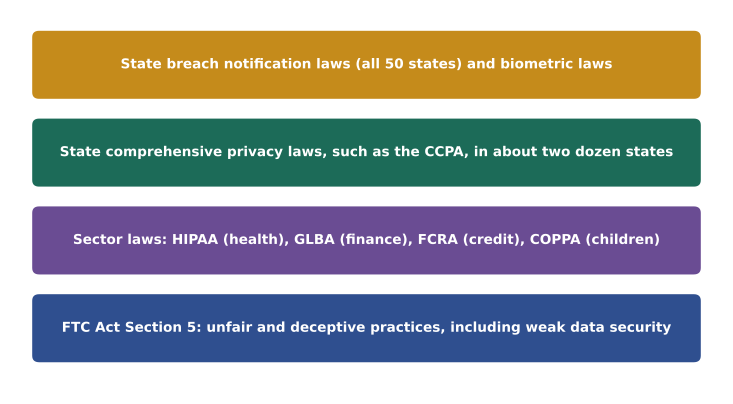
The United States has no comprehensive federal privacy law. Instead, sector-specific statutes govern health information (HIPAA), financial information (the Gramm-Leach-Bliley Act), credit reports (FCRA), children's online information (COPPA, which requires verifiable parental consent for collecting data from children under 13) and video rental records, among others. The FTC uses Section 5 to bring actions against companies that break their privacy promises or fail to use reasonable security, and its consent orders can require 20-year compliance programs. States fill the gap. California's Consumer Privacy Act, as amended by the California Privacy Rights Act and enforced by the California Privacy Protection Agency and the attorney general, gives consumers rights to know, delete, correct and opt out of the sale or sharing of personal information, and about two dozen states had enacted comprehensive consumer privacy laws by mid-2026, with different thresholds and requirements. Every state has a data breach notification law requiring notice to affected residents, and often to regulators, when certain personal information is compromised. Illinois's Biometric Information Privacy Act, with its private right of action, has produced some of the largest privacy settlements.
Worked problem
Does the breach have to be reported?
An employee of Harbourview Clinic, a physical therapy practice in Massachusetts, loses an unencrypted laptop containing names, addresses, Social Security numbers and treatment notes for 3,200 patients. The laptop is not recovered after a week. Who must Harbourview notify?
Show solution
- As a health care provider that bills electronically, Harbourview is likely a HIPAA covered entity. Unsecured protected health information was lost, which is presumed to be a reportable breach unless a risk assessment shows a low probability of compromise.
- HIPAA requires notice to affected individuals without unreasonable delay and within 60 days of discovery. Because more than 500 individuals are affected, Harbourview must also notify the Department of Health and Human Services within 60 days and prominent media outlets in the state.
- Massachusetts's breach notification law also requires notice to affected residents, the attorney general and the state consumer affairs office, and the offer of credit monitoring for at least 18 months when Social Security numbers are exposed.
- Harbourview should document its response, investigate and encrypt all portable devices, since encrypted data is generally exempt from notification duties.
Answer: Both jurisdictions require prompt notice. Encrypting portable devices is the single cheapest way to avoid this kind of breach and its notification costs.
Commercial electronic messages
The CAN-SPAM Act regulates commercial email using an opt-out model: businesses may send marketing email without prior consent, but every message must not use false or misleading header information or deceptive subject lines, must identify itself as an advertisement, must include a valid physical postal address and must provide a clear way to opt out, honored within 10 business days. Penalties can reach $53,088 per non-compliant email at 2026 inflation-adjusted levels, and both the advertiser and the sender can be liable. Text messages and automated calls are governed by the stricter Telephone Consumer Protection Act (TCPA), which generally requires prior express written consent for marketing texts and robocalls to mobile phones and allows consumers to sue for $500 to $1,500 per message, which makes TCPA class actions common.
Worked problem
Is the email campaign compliant?
Trailhead Outfitters wants to email a spring promotion to three groups: (a) 8,000 customers who bought something in the past 18 months; (b) 5,000 people who bought something three years ago; (c) 12,000 email addresses bought from a list broker. It also wants to send a promotional text message to customers who gave their mobile numbers at checkout. Which communications are permitted?
Show solution
- Groups (a) and (b): CAN-SPAM does not require prior consent, so Trailhead may email both, provided each message has accurate headers, a non-deceptive subject line, identification as an ad, a physical address and a working opt-out honored within 10 business days.
- Group (c): CAN-SPAM does not ban emailing purchased lists, but deliverability, reputation and state laws matter; Trailhead must still honor opt-outs, and it may not use addresses harvested from websites or generated by dictionary attacks.
- Text messages: giving a mobile number at checkout does not by itself provide prior express written consent for marketing texts under the TCPA; Trailhead needs a clear written consent before texting, or it risks statutory damages of $500 to $1,500 per text.
- If any recipients are in Canada, CASL's stricter consent rules also apply.
Answer: Email to all three groups is legally possible with proper content, but the text campaign needs written consent. Cross-border lists must also satisfy CASL.
Common mistakes
MistakeAdvertising a headline price that excludes mandatory fees.
InsteadShow the all-in price up front; add only government taxes separately where permitted.
MistakeDiscussing prices, bids, customers or wages with competitors, even informally.
InsteadLeave the conversation, object clearly and report to counsel; train staff and manage trade association meetings.
MistakeMaking broad environmental claims such as "eco-friendly" or "carbon neutral" without proof.
InsteadMake specific claims supported by testing or recognized methodologies before publishing.
MistakeCollecting more personal information than needed and keeping it indefinitely.
InsteadLimit collection to identified purposes, set retention periods, encrypt devices and plan for breaches.
MistakeSending marketing texts without written consent.
InsteadThe TCPA requires prior express written consent for marketing texts and robocalls.
Summary and key terms
- FTC Act Section 5 and state UDAP laws prohibit unfair and deceptive practices; claims need substantiation.
- The Sherman Act condemns price-fixing per se and prohibits monopolization; the Clayton Act governs mergers; private plaintiffs recover treble damages.
- The FTC's fees rule, review rule, Green Guides and Endorsement Guides target hidden fees, fake reviews and greenwashing.
- US privacy is sectoral plus state comprehensive laws such as the CCPA; every state requires breach notification.
- CAN-SPAM uses an opt-out model for email; the TCPA requires written consent for marketing texts and robocalls.
- Unfair practice
- Conduct such as false, misleading or unconscionable representations prohibited by consumer law.
- Drip pricing
- Advertising a price that excludes mandatory fees added later.
- Price-fixing
- An agreement among competitors on prices, which is illegal per se or a criminal offense.
- Greenwashing
- Misleading claims about environmental benefits.
- Personal information
- Information about an identifiable individual.
- Breach notification
- The duty to notify individuals and regulators of a security breach affecting personal information.
- UDAP law
- A state statute prohibiting unfair and deceptive acts and practices.
- Per se rule
- The rule that certain agreements, such as price-fixing, are illegal without proof of harm.
- Treble damages
- Triple damages available to private antitrust plaintiffs.
Practice problems
Work each problem on paper first, then reveal the answer to check.
What two questions does the FTC deception standard ask?
Show answer
Whether a practice is likely to mislead reasonable consumers, and whether it is material.
What is a UDAP statute?
Show answer
A state law prohibiting unfair and deceptive acts and practices, often with private remedies.
An ad shows "$89" but mandatory fees of $26 are added at checkout. What is the all-in price, and what is the problem?
Show answer
$115; advertising $89 is drip pricing and likely deceptive.
Why are price-fixing agreements called per se illegal?
Show answer
They are condemned without inquiry into their effects.
What should an employee do if competitors start discussing prices at a social event?
Show answer
Object, leave and report to counsel.
Which FTC guidance governs environmental marketing claims?
Show answer
The Green Guides.
Name three sector-specific US privacy laws.
Show answer
For example HIPAA, GLBA and COPPA.
Within how many days must HIPAA breach notices be sent to individuals?
Show answer
Without unreasonable delay and within 60 days of discovery.
Does CAN-SPAM require prior consent for marketing email?
Show answer
No; it uses an opt-out model, but messages must meet content rules.
Portfolio task: review a company's homepage and checkout for consumer, pricing and privacy compliance risks.
Show answer
Answers vary; a good answer checks price display, claims, reviews, consent flows, privacy notice and cancellation terms.
Lesson quiz · 5 questions
Score 60% or more to complete this lesson.
Create a free account to save your progress, take quizzes and earn a certificate.