
BUS-210 · Lesson 7 of 12 · 35 min
Business torts and product liability
Some torts are aimed at business interests rather than bodies or property: lies that destroy a company's reputation, imitations that confuse customers, interference with contracts and the misuse of confidential information. Other torts arise from the products a business makes and sells. This lesson covers the torts that protect reputation, relationships and goodwill, and the law of product liability, which is one of the largest sources of business litigation. Intellectual property statutes, which protect many of the same interests, are introduced in lesson 12, and consumer protection and privacy legislation in lesson 11.
Deceit
Deceit, also called fraud or fraudulent misrepresentation, is a false statement of fact made knowingly, without belief in its truth or recklessly, intending the other party to rely on it, which causes loss when that party does rely. It overlaps with contract law (lesson 4): a party induced to contract by fraud can rescind the contract and claim damages in tort. Deceit also arises outside contracts, for example when a seller of a business inflates its revenues to a prospective buyer. Because it involves dishonesty, courts can award punitive damages, and individuals who personally made the fraudulent statements are liable even if they acted for a corporation.
Defamation and injurious falsehood
Defamation protects reputation. A statement is defamatory if it would tend to lower a person's reputation in the eyes of a reasonable person. The plaintiff must show that the words referred to it and were published, meaning communicated to at least one person other than the plaintiff. Defamation in permanent form, such as print, online posts and broadcasts, is traditionally called libel; spoken defamation is slander. Corporations can sue for defamation that harms their business reputation. Every person who repeats a defamatory statement is a publisher and can be liable, which matters for businesses that share or repost content.
American defamation law is shaped by the First Amendment. In New York Times Co. v. Sullivan (1964), the Supreme Court held that a public official cannot recover for defamation about official conduct unless the statement was made with actual malice, meaning knowledge of falsity or reckless disregard for the truth, and later cases extended this to public figures. Private plaintiffs must usually show at least negligence, and the plaintiff generally bears the burden of proving falsity on matters of public concern. Statements of pure opinion that cannot be proved true or false are protected, though calling something opinion does not protect an implied false statement of fact. Truth is a complete defense, and privileges protect statements in judicial proceedings and some reports. More than thirty states have anti-SLAPP statutes that allow early dismissal of suits targeting speech on public issues and often award attorney's fees to successful defendants. Under Section 230 of the Communications Decency Act, online platforms are generally not liable as publishers for content posted by users, although the users themselves are.
Injurious falsehood, also called trade libel or product disparagement, protects economic interests rather than reputation. It covers false statements about a business's products, services or title to property, made maliciously or with knowledge of falsity, that cause economic loss. A competitor that falsely claims a rival's product contains harmful chemicals commits injurious falsehood and may also breach false advertising laws (lesson 11). Unlike defamation, the plaintiff must prove falsity, malice and actual economic loss.
Worked problem
Responding to a negative online review
A customer posts a one-star review of Bayview Auto Repair in Tampa: "They charged me $1,800 for brake work that wasn't needed. These people are crooks." Bayview's owner wants to sue the customer and the review site, and also to post a reply saying the customer "is a liar who never paid his last bill". The customer did pay, and an independent mechanic later confirmed the brakes needed work. Advise Bayview.
Show solution
- The review refers to Bayview, was published and would harm its reputation. As a private business, Bayview must show the statements were false and that the customer was at least negligent.
- "These people are crooks" may be treated as opinion or hyperbole, but the specific claim of unnecessary work is a factual assertion that appears false given the independent mechanic's finding.
- Florida has an anti-SLAPP statute that protects speech in connection with public issues and awards fees to defendants who win early dismissal; consumer reviews may qualify, so a weak suit could cost Bayview the customer's legal fees.
- Bayview cannot sue the review site for the customer's words because of Section 230, and the federal Consumer Review Fairness Act voids contract terms that try to stop customers from posting honest reviews.
- Bayview's proposed reply would itself be defamatory: it is false that the customer did not pay.
Answer: Bayview should not post the reply. A calm, factual response ("An independent inspection confirmed the brake work was needed; we invite you to contact us") protects its reputation without legal risk. A lawsuit is a last resort, after a demand for correction, because anti-SLAPP laws and publicity can make it backfire.
Interference with contracts and economic relations
Tortious interference with contract occurs when a defendant, knowing of a valid contract between the plaintiff and a third party, intentionally and improperly induces or causes the third party to breach it, causing damage. Tortious interference with prospective economic advantage protects expected business relationships that have not yet become contracts; most states require the defendant to have used independently wrongful means, such as fraud, defamation or threats, because competing for customers is otherwise lawful. Hiring a competitor's employee who is free to leave is not a tort, but inducing an employee to breach a valid non-solicitation agreement or to bring trade secrets can be. In one of the most famous examples, Texaco was ordered in 1985 to pay more than $10 billion for interfering with Pennzoil's agreement to acquire Getty Oil, although the parties later settled for $3 billion.
Passing off and unfair competition
Section 43(a) of the federal Lanham Act creates a civil action against any person who uses a word, symbol, device or false designation of origin that is likely to cause confusion about the source, sponsorship or approval of goods or services, which protects unregistered trademarks and trade dress, and against false or misleading commercial advertising. State unfair competition laws and the common law tort of passing off provide similar protection. Registering a trademark with the United States Patent and Trademark Office (USPTO) gives nationwide constructive notice and stronger remedies (lesson 12), but section 43(a) protects unregistered marks and distinctive product packaging too.
Worked problem
Is the new café passing off?
For twelve years, Blue Kettle Tea House has operated three popular tea rooms in a mid-sized city, with a distinctive blue kettle logo and blue-and-cream décor. A new café opens two blocks from one of them under the name "Blue Kettle Café", with a similar logo. Several customers post online asking whether it is a new Blue Kettle location. Blue Kettle never registered its name or logo. Does it have a claim?
Show solution
- Blue Kettle has used its name and logo for twelve years, so it has common law trademark rights in its market even without registration.
- Using a nearly identical name and similar logo for the same services nearby is likely to cause confusion about source or affiliation; customer questions are evidence of actual confusion.
- Blue Kettle can sue under Lanham Act section 43(a) and state unfair competition law for an injunction and damages.
- Because its rights are limited to the area where it has a reputation, Blue Kettle should apply to register its marks to secure nationwide priority.
Answer: Blue Kettle probably wins, but proving goodwill without registration costs time and money. Registering key marks early is a cheap form of insurance.
Confidential information and trade secrets
Trade secrets are protected by the Uniform Trade Secrets Act, adopted in 49 states (New York relies on common law), and by the federal Defend Trade Secrets Act of 2016, which lets owners sue in federal court and, in extraordinary cases, obtain an ex parte order seizing property to prevent dissemination. A trade secret is information that derives independent economic value from not being generally known and is the subject of reasonable efforts to keep it secret. Misappropriation means acquiring a secret by improper means, such as theft or breach of a duty of confidentiality, or using or disclosing it without consent. Reverse engineering and independent discovery are not misappropriation. The Economic Espionage Act makes trade secret theft a federal crime. Practical protection depends on non-disclosure agreements, access controls and marking documents confidential.
Product liability
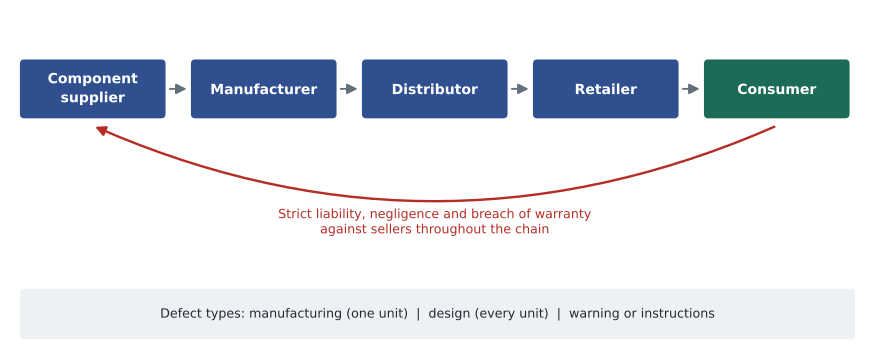
Product liability covers injuries and losses caused by defective products. Claims may be brought in contract, against the seller under sale of goods warranties (lesson 5), and in tort, against anyone in the chain of distribution: the manufacturer, component suppliers, distributors and retailers. Product defects fall into three categories. A manufacturing defect is a flaw in a particular unit that departs from the intended design, such as a contaminated batch of food. A design defect affects every unit because the design itself is unreasonably dangerous. A warning or instruction defect exists when a product lacks adequate warnings about risks or instructions for safe use.
American product liability law is largely strict liability in tort. In Greenman v. Yuba Power Products (1963), the California Supreme Court held a manufacturer strictly liable when a defective power tool injured a user, and Restatement (Second) of Torts section 402A made the rule nationwide: anyone in the business of selling a product in a defective condition unreasonably dangerous to the user is liable for resulting physical harm, even if it exercised all possible care, and even without a contract with the injured person. Manufacturing defects are judged strictly. For design defects, most courts now apply a risk-utility test, and the Restatement (Third) of Torts: Products Liability requires the plaintiff to show a reasonable alternative design that would have reduced the foreseeable risks; some states also use a consumer expectations test. A product also has a warning defect if it lacks warnings of foreseeable risks that are not obvious. Retailers and distributors can be strictly liable too, although many states let innocent sellers pass liability to the manufacturer. Plaintiffs can also sue in negligence and for breach of warranty.
Defenses include product misuse that was not reasonably foreseeable, alteration of the product after sale, comparative fault, assumption of a known risk, the state-of-the-art defense in some states (the product reflected the best available technology when made), statutes of limitations and repose, and federal preemption in regulated areas, for example for certain medical devices that received premarket approval from the Food and Drug Administration. Product liability cases often proceed as class actions or are consolidated in federal multidistrict litigation (MDL), which can involve thousands of claims against a single manufacturer.
Worked problem
Is the design defective?
Summit Gear sells a folding ladder rated for 120 kg. Its hinge lock can appear engaged when it is only partly locked; if a user climbs before it fully clicks, the ladder can collapse. Over three years, 14 users were injured out of about 400,000 ladders sold. An engineer shows that a redesigned lock with a red-green indicator would cost $1.50 more per ladder and would almost eliminate the risk. A user who was seriously injured sues. Analyze the claim.
Show solution
- The claim alleges a design defect, because the problem affects every ladder, and possibly a warning defect.
- Under the risk-utility test, the foreseeable risk of serious injury could have been reduced by a reasonable alternative design costing $1.50 per ladder ($600,000 in total), which does not impair the ladder's function. The design is likely defective.
- Strict liability means Summit is liable even if it was careful, once the defect and causation are shown.
- Summit might argue misuse or comparative fault if the user ignored clear instructions to check the lock, but climbing a ladder that appears locked is foreseeable use. Summit may also face punitive damages if it knew of the injuries and did nothing.
Answer: Summit faces likely liability and should redesign the lock, warn existing users and work with regulators on a recall. A design review that applied the same risk-utility reasoning before launch would have been far cheaper.
Product safety regulation and recalls
The Consumer Product Safety Commission (CPSC) regulates most consumer products under the Consumer Product Safety Act. Section 15(b) requires manufacturers, importers, distributors and retailers to report to the CPSC within 24 hours once they obtain information reasonably supporting the conclusion that a product contains a defect that could create a substantial product hazard, creates an unreasonable risk of serious injury or death or fails to comply with a safety rule. Late reporting has led to civil penalties of many millions of dollars. The CPSC can negotiate voluntary recalls or seek mandatory ones. Food, drugs and medical devices are regulated by the Food and Drug Administration, vehicles by the National Highway Traffic Safety Administration and many workplace products by OSHA.
Worked problem
Making a recall decision
Summit Gear (the previous example) estimates that if it does nothing, injuries will continue at about 5 a year for the 5-year expected life of ladders already sold, with an average liability cost of $250,000 per injury plus reputational losses it cannot easily quantify. A voluntary recall offering a free replacement lock would cost about $1.8 million, and roughly 60 % of owners are expected to respond. What does a simple expected-cost comparison show, and what else matters?
Show solution
- Expected injury cost without recall = 5 injuries × 5 years × $250,000 = $6.25 million.
- With a recall reaching 60 % of owners, injuries fall to about 40 % of the baseline: 0.40 × $6.25 million = $2.5 million.
- Expected cost with recall = $1.8 million + $2.5 million = $4.3 million, about $1.95 million less than doing nothing, before counting reputation.
- Legally, Summit must already have reported to the CPSC within 24 hours of having information reasonably supporting a substantial product hazard; failing to do so risks large civil penalties.
- Ethically, deliberately accepting preventable injuries because a recall is costly is indefensible, and juries punish companies that are shown to have made that calculation.
Answer: The recall is cheaper even on narrow financial terms, and it is legally and ethically required. Cost-benefit analysis should be used to design the most effective recall, not to decide whether to protect customers from serious injury.
Common mistakes
MistakeResponding to criticism with accusations about the critic.
InsteadRespond calmly and factually; your reply can be defamatory too.
MistakeHiring a competitor's employee without checking their contractual obligations.
InsteadReview restrictive covenants and confidentiality duties first and tell the new hire not to bring confidential material.
MistakeChoosing a business name close to a well-known local brand.
InsteadSearch names and marks before launching and register your own key marks.
MistakeTreating product complaints as customer service issues only.
InsteadTrack incidents for safety patterns and report to the CPSC within 24 hours when required.
MistakeRelying on warnings to fix a dangerous design that could be made safer cheaply.
InsteadSafe design comes first; warnings supplement it but do not replace a reasonable alternative design.
Summary and key terms
- Deceit requires a knowingly or recklessly false statement that induces reliance and loss.
- Defamation of public figures requires actual malice; opinion is protected; Section 230 shields platforms; many states have anti-SLAPP laws.
- Injurious falsehood protects against malicious false statements about products or business.
- Tortious interference protects contracts and, with wrongful means, prospective relationships.
- Lanham Act section 43(a) protects unregistered marks and trade dress against confusion and false advertising.
- Trade secrets are protected by the UTSA and the Defend Trade Secrets Act.
- Product liability is largely strict liability for manufacturing, design and warning defects.
- The CPSC requires reports within 24 hours of information about substantial product hazards.
- Deceit
- A knowingly or recklessly false statement intended to be relied on that causes loss.
- Defamation
- A published statement that would lower a person's reputation in the eyes of a reasonable person.
- Injurious falsehood
- A malicious false statement about a business or its products that causes economic loss.
- Anti-SLAPP law
- A law allowing early dismissal of lawsuits that target expression on matters of public interest.
- Design defect
- A defect affecting every unit because the design is unreasonably dangerous.
- Duty to warn
- The obligation to warn users of risks the manufacturer knows or ought to know about.
- Recall
- Corrective action to remove a dangerous product from use or repair it.
- Actual malice
- Knowledge of falsity or reckless disregard for the truth.
- Strict liability
- Liability without proof of fault, as for defective products.
- Trade secret
- Valuable information kept secret by reasonable efforts.
Practice problems
Work each problem on paper first, then reveal the answer to check.
What must a plaintiff prove to establish defamation?
Show answer
The words were defamatory, referred to the plaintiff and were published to a third party.
What must a public figure prove to win a defamation case?
Show answer
That the statement was false and made with actual malice.
How does injurious falsehood differ from defamation?
Show answer
It protects economic interests and requires proof of falsity, malice and actual loss.
Is hiring a competitor's employee who is free to leave a tort?
Show answer
No; ordinary competition is lawful unless the hire induces a breach of contract or uses wrongful means.
What does Lanham Act section 43(a) protect against?
Show answer
Confusing use of words, symbols or false designations of origin, and false advertising.
Name the three types of product defect.
Show answer
Manufacturing, design and warning (or instruction) defects.
Which case launched strict product liability in the United States?
Show answer
Greenman v. Yuba Power Products (1963).
Within how long must a substantial product hazard be reported to the CPSC?
Show answer
24 hours.
Why are warnings not a complete answer to a dangerous design?
Show answer
Courts expect reasonable safer designs where feasible; warnings supplement rather than replace them.
Portfolio task: draft a policy for responding to negative online reviews that avoids defamation risk.
Show answer
Answers vary; a good answer requires factual, polite replies, escalation to management and legal review before any threat of litigation.
Lesson quiz · 5 questions
Score 60% or more to complete this lesson.
Create a free account to save your progress, take quizzes and earn a certificate.