
BUS-210 · Lesson 12 of 12 · 38 min
Property, intellectual property, credit and insolvency, and capstone: a legal risk audit
Businesses own, rent and borrow against property of many kinds: land and buildings, equipment and inventory, accounts receivable and, increasingly, intangible assets such as brands, software and data. This final lesson surveys the law of real and personal property, introduces the main forms of intellectual property, explains how lenders take security and what happens when a business cannot pay its debts, and then brings the whole course together in a capstone: a legal risk audit of an invented business. Copyright, licensing and creative business structures are covered in more depth in PHOT-410 and CRE-330.
Real property and leases
Real property is land and everything permanently attached to it, such as buildings and fixtures. The most complete form of ownership is the fee simple absolute, which can be sold, leased, mortgaged and inherited. Other interests include leases, easements and mortgages or deeds of trust, which give lenders security over land. Ownership is transferred by deed and recorded in county land records. Under state recording acts, an unrecorded interest may lose priority to a later buyer who records first without notice, so buyers search the records and almost always buy title insurance, which protects against defects the search missed. Zoning and land use rules are set by local governments under state law.
Most businesses lease rather than own their premises, so the commercial lease is often one of their largest contracts. Unlike residential tenancies, commercial leases are governed mainly by the lease itself and the common law, with few statutory protections. Key terms include the rent and how it escalates; whether the lease is gross (the landlord pays operating costs) or net (the tenant pays its share of taxes, insurance and maintenance, often called additional rent or common area maintenance); the permitted use and any exclusivity; responsibility for repairs and capital replacements (lesson 4's roof example); assignment and subletting rights; renewal options; personal guarantees; and what happens on default. A tenant should model the total occupancy cost over the term and negotiate before signing, because the lease will usually be enforced as written.
| Lease term | Question for the tenant | Why it matters |
|---|---|---|
| Term and renewal | Is there an option to renew, and at what rent? | Relocation is expensive; a renewal option protects the investment in fit-out |
| Rent and additional rent | Gross or net? What costs are passed through, and is there a cap? | Operating costs can add 30 % to 50 % to base rent |
| Repairs and replacements | Who pays for structural items and end-of-life replacements? | Capital items such as roofs and HVAC can cost hundreds of thousands |
| Assignment and subletting | Can the tenant assign if it sells the business? | A business sale may need the landlord's consent |
| Personal guarantee | Must the owner guarantee the lease, and is it capped? | A guarantee defeats limited liability for the lease |
| Default and remedies | How much notice before termination or distress? | Short cure periods increase the risk of losing the premises |
Personal property is everything else that can be owned: tangible goods, such as equipment, vehicles and inventory, and intangibles, such as accounts receivable, shares and intellectual property. When one person holds another's goods with permission, such as a repair shop holding a customer's car or a warehouse storing inventory, the relationship is a bailment, and the bailee must take reasonable care of the goods, with the standard depending on who benefits from the arrangement. Warehouses and carriers typically limit their liability by contract, as in London Drugs (lesson 4).
Intellectual property
Intellectual property (IP) law gives creators and businesses exclusive rights over certain intangible creations. The main categories are copyright, which protects original works of authorship; patents, which protect new, useful and non-obvious inventions; trademarks, which protect signs that distinguish one business's goods or services from another's; industrial designs or design patents, which protect the visual appearance of products; and trade secrets (lesson 7). IP rights are territorial, so protection must generally be obtained in each country where it is needed, although treaties simplify filing.
| Right | What it protects | Registration | Duration (general rule) |
|---|---|---|---|
| Copyright | Original works of authorship fixed in a tangible medium, including software code | Arises automatically; registration with the US Copyright Office is required before suing for infringement of US works and needed for statutory damages and attorney's fees | Life of the author plus 70 years; for works made for hire, 95 years from publication or 120 from creation, whichever is shorter |
| Utility patent | New, useful and non-obvious processes, machines, manufactures and compositions | Granted by the USPTO after examination; first inventor to file since 2013 | 20 years from the filing date, with maintenance fees |
| Trademark | Words, logos, sounds and other marks that identify source | Federal registration with the USPTO requires use (or intent to use) in commerce; common law rights arise from use | 10-year renewable registrations, indefinitely while in use |
| Design patent | The ornamental design of a manufactured article | Granted by the USPTO | 15 years from grant |
| Trade secret | Valuable information kept secret by reasonable efforts | No registration; protected by the DTSA and state law | As long as it stays secret |
Under the Copyright Act, the author owns copyright, but in a work made for hire the employer or commissioning party is the author. A work is made for hire if an employee creates it within the scope of employment, or if it is specially commissioned, falls within nine listed categories (such as a contribution to a collective work, part of an audiovisual work, a translation or a compilation) and the parties sign a written agreement that it is a work made for hire. Many works commissioned from contractors, such as logos and much software, do not fall within the categories, so the business needs a written assignment of copyright. Patents belong to the inventor unless assigned, so employers use invention assignment agreements, subject to state laws, such as California's, that protect inventions employees develop entirely on their own time without company resources. Trademark rights in the United States depend on use, so businesses should register marks they use or intend to use and monitor for conflicting uses.
Worked problem
Who owns the logo?
Harbourline Coffee Roasters paid a freelance designer $4,000 to create its logo and packaging. The email exchange describes the work and price but says nothing about ownership. Two years later, the designer licenses a near-identical design to another café and objects when Harbourline alters the logo. What are Harbourline's rights?
Show solution
- The designer is an independent contractor, and a logo is not one of the nine work-for-hire categories, so the designer owns the copyright.
- With no written assignment, Harbourline probably has only an implied non-exclusive license to use the logo for the purpose it was created.
- The designer could license the artwork to others, but trademark law limits that: if Harbourline has used the logo to identify its coffee, it has trademark rights, and another café's use of a confusingly similar logo may infringe them under the Lanham Act.
- Moral rights under the Visual Artists Rights Act do not apply to logos or commercial packaging.
- Fix: obtain a signed written assignment of copyright, ideally in the original contract, and register the logo as a trademark.
Answer: Paying for creative work does not transfer ownership. Every contract with a designer, developer or consultant should include a written IP assignment.
Secured transactions
When a business borrows, lenders usually take security over its assets, so they can seize and sell them if the business defaults. Security interests in personal property are governed by Article 9 of the UCC. A security interest attaches when value is given, the debtor has rights in the collateral and the debtor authenticates a security agreement describing it. To protect its priority against other creditors and a bankruptcy trustee, the secured party must perfect its interest, usually by filing a UCC-1 financing statement with the secretary of state in the state where the debtor is located (for a corporation or LLC, its state of organization). Priority between perfected interests generally goes to the first to file or perfect. A purchase-money security interest (PMSI), taken by a seller or lender who finances the purchase of specific collateral, has priority over an earlier blanket lien if it is perfected within 20 days after the debtor receives the collateral (and, for inventory, if prior notice is given to the earlier secured party). Security over land is taken by mortgage or deed of trust recorded in the land records.
Worked problem
Which lender has priority?
On March 1, Prairie Bank lent $500,000 to Delta Machining and registered a financing statement covering "all present and after-acquired personal property". On June 10, Delta bought a CNC machine for $180,000 from Apex Tools, paying $30,000 down; Apex kept a security interest in the machine for the balance of $150,000 and registered a financing statement on June 18. Delta received the machine on June 12. In December, Delta defaults on both loans, and the machine sells for $120,000. Who gets the proceeds?
Show solution
- Prairie Bank filed first, and its blanket lien covers after-acquired property, including the machine.
- Apex holds a PMSI because it financed the purchase of that specific machine.
- Under UCC section 9-324(a), a PMSI in equipment has priority over a conflicting earlier security interest if it is perfected within 20 days after the debtor receives the collateral. Apex filed six days after delivery.
- Apex therefore has priority in the machine: it receives the full $120,000, leaving $30,000 unsecured. Prairie Bank keeps its priority over Delta's other assets.
Answer: Purchase-money priority encourages suppliers to finance equipment even for heavily indebted buyers. It works only if the supplier registers quickly, which is why equipment sellers calendar their filing deadlines.
Insolvency and bankruptcy
A business is insolvent when it cannot pay its debts as they come due or its liabilities exceed its assets. Bankruptcy is federal law under the Bankruptcy Code. In Chapter 7, a trustee liquidates the debtor's non-exempt assets and distributes the proceeds; a corporation in Chapter 7 does not receive a discharge and simply ceases to operate. In Chapter 11, the debtor usually remains in possession and runs the business while it negotiates a plan of reorganization, which must be approved by classes of creditors and confirmed by the court; Subchapter V offers a faster, cheaper Chapter 11 process for small businesses with debts below a threshold adjusted periodically ($3,424,000 since April 2025). Chapter 13 lets individuals with regular income repay debts over three to five years. Filing triggers an automatic stay that stops most collection actions. The trustee can recover preferential payments made to creditors in the 90 days before filing (one year for insiders) and fraudulent transfers made for less than reasonably equivalent value while insolvent.
Distributions follow a strict order of priority. Secured creditors are paid first from their collateral, up to its value. Certain claims have statutory priority. Unsecured creditors share pro rata in what is left, and shareholders receive anything only after all creditors are paid in full, which rarely happens. Because unsecured trade creditors often recover only a small fraction of their claims, suppliers manage credit risk through credit checks, deposits, credit insurance, retention of title clauses and purchase-money security.
Section 507 of the Bankruptcy Code sets priorities among unsecured claims after administrative expenses: they include domestic support obligations, employee wages, salaries and commissions earned within 180 days before filing, up to $17,150 per employee for cases filed from April 1, 2025, employee benefit plan contributions and certain taxes. Under section 503(b)(9), suppliers have an administrative priority claim for the value of goods received by the debtor within 20 days before filing, and under section 546(c) sellers may reclaim goods delivered within 45 days before filing if they make a timely written demand. In Chapter 11, the absolute priority rule generally requires that a dissenting class of unsecured creditors be paid in full before equity holders keep anything.
Worked problem
Distributing the proceeds
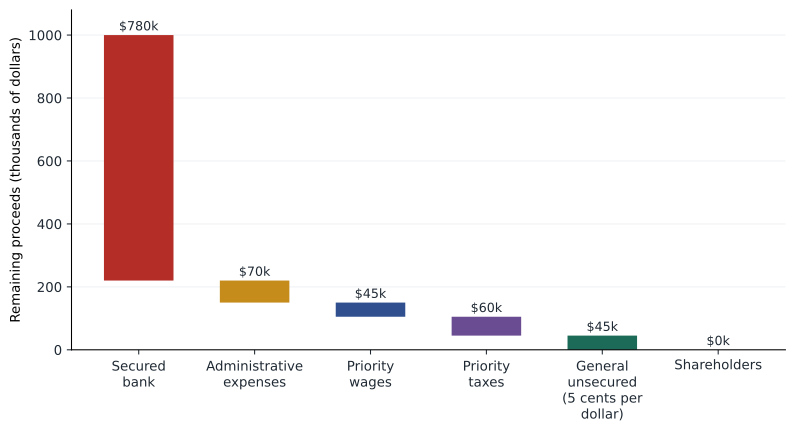
Delta Machining files under Chapter 7. After the Apex machine is dealt with, the trustee realizes $1,000,000 from other assets, all subject to Prairie Bank's perfected lien securing $780,000. Other claims include administrative expenses (trustee's fees and costs) of $70,000, priority wage claims of $45,000 (none over the per-employee cap), priority tax claims of $60,000 and general unsecured claims of $900,000 (including Apex's $30,000 shortfall). Distribute the $1,000,000 in simplified form.
Show solution
- Prairie Bank's perfected lien means it is paid first from its collateral: $780,000, leaving $220,000.
- Administrative expenses: $70,000, leaving $150,000.
- Priority wage claims: $45,000, leaving $105,000.
- Priority tax claims: $60,000, leaving $45,000.
- General unsecured creditors share $45,000 pro rata on $900,000 of claims: 5 cents on the dollar. Apex receives $1,500 on its $30,000 shortfall. Shareholders receive nothing.
Answer: Unsecured creditors recover 5 %. The bank's perfected lien protected it fully, while trade suppliers bore most of the loss, which is why suppliers use deposits, credit insurance and PMSIs.
Insurance as a risk management tool
Insurance transfers financial risk to an insurer in exchange for a premium. Common business coverages include commercial general liability (bodily injury and property damage to third parties, including premises and product liability), property insurance, business interruption insurance, automobile insurance, professional liability or errors and omissions, directors' and officers' liability, cyber insurance, employment practices liability and, where required, workers' compensation. Insurance contracts are interpreted against the insurer where ambiguous, and insurers owe a duty of good faith in handling claims, but policyholders must disclose material facts when applying, comply with notice requirements and read exclusions carefully. Insurance does not cover everything: fines, deliberate wrongdoing, contractual liabilities assumed beyond the law and unremitted taxes are commonly excluded or uninsurable.
Capstone: a legal risk audit
A legal risk audit is a structured review of where a business is exposed to legal liability and what it is doing about it. It draws on every lesson in this course. The process has five steps: understand the business (its activities, people, contracts, assets, customers and locations); identify legal risks in each area; assess each risk by likelihood and impact; decide on a response (avoid, reduce, transfer through contracts or insurance, or accept); and assign owners and deadlines for the actions, with periodic review. The output is a risk register that management and the board can use.
The capstone business is invented. Harbourline Coffee Roasters, Inc. is a Delaware corporation headquartered in Oregon, owned by two founders, each holding 50 % of the shares with no shareholders' agreement. It has 45 employees, including six delivery drivers and two "freelance" baristas who work regular shifts. It roasts coffee in a leased warehouse, sells wholesale to 120 cafés under its own standard terms and conditions, runs an online store with customer accounts, an email newsletter of 18,000 subscribers collected over five years and a new text-message promotion program, and has just signed a five-year lease for a second café, personally guaranteed by both founders. Its logo was designed by a freelancer. It is negotiating a large supply contract with a grocery chain that requires a cap on Harbourline's liability of no more than the contract value and a strict product recall indemnity.
Worked problem
Scoring and responding to Harbourline's risks
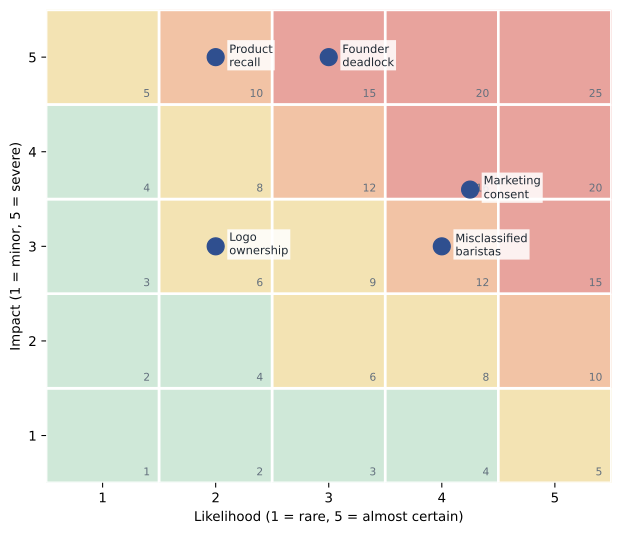
Using a 1 to 5 scale for likelihood and impact, score five of Harbourline's risks, rank them and propose a response for each.
Show solution
- Misclassified baristas (lesson 10): likelihood 4, impact 3, score 12. Response: reclassify as employees, pay back taxes and overtime owed and review all contractor arrangements against the IRS, FLSA and Oregon tests.
- Founder deadlock with no shareholder agreement (lessons 8 and 9): likelihood 3, impact 5, score 15. Response: sign a shareholder agreement with deadlock resolution, buy-sell provisions, valuation and dispute resolution.
- Newsletter and text program (lesson 11): likelihood 4, impact 4, score 16. Response: confirm CAN-SPAM content rules; obtain prior express written consent before any marketing texts to avoid TCPA statutory damages; check Oregon's comprehensive privacy law thresholds and update the privacy notice and breach plan.
- Product contamination and recall (lessons 6 and 7): likelihood 2, impact 5, score 10. Response: strengthen food safety controls and traceability, buy product recall and contamination insurance, and negotiate the grocery chain's indemnity to cover only Harbourline's own fault, with the liability cap applying.
- Logo ownership (lesson 12): likelihood 2, impact 3, score 6. Response: obtain a written copyright assignment (and moral rights waiver where relevant) from the designer and register the trademark.
Answer: Ranked: text and privacy compliance (16), founder deadlock (15), misclassification (12), recall (10), logo (6). Harbourline should pause the text program until consent is fixed, sign a shareholders' agreement and reclassify the baristas, then review its wholesale terms against UCC sections 2-207 and 2-316.
| Area | Typical legal risk | Lesson | First control |
|---|---|---|---|
| Disputes | Missed limitation periods; lost evidence | 2 | Litigation hold procedure and limitation calendar |
| Contracts | Unfavorable standard terms; battle of the forms | 3–5 | Signed master agreements with clear liability, warranty and force majeure terms |
| Torts | Premises injuries; negligent advice; defamation | 6–7 | Inspection logs, review policy for public statements, insurance |
| Products | Defects and recalls | 7 | Quality control, traceability, incident reporting procedure |
| Structure | Owner disputes; personal liability | 8–9 | Shareholder agreement; separate accounts; board minutes |
| Employment | Misclassification; wrongful dismissal; discrimination | 10 | Classification review; compliant contracts; accommodation process |
| Customers and data | Deceptive pricing; privacy breaches; spam | 11 | All-in pricing; consent records; encryption and breach plan |
| Assets and credit | IP ownership gaps; unsecured credit losses | 12 | IP assignments; registrations; credit checks and security |
The audit is not a one-time exercise. Laws change, as many examples in this course show, and the business itself changes as it grows, enters new markets and launches new products. A short annual review, plus a review before any major decision such as a new location, product launch, financing or acquisition, keeps the register current. The audit also improves relationships with professional advisers: a lawyer given a clear risk register can focus advice where it matters most, and an insurance broker can match coverage to actual exposures.
Common mistakes
MistakeSigning a commercial lease without modeling total occupancy costs and repair obligations.
InsteadNegotiate rent, pass-through costs, repairs, renewal and guarantees before signing.
MistakeAssuming paying a contractor for creative work transfers the IP.
InsteadGet a written assignment (and moral rights waiver where relevant) in every contract.
MistakeDelaying registration of a security interest.
InsteadRegister promptly; priority usually goes to the first to register, and PMSI deadlines are short.
MistakeExtending large unsecured credit to a struggling customer.
InsteadUse credit checks, deposits, credit insurance and purchase-money security; unsecured creditors recover little in insolvency.
MistakeTreating legal risk as something to handle only when a lawsuit arrives.
InsteadRun a structured legal risk audit and review it annually and before major decisions.
Summary and key terms
- Land interests are recorded under state recording acts and protected by title insurance; commercial leases are enforced largely as written.
- Copyright, patents, trademarks, designs and trade secrets protect different intangible assets for different periods.
- Works by contractors are made for hire only in listed categories with a written agreement; otherwise an assignment is needed.
- UCC Article 9 governs security interests: attachment, perfection by filing, first-to-file priority and PMSI priority within 20 days.
- Chapters 7, 11 and 13 govern liquidation and reorganization; the automatic stay, priorities and preference rules shape recoveries.
- Insurance transfers many, but not all, legal risks.
- A legal risk audit identifies, scores and manages risks across contracts, torts, structure, employment, customers and assets.
- Fee simple
- The most complete form of land ownership.
- Commercial lease
- A lease of business premises, governed mainly by its own terms.
- Bailment
- Possession of another's goods with permission, requiring reasonable care.
- Security interest
- An interest in property that secures payment of a debt.
- Perfection
- The step, usually registration or filing, that protects a security interest against third parties.
- Purchase-money security interest
- A security interest securing credit used to buy the collateral, which can have special priority.
- Insolvency
- Inability to pay debts as they come due, or liabilities exceeding assets.
- Risk register
- A document listing identified risks, their scores, responses and owners.
- Work made for hire
- A work owned by the employer or commissioning party under the Copyright Act.
- Automatic stay
- The injunction that stops most collection actions when a bankruptcy petition is filed.
Practice problems
Work each problem on paper first, then reveal the answer to check.
What is the difference between a gross and a net lease?
Show answer
In a gross lease the landlord pays operating costs; in a net lease the tenant pays its share of them.
When is a work made by a contractor a work made for hire?
Show answer
Only if it falls in a listed category and the parties sign a written work-for-hire agreement.
How long does a patent last, generally?
Show answer
20 years from the filing date.
A freelancer designed your logo with no written contract. Who owns the copyright?
Show answer
The freelancer, unless it was assigned in writing; you probably have an implied license.
How does a secured party usually perfect a security interest under Article 9?
Show answer
By filing a UCC-1 financing statement in the debtor's state.
Why can a PMSI holder take priority over an earlier general lender?
Show answer
Because the law gives purchase-money financing special priority if perfected quickly, encouraging credit for new assets.
Which chapter of the Bankruptcy Code is used to reorganize a business?
Show answer
Chapter 11 (including Subchapter V for small businesses).
Unsecured creditors with $600,000 of claims share $30,000. What does a creditor owed $40,000 receive?
Show answer
$2,000 (5 cents on the dollar).
A risk has likelihood 4 and impact 4. What is its score on a 1 to 5 × 1 to 5 matrix?
Show answer
16.
Portfolio task: complete a legal risk audit with at least eight risks for a business you know or an invented one.
Show answer
Answers vary; a good answer covers several areas of law, scores each risk, ranks them and assigns specific responses and owners.
Lesson quiz · 5 questions
Score 60% or more to complete this lesson.
Create a free account to save your progress, take quizzes and earn a certificate.