
BAR-253 · Lesson 9 of 12 · 19 min
Commonwealth courts, the Commonwealth Code and rules of decision
▶ Video coming soon A video version of this lesson is on the way.
Kiana's first court filing at Quiles and Tudela was a motion in a land case. Before she drafted a word, Fermin Tudela asked her three questions. Which court are we in? Which rules govern the motion? And if there is no Commonwealth statute or case on point, what law does the court apply? 'The first two questions are the same anywhere,' he said. 'The third one is where the Commonwealth is different.'
This lesson covers the Commonwealth court system, the federal District Court for the Northern Mariana Islands, the sources of written law, the court rules, and the Commonwealth's rules of decision, which tell courts what law to apply when written law is silent.
The Commonwealth courts
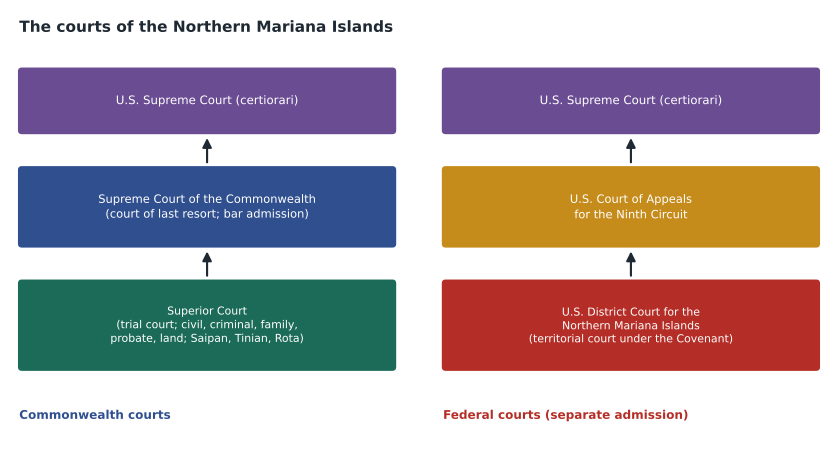
The Commonwealth judiciary has two levels. The Supreme Court of the Commonwealth of the Northern Mariana Islands is the court of last resort. It hears appeals from the trial court, regulates the practice of law, and adopts rules of procedure. The Court consists of a Chief Justice and Associate Justices; when a justice is unavailable, a Justice Pro Tempore may sit, as Justice Pro Tempore Roberto C. Naraja did on the April 2, 2026 order setting the NextGen passing score, alongside Chief Justice Alexandro C. Castro and Associate Justice John A. Manglona.
The Superior Court of the Commonwealth is the trial court of general jurisdiction. It hears civil, criminal, family, probate and land cases, as well as small claims and traffic matters, and it sits on Saipan, Tinian and Rota. Appeals from the Superior Court go to the Supreme Court.
The current structure dates from the Commonwealth Judicial Reorganization Act of 1989. Before that act, the local trial court's decisions were reviewed by the Appellate Division of the federal District Court, with further review in the Ninth Circuit. The 1989 act created a local Supreme Court and moved appellate review of local cases into the Commonwealth's own courts. Rule 73-3(b) of the Rules of Admission still refers to persons admitted before that act, which shows how recent the change is in professional memory.
For many years after 1989, the Ninth Circuit retained a limited power to review Commonwealth Supreme Court decisions. Congress later ended that arrangement, so that Commonwealth Supreme Court decisions are now reviewed by the United States Supreme Court on certiorari in the same way as decisions of the highest court of a state. A Commonwealth Supreme Court decision on a question of Commonwealth law is final.
The District Court for the Northern Mariana Islands
The Covenant created a federal district court for the Commonwealth, the United States District Court for the Northern Mariana Islands. It is a territorial court established under Congress's power over territories rather than an Article III court, and its judge serves a fixed term rather than for life. It exercises the jurisdiction of a United States district court, including federal question and diversity jurisdiction, and it hears federal criminal cases and bankruptcy matters. Appeals go to the Ninth Circuit.
The District Court has its own bar. Admission to the Commonwealth bar does not admit a lawyer to practice in the District Court; the lawyer applies separately under the District Court's local rules. Most Commonwealth litigators are admitted to both, because many disputes involve federal law or a choice between the two forums.
The choice of forum is often strategic. A plaintiff with a federal claim, such as a civil rights claim against a government officer, may sue in the District Court. A plaintiff with only Commonwealth claims sues in the Superior Court unless diversity jurisdiction exists. Questions about Commonwealth constitutional provisions, such as Article XII or the Commonwealth equal protection clause, are decided authoritatively by the Commonwealth Supreme Court.
| Court | Created by | Hears | Appeals to |
|---|---|---|---|
| Superior Court | Commonwealth Constitution and statute | Civil, criminal, family, probate, land, small claims | Commonwealth Supreme Court |
| Commonwealth Supreme Court | Commonwealth Judicial Reorganization Act of 1989 and Constitution | Appeals; bar admission and discipline; rules | U.S. Supreme Court (certiorari, federal questions) |
| District Court for the NMI | The Covenant and federal statute | Federal question, diversity, federal crimes, bankruptcy | Ninth Circuit |
Sources of written law
Commonwealth written law comes from several sources. At the top are the Covenant and the Commonwealth Constitution, covered in lesson 7. Below them are statutes enacted by the Commonwealth Legislature as public laws and codified in the Commonwealth Code, regulations adopted by executive agencies and published in the Commonwealth Register, and court rules adopted by the Supreme Court. Local laws for particular islands, enacted by island delegations, also exist.
The Commonwealth Code is cited by title and section, with the abbreviation CMC. Title 1 deals with the government, including the judiciary; the old statutory provisions on attorney admission that Rule 73-3 mentions, 1 CMC sections 3601 to 3603, are in Title 1. Title 7 deals with civil procedure and contains, among other things, the Government Liability Act and the rules-of-decision statute. Other titles cover crimes, family relations and probate, economic resources and natural resources. A new lawyer should learn the titles most used in her practice and the habit of checking whether a section has been amended by a recent public law.
Regulations are published in the Commonwealth Register and compiled in the Northern Mariana Islands Administrative Code. Agencies regulate land, labor, taxation, health and many other matters, and a regulatory question often decides a client's problem before any court is involved.
Commonwealth court rules
The Supreme Court adopts rules of procedure for the Commonwealth courts, including rules of civil procedure, criminal procedure, evidence and appellate procedure, along with the Rules of Admission and rules on discipline and continuing legal education. The Commonwealth Rules of Civil Procedure are modeled on the Federal Rules of Civil Procedure, and Commonwealth courts often find federal decisions interpreting a parallel federal rule persuasive. They are not bound by them, and a lawyer should read the Commonwealth rule itself, because differences in timing and detail exist.
Citing Commonwealth decisions
Commonwealth Supreme Court decisions use a public domain citation that combines the year, the abbreviation MP and a sequential number, such as 2024 MP 10, the citation for Maratita v. CHCC. Older decisions also appear in the Northern Mariana Islands Reporter, cited with the abbreviation NMI, and in the Commonwealth Reporter, cited as CR, which collects trial court decisions. The Commonwealth's official law website publishes opinions, the Code, public laws and court rules.
Rules of decision
Every legal system needs a rule for cases that no statute or precedent decides. In a state, the answer is usually the state's common law, as developed by its courts. The Commonwealth is young and its body of case law is small, so the Legislature enacted a rules-of-decision statute, codified at 7 CMC section 3401, that tells courts what law to apply.
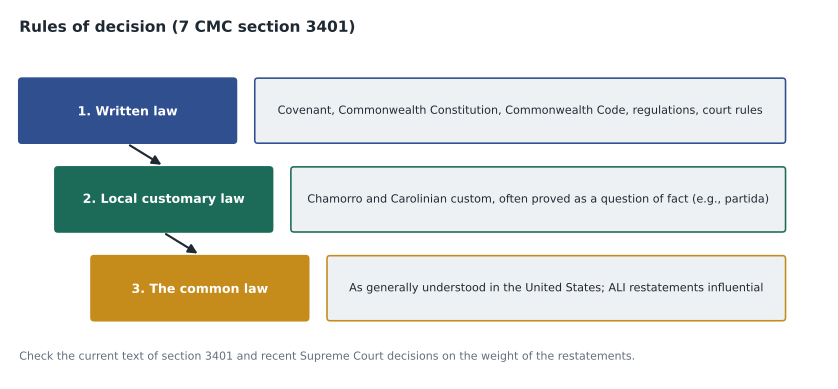
The statute sets an order of sources. Written law comes first: the Covenant, the Constitution, statutes and regulations. Where written law does not decide the question, the statute directs courts to local customary law. Where neither written law nor local customary law decides the question, courts apply the common law. For many years the statute pointed courts to the rules of the common law as expressed in the restatements published by the American Law Institute, and Commonwealth courts relied heavily on the restatements. The statute's wording has been amended, and the Commonwealth Supreme Court has discussed how much weight the restatements now carry and when it may develop Commonwealth common law of its own. Restatements remain influential and are frequently cited; the Court has, for example, drawn on the Restatement of the Foreign Relations Law of the United States. A lawyer should read the current text of section 3401 and the Supreme Court's recent decisions applying it before relying on a restatement section.
Customary law in the courts
The place of customary law in the rules of decision is one of the Commonwealth's most distinctive features. Chamorro and Carolinian customs govern important matters in family life and land, especially how parents distribute family land among their children. When a dispute turns on a customary practice, the court must determine what the custom is, usually through evidence from people who know it, and whether it applies to the facts. Customary law is a question of fact to be proved in many cases, unless it has been established by prior decisions or statute. Lesson 10 covers the most important customary practices.
Languages
The Commonwealth Constitution recognizes Chamorro, Carolinian and English as official languages. Court proceedings and filings are in English, but interpreters are used for witnesses and parties who need them, and some documents in land and family cases are in Chamorro or Carolinian. A lawyer handling a family land dispute may need a translator to read old family papers or to take testimony about custom.
Practical habits
Fermin's advice to Kiana came down to a short checklist. Identify the court and its rules. Find the written law, starting with the Constitution and the Code, and check for recent amendments. If written law is silent, ask whether customary law speaks to the question, and if so how it will be proved. Only then turn to the common law and the restatements, and check how the Commonwealth Supreme Court has treated the relevant restatement. And when a federal issue is in the case, consider whether the District Court is the better forum.
Worked problem
An unsettled tort question
Kiana's client, Ignacia Mendiola, was injured when a neighbor's retaining wall collapsed onto her property after heavy rain. No Commonwealth statute addresses the duty of a landowner to maintain a retaining wall, and Kiana finds no Commonwealth Supreme Court decision on point. How should she identify the governing law?
Show solution
- Written law: check the Commonwealth Code and any building regulations in the Commonwealth Register for a duty or standard on retaining walls.
- Customary law: ask whether any local custom governs duties between neighboring landholders; if one is claimed, plan how to prove it.
- Common law: if neither source decides the question, turn to the common law under section 3401, consulting the relevant restatement on landowners' duties and nuisance as an influential source.
- Check the Court's approach: read recent Supreme Court decisions on how it treats restatement sections, and consider persuasive decisions from other American jurisdictions.
Answer: Kiana should work down the section 3401 ladder: written law, then customary law, then the common law, using the restatements as an influential but not automatically binding source, as the Supreme Court has treated them.
Common mistakes
MistakeThe Ninth Circuit reviews Commonwealth Supreme Court decisions.
InsteadThe U.S. Supreme Court reviews them on certiorari like a state high court; the Ninth Circuit hears appeals from the District Court.
MistakeCommonwealth bar admission covers the District Court.
InsteadThe District Court has its own admission process.
MistakeThe District Court is an Article III court.
InsteadIt is a territorial court created under the Covenant and Congress's territorial power.
MistakeRestatements always control in the Commonwealth.
InsteadUnder section 3401 written law and customary law come first, and the Supreme Court has discussed the weight of restatements.
MistakeCommonwealth procedure is identical to federal procedure.
InsteadThe Commonwealth rules are modeled on the federal rules but differ in details.
A first civil case
A new lawyer's first civil case in the Superior Court follows a familiar sequence: a complaint, service, an answer or a motion, discovery, possibly mediation, and trial or settlement. The Commonwealth Rules of Civil Procedure govern each step. Because they are modeled on the federal rules, a lawyer trained on the federal rules will recognize most of the structure, but she should check every deadline in the Commonwealth rule itself and in any local practice order, rather than relying on the federal timetable.
Service of process deserves particular attention. Defendants may live on another island, in Guam or on the mainland, and service rules for out-of-jurisdiction defendants must be followed precisely. A lawyer suing a government agency must also comply with any notice or claim requirements in the governing statute before filing.
Choosing between Commonwealth and federal court
When both courts are available, the choice turns on several considerations: which court is more familiar with the governing law, the availability of a jury, the speed of the docket, the appellate route, and whether the case raises questions of Commonwealth law that only the Commonwealth Supreme Court can answer authoritatively. A case that depends on Article XII or customary law is usually better suited to the Commonwealth courts, which decide those questions finally. A case that depends mainly on federal law may be better suited to the District Court.
Summary and key terms
- The Superior Court is the trial court; the Supreme Court of the Commonwealth, created by the 1989 Judicial Reorganization Act, is the court of last resort.
- Commonwealth Supreme Court decisions are reviewed by the U.S. Supreme Court on certiorari, like state high court decisions.
- The District Court for the Northern Mariana Islands is a territorial federal court with its own bar; appeals go to the Ninth Circuit.
- Written law includes the Covenant, the Constitution, the Commonwealth Code (CMC), regulations in the Commonwealth Register and court rules.
- Under 7 CMC section 3401, courts look to written law, then local customary law, then the common law, with restatements influential.
- Commonwealth decisions are cited as, for example, 2024 MP 10; Chamorro, Carolinian and English are official languages.
- 0
- Supreme Court of the Commonwealth
- 1
- Superior Court
- 2
- District Court for the Northern Mariana Islands
- 3
- Commonwealth Judicial Reorganization Act
- 4
- Commonwealth Code
- 5
- Commonwealth Register
- 6
- rules of decision
- 7
- 7 CMC section 3401
- 8
- customary law
- 9
- restatements
Practice problems
Work each problem on paper first, then reveal the answer to check.
What court hears appeals from the Superior Court?
Show answer
The Supreme Court of the Commonwealth.
Which statute created the current Commonwealth Supreme Court structure?
Show answer
The Commonwealth Judicial Reorganization Act of 1989.
What does 7 CMC section 3401 do?
Show answer
It sets the rules of decision: written law, then local customary law, then the common law.
Where do appeals from the District Court for the Northern Mariana Islands go?
Show answer
To the Ninth Circuit.
Lesson quiz · 5 questions
Score 60% or more to complete this lesson.
Create a free account to save your progress, take quizzes and earn a certificate.